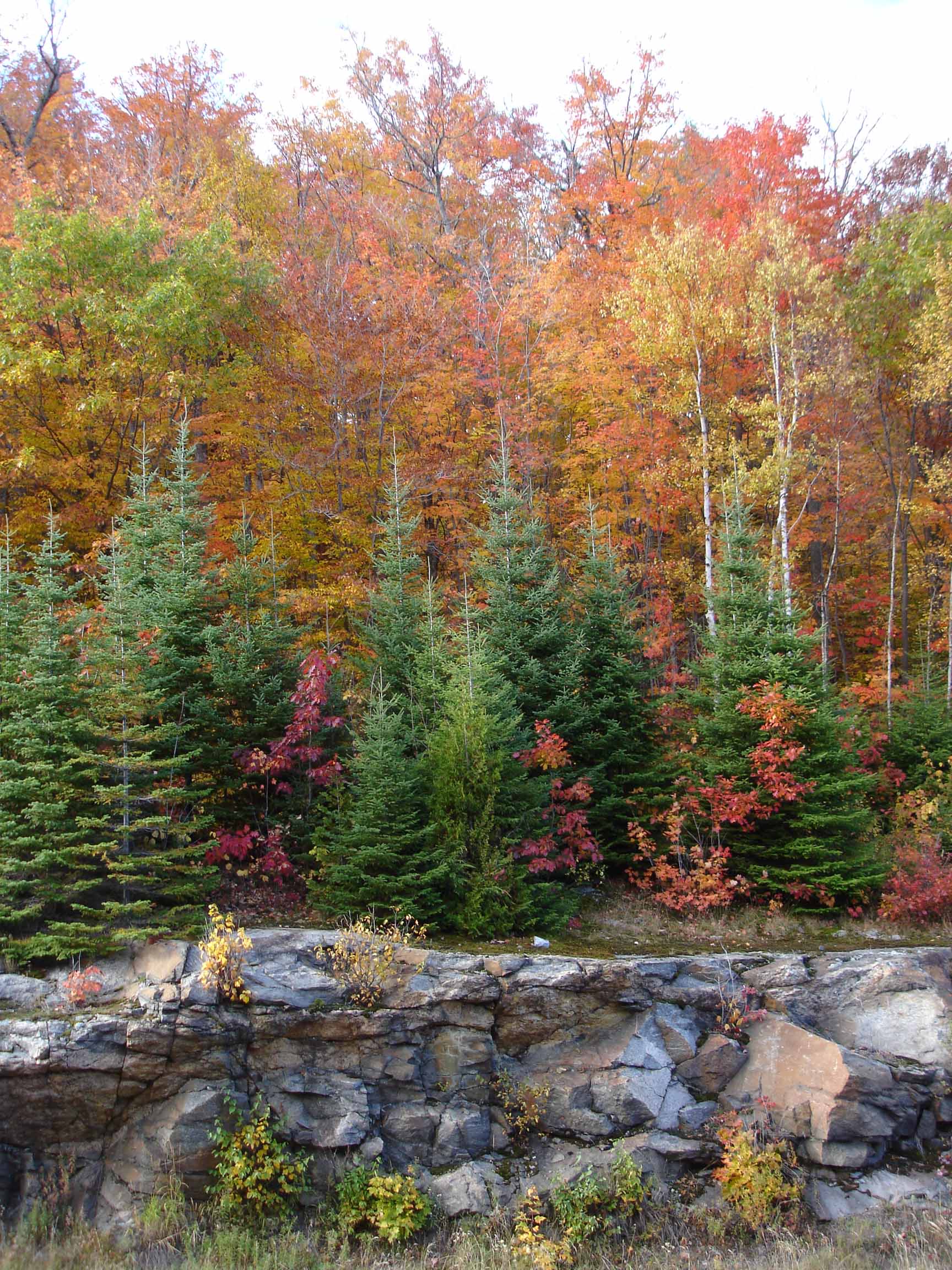
Algonquin Provincial Park is Ontario's oldest park (created in 1893) and one of Canada's natural icons: almost 7,700 km² of forest, lakes, rivers and bogs where you find the essence of the Canadian landscape. It is an immense transition between the coniferous forests of the north and the deciduous forests of the south, which makes it an exceptional place to see wildlife —moose, beavers, black bears, wolves— and, in the fall, to enjoy one of the most famous displays of color on the continent.
Algonquin is above all canoe country. Its maze of more than 2,000 lakes linked by rivers and portages has made it legendary among canoeists, who can head off for days into the purest wilderness. But it is also very accessible: Highway 60 crosses the southern end of the park, and along it are concentrated the short trails, the visitor centers, the lookouts and the car campgrounds, ideal for anyone visiting for a day or a few days.
This guide walks through the essentials of Algonquin with a practical eye: what to do along the Highway 60 Corridor, how to organize hikes and canoe trips, where and when to see moose and the fall colors, and how to plan the visit (permits, best time to go, what to bring). Algonquin is Canada in its purest form, a few hours from Toronto and Ottawa.
For thousands of years the park's territory was the land of the Algonquin peoples, from whom it takes its name. In the 19th century it was intensively worked by the logging industry, which left its mark on the rivers and in the loggers' camps. In 1893 Algonquin Provincial Park was created, the first in Ontario, in part to protect the river headwaters and the wildlife. Over time it became the birthplace of recreational canoeing and a source of inspiration for artists such as the famous painter Tom Thomson. The full story is on our history page.
Read the full history ↓Canada's economic and demographic heart: land of the Iroquoian and Algonquian nations, refuge of the Loyalists, cradle of Upper Canada and the country's industrial engine, home to Toronto, to the national capital Ottawa and to Niagara Falls.
Read the history of Ontario →No exact prices: a scale from $ (budget) to $$$$$ (luxury), with 2-3 options per category.
Origins, formation and what the sources say.
The name says it all: Algonquin is not named after a lake or a river, but after a people. Long before it became Ontario's first provincial park, this vast territory of forests and lakes in the southern Canadian Shield was home to First Nations peoples, especially the Algonquin (Algonquin / Anishinaabe), who traveled these waters for thousands of years and left it their name. These peoples moved through the region following the cycles of hunting, fishing and gathering, traveling the dense network of lakes and rivers in birchbark canoes, a means of transport perfectly suited to a landscape laced with water.
The same network of waterways that today makes Algonquin a paradise for recreational canoeing was, for its original inhabitants, a system of routes connecting the headwaters of several great rivers in Ontario and Quebec. The portages still used between one lake and the next follow, in many cases, paths opened by generations of Indigenous peoples.
That legacy left its mark on the place names and on the very idea of the park as a land of canoes and forests. The canoe culture that visitors would later make their own has its roots in the way of life of the peoples who lived on these waters long before the Europeans arrived.
Through the 19th century, long before anyone thought of protecting the area, the region of today's Algonquin was intensively worked by the logging industry. The tall white and red pines of these forests were highly prized, and the loggers pushed into the territory opening camps and using the rivers to move the logs: every spring, with the thaw, huge log drives floated down the waterways toward the sawmills and the great rivers.
Life in the logging camps was hard and singular, with crews that spent the winters felling trees and the thaw driving the logs downstream. That activity left a deep mark on the region's history and culture, which the park preserves today in its Algonquin Logging Museum, an open-air museum that recreates, along a trail, the techniques and tools of those days.
Curiously, logging and the creation of the park were not incompatible: when Algonquin Provincial Park was established in 1893, cutting continued (and continues, regulated, across much of the park), on the idea of combining conservation with a controlled use of forest resources.
In 1893 the government of Ontario created Algonquin Provincial Park, the province's first provincial park and one of the first in Canada. The motives were varied: protecting the headwaters of important rivers, preserving the wildlife and the forests, and creating a space for recreation and conservation. Through the 20th century the park grew in popularity, above all once the railway and later Highway 60 made access easier, and recreational canoeing turned into a national passion.
Algonquin holds a special place in the Canadian cultural imagination, and much of that aura it owes to a painter. Tom Thomson, whose work inspired and preceded the celebrated Group of Seven, found in these lakes and forests the central subject of his art: canvases such as 'The Jack Pine' or 'The West Wind', national icons today, came out of his summers paddling and painting in the park. His story also has a novelistic ending: in July 1917 Thomson went out paddling on Canoe Lake and disappeared; his body turned up days later, and although the official cause was drowning, more than a century of rumors about a possible murder or suicide has made his death one of the great mysteries of Canadian culture. Generations of summer camps, explorers and artists have made these lakes and forests a symbol of the country's wilderness.
Today Algonquin combines the protection of its extraordinary biodiversity —moose, eastern wolves, beavers, loons— with nature tourism and regulated logging in specific sectors. More than a century after it was created, it is still Ontario's emblematic park and a destination where visitors go looking for the very heart of the Canadian landscape.
One of the most fascinating chapters in Algonquin's recent history revolves around the wolf. For decades the park was thought to hold the common gray wolf, until genetic research recognized its population as a distinct and threatened species or subspecies: the eastern wolf or Algonquin wolf (Algonquin wolf, Canis lupus lycaon / Canis lycaon), smaller than the gray wolf and related to the coyote and the red wolf. Algonquin thus became a world center for the study of this canid.
From the 1960s on, the park ran the celebrated Public Wolf Howls: summer night outings in which the park rangers, after locating a pack, led hundreds of visitors to howl in silence and listen for the wolves' reply in the darkness of the forest. Those events, of enormous educational value, made Algonquin a world pioneer in public outreach about wolves and drew tens of thousands of people over more than half a century. In August 2022, however, Ontario Parks decided to end the program, citing wildlife-viewing ethics, carbon footprint and logistics; today outreach about wolves happens by other means, though the park remains a sanctuary of the eastern wolf.
Concern for the conservation of the eastern wolf led, in the 21st century, to banning its hunting and trapping in the park and in surrounding municipalities, to protect a key population of an endangered species. Today Algonquin's management balances the protection of this and other emblematic species —moose, beavers, loons— with carefully regulated nature tourism and controlled logging in specific sectors, in a model that keeps evolving more than a century after the park was created.