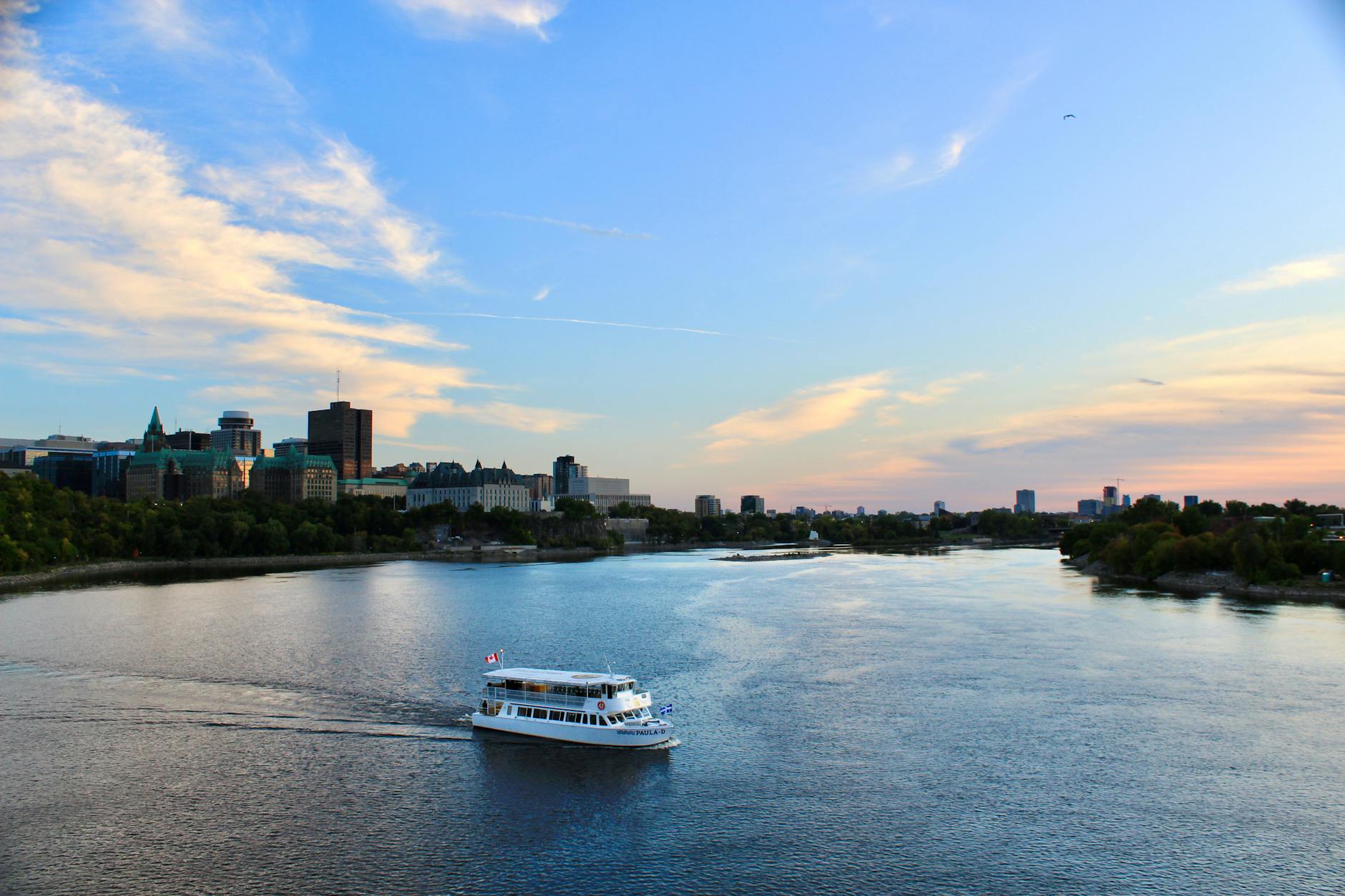
Ottawa is the capital of Canada, a serene, elegant city on the banks of the Ottawa River, on the line between English-speaking Ontario and French-speaking Quebec. Unlike Toronto or Montreal, it doesn't impress by its size or its rush, but by its character as a calm, green capital: here are Parliament with its neo-Gothic towers looking out over the river, the great national institutions, the embassies and some of the best museums in the country. It is the city where Canada tells its own story.
Its heart is Parliament Hill, with the imposing Peace Tower, and the Rideau Canal, a 19th-century feat of engineering declared a UNESCO World Heritage Site that runs through the city: in summer you can boat on it and stroll its banks, and in winter it becomes the longest natural ice skating rink in the world. A few steps away beats ByWard Market, the liveliest neighbourhood, with its market, its restaurants and its nightlife. And one bridge away, in the province of Quebec, Gatineau waits with its great Canadian Museum of History.
This guide covers the essentials of Ottawa with a practical and warm eye: how to visit Parliament, which museums to choose and what they cost, how to enjoy the Rideau Canal in each season, where to eat in ByWard Market and how to get out into the nature of Gatineau Park. Ottawa is a capital on a human scale, covered on foot and by bike, and it surprises you with its mix of institutional solemnity and relaxed living.
The Ottawa region was inhabited for millennia by the Algonquin (Anishinaabe) people, for whom the Ottawa River (Kichi Sibi, 'the great river') was a route of trade and of life. The name 'Ottawa' comes from the Algonquin word 'adawe', meaning 'to trade', referring to the peoples who traded along the river. European presence grew with the fur trade and, above all, with timber. The modern settlement was born in 1826 with the construction of the Rideau Canal, directed by Lieutenant Colonel John By of the British army, a military work meant to create a safe route between Montreal and the Great Lakes that avoided the St. Lawrence River (vulnerable to the United States after the War of 1812). The workers' camp gave rise to Bytown, named after By. In 1855, Bytown was reincorporated under the name Ottawa. The big turn came in 1857: Queen Victoria, to settle the disputes between the candidate cities (Toronto, Montreal, Quebec, Kingston), chose Ottawa as the capital of the Province of Canada. The choice, surprising for a relatively small lumber town, rested on its position on the border between the English-speaking and French-speaking areas, and on its greater distance from the American border, which made it more defensible. With Confederation in 1867, Ottawa became the capital of the new Dominion of Canada. Its neo-Gothic parliament buildings opened in those years (and were rebuilt after a fire in 1916). Through the 20th century, the city grew as an administrative, diplomatic and, later, technological centre. The Rideau Canal was declared a UNESCO World Heritage Site in 2007. The full story is on our history page.
Read the full history ↓Canada's economic and demographic heart: land of the Iroquoian and Algonquian nations, refuge of the Loyalists, cradle of Upper Canada and the country's industrial engine, home to Toronto, to the national capital Ottawa and to Niagara Falls.
Read the history of Ontario →If you only have one day, take a guided tour on the first one: it sets up the rest of your trip and saves you a lot of walking. We look ours up on Civitatis: guided in Spanish and booked online with no fuss. They have 4 activities in Ottawa. And there are free tours here: you book without paying and tip the guide whatever you think at the end, so trying one costs you nothing. Have a look below: tap any of them to see them all.
If you book from here we earn a commission and you pay no more. Prices and availability come from Civitatis.
No exact prices: a scale from $ (budget) to $$$$$ (luxury), with 2-3 options per category.
Origins, formation and what the sources say.
Long before any city existed, the region where Ottawa stands today was, for thousands of years, the territory of the Algonquin (Anishinaabe) people. For them, the great river we now call the Ottawa was the Kichi Sibi (or Kitchissippi), 'the great river', a vital artery of communication, trade, fishing and life running through their lands. The meeting of the Ottawa, Gatineau and Rideau rivers — where the city sits — was an important gathering and crossing point.
For centuries the Ottawa River was one of the great canoe routes of the fur trade, connecting the St. Lawrence with the upper Great Lakes and the interior of the continent. Indigenous peoples, explorers and the voyageurs of the fur trade all passed along these waters. The region, then, was a strategic corridor long before anyone thought of founding a capital.
The name of the city and of the river carries that legacy. 'Ottawa' comes from the Algonquin word 'adawe', meaning 'to trade' or 'to exchange', referring to the peoples who traded along the river (the Odawa or 'Ottawa' were, in fact, known as traders). So the name of Canada's capital honours, without many people knowing it, the ancestral trading activity of the Indigenous peoples who lived on its banks. It is also important to remember that Ottawa sits on unceded Algonquin territory, a fact the country acknowledges more and more explicitly.
The modern city was born for a military reason. After the War of 1812 against the United States, the British Empire was worried about the vulnerability of its main navigation route in the area: the St. Lawrence River, which ran right along the American border and could easily be blocked in a new conflict. The solution was to build an alternative navigation route, inland and safe, connecting Montreal with the Great Lakes through the interior: the Rideau Canal.
The monumental project was entrusted to Lieutenant Colonel John By, a military engineer of the British Royal Engineers, who arrived in 1826 to direct the construction of the canal between the Ottawa River and Kingston, on Lake Ontario. By set up his camp and base of operations at the point where the canal would join the Ottawa River, stepping down through an impressive flight of locks. Around that camp of workers, engineers and suppliers a settlement grew that soon took the name Bytown, after the colonel.
The Rideau Canal, finished in 1832, was an engineering feat for its time, with dozens of locks and dams along some 200 kilometres, built in brutal conditions (hundreds of workers died, many of malaria). Although it was never used for the war they feared, it became a commercial route and, in time, a heritage jewel: in 2007 it was declared a UNESCO World Heritage Site as the best preserved canal of its kind in North America still in operation. Bytown, meanwhile, grew as a rough lumber and workers' town.
In 1855 the growing town of Bytown was reincorporated as a city and changed its name to Ottawa, taken from the river. It was then a prosperous but relatively modest lumber town, devoted above all to the timber industry, which floated down the rivers to market. Few would have imagined the fate about to fall to it.
The Province of Canada of the day (the union of present-day Ontario and Quebec) had spent years unable to settle on a permanent capital: the government kept moving between cities like Kingston, Montreal, Toronto and Quebec, in a rivalry that would not resolve. To settle the dispute, in 1857 the question was put to Queen Victoria. And the Queen, surprisingly, chose Ottawa.
The choice, which astonished many because it fell on a comparatively small lumber town, had its reasons. Ottawa lay right on the border between Canada West (English-speaking) and Canada East (French-speaking), which made it a compromise between the two communities. It was also further from the United States border than cities like Toronto or Kingston, which made it more defensible militarily (a very present concern at the time). Its position beside the Rideau Canal and the rivers also counted in its favour. So, almost overnight, the lumber town of Ottawa became the future capital, and work began on the grand parliament buildings.
Ottawa's fate was sealed with Confederation. On 1 July 1867, the British colonies of North America united to form the Dominion of Canada, a new country within the British Empire, and Ottawa, already chosen as capital of the old Province of Canada, was confirmed as the capital of the new country. That date, 1 July, is now Canada Day, the national holiday, celebrated with particular intensity on Parliament Hill in Ottawa.
To house the new government, work had already begun on the parliament buildings on the hill above the river. The complex, in magnificent Victorian neo-Gothic architecture — with its towers, spires and copper roofs — went up from 1859 and was completed over the following decades, becoming the country's architectural symbol. The choice of the Gothic style, inspired by the British Parliament at Westminster, was meant to convey solidity, tradition and a bond with the Crown.
A dramatic episode marked its history: in 1916, in the middle of the First World War, a great fire destroyed the original central building (the Centre Block), with only the Library of Parliament saved thanks to iron doors closed in time. The Centre Block was rebuilt in the following years, and as part of that rebuilding the Peace Tower was raised, the memorial tower to those who fell in the war, opened in the 1920s, which became the most recognizable emblem of the Canadian Parliament.
Through the 20th century, Ottawa turned from a rough lumber town into a modern, green, planned capital. At the start of the century it was still, in large part, a centre of the timber industry, with sawmills on the riverbanks. But as it grew as the seat of the federal government, it took on a more administrative, diplomatic and residential profile.
A turning point was the deliberate effort to beautify and plan the capital. Already in the interwar years, and above all at mid-century, the government commissioned urban plans to give Ottawa the dignity of a national capital. The French planner Jacques Gréber drew up an influential plan in the 1940s and 1950s that reorganized the city: the railway tracks were moved out of downtown, parks and green belts were created (the Greenbelt), the banks of the canal and the river were beautified, and large natural spaces such as Gatineau Park were preserved. The National Capital Commission (NCC) was left in charge of maintaining this green, ceremonial character.
So Ottawa took shape as a capital on a human scale, with abundant green space, national museums (created and expanded across the century) and a strong component of public employment. In the last decades of the 20th century and the start of the 21st it also added a significant technology sector, which earned it the nickname 'Silicon Valley North'. The city also expanded: in 2001, several neighbouring municipalities were amalgamated into the present-day city of Ottawa.
Today's Ottawa is a prosperous, calm capital deeply identified with its institutional role. With close to a million people (and more than a million and a half counting neighbouring Gatineau, in Quebec), it is a comfortable, safe, green city where life revolves around government, diplomacy, technology and culture. Its border character between English-speaking Ontario and French-speaking Quebec makes it one of the most bilingual cities in Canada, where English and French live side by side in the streets, on the signs and in daily life.
Culturally, Ottawa holds the great national institutions: the Canadian Museum of History (the most visited in the country, across the river), the National Gallery of Canada, the Canadian War Museum, the Museum of Nature and others, plus the National Arts Centre. Its calendar is marked by big events: the Canadian Tulip Festival in May (a legacy of the Netherlands' gratitude to Canada after the Second World War), the Canada Day celebrations on 1 July on Parliament Hill, and the winter festival Winterlude.
Its heritage jewel is the Rideau Canal, a UNESCO World Heritage Site since 2007, which in summer you boat on and stroll along and in winter becomes the longest natural skating rink in the world, a symbol of Canadians' relationship with winter. For the traveller, Ottawa offers a capital on a human scale: solemn but relaxed, rich in history and institutions, ringed by nature and easy to cover on foot and by bike. It is the place where Canada thinks about and represents itself.