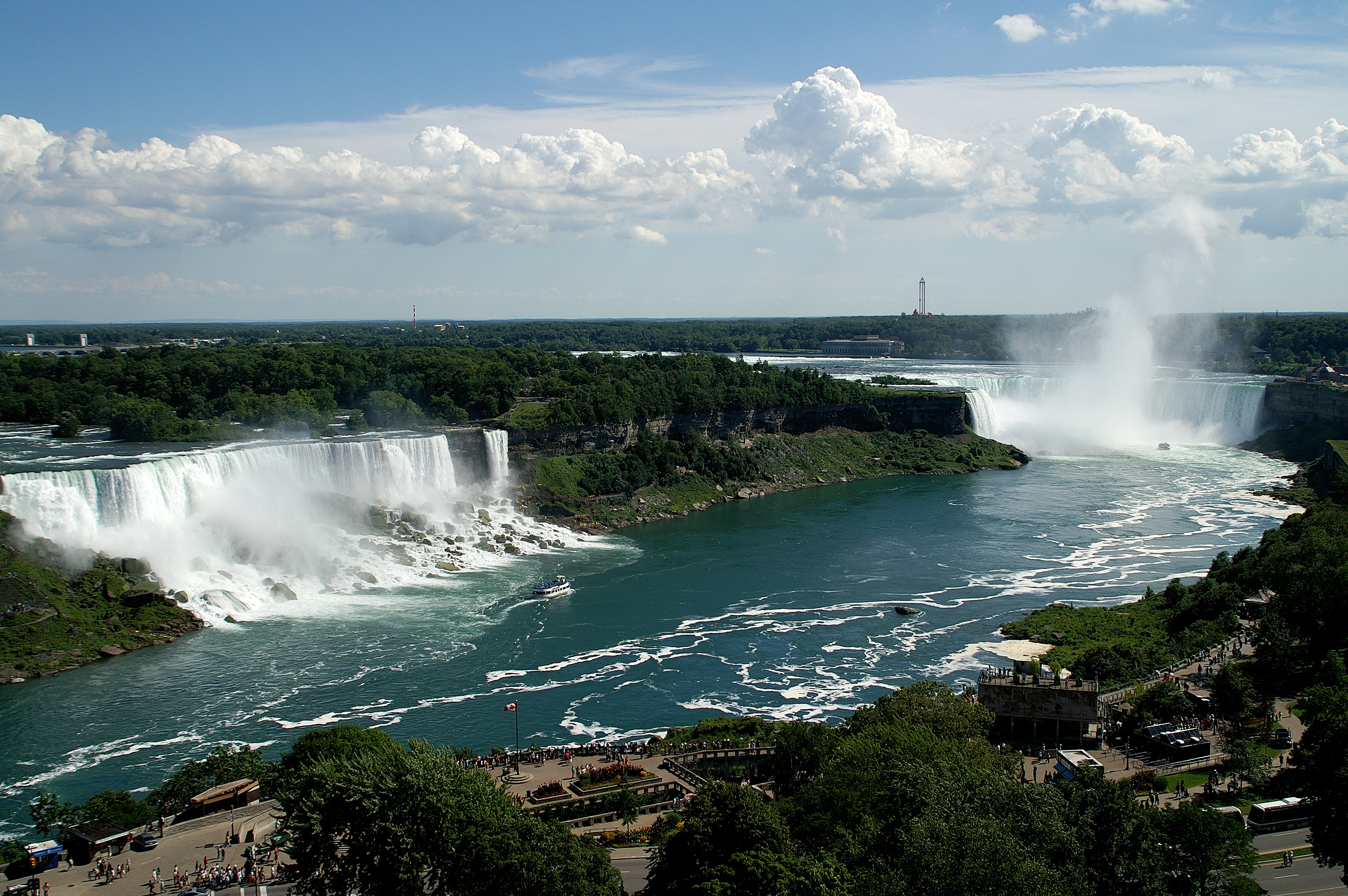
Few natural postcards are as universally known as Niagara Falls: a thundering curtain of water plunging between Canada and the United States, throwing up a cloud of mist visible from kilometres away. They aren't the tallest in the world, but their colossal flow — millions of litres a minute falling without pause — makes them one of the most impressive displays of natural force on the planet. And the best way to take them in is from the Canadian side, where the riverside promenade gives you the head-on view of the great Horseshoe Falls.
The set is made up of three waterfalls: the enormous Horseshoe Falls (mostly Canadian, with its horseshoe shape), and the American Falls and Bridal Veil Falls (on the American side). From the Canadian shore you see them head-on, and the whole waterfront has been developed for visitors, with viewpoints, the boat that pulls up to the foot of the falls wrapped in spray, tunnels that take you behind the curtain of water, and, at night, a play of coloured lights and fireworks that turns it all into a fairground spectacle.
This guide covers the essentials of Niagara Falls with a practical, warm eye: how to see them from the best spots, which experiences are worth it (the boat, the walk behind the falls, the towers), what the lively Clifton Hill area is like, and how to combine the visit with the vineyards and the charming town of Niagara-on-the-Lake. It's one of the easiest and most rewarding getaways from Toronto.
Niagara Falls formed at the end of the last ice age, about 12,000 years ago, when the retreat of the glaciers released the flow of water from the upper Great Lakes towards Lake Ontario through the Niagara River, creating a waterfall that has been eroding the rock and retreating upstream by several kilometres ever since. The region was inhabited for millennia by Indigenous peoples, especially of the Haudenosaunee (Iroquois) Confederacy; the name 'Niagara' is usually traced to a word of Iroquoian origin (often linked to 'thunder of the waters' or to the name of a local village, 'Onguiaahra'). The first Europeans to describe the falls, in the 17th century, were French explorers and missionaries, such as Father Louis Hennepin, whose account (with exaggerations about the height) made them known in Europe. The region was a battleground during the War of 1812 between the British/Canadians and the Americans. Through the 19th century the falls became a fashionable tourist destination and the stage for daredevil feats: tightrope walkers crossing the river (like the famous Blondin) and adventurers who went over the edge inside barrels. From the end of the 19th century they were also a key piece in the development of hydroelectric power, harnessing the enormous force of the water. Today a significant part of the flow is diverted to generate electricity, regulated by treaties between Canada and the United States, while the rest keeps putting on the spectacle that draws millions of visitors every year. The full story is on our history page.
Read the full history ↓Canada's economic and demographic heart: land of the Iroquoian and Algonquian nations, refuge of the Loyalists, cradle of Upper Canada and the country's industrial engine, home to Toronto, to the national capital Ottawa and to Niagara Falls.
Read the history of Ontario →They depart from Cataratas Del Niagara, 0 km away. If you book from this link we earn a commission and you pay no more.
No exact prices: a scale from $ (budget) to $$$$$ (luxury), with 2-3 options per category.
Origins, formation and what the sources say.
Niagara Falls is, in geological terms, surprisingly young. It was born at the end of the last ice age, about 12,000 years ago, when the enormous glaciers covering much of North America began to retreat. As they melted they left the Great Lakes behind and opened new channels for the water. The Niagara River formed then as the natural drain through which the water of the upper lakes (Erie, and above it Huron, Michigan and Superior) flows towards Lake Ontario and, from there, to the St. Lawrence River and the Atlantic.
On its way, the river meets a geological step, the Niagara Escarpment: a rock formation with an upper layer of hard rock (dolomite) over softer layers beneath. Plunging over that step, the water created the waterfall. And here's the fascinating part: the force of the water constantly erodes the soft rock at the base, which makes the hard upper layer break off and the falls 'retreat' upstream over time. That's why the falls aren't where they began: over these millennia they have retreated several kilometres, carving the spectacular Niagara gorge we see downstream today.
That same erosion process continues today, though far more slowly thanks to control works and to the water diverted to generate electricity. The falls are still, technically, retreating a few centimetres a year. The famous gorge, with its furious rapids and its great whirlpool, is the trail the waterfall has left along its slow journey backwards through the millennia.
Long before the Europeans arrived, the Niagara region was inhabited and travelled for thousands of years by Indigenous peoples. At the time of European contact the area was linked to Iroquoian-speaking peoples, including the powerful Haudenosaunee Confederacy (the Five, later Six, Iroquois Nations), and to a people known as the Neutral. The river and the falls were a landmark and a place charged with meaning for these nations.
The name 'Niagara' itself comes from that Indigenous heritage, although its exact meaning is debated. Most sources trace it to a place name of Iroquoian origin: one of the most widely repeated explanations links it to 'Onguiaahra', a name that appears on old maps and might refer to a village in the area. The most widespread popular reading translates 'Niagara' as 'thunder of the waters', a poetic image and a very fitting one for the thundering roar of the falls, although linguists warn that this translation is disputed and possibly more romantic than rigorous.
Etymology aside, what's certain is that Niagara was part of the world of the Indigenous peoples long before European explorers 'discovered' it for the West. The falls were already a geographical feature known, respected and named by those who lived on this land.
The first Europeans to reach the region and to leave written descriptions of the falls were French explorers and missionaries, as part of New France's expansion through the Great Lakes during the 17th century. The area was a key crossing point on the routes of the fur trade and of missionary work, and the accounts of these travellers carried the image of Niagara to Europe for the first time.
The most famous account is that of Father Louis Hennepin, a Franciscan (Recollect) missionary who accompanied the explorer La Salle's expedition and visited the falls around 1678. Hennepin was so struck by the spectacle that he published a description that circulated widely in Europe, helping to make the falls famous in the Old World. His account, however, exaggerated the height of the drop considerably, giving it proportions far greater than the real ones: a sign of the astonishment (and the tendency to exaggerate) that this colossus of water provoked in those who saw it for the first time.
During the 18th century the Niagara region was a stage for the rivalry between France and Britain over control of North America, with forts built to command the strategic river and its transport. After the British victory over the French, the area passed to the British Empire, which would shape the region's fate in the following decades, including the border that today separates Canada from the United States.
The Niagara region was one of the bloodiest theatres of the War of 1812, the conflict between the British Empire (with its colonies, the future Canada) and the United States. The Niagara River, which marked the border between British Upper Canada and the state of New York, became a contested battle line, with crossings, invasions and fighting on both sides.
Decisive battles were fought along the Niagara front. At Queenston Heights, in 1812, British and Canadian forces, together with Indigenous allies and under General Isaac Brock (who died in the fighting and became a hero), repelled an American invasion. In 1814 came the bloody battles of Chippawa and Lundy's Lane, the latter one of the most savage of the entire war, fought a short distance from the falls. Towns in the area were burned during the conflict.
The war ended in a draw, with no major territorial changes, but it had a lasting effect: it consolidated the border between what would become Canada and the United States along the Niagara River, and it strengthened in the British colonies a sense of their own identity and of resistance to the neighbour to the south. Today the battlefields and monuments of the region (like Brock's at Queenston Heights, near Niagara-on-the-Lake) recall those years, in a landscape that is now one of vineyards and tourism. The peace that followed allowed the falls, decades later, to become the great tourist destination they are.
Through the 19th century Niagara Falls became one of the great tourist destinations in the world. The arrival of the railway and better roads put it within reach of travellers, and it turned into a fashionable romantic destination, famous as a honeymoon spot. Hotels and viewing platforms multiplied and, as early as 1846, the 'Maid of the Mist' boat began carrying visitors to the foot of the falls, a tradition that continues to this day. In 1885 the Canadian side created Queen Victoria Niagara Falls Park to protect the setting from unchecked development, the forerunner of today's Niagara Parks.
But the 19th century and the early 20th were also the era of daredevil feats, which gave Niagara a legendary fame. The most celebrated was the French tightrope walker Charles Blondin, who in 1859 crossed the Niagara gorge on a rope strung over the abyss, repeating the feat in ever riskier variations (blindfolded, with a wheelbarrow, carrying a man on his back, and even cooking an omelette halfway across). Other funambulists followed his lead.
The other great daredevil tradition was going over the falls inside a barrel or some other contraption. The first person to survive the drop over Horseshoe Falls in a barrel was Annie Edson Taylor, a 63-year-old schoolteacher, in 1901, who did it in search of fame and fortune. Many others tried over the years, with varying and often tragic results. These stunts, illegal today, are part of Niagara's imagery and legend, and are remembered in the local museums.
Towards the end of the 19th century, the enormous force of Niagara's water drew engineers and entrepreneurs who saw in it a colossal source of energy. Niagara became a key piece in the history of electricity: some of the world's first large hydroelectric plants were developed here at the turn of the 19th and 20th centuries, in an episode tied to figures like Nikola Tesla and George Westinghouse and to the triumph of alternating current for transmitting electricity over distance. The power generated at Niagara drove the industrial development of the whole region.
Since then the falls have served a double function: natural spectacle and electricity generator. A very substantial part of the Niagara River's flow is diverted, above the falls, to the hydroelectric plants of both countries. How much water is diverted and how much is allowed to fall over the falls is regulated by treaties between Canada and the United States, which ensure that during the day and the tourist season enough water falls to sustain the spectacle, while at night and out of season more of the flow is diverted for power. In other words, the falls we see are, in a sense, 'managed'.
Today Niagara Falls is one of the most visited destinations in North America, with millions of tourists a year. Protected on the Canadian side by the Niagara Parks, it combines the grandeur of nature with enormous tourist development (hotels, attractions, Clifton Hill, casinos) and remains a symbol shared between Canada and the United States. That waterfall born from the melting glaciers keeps roaring, drawing people with the same force it has for centuries.