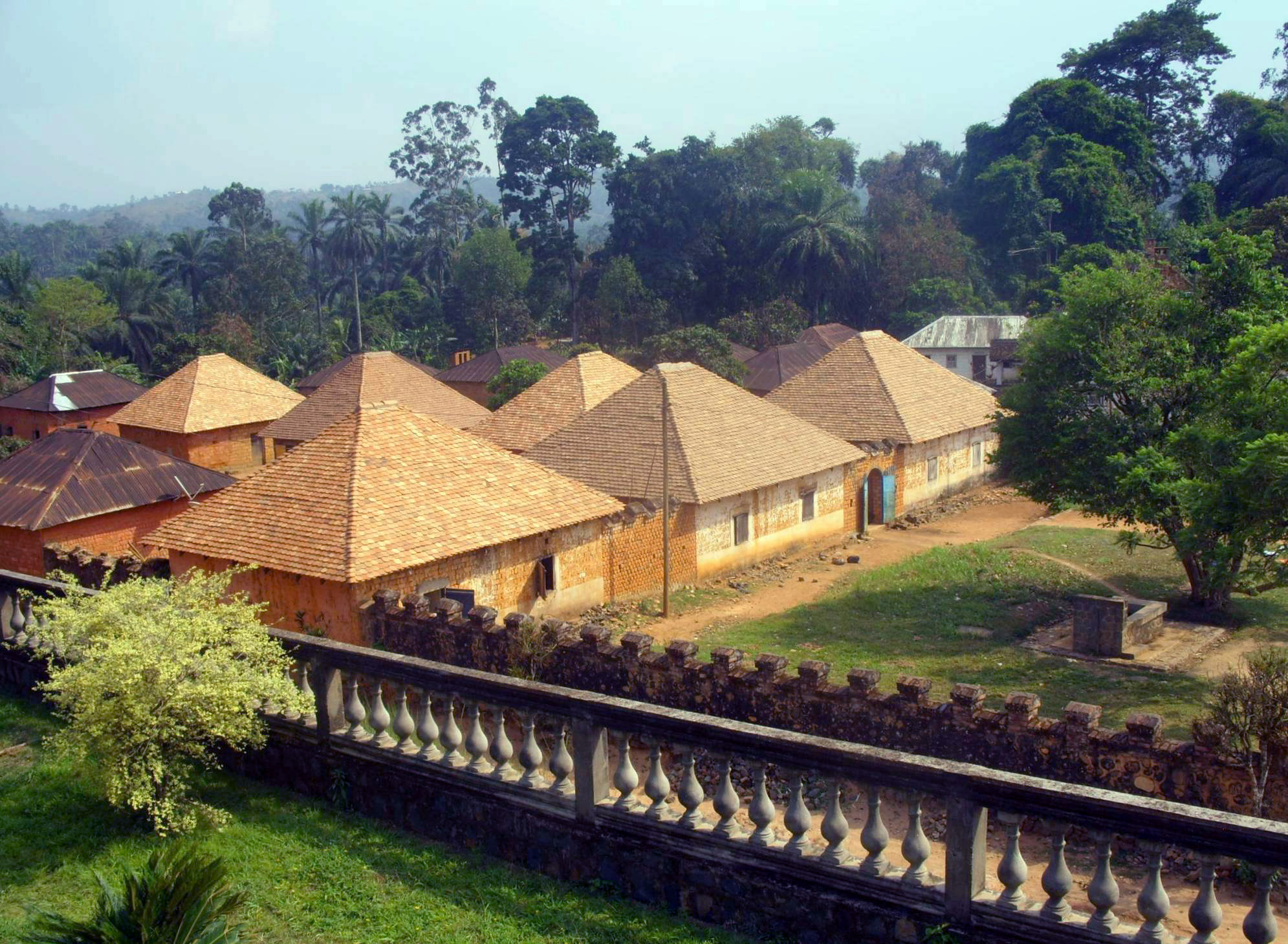
Bafut is one of Cameroon's great traditional kingdoms and, in normal times, one of the most fascinating cultural visits in the country: the seat of a 'fondom' (kingdom) with more than six centuries of history, whose Royal Palace — a complex of more than fifty buildings around a sacred shrine — is on the UNESCO World Heritage Tentative List. It is also the setting immortalised by the British naturalist and writer Gerald Durrell in his famous books 'The Bafut Beagles' and 'A Zoo in My Luggage'.
However, Bafut cannot be visited safely today. It is in the North-West Region, one of Cameroon's two anglophone regions, which since 2016 have been living through a serious armed separatist conflict. The Royal Palace itself was attacked and looted in 2019. Governments around the world advise against any travel to the area. This guide describes Bafut for its extraordinary historical and cultural value — and in the hope that one day it can be visited again — but with a clear warning: for now, it is not a destination you can go to.
In these pages we explain what Bafut is and what it represents: its 'fondom' and its 'fon' (king), the Royal Palace and its shrine, the legacy of Gerald Durrell, the culture of the North-West grassfields and the context of the anglophone crisis that makes it inaccessible today. Reading it is a window onto an exceptional heritage and a way to understand why, for the moment, it has to be admired from afar, always checking the official advice before making any plans.
The 'fondom' of Bafut is one of the most powerful traditional kingdoms in the North-West highlands of Cameroon, with a history that tradition traces back more than six centuries. Its Royal Palace, seat of the 'fon' (king), brings together some fifty buildings around a sacred shrine ('Achum') and is on the UNESCO Tentative List. Bafut resisted the Germans in the early 20th century, later came under British administration and became world-famous through Gerald Durrell's books. Since 2016, the anglophone conflict has plunged it into insecurity. The full story is told on our history page.
Read the full history ↓The fondoms of the highlands: the kingdom of Bafut immortalised by Gerald Durrell, the city of Bamenda, cradle of the opposition, and the scenic Ring Road, all now marked by the anglophone crisis.
Read the history of The anglophone Northwest highlands →No exact prices: a scale from $ (budget) to $$$$$ (luxury), with 2-3 options per category.
Origins, formation and what the sources say.
Bafut is one of the oldest and most powerful traditional kingdoms ('fondoms') in the highlands of North-West Cameroon. This is the grassfields region, which shares its cultural roots with the Bamileke country of the West but which colonial history made English-speaking. Oral tradition traces the kingdom's founding back more than six centuries, to when a group led by a founding chief settled in these hills and conquered or federated the neighbouring communities under the authority of a 'fon' (king).
Like the other peoples of the grassfields, Bafut's founders descended from migrations that came from the north and east and, over several centuries, settled the highlands of western Cameroon. Once settled, they organised themselves into many independent kingdoms, each with its own 'fon', territory and institutions. Bafut became one of the largest and most prestigious in the North-West, with many villages and lineages under its crown.
As everywhere in the region, the 'fon' of Bafut is both a political and a sacred king. He is the go-between for the living and the ancestors, and he guarantees the order and prosperity of the kingdom. His power is balanced by that of powerful secret societies, known locally as 'kwifon'. They guard ritual knowledge, keep a check on the 'fon' himself and organise the great ceremonies. The Royal Palace was built at the heart of the kingdom, as both the seat of power and the community's sanctuary.
The Royal Palace of Bafut is one of the masterpieces of traditional Cameroonian architecture. It is not one building but a complex of more than fifty structures: the homes of the 'fon' and his wives, houses for notables, ceremonial courtyards and ritual buildings. They are laid out according to a precise logic around the 'Achum', the kingdom's sacred shrine. With its towering conical roof, the 'Achum' is the spiritual heart of the 'fondom'. It is surrounded by sacred groves that tradition forbids anyone to touch.
The complex combines grassfields architecture with a few buildings from the German and British colonial periods. The grassfields style uses bamboo, wood carved with ancestor figures and symbols of power, and conical thatched roofs. Tradition gives the palace more than six hundred years of history and deep symbolic meaning. Every space has a ritual function, and only certain initiates may enter the most sacred areas.
Because of its exceptional value, the Royal Palace of Bafut was added to UNESCO's World Heritage Tentative List in 2006. This is a first step towards a possible listing as a World Heritage Site. For years the grounds housed a museum of masks, thrones, drums, weapons and royal objects that told the story of the kingdom and of North-West culture. The museum made Bafut one of the most important cultural destinations in the country.
In the early 20th century, under the German protectorate of Kamerun, Bafut put up a notable resistance. The 'fon' of the time opposed the colonial advance, and the kingdom fought the German forces before it was finally subdued. After the First World War and Germany's defeat, Cameroon was divided between France and the United Kingdom. The North-West highlands, Bafut included, came under British administration and were governed indirectly through the 'fons'. That is how English-speaking Cameroon was born.
In this setting, Bafut became internationally famous thanks to an unexpected visitor: the British naturalist and writer Gerald Durrell. Durrell came to Bafut on two animal-collecting expeditions, in 1949 and 1957. Both times he stayed as a guest of the 'fon' Achirimbi II, and the two became close friends. Those stays produced two of his best-loved books: 'The Bafut Beagles' (1954) and 'A Zoo in My Luggage' (1960).
In these books, Durrell portrayed life at the court of the 'fon' with humour and affection. He described hunts through the hills with the 'beagles' (the local hunters and their dogs), parties awash with palm wine and the region's abundant wildlife. The books made Bafut a familiar name to several generations of readers. They are still a delightful window onto life in the kingdom in the first half of the 20th century.
The colonial carve-up left Cameroon split in two: the larger part, run by France, and the smaller British Cameroons, which was itself divided. When independence came, this split shaped the country's future. French Cameroon became independent in 1960. The following year, in 1961, a UN-supervised plebiscite settled the fate of British Cameroons. The southern part, made up of the North-West grassfields (Bafut included) and the South-West, joined the Republic of Cameroon to form a bilingual federation. The northern part became part of Nigeria.
Reunification created a state with two colonial legacies. The French-speaking side was the majority. The English-speaking side was a minority, around a fifth of the population, with its own British-based education, legal and administrative systems. In 1972 the federation was replaced by a unitary state. Over the years, the English-speaking regions felt more and more politically and economically sidelined, and they watched their English-tradition institutions being worn away.
For decades Bafut remained a prosperous kingdom and a leading cultural destination, as its Royal Palace, its museum and the memory of Durrell drew visitors. But resentment over perceived discrimination kept building in the English-speaking regions. In the second half of the 2010s it erupted into the conflict that is still tearing the region apart today.
In 2016, English-speaking lawyers, teachers and students protested against French-speaking rules and officials being imposed on their legal and education systems. The protests set off a spiral of demonstrations, repression and radicalisation. In 2017, separatists declared independence for a state they called 'Ambazonia', and armed groups emerged to fight the Cameroonian security forces. That was the start of the 'Anglophone Crisis', a conflict that has killed thousands of people and displaced hundreds of thousands in the North-West and South-West regions.
Bafut lies close to Bamenda, the capital of the North-West and a hotspot of the conflict, so it was caught up in the violence. Since then the region has lived with armed clashes, kidnappings and curfews. It also has 'ghost town' days, when separatists force shops, schools and transport to shut down. Heritage was not spared. In 2018, and above all in September 2019, the Royal Palace of Bafut was attacked and looted. According to Human Rights Watch, the attackers were soldiers searching for separatists. Historic pieces from the museum were lost, including an 18th-century bronze mask.
On paper, Bafut is still one of the great kingdoms of Cameroon and part of its most valuable heritage, but the crisis has made it impossible to visit. All major governments advise against any travel to the region. This text describes Bafut for its historical and cultural value, in the hope that peace will one day let people walk through its palace again. Until then, the best way to get to know Bafut is through books, photographs and the memory of a kingdom waiting for better times. Always check official travel advice before making any plans.