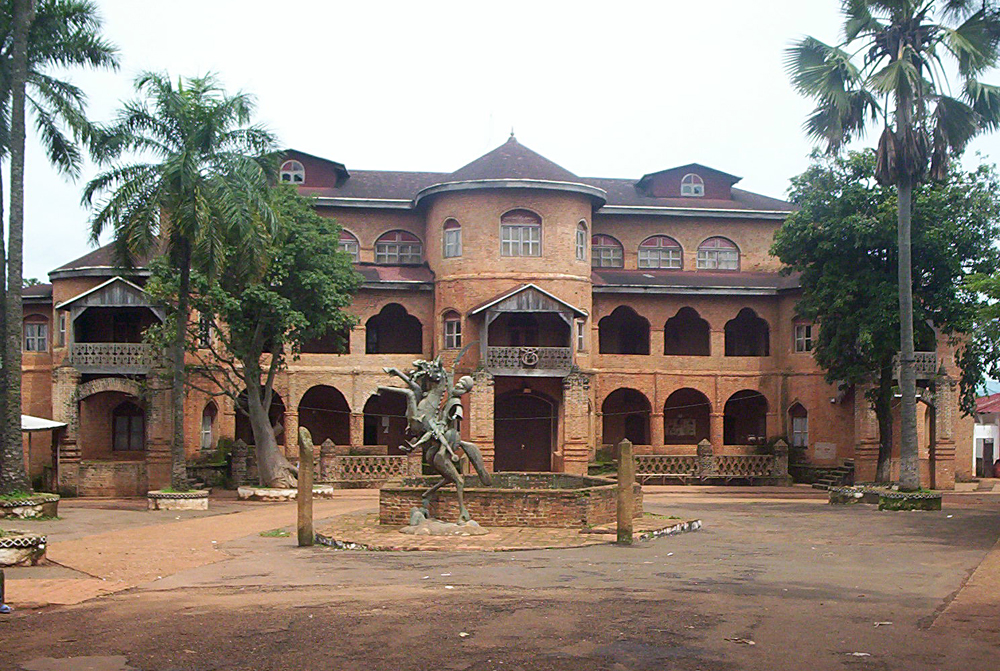
Foumban is Cameroon's cultural jewel. It is the capital of the Bamun kingdom, one of the most remarkable and best-documented African states, with more than six centuries of history and a dynasty of sultans that still reigns. This Muslim-tradition town sits in the heart of the western highlands. It has a Royal Palace where the sultan lives and an extraordinary museum of thrones, masks, weapons and royal objects. It also has a whole street given over to artisans: woodcarvers, embroiderers, weavers and, above all, the famous Bamun bronze casters.
The central figure in its history is Sultan Ibrahim Njoya, who reigned across the late 19th and early 20th centuries. He was a brilliant scholar-king who invented a writing system for his language from scratch: the Bamun script, or shümom. He also wrote down the history and customs of his people, designed a palace, drew maps, built mills and even founded a syncretic religion. He is comparable to the great reformers of history, and he makes Foumban a unique place: the capital of a kingdom that created its own script and one of the richest artistic traditions in Africa.
This guide takes a practical look at Foumban. It covers how to visit the Royal Palace and the new Museum of the Bamun Kingdom, what to buy on the artisans' street and how to bargain, which other museums and sites to see, when the great Nguon festival takes place, and how to combine Foumban with Bafoussam and the Bamileke royal courts of the West. It is the essential destination for anyone who wants to understand the historical and artistic depth of Cameroon.
Nchare Yen founded the Bamun kingdom around the 14th century (c. 1394). Over the centuries it became one of the great states of the Cameroonian grassfields, with Foumban as its capital. Its most famous figure is Sultan Ibrahim Njoya, who reigned from the late 19th century until 1933. He invented the Bamun script (shümom), was a reformer and a great patron of the arts, had the current Royal Palace built (1917) and drove the kingdom's conversion to Islam. The dynasty continues to this day. You can read the full story on our history page.
Read the full history ↓The land of kingdoms: the Bamum sultanate of Foumban with its own script, and the nearly one hundred Bamileke chefferies of the grassfields, a land of masks, palaces and conical roofs.
Read the history of The West: kingdoms, palaces and grassfields →No exact prices: a scale from $ (budget) to $$$$$ (luxury), with 2-3 options per category.
Origins, formation and what the sources say.
The Bamum kingdom is one of the oldest, most remarkable and best-documented states in Africa, and its history begins in the late 14th century. According to tradition, around 1394 a prince named Nchare Yen, from the Tikar dynasty to the north, founded the kingdom after conquering and uniting many chiefdoms in the region. He set up his capital in what would become Foumban, in the Grassfields highlands of western Cameroon. Nchare Yen was the first of a long line of kings (mfon), or sultans, that has continued unbroken to this day.
Over the centuries, the Bamum kingdom grew through conquest, alliances and the absorption of neighbouring peoples, until it became one of the most powerful states in the region. It developed a sophisticated political organisation, with a court, societies of dignitaries, an army and an elaborate system of royal symbols: beaded thrones, masks, drums, pipes and ceremonial objects that make up one of the richest artistic traditions in Africa.
The capital, Foumban, was ringed by fortifications and laid out around the royal palace. The Bamum kingdom kept a strong identity and an exceptional historical memory, thanks partly to oral tradition and, later, to the script that one of its kings would invent. More than six centuries of dynastic continuity make Foumban a unique case: the capital of a living African kingdom, whose king, court and traditions are all still in place.
The most extraordinary figure in Bamum history is Sultan Ibrahim Njoya, who reigned from the late 19th century (around 1886/1892) until 1933. Njoya was a brilliant king with many talents, comparable to the great reformers of world history. His most astonishing achievement was inventing a writing system for the Bamum language from scratch. He knew of writing only by hearsay, yet over several versions he designed and refined the so-called shümom script, moving from a pictographic system to a syllabic one. It is one of the very few writing systems created independently in Africa.
Using this script, Njoya and his court wrote chronicles, the history and customs of the kingdom, medical treatises, religious texts and maps. The sultan also set up a printing press, schools to teach the script, a royal archive and a library. He reformed the calendar, promoted the mapping of the kingdom and designed a new palace. He even developed a syncretic religion that blended elements of Islam, Christianity and traditional Bamum beliefs, seeking a spiritual synthesis of his own.
Njoya was also a great patron of the arts, which flourished as never before during his reign: bronze casting, carving, embroidery and weaving reached extraordinary heights. His reign turned Foumban into a dazzling intellectual and artistic centre. His end, however, was tragic. The French colonial administration, wary of his power and influence, stripped him of his authority and sent him into exile in Yaoundé, where he died in 1933. Today he is a revered figure and a symbol of African genius.
In the late 19th century the Bamum kingdom met the colonial powers. In 1884 the region became part of the German protectorate of Kamerun. Sultan Njoya, a skilful diplomat, kept good relations with the Germans. This let him hold on to a wide degree of autonomy and benefit from some of the exchanges. He even sent gifts to the German emperor, among them a famous beaded throne. During this period, after learning about Islam and Christianity, Njoya promoted his religious synthesis and adopted Islam. It became the kingdom's main religion, a feature that sets Foumban apart from the rest of the mostly Christian West Region.
After Germany's defeat in the First World War, the territory came under French administration. Njoya's relationship with the French was far more strained: the colonial administration was suspicious of his power, his prestige and his drive for reform. The French gradually cut back his authority and dismantled some of his institutions, including the teaching of his script. In the end they deposed him and banished him to Yaoundé, where he died in exile in 1933.
Despite that blow, the Bamum kingdom survived. The dynasty carried on through his successors, and the city kept its palace, its traditions, its art and the memory of Njoya. The current royal palace, commissioned by Njoya himself and completed in 1917, is the great architectural legacy of that golden age: a monumental building that is still the seat of the sultanate today.
After Cameroon's independence (1960) and reunification (1961), the Bamum kingdom became part of the modern state, like the country's other traditional monarchies. It kept a cultural, symbolic and spiritual role of enormous weight. The dynasty founded by Nchare Yen still reigns: the current sultan is heir to a line more than six centuries long, and the Royal Palace of Foumban remains his residence and the centre of the kingdom's ceremonial life.
Foumban has established itself as Cameroon's leading cultural destination. In 2024 the new Museum of the Bamum Kingdom opened. Its modern building takes a symbolic shape, the spider and the two-headed serpent, emblems of the kingdom. It holds some 10,000 pieces, including thrones, masks, statues, weapons, jewellery and Njoya's manuscripts in Bamum script, making it one of the most important museums in Central Africa. Next to it, the famous artisans' street keeps the Bamum tradition of bronze work, carving and weaving alive.
The kingdom's culture also lives on in the Nguon, the great traditional Bamum festival. It is one of the oldest traditional institutions in Africa and includes a rite in which the people can judge the king. In 2024 it was inscribed on UNESCO's list of the Intangible Cultural Heritage of Humanity. With its living palace, museums, art, Njoya's script and the Nguon, Foumban offers an unmatched immersion in the history and culture of a great African kingdom.
Foumban's most remarkable claim is that it was the birthplace of a writing system invented from scratch: the Bamum or shümom script, created by Sultan Njoya in the late 19th century. Very rarely in human history has one person devised a complete writing system on their own. It is rarer still for that person to be a king who also reformed the calendar, drew maps, founded schools and even created a religion. That is why Njoya is one of the most fascinating figures in African history.
The Bamum kingdom has one of the richest and most celebrated artistic traditions in Africa. Its bronzes, carvings, masks and beaded thrones are found in the world's great museums, and Foumban's artisans' street still makes them with ancestral techniques such as lost-wax casting. The kingdom's emblems, the spider (a symbol of wisdom and divination) and the two-headed serpent (a symbol of power and victory), appear everywhere, even in the shape of the new museum.
Foumban is also a Muslim island in a West Region that is mostly Christian and Bamileke, a result of the conversion Njoya promoted. Its great festival, the Nguon, is considered one of the oldest traditional 'democratic' institutions on the continent, because it includes a ritual in which subjects can publicly reproach and judge the sovereign. An ancient kingdom, its own script, dazzling art, a religious synthesis and a festival that judges the king: few places in the world pack in as much historical and cultural richness as this city in the Cameroon highlands.