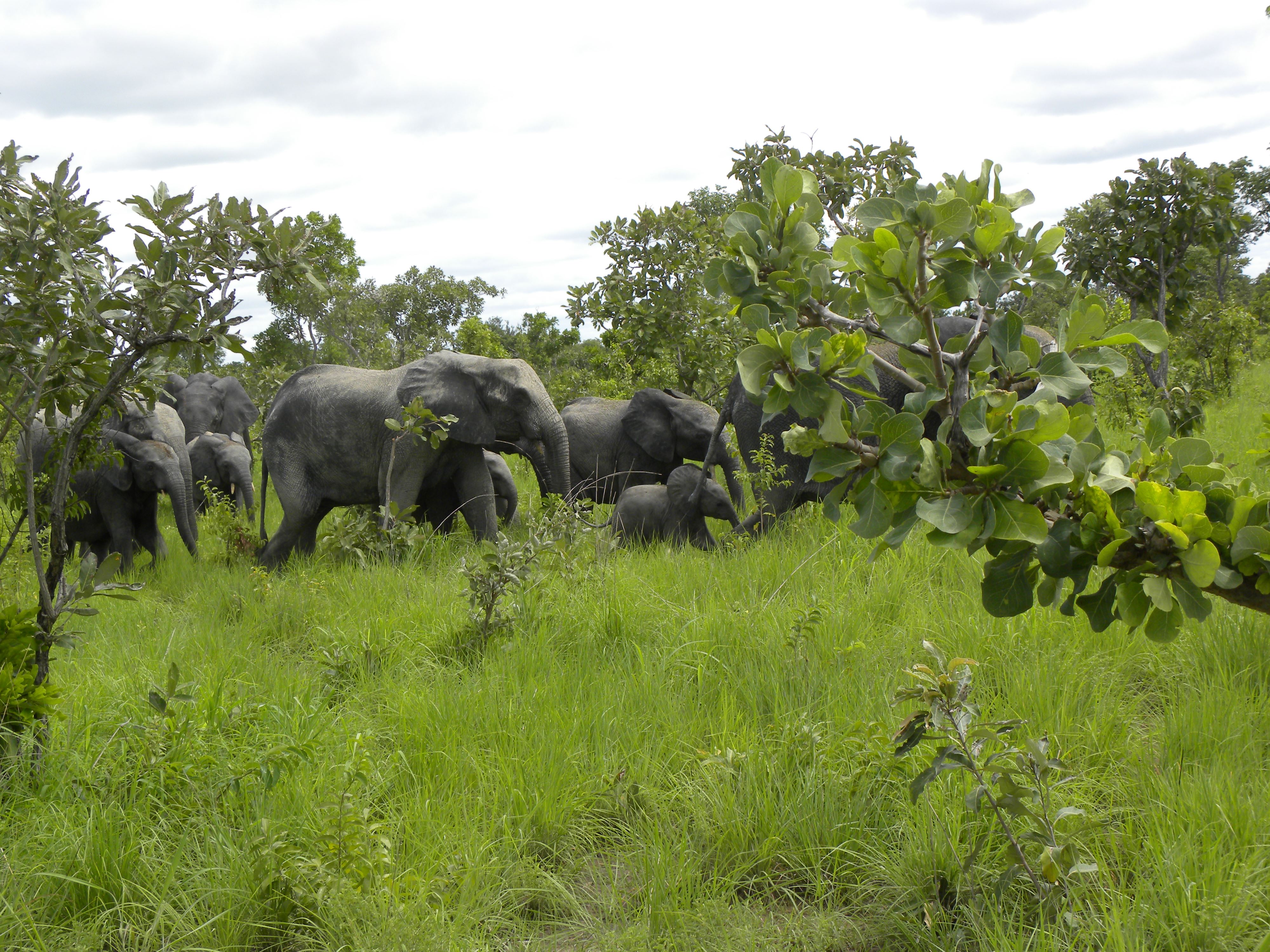
The Nazinga Game Ranch —also known as the Nazinga reserve or park— is the great wildlife reserve of southern Burkina Faso and one of the few places in the country where, in normal times, you could go on a small safari. Its more than 900 km² of wooded savannah, dotted with artificial dams, host one of the largest concentrations of elephants in West Africa: watching them come down to drink at the waterholes, sometimes in large groups, is Nazinga's great spectacle and a rarity in this part of the continent, where elephants are scarce.
Nazinga is not a park like those of East Africa: it was born in 1979 as a pioneering conservation experiment, the 'ranch de gibier' (game ranch) created by the Canadian brothers Robert and Clark Lungren, which combined wildlife protection, wildlife-viewing tourism and sustainable use of resources. Over the years it passed into the hands of the Burkinabè State and became a benchmark for wildlife management in the Sahel, with its conservation, buffer and controlled-hunting zones, and a camp where you could stay inside the reserve.
This guide explains what Nazinga is, its wildlife, its history and how it used to be visited. WARNING: at the time of writing, Burkina Faso is under an official 'do not travel' advisory due to the serious security situation, and tourism to this region has stopped. We include Nazinga for its natural and conservation value and so that you can get to know it; any actual visit should be postponed until the situation changes and checked against official sources, including the state of the reserve and its access routes.
The Nazinga Game Ranch was founded in 1979 by the Canadian brothers Robert and Clark Lungren as a pioneering conservation experiment in West Africa, combining wildlife protection with tourism and controlled use. Across more than 900 km² of savannah, with a network of dams that guarantee water in the dry season, the reserve managed to restore and sustain one of the largest elephant populations in the region. Nationalised by the Burkinabè State, Nazinga became a model of wildlife management and one of the few safari destinations in the country. Its full history is told on our history page.
Read the full history ↓The south of the peoples without kings: the painted houses of the Kassena in Tiébélé, the enigmatic Lobi civilisation of Gaoua and the thousand-year-old walls of Loropéni, the country's first World Heritage Site.
Read the history of The south (Gurunsi, Lobi and Kassena country) →No exact prices: a scale from $ (budget) to $$$$$ (luxury), with 2-3 options per category.
Origins, formation and what the sources say.
Nazinga's story is the story of a bold idea. In the late 1970s, much of the wildlife in Burkina Faso — then Upper Volta — was in decline because of poaching, agricultural pressure and habitat loss. Against that backdrop, two Canadian brothers, Robert and Clark Lungren, pushed in 1979 for the creation of the Ranch de Gibier de Nazinga, in the south of the country, near Pô and the border with Ghana. It was not a classic national park but an experiment in wildlife management that was new to West Africa.
The idea was to combine three goals that are often seen as opposites: protecting wildlife, letting tourists watch it, and using its resources in a controlled, sustainable way, including regulated hunting in certain areas. Instead of shutting out human use altogether, the 'game ranch' aimed to give wildlife economic value and so create an incentive to conserve it, with local communities involved. It was a philosophy ahead of its time, related to the community-based wildlife management models that would later become famous in southern Africa.
Across more than 900 km² of wooded savannah, the project began to shape what would become one of the most unusual reserves in the region. In a climate with a long, harsh dry season, the key to everything was going to be water: without it, neither the wildlife nor the project could thrive. And that is where one of Nazinga's great innovations comes in.
Nazinga's big technical success was building a network of dams, or artificial reservoirs (barrages), spread across the reserve. In a region where the dry season drains rivers and ponds for months, these reservoirs provide water all year round, and with it the chance for wildlife to survive and gather within a defined area instead of migrating or dying. Water literally became the engine of the reserve.
The effect was remarkable. The water points draw herbivores — elephants, buffalo, many species of antelope, warthogs — along with the predators and birds that depend on them, creating concentrations of wildlife that are especially easy to see at the height of the dry season, from January to April. For visitors, this means Nazinga's great spectacle: herds of elephants coming to drink and bathe at close range, something exceptional in West Africa. For the reserve, it means being able to sustain rich biodiversity in a demanding environment.
The reservoirs are also home to Nile crocodiles and plenty of waterbirds, and gallery forest thrives around them, adding to the variety of habitats. Nazinga showed that, with smart water management, it was possible to bring back and keep wildlife in areas where it seemed doomed to disappear. That model of active habitat management is one of the reserve's most valuable lessons.
If Nazinga is known for one thing, it is its elephants. The reserve is home to one of the largest populations of savannah elephants in all of West Africa: together, Nazinga, the neighbouring Sissili reserve and Kaboré Tambi National Park hold several hundred animals, most of them in Nazinga. In a region where elephants have been decimated by the ivory trade and human encroachment, this population is a conservation treasure of international importance.
Seeing wild elephants in West Africa is hard: the great herds of the east or south of the continent are gone, and those that survive tend to be elusive. Nazinga is one of the exceptions, thanks precisely to its water and its protection. In the dry season, the elephants become relatively easy to spot around the dams, which turned the reserve into Burkina Faso's main safari destination and a symbol that conservation can work even in tough conditions.
That same population, however, is fragile. It depends on anti-poaching patrols, on the upkeep of the dams and on stability in the area. The security crisis that has gripped the country since the mid-2010s threatens not only tourism but the management of the reserve itself: with no rangers, no resources and no control of the territory, populations like Nazinga's are left exposed. Protecting these elephants goes beyond tourism; it is about conserving a unique natural heritage.
Over the years, the Ranch de Gibier de Nazinga was nationalised by the Burkinabè state, which took over its management through its protected-area agencies under the Ministry of the Environment. The reserve was divided into zones with specific roles: a strict conservation zone, a buffer zone and a large controlled hunting zone, plus hunting zones belonging to the neighbouring villages. This zoning tried to balance protection, use and benefits for local communities.
Nazinga thus established itself as a benchmark for wildlife management in the Sahel and as one of the few places in the country equipped to welcome visitors looking for wildlife. A camp was set up inside the reserve, with bungalows and rooms, run as part of the national tourism system, so visitors could sleep in the middle of nature and head out on safari when the animals were most active. Visits were always made with local tracker-guides, experts at finding wildlife along the reserve's hundreds of kilometres of tracks.
In its best years, Nazinga brought together science, conservation and tourism: its elephants and ecology were studied, it generated income and jobs for the region, and it offered Burkinabè and foreign visitors a nature experience rarely found in West Africa. In short, it was a bet on proving that wildlife is worth more alive than dead, and that conservation can also be a path to development.
Nazinga's recent fortunes are tied to those of Burkina Faso as a whole. Since the mid-2010s, the spread of armed jihadist groups across the Sahel and large parts of the country has plunged the nation into a severe security and humanitarian crisis, with thousands killed and millions internally displaced. The insecurity, which hit the north and east first, spread and undermined the state's ability to manage and protect its natural areas, including the reserves in the south.
Foreign governments ended up advising against all travel to Burkina Faso, and wildlife tourism — which at Nazinga had driven both conservation and income — came almost entirely to a halt. For a reserve whose model relied partly on the economic value of wildlife, the loss of tourism and weaker patrols are a direct threat: without resources or effective control of the territory, the risks of poaching and habitat degradation grow, and conservation gains built up over decades are put at risk.
Despite everything, Nazinga is still one of the great hopes for conservation in West Africa: its elephants, its dams and its pioneering model are still there, waiting for safer times when full management, research and responsible tourism can resume. Knowing its story means understanding that protecting nature in the Sahel is as difficult as it is necessary, and that places like Nazinga deserve to survive the crisis so they can once again amaze those who, one day, may see its elephants coming down to drink at sunset.