Viajá con Gus
Home › Burkina Faso › Sindou Peaks
Sindou Peaks
🇧🇫 Burkina Faso · Bobo-Dioulasso and the southwest

Sindou Peaks

🪪 What do I need to enter Burkina Faso?Pick your citizenship and we tell you the visa, the days and the paperwork, with the official source.

By leaving your email and citizenship you agree to receive the documents you asked for and weekly travel news. You can unsubscribe whenever you want. How we handle your data.
Jump to what you need
📍Region
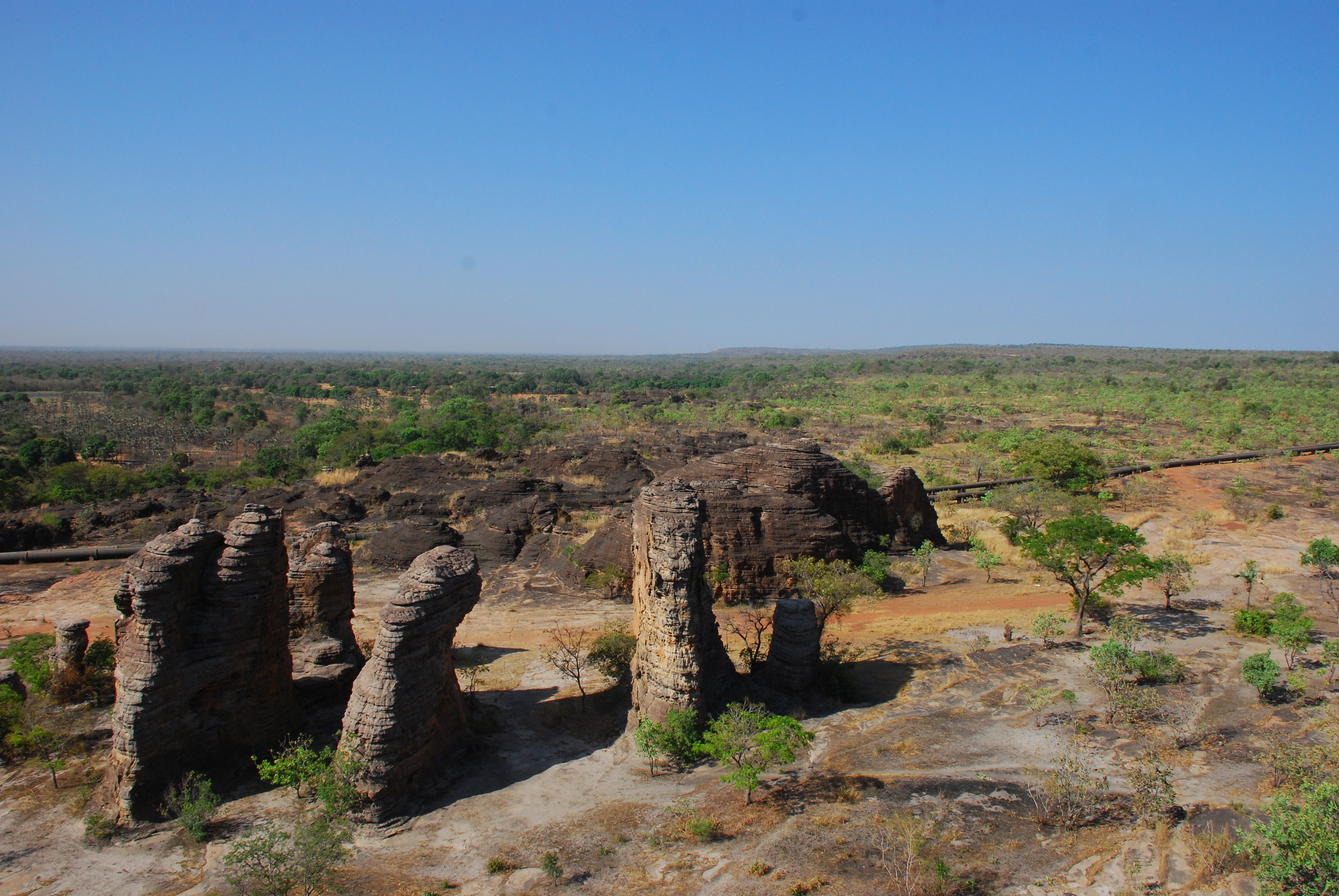
The Sindou Peaks (la chaîne de Sindou or pics de Sindou) are a chain of sandstone rock formations in the far southwest of Burkina Faso, next to the village of Sindou, in Léraba province, about 50 kilometres west of Banfora. It is one of the most spectacular natural landscapes in the country: cones, needles and ridges of stone sculpted by erosion, rising above the savannah like a city of rock.
📌Best time
The best time is the dry season, from November to February, when the heat is moderate and the paths are in good condition for walking. The best time of day is sunset, when the low light sets the sandstone glowing in golden and reddish tones and the shadows bring out the shapes of the peaks; sunrise is beautiful too. At midday the sun is very strong and takes the magic out of the landscape.
📌What it is
The Sindou Peaks are a sandstone geological formation shaped over millions of years by wind and water erosion, which left behind a maze of cones, needles, towers and gorges. Beyond their scenic value, the site has strong cultural and spiritual significance for the peoples of the area, with sacred places tied to local tradition.
📌Suggested days
The Sindou Peaks are visited as a half-day to full-day trip from Banfora, which is the usual base. The guided walk through the chain takes a couple of hours, plus the journey. You can combine them with other sights in the southwest (Karfiguéla waterfalls, Lake Tengrela) by spreading them over two or three days based in Banfora.
📌Getting there
From Banfora you head west by road towards Sindou, a drive of just under an hour (about 50 km). The most practical option is to hire a car with driver or a guide with a vehicle in Banfora, combining the transfer and the walk. There is no comfortable direct public transport; some travellers go by motorbike, but it is best to go with a local guide.
📌Safety
Important: foreign ministries advise against all travel to Burkina Faso due to the threat of terrorism, kidnapping and instability. Sindou is in the southwest, the relatively safest area, but very close to the border with Mali, a sensitive zone, so take extra precautions: check the situation carefully before going, travel only by day with a trusted local guide, stay away from the border and do not spend the night in isolated rural areas.
💱 XOF exchange rate
Loading rate…
🌤️ Weather in Sindou Peaks
Loading weather…

For many, the Sindou Peaks are the most astonishing landscape in Burkina Faso: a long chain of sandstone cones, needles and ridges rising above the southwestern savannah like a fantastic city of stone. Sculpted by millions of years of erosion, they form a maze of towers, gorges and viewpoints that looks like it came from another planet, and that turns magical in the light of sunset.

Located next to the village of Sindou, about 50 kilometres west of Banfora, the peaks are a destination for walking and taking in the view. Exploring them on foot with a local guide, climbing to the viewpoints and slipping between the needles, is an unforgettable experience; and watching them light up in golden and reddish tones as the sun goes down is one of those moments that make the trip worthwhile. The site is also deeply sacred to the peoples of the area.

This guide tells you how to visit the Sindou Peaks from Banfora, when to go to catch the best light, how to arrange the guided walk and what precautions to take. We also include, plainly, the essential safety information: although the southwest is the safest part of Burkina Faso, Sindou is very close to the border with Mali and requires thorough research and extra care.

📖 History of Sindou Peaks

The Sindou Peaks are a sandstone formation sculpted over millions of years by wind and water erosion, which carved the rock into a maze of cones, needles and ridges. Beyond their geological origin, the site is deeply tied to the culture of the peoples of the southwest, who regard it as a place full of spirituality, with sacred spaces and legends of its own. Now one of the great natural icons of Burkina Faso, the peaks are a destination for walking and contemplation and the centrepiece of tourism promotion in the southwest. Their natural and cultural history is told on our history page.

Read the full history ↓

🏛️ Sindou Peaks is in Bobo-Dioulasso and the southwest

The green, commercial southwest: Bobo-Dioulasso, the second city, with its great mud mosque, and the Banfora region, with its waterfalls, sandstone peaks and sacred hippos.

Read the history of Bobo-Dioulasso and the southwest →

🗺️ What to see

1
The chain of sandstone peaks
The heart of the site: a maze of sandstone cones, needles and ridges sculpted by erosion, to explore on foot.
Leer más ↓
The main attraction is the chaîne de Sindou itself: a chain of sandstone formations stretching several kilometres, with cones, sharp needles, towers and ridges separated by narrow gorges. Walking among them with a guide who knows the trails means stepping into a fascinating, maze-like landscape where every turn reveals a new stone silhouette. The sandstone, in ochre, reddish and grey tones, shows layers of sediment built up over millions of years and shaped by erosion. There are narrow passages, climbs to natural viewpoints and surprising corners. It is a moderate walk, very visual and photogenic. Getting there: next to the village of Sindou, about 50 km from Banfora. Best time: dry season; sunset. Tips: a local guide is essential (for finding your way and for safety); bring water, hiking shoes and a hat, and plan to be back before dark.
ℹ️ Distance: Next to the village of Sindou, about 50 km west of Banfora · Best time: Dry season (November-February); sunset · Admission: Local guide and site entry, about 3.000-8.000 CFA in total (approx. US$ 5-14) depending on group (to be verified, 2026) · Duration: 2 to 3 hours of walking
2
The viewpoints at sunset
The high points of the chain, from where you can watch the sunset show over the sea of stone.
Leer más ↓
The highlight of a visit to Sindou is sunset. From the natural viewpoints along the chain, as the sun goes down, the sandstone lights up in golden, orange and reddish tones, and long shadows trace the outlines of the cones and needles. It is a show of light and stone that leaves a lasting impression and crowns any walk through the site. The guide usually takes visitors to the best spots for watching the sunset and taking photos. Plan the trip so you are up high at that moment, then come down while there is still enough light. Getting there: within the chain of peaks. Best time: sunset in the dry season. Tips: bring a torch or headlamp for the descent, and agree the return time to Banfora with the guide and driver before it gets dark.
ℹ️ Distance: Within the chain of peaks itself · Best time: Sunset, especially in the dry season · Admission: Included in the guided visit to the site (to be verified, 2026) · Duration: 1 to 2 hours around sunset
3
Sacred places and local culture
Spaces in the chain charged with spiritual meaning for the peoples of the southwest, with their own legends and rites.
Leer más ↓
The Sindou Peaks are not just a geological wonder: for the peoples of the area they are a place full of spirituality, with sacred spaces, altars and legends tied to local tradition. The region's culture, with its rich ritual life, has lived alongside this extraordinary landscape for generations, weaving it into its symbolic world. A good local guide does more than show the trails and viewpoints: they tell the stories, beliefs and sacred meaning of certain places in the chain, which greatly enriches the visit and helps you explore it respectfully. Getting there: within the site, pointed out by the guide. Best time: during the guided walk. Tips: respect places marked as sacred or restricted, don't touch or take anything, and ask permission before photographing members of the community.
ℹ️ Distance: In the Sindou chain · Best time: During the guided visit · Admission: Included in the visit with a local guide (to be verified, 2026) · Duration: Part of the walk
4
The village of Sindou and its people
The village at the foot of the peaks, starting point for the walk and a place to meet the local community.
Leer más ↓
At the foot of the rocky chain lies the village of Sindou, capital of Léraba province, which gives the peaks their name and serves as the starting point for the walk. It is a quiet town in the southwest, where you hire local guides and can get a first taste of daily life and the hospitality of the people of the region. Spending some time in the village, having a drink at a maquis or chatting with the guides before or after the walk is part of the experience and helps you understand the community's relationship with the extraordinary landscape around it. Getting there: at the foot of the peaks, about 50 km from Banfora. Best time: any day; combined with the walk. Tips: local guides are part of the community; hiring them directly supports the village economy.
ℹ️ Distance: Village of Sindou, at the foot of the peaks · Best time: Combined with the walk · Admission: Free; drinks and guides paid separately (verified July 2026) · Duration: Short, for context
5
The savannah setting and valley views
The southwestern savannah landscape surrounding the chain, with wide views from the peaks and ever-changing light.
Leer más ↓
Beyond the sandstone formations, the Sindou Peaks rise above a broad southwestern savannah landscape, greener than in the rest of the country, dotted with trees and villages. From the high points of the chain, panoramic views open up over the valley and the plain, changing completely with the time of day and the season. That mix of sculpted stone and open horizon is part of the place's charm: you don't just look at the rock up close, but also at the vast land around it. In the rainy season the landscape turns intensely green; in the dry season, golden. Getting there: from the viewpoints along the chain. Best time: morning or sunset, for the light. Tips: take a moment to look at the horizon, not just the needles; the contrast is part of the show.
ℹ️ Distance: From the chain of peaks · Best time: Morning or sunset · Admission: Included in the guided visit (to be verified, 2026) · Duration: Part of the walk
📶I have never landed without internet. I arrive and my phone connects to the strongest network in the country I am visiting: I can say I landed, sort out transport, book tours and keep posting, at a seriously good price. I always use the Maya eSIM — check their plans by clicking the banner.See plans →Maya Mobile eSIM — download, install, go
What nobody tells you

💵 Prices

Tickets

TypePrice
Picos de Sindou (guía local + entrada al sitio)About 3.000-8.000 CFA in total (approx. US$ 5-14) depending on group (to be verified when visiting, 2026)
Guía local (imprescindible)Negotiated rate, about 3.000-6.000 CFA (approx. US$ 5-10) depending on group and duration (to be verified, 2026)
🔄 updated monthlyOfficial / reference values · double-check when buying

Activities and tours

Guided walk through the chain of peaks
Duration2 to 3 hours
OperatorLocal guides from Sindou
Price
Guide and entry, about 3.000-8.000 CFA (approx. US$ 5-14) per person depending on group (to be verified, 2026)
Full-day trip to Sindou from Banfora
DurationFull day
OperatorAgencies and guides in Banfora
Price
Car with driver and guide from about 30.000-55.000 CFA (approx. US$ 52-95) per day, to be shared (to be verified, 2026)
Sunset photography from the viewpoints
PriceIncluded in the guided walk (to be verified, 2026)
Duration1 to 2 hours
OperatorLocal guide recommended
🔄 updated monthlyOfficial / reference values · double-check when buying

🚌 How to get there and distances

Getting around

Car with driver from Banfora
DurationThere, walk and back in a day
Price
From about 30.000-55.000 CFA (approx. US$ 52-95) per day (to be verified, 2026)
Notes
The most practical and safest option; book through your hotel or an agency in Banfora, guide included
Motorbike for experienced travellers
DurationReturn trip in a day
Price
Rental in Banfora from about 5.000-10.000 CFA per day (to be verified, 2026)
Notes
Only for those with experience; given how close it is to the border with Mali, go with a guide and check the safety situation
Taxi-brousse to Sindou (not very comfortable)
PriceDepends on the route; ask locally (to be verified, 2026)
DurationVariable
Notes
A budget option but uncomfortable and irregular; most people prefer a car with driver and guide
🔄 updated monthlyOfficial / reference values · double-check when buying

How to get there

RouteAirlines / operatorsAvg. priceDuration
Banfora → Sindou (by road, heading west)Car with driver, guide with vehicle, taxi-brousseDay transfer with guide from about 30.000-55.000 CFA (approx. US$ 52-95) (to be verified, 2026)Just under 1 hour (about 50 km)
Bobo-Dioulasso → Banfora → SindouBus/taxi to Banfora, then car with driverBobo-Banfora about 2.000-3.500 CFA + trip to Sindou (to be verified, 2026)About 2,5 to 3 hours in total from Bobo, based in Banfora
🔄 updated monthlyOfficial / reference values · double-check when buying

🏨 Where to stay

No exact prices: a scale from $ (budget) to $$$$$ (luxury), with 2-3 options per category.

Accommodation in Banfora (recommended base)
Price$$$$$
Recommended options
The peaks are visited as a day trip from Banfora, which has mid-range hotels (about 25.000-55.000 CFA) and budget ones (from about 8.000 CFA a night)
Simple accommodation in Sindou
Price$$$$$
Recommended options
Very limited, basic options in the village of Sindou; confirm availability and safety beforehand. Most travellers go back to Banfora to sleep

🍴 Where to eat

Comida local en Sindou y la ruta
Price$$$$$
Options / signature dish
From about 1.000-3.000 CFA (approx. US$ 1,75-5) per person; maquis and simple stalls; bring water and some food for the walk
Restaurantes en Banfora (a la vuelta)
Price$$$$$
Options / signature dish
From about 1.500-8.000 CFA (approx. US$ 2,50-14) per person; maquis and hotel restaurants in Banfora, where the trip usually ends

📖 History of Sindou Peaks

Origins, formation and what the sources say.

Millions of years of erosion: how the peaks came to be

The Sindou Peaks are, above all, the work of time and erosion. They are made of sandstone, a sedimentary rock formed over millions of years as layers of sand and sediment built up and were compacted. Those layers, still visible today in the strata of the peaks, were laid down in remote geological eras, when the region looked very different from how it does now.

Over the ages, wind and water (rain, seasonal streams, swings in temperature) wore the rock down unevenly. The harder parts held out, while the softer ones eroded away, exposing a residual landscape of cones, needles, towers and ridges separated by narrow gorges. It is the same process that has shaped spectacular ruin-like rock landscapes in other parts of the world.

In Sindou, the result is a chain of sandstone formations several kilometres long that look as if they had been carved on purpose, a stone labyrinth rising above the savannah of the southwest. The ochre, reddish and grey tones of the rock, which shift with the daylight, and the sharp silhouettes of the peaks make this a place of geological beauty unlike anywhere else in Burkina Faso.

A sacred landscape for the peoples of the southwest

For the peoples of southwestern Burkina Faso, the Sindou Peaks are not just a natural phenomenon but a place full of spiritual meaning. As with many striking features of the African landscape (mountains, rocks, forests, rivers, lakes), the Sindou formations are part of the worldview and beliefs of local communities.

Tradition links certain corners of the chain with sacred values, altars and legends handed down from generation to generation. These spaces belong to the ritual world of the region's peoples, who for centuries have lived alongside this extraordinary landscape, respecting it and weaving it into their ceremonial life. Respecting these places is an essential part of a responsible visit.

This cultural side adds depth to the purely visual enjoyment of the peaks. Exploring them with a local guide who knows the stories and the sacred meaning of each site helps you understand that this is not an 'empty' landscape, but a lived-in territory, full of memory and meaning for the people who live around it, in the town of Sindou and in the villages of Léraba Province.

From local wonder to national natural icon

As the country became better known and tourism developed in the 20th century, the Sindou Peaks went from a wonder known mainly to local people to one of Burkina Faso's great natural icons. Their image (sandstone silhouettes outlined against the sunset sky) became emblematic and began to appear in guidebooks, features and promotional material about the southwest.

Along with the Karfiguéla waterfalls, the hippo lake at Tengrela and the Fabédougou domes, the Sindou Peaks became part of the southwest's great nature circuit, based in Banfora, which drew travellers interested in nature and scenery. Hiking along the chain and watching the sunset became must-do experiences for anyone visiting the region.

That recognition put Sindou on the map of nature tourism in West Africa, as a one-of-a-kind destination where geology, landscape and culture come together. The peaks became a source of pride for the Cascades Region and for all of Burkina Faso, a place that can surprise even those who have already seen other rocky landscapes around the world.

The peaks today: beauty waiting for better times

Today, the Sindou Peaks are still one of the most impressive landscapes in Burkina Faso, but visiting them is shaped by the serious security crisis the country has faced since the mid-2010s. Although the southwest is the relatively safest region, Sindou lies very close to the border with Mali, a sensitive area, so extra caution is essential and you should check the situation carefully before any trip.

Even so, the peaks have kept their beauty and their meaning intact. For the few travellers who reach the southwest from a base in Banfora, they remain one of the most memorable experiences: walking among the sandstone needles and watching the sun set over the sea of stone is a sight you don't forget, and a reminder of the natural riches of a country too often associated only with its hardships.

The Sindou Peaks thus embody a double reality: an exceptional geological and cultural treasure, and a destination waiting for calmer times to show itself fully to the world again. In the meantime, they are still there, carved by millions of years of erosion, sacred to the peoples of the southwest, patient witnesses to the history of a beautiful and battered land.

📚 Bibliography

  • Wikipedia (EN) — «Sindou Peaks»: https://en.wikipedia.org/wiki/Sindou_Peaks
  • Wikipedia (EN) — «Léraba Province»: https://en.wikipedia.org/wiki/L%C3%A9raba_Province
  • Wikipedia (EN) — «Cascades Region»: https://en.wikipedia.org/wiki/Cascades_Region
  • Wikipedia (ES) — «Banfora»: https://es.wikipedia.org/wiki/Banfora
  • Wikipedia (ES) — «Burkina Faso»: https://es.wikipedia.org/wiki/Burkina_Faso
  • Routard — Pics de Sindou (Sud-Ouest): https://www.routard.com/fr/guide/afrique/burkina-faso/sud-ouest/banfora
  • Office National du Tourisme Burkinabè (ONTB): https://www.ontb.bf/
  • Encyclopaedia Britannica — «Burkina Faso»: https://www.britannica.com/place/Burkina-Faso

❓ Frequently asked questions

What are the Sindou Peaks?+
They are a chain of sandstone rock formations next to the village of Sindou, about 50 km west of Banfora, in southwestern Burkina Faso. Millions of years of erosion carved the rock into a maze of cones, needles, towers and gorges, creating one of the most spectacular landscapes in the country. Beyond its geological value, the site holds strong sacred significance for the peoples of the area.
When is the best time to go, and why at sunset?+
The best time is the dry season (November to February), with moderate heat and good paths. The best time of day is sunset: as the sun goes down, the sandstone lights up in golden and reddish tones and the shadows bring out the shapes of the peaks, an unforgettable sight. At midday the sun is very strong and flattens the landscape. Sunrise is also beautiful, and cooler.
How do you visit them, and do you need a guide?+
The peaks are visited as a half-day to full-day trip from Banfora, most practically with a car with driver and a local guide. The guide is essential: they lead you through the maze of trails, show you the best viewpoints and explain the sacred meaning of the places, as well as adding safety. The walk takes a couple of hours and is of moderate difficulty.
What should you bring for the walk?+
Hiking boots or trainers with good grip, plenty of water, a hat and sunscreen, and a torch or headlamp if you're staying for sunset, for the way down. It's best to set off early and agree on the return time to Banfora with your guide and driver before it gets dark. Respect the sacred sites and don't take stones or objects from the site.
Is it safe to go to Sindou?+
Foreign ministries advise against all travel to Burkina Faso due to the threat of terrorism, kidnapping and instability. Sindou is in the southwest, the relatively safest area, but very close to the border with Mali, which is a sensitive zone. That's why you should take extreme precautions: check the security situation very carefully before going, travel only during the day with a trusted local guide, stay away from the border and don't spend the night in isolated rural areas.

More places in Burkina Faso

Ruinas de LoropéniTiébéléUagadugúBanforaBobo-DiulasoCascadas de Karfiguéla
See every place in Burkina Faso →The history of Burkina Faso →
Sources consulted (5)
Still planning?
Explore more destinations in Burkina Faso
See all destinations →
Image credits
Photos from Wikimedia Commons, each under its own licence (CC BY, CC BY-SA or public domain). Open each file to see its author and licence.
Pic de sindou