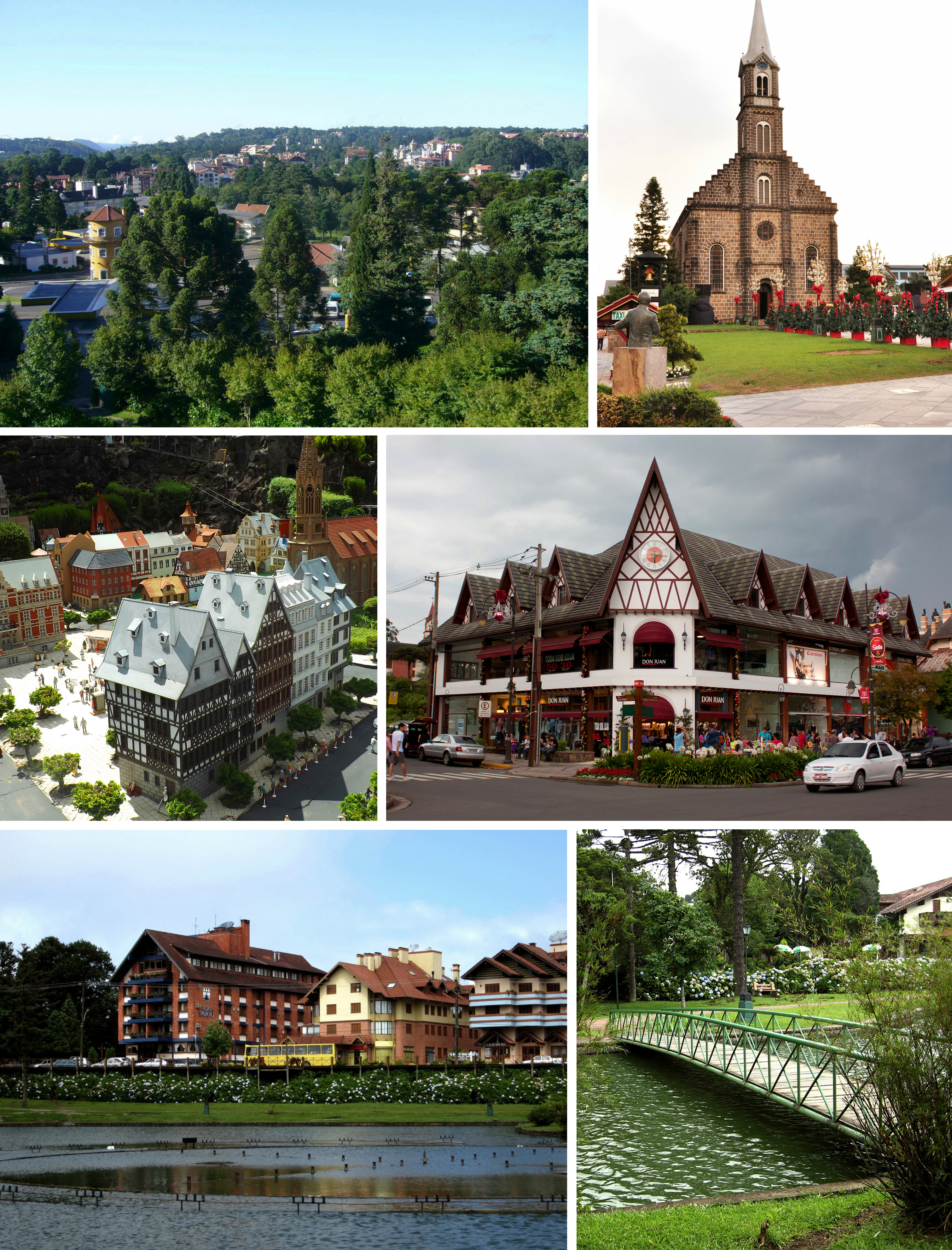
There are places in Brazil that seem to belong to another continent, and Gramado is the most famous of them all. Perched high in the Serra Gaúcha, in the far south of the country, this small town of tree-lined streets, gabled roofs and Alpine-village air surprises anyone who turns up expecting beaches and heat. The climate here is cool, in winter sleet or even snow sometimes falls, and the atmosphere —with its Bavarian- and German-inspired architecture, its chocolate shops and its cafés— feels like a corner of Europe in the middle of southern Brazil.
Gramado is, above all, a town for the senses and for slow enjoyment. It is the smell of artisan chocolate coming out of its dozens of factories, the warmth of a fondue shared on a cold night, the stroll along the Rua Coberta and Avenida Borges de Medeiros between shops and flowers, the reflection of the trees in the Lago Negro and the miniature magic of the Mini Mundo. And above all it is the Natal Luz, Brazil's best-known Christmas show, when the whole town lights up and fills with shows, parades and excitement for weeks on end.
This guide covers the essentials of Gramado with a practical, warm eye: what to see in town and in neighbouring Canela, when to go depending on the cold, the blossom or the Natal Luz, how to get here from Porto Alegre, how to get around, where to eat fondue and chocolate, and how to organise your days so you do not miss anything. Gramado is a destination for slowing down, wrapping up warm and letting yourself be charmed: ideal for couples, families and anyone who wants to discover an unexpected and delicious side of Brazil.
The part of the Serra Gaúcha where Gramado stands today was, until the 19th century, land you passed through: araucaria forest crossed by tropeiros (drovers) taking cattle along the mountain tracks; in fact the name 'Gramado' refers to a grassy field (grama) where those droves rested. The big change came with European immigration: from the mid-19th century, southern Brazil took in waves of German and, later, Italian settlers, who put down roots in these hills and left a decisive mark on the region's architecture, language, food and customs. Gramado grew as a farming colony and, once the railway arrived in the early 20th century, began drawing holidaymakers after its cool, healthy climate. It became a municipality in its own right in 1954. Through the second half of the 20th century the town deliberately bet on tourism and on an identity as a 'European mountain village', pushing its Alpine architecture, its festivals —such as the celebrated Festival de Cinema de Gramado, born in 1973— and, above all, the Natal Luz, created in 1986, which turned it into one of Brazil's major tourist destinations. The full story is on our history page.
Read the full history ↓Brazil's southernmost state: a disputed frontier of the Pampa and of the Guaraní Jesuit missions, cradle of the gaúcho of mate and churrasco. Land of the Farroupilha Revolution and of Garibaldi, of the German and Italian immigration of the Serra Gaúcha, of wine and of the spectacular canyons of Cambará do Sul.
Read the history of Rio Grande do Sul →Some places make no sense on your own; with someone explaining them, they change completely. We look ours up on Civitatis: guided in Spanish and booked online with no fuss. They have 17 activities in Gramado. Three are below so you get the idea: tap any of them and they all open.
If you book from here we earn a commission and you pay no more. Prices and availability come from Civitatis.
No exact prices: a scale from $ (budget) to $$$$$ (luxury), with 2-3 options per category.
Origins, formation and what the sources say.
The name Gramado has a simple origin, closely tied to the history of the roads of southern Brazil. 'Gramado', in Portuguese, refers to ground covered in 'grama', that is, grass or turf. Tradition has it that the place owes its name to a field of good pasture high in the hills where the tropeiros —the drovers who took herds of cattle and mules along the southern roads— would stop so their animals could rest and feed before moving on.
Through the 18th and 19th centuries, these droving roads crossed the Serra Gaúcha, linking the cattle regions of the south with the markets and fairs of inland and southeastern Brazil. The high plateau where Gramado sits today, with its cool climate and its open fields, was a natural staging post on those routes, long before the town existed. The place name was thus tied forever to that stretch of pasture where the droves stopped.
The region, covered in araucaria forest (the Brazilian pine) and highland fields, was part of a relatively sparsely populated territory until, over the course of the 19th century, European immigration began to transform the human landscape of the Serra Gaúcha completely. Out of that meeting between highland geography, the tradition of the droving roads and the arrival of the settlers, the Gramado we know today would eventually be born.
The identity of Gramado and of the whole Serra Gaúcha is, above all, the product of the great European immigration that transformed southern Brazil in the 19th century. From 1824 the Brazilian government began encouraging the arrival of German settlers to populate and develop the southern lands; the first colonies were established around São Leopoldo, in the valley of the Rio dos Sinos, and from there settlement pushed up towards the hills. Decades later, from 1875, large contingents of Italian immigrants arrived and settled above all in the area of Caxias do Sul, Bento Gonçalves and the Vale dos Vinhedos.
These European settlers brought with them their language, their religion, their farming techniques, their food and their way of building. The Gramado area took in mainly families of German origin (and Italian too), who cleared part of the forest, worked the land and put up houses, chapels and villages bearing the stamp of the regions they came from. The cool highland climate, similar to Europe's, favoured crops and customs that are now hallmarks of the place: fruit growing, a taste for cured meats and sweets, the café colonial and, in time, chocolate.
Much of Gramado's soul comes from that settlement: the German-inspired architecture with its half-timbering (enxaimel style), the German and Italian culinary heritage, the European surnames of many families and a care for order, gardens and neatness that would shape the town's character. On that cultural bedrock, in the 20th century, Gramado would build the image of a 'European mountain village' that became its great tourist draw.
In the early 20th century Gramado took a decisive step that would shape its future: the arrival of the railway. In 1921 a branch line opened linking the area to the state rail network, making it easier to move people and goods and bringing the hills closer to the cities. With the train came the first holidaymakers too, drawn by the cool, healthy climate of the plateau, so different from the heat of the rest of Brazil.
At a time when mountain climates were highly prized for their supposed health benefits, Gramado built a reputation as a place of rest and summer retreat, especially for well-off families from Porto Alegre and other cities. Summer houses, hotels and guesthouses began to go up, and the town developed a fledgling tourist vocation on top of its farming and settler base. The clean air, the pine woods, the gardens and the highland calm became its calling card.
For much of its history Gramado was administratively part of neighbouring municipalities (it was tied to Taquara and later to Canela). The town's growth and its rising importance led to its emancipation: on 15 December 1954, Gramado became an independent municipality. From then on the town could set its own course, and that course would point, ever more firmly, towards tourism as the main engine of its economy and its identity.
Through the second half of the 20th century, Gramado made a decision that would define its destiny: to bet deliberately and consciously on a tourist identity as a 'European mountain village'. Drawing on its German and Italian immigrant heritage and its cool climate, the town shaped its urban landscape around an Alpine and Germanic look: architecture with gabled roofs and half-timbering, flowering gardens, hydrangeas, well-kept streets and an atmosphere that evoked central Europe. That image, half genuine inheritance and half tourist construction, became its great brand.
A landmark in that projection was the creation, in 1973, of the Festival de Cinema de Gramado, one of the most important and prestigious film festivals in Brazil and Latin America. Every year it brings together stars, directors and films from Brazilian and Latin American cinema, hands out its awards (the celebrated 'Kikitos') and draws the press and the public from all over the country. The festival put Gramado on Brazil's cultural map and reinforced its image as a sophisticated, tourist-facing town.
Over the years these attractions were joined by a growing supply of hotels, restaurants, chocolate factories, theme parks and year-round events. Gramado established itself as one of the favourite destinations for Brazilian domestic tourism, especially for couples and families after a different climate, well-kept surroundings and food and cultural experiences. The town proved that, with planning and a well-defined identity, a small highland municipality could become a tourist phenomenon on a national scale.
If one event finally sealed Gramado's status as a first-rank tourist destination, it was the creation of the Natal Luz. Launched in 1986, this Christmas event was born out of the idea of lighting up and enlivening the town over the year-end period, making the most of its cool climate and its European look, so well suited to the imagery of a 'storybook Christmas'. In time, the Natal Luz grew into one of the most famous Christmas shows in Brazil and Latin America.
For weeks —usually from late October or November through to January— Gramado is completely transformed: streets, squares, lakes and buildings are covered in millions of lights, illuminated trees and giant decorations, while a calendar packed with parades, choirs and big performances fills every day. Some shows are large-scale productions, with music, dance, acrobatics and effects, which draw crowds and for which it is worth buying tickets well ahead. The Natal Luz turned the Christmas season into the town's busiest tourist period.
Thanks to the Natal Luz and to the sum of its attractions, Gramado established itself as one of Brazil's main tourist 'capitals' and as a byword for Christmas for millions of Brazilians. Today the town combines its European settler heritage, its food (fondue, chocolate, café colonial), its theme parks, its film festival and its Christmas show into a year-round offer, in close partnership with neighbouring Canela. From that field of pasture where the droves stopped to the dazzling 'Christmas town', Gramado came a long way to become one of the best-loved and most visited destinations in the south of the continent.