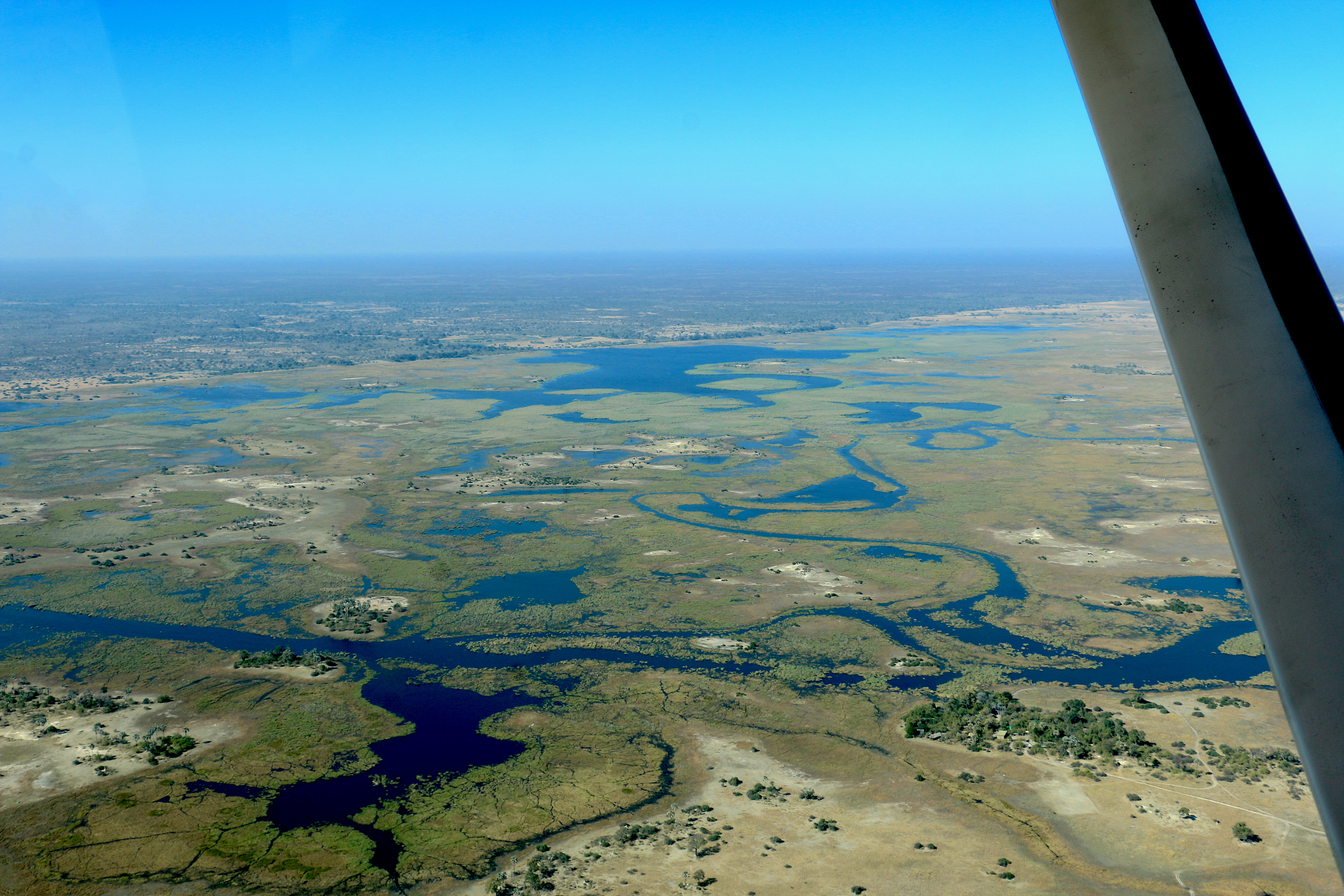
Linyanti is one of the best-kept secrets of safari in Botswana: a region of wetlands, lagoons and woodland in the remote north of the country, on the border with Namibia, where wildlife unfolds with breathtaking intimacy and abundance. Far from the crowds, in exclusive private concessions with very few beds, Linyanti offers top-quality safaris, with expert guides and animal encounters that many consider among the best in Africa.
Its great hallmarks are elephants and wild dogs. In the dry season, when the interior dries out, dense herds of elephants gather along the Linyanti River and its lagoons, a spectacle comparable to the Chobe River but with far fewer people. The region is also one of the best places on the continent to see the endangered African wild dog, as well as lions, leopards and incredibly rich wildlife. Because it's made up of private concessions, things are allowed here that aren't allowed in the national parks: night drives and off-road driving.
This guide covers Linyanti from a practical angle: its wetlands and concessions, its star wildlife, night drives and walking safaris, how to get there (almost always by light aircraft) and how to combine it with the rest of northern Botswana. Exclusive, wild and remote, Linyanti is the destination for anyone looking for the best of the African safari far from mass tourism: few vehicles, first-rate guides and untouched nature on the banks of a border river.
Linyanti owes its name and its life to the Linyanti River, the Botswana stretch of the Kwando (or Cuando) River, which flows down from Angola and forms a wetland system on the border with Namibia. The region was travelled by river peoples and by the great 19th-century explorers (David Livingstone travelled along the Kwando/Linyanti on his journeys), and in the 20th century it was protected partly within Chobe National Park and partly as private conservation concessions, which made it one of the most exclusive safari destinations in Africa. Its full history is told on our history page.
Read the full history ↓The kingdom of the elephants: where four countries meet beside the Chobe River, Botswana's first national park holds the largest concentration of elephants on the planet, just a step away from Victoria Falls.
Read the history of Chobe and the northeast →No exact prices: a scale from $ (budget) to $$$$$ (luxury), with 2-3 options per category.
Origins, formation and what the sources say.
Linyanti's story begins, like so many in this region, with a river. The Linyanti River is really a stretch of the great Kwando (or Cuando) River, which rises in the highlands of Angola, flows south across Namibia's Caprivi Strip and, on reaching the border with Botswana, abruptly changes direction. When it meets a tectonic fault, part of the same fracture system that shaped the Okavango Delta and the Savuti Marsh, the river turns almost at a right angle towards the northeast and takes the name Linyanti. There it forms a system of wetlands, lagoons and channels that marks the boundary between Botswana and Namibia.
Further downstream, the Linyanti becomes the Chobe River before joining the Zambezi near Kasane. Geology governs this whole river system in northern Botswana: tectonic faults divert rivers, create wetlands where water pools, and link or separate basins over time. The Selinda Spillway, a channel that in very wet years can connect the Okavango system with the Linyanti, is a living example of that process.
This border river carries water all year round through land that dries out further inland. That made Linyanti a magnet for wildlife, and for people, since ancient times. Plentiful water, fish and game, together with its position at a natural crossroads of several ecosystems and several peoples, made the region rich and strategic long before modern borders and safaris existed.
For centuries, many peoples of southern Africa lived in and passed through the Linyanti and Kwando region. San (Bushmen) hunter-gatherers, the region's oldest inhabitants, roamed these lands following game and water. Bantu-speaking herders and farmers came later. In the 19th century the area fell within the sphere of powerful African kingdoms, first the Kololo and then the Lozi, who ruled the upper Zambezi and Kwando region.
It was on the Linyanti that African and European history met in a remarkable way. In the mid-19th century, the Scottish missionary and explorer David Livingstone made contact with the Kololo chief Sekeletu in this region. He used the Linyanti area as a base for some of his journeys into the interior of Africa, including the expedition that led him to 'discover' Victoria Falls on the Zambezi for the Western world. That is how the name 'Linyanti' came to appear in the accounts of the continent's great journeys of exploration.
Those contacts opened the period of European penetration and, later, of colonial rule. The region ended up in the complex patchwork of borders that the European powers drew across Africa. On one side of the river was the British Bechuanaland Protectorate (today's Botswana). On the other was the Caprivi Strip, an odd territorial appendage that Germany obtained for its colony of German South West Africa (today's Namibia). Those colonial borders, drawn along the Linyanti River, still separate Botswana from Namibia in this region today.
During the first half of the 20th century, as in so many parts of Africa, the wildlife of the Linyanti region was seen mainly as a hunting resource, and big-game hunters operated in the area. With Botswana's independence in 1966 and the growth of its conservation and tourism policy, the region began to change. Part of the area was protected within Chobe National Park (created in 1967), and another part was organised into wildlife concessions.
After growing wealthy from diamonds, Botswana adopted a 'low volume, high value' tourism model: few beds, high prices and a strong focus on conservation and low impact. Under that model, large private concessions in Linyanti, such as the Linyanti Wildlife Reserve, the Selinda reserve and the Kwando concession, were awarded to tour operators. These operators set up exclusive camps and committed to protecting the wildlife and, in many cases, to benefiting local communities. Hunting gradually gave way to photographic safaris.
This model of private concessions is the key to what makes Linyanti special today. Because these areas are managed exclusively rather than being a national park open to the general public, they allow intimate tourism with very few vehicles. They also allow activities that the parks prohibit, such as night drives and off-road driving. As a result, Linyanti became established as one of Africa's most exclusive and best-preserved safari destinations, and a refuge for endangered species such as the African wild dog.
Conservation in Linyanti has had remarkable results. The region became one of the best places on the continent to see the African wild dog (Lycaon pictus), one of Africa's most endangered predators, with only a few thousand left. Linyanti offers plenty of game, little human presence, expert guides and the freedom to follow animals off-road. These conditions turned its concessions into a sanctuary for the dappled packs, whose coordinated hunts are among the great sights of any safari in the world.
Alongside its wild dogs, Linyanti stands out for its elephants. Botswana is home to Africa's largest elephant population. In the dry season, as the interior dries up, dense herds gather along the Linyanti River and its lagoons, crossing between Botswana and Namibia's Caprivi Strip as they follow the water. Watching these gatherings in the concessions, with very few vehicles around, is one of the region's hallmarks.
Linyanti's wildlife also includes lions, leopards, hyenas, hippos, crocodiles, a wide range of antelope and a rich array of water-linked birds. Wetlands and woodland, water and dry savannah together create a mosaic of habitats that supports exceptional biodiversity. That richness, together with its exclusive camps, made Linyanti a dream destination for the most discerning safari lovers, who look for quality, privacy and encounters with rare species.
Today's Linyanti is one of the most exclusive and highly regarded safari destinations in southern Africa. Its private concessions have some of the best camps on the continent, with a handful of luxury tents facing the river and lagoons, top-class guides and an intimate wildlife experience that many consider unbeatable. It is part of the great protected mosaic of northern Botswana, along with the Okavango Delta, Moremi, Savuti and the rest of Chobe, which is one of the planet's last great refuges for large wildlife.
Classic itineraries combine Linyanti with these other regions, linking camps by light aircraft: the water and mokoro trips of the Delta, the predators of Moremi and Savuti, the elephants of the Chobe River, and Linyanti's exclusivity and wild dogs. This northern circuit is one of the world's great nature journeys, and Linyanti brings its most intimate and wild side.
Like all of northern Botswana, the region faces the challenges of modern conservation. Its rivers rise in Angola, so their changing water levels depend on what happens upstream. There is also the management of the country's huge elephant population, the pressure of tourism, climate change, and the balance between conservation, communities and development. Even so, Linyanti remains above all a remote, exclusive sanctuary on the banks of a border river. Wildlife, and especially the endangered wild dog, finds one of its last great refuges here, and travellers can experience the African safari in its purest, most intimate and most memorable form.