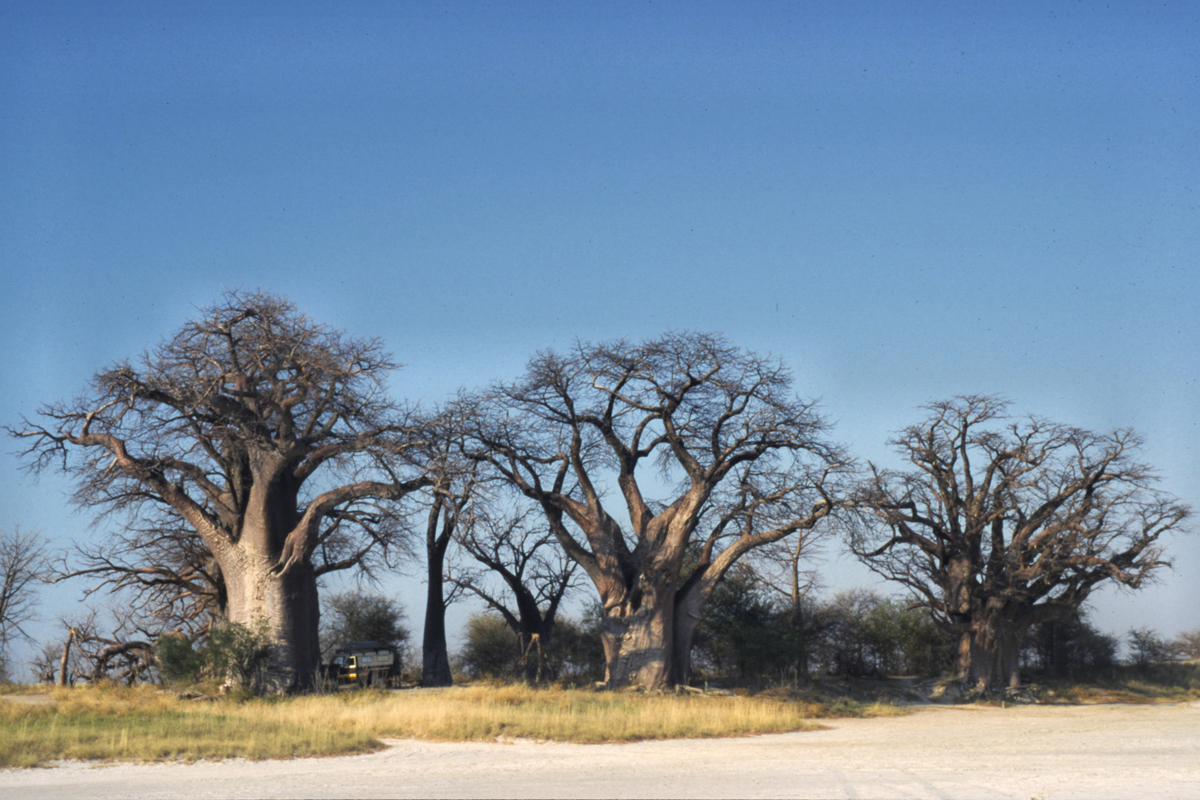
Nxai Pan National Park is one of those corners of Botswana that brings landscape, history and wildlife together on a manageable, accessible scale. Its grass-covered pans, dotted with islands of acacias and palms, turn into green grasslands after the rains and draw thousands of animals. It's home to lions, cheetahs, elephants, giraffes, springbok and impala and, above all, to one of the continent's great zebra migrations.
Its most famous symbol is Baines' Baobabs, a group of seven ancient baobabs also known as the 'Sleeping Sisters'. The explorer and painter Thomas Baines painted them in 1862, and they look almost the same today, as if no time had passed. Seeing them outlined against the sunset sky, next to a pan that fills with water in the rainy season, is one of the country's most iconic sights.
This practical guide covers Nxai Pan in detail: when to go (the rainy season, for the migration and the green landscape), how to get there by 4x4 or light aircraft, what to see (the baobabs, the pans, the wildlife), how much the DWNP entrance fees cost and how to combine the park with Makgadikgadi, Maun and the Delta. It's a perfect destination if you're looking for a safari with soul, history and landscapes that look painted.
Like the rest of the Makgadikgadi region, Nxai Pan is the bed of an ancient prehistoric lake. Its flat pans, now covered in grass, were part of a great inland sea that dried up about 10.000 years ago. Its modern fame began in 1862, when the explorer and artist Thomas Baines was travelling by ox wagon towards Victoria Falls and painted a group of seven baobabs that have carried his name ever since. Declared a park in 1971 and later enlarged, Nxai Pan now protects those ancient trees and one of Africa's largest zebra migrations. You can read about its geological and human history on our history page.
Read the full history ↓The great sea of sand and the remains of a prehistoric lake: ancestral land of the San, endless skies, ancient baobabs and white salt pans that stretch to the horizon.
Read the history of The Kalahari and the salt pans →No exact prices: a scale from $ (budget) to $$$$$ (luxury), with 2-3 options per category.
Origins, formation and what the sources say.
Like the rest of the Makgadikgadi region, Nxai Pan was born on the floor of a vanished sea. Around a million years ago, much of what is now northern Botswana was covered by the vast Lake Makgadikgadi, fed by ancient rivers such as the proto-Zambezi and the Okavango. The salt pans of Nxai Pan, Kgama-Kgama and Kudiakam, which safaris cross today, were then part of the bed of that enormous inland lake.
When tectonic activity in the Great Rift Valley diverted the rivers and the climate grew drier, the lake evaporated in stages until it disappeared around 10,000 years ago, leaving these plains behind. Unlike the bare salt pans of Ntwetwe and Sowa, the Nxai pans were gradually covered by a layer of grass, turning into open grasslands on top of the old lake basin. That explains their distinctive look: grassy plains surrounded by acacia savannah and tree islands.
This geological heritage also explains the park's seasonal rhythm. When the summer rains arrive, water collects again in the old lake floors, such as the Kudiakam Pan next to Baines' Baobabs, and the grass turns green, drawing in the wildlife. It is as if, for a few months each year, the ghost of the ancient lake comes back to life.
The episode that made Nxai Pan famous around the world took place in 1862. That year, the English explorer, naturalist and painter Thomas Baines was travelling with his companion James Chapman on an ox-wagon expedition from the coast of present-day Namibia towards Victoria Falls. It was one of the great exploration journeys of the Victorian era in southern Africa.
Crossing these plains, Baines came across a group of seven huge, ancient baobabs on the edge of a salt pan. He was so struck by them that he captured them in a watercolour. That painting, now famous, showed the trees in precise detail. Baines was a remarkable scientific artist: he painted landscapes, plants, animals and scenes of African life with great accuracy, and his works are historical records of a continent that Europeans were only just beginning to map.
What makes it extraordinary is the comparison with the present. Because baobabs grow extremely slowly and live for thousands of years, the seven trees at Nxai Pan look almost exactly as they did when Baines painted them more than 160 years ago: the same layout, the same silhouettes, even the fallen tree that is still alive. That is why they bear his name, Baines' Baobabs, and why visiting them feels almost like travelling back in time, with the original watercolour as a witness.
For thousands of years, the Nxai Pan region was home to the San (Bushmen), hunter-gatherers of the Kalahari who knew its seasonal waterholes, its grazing and its wildlife routes. The pans and the land around them were part of a vast ecosystem through which both animals and people moved, following the rains.
In 1971, with Botswana already independent (since 1966), the authorities declared Nxai Pan a reserve and later a national park. The aim was to protect its grassy pans, its wildlife and, above all, the historic Baines' Baobabs. Over time, the park was enlarged to take in a bigger stretch of the ecosystem and to link up better with the neighbouring Makgadikgadi Pans National Park, south of the A3 road. Today the two parks are managed jointly as part of the Makgadikgadi complex.
Protecting Nxai Pan proved crucial for preserving one of the region's great wildlife migrations. Later research using animal tracking showed how zebras move between Chobe, the Okavango, Makgadikgadi and Nxai Pan, revealing that this relatively small park is an essential piece of a much larger ecological puzzle. In practice, conserving it meant protecting one link in a migration that covers hundreds of kilometres.
People had long known that zebras moved around the region, but only in recent decades has science documented the true scale of it. Studies using satellite tracking collars showed that around 25,000 zebras, along with wildebeest, make a round trip of more than 500 km every year between the Chobe and Okavango floodplains in the north and the grasslands of Nxai Pan and Makgadikgadi in the south. It is the second-largest zebra migration in southern Africa, after the Serengeti-Masai Mara, and one of the longest on the whole continent.
Water and grass drive the migration. With the summer rains (November to April), the southern pans turn green and offer fresh, mineral-rich grazing, ideal for pregnant females and newborn foals, so the zebras head south towards Nxai Pan. As the dry season sets in, they return north to the permanent rivers. This cycle, guided by instinct and by memory of the landscape, repeats itself generation after generation.
The 'rediscovery' of this migration greatly increased the conservation value of Nxai Pan and of the whole Makgadikgadi ecosystem. It showed that these parks, sometimes seen as secondary next to the Delta or Chobe, are in fact vital to one of Africa's great wildlife movements. It also strengthened the case for keeping the different habitats connected so the zebras can keep making their age-old journey.
Today, Nxai Pan National Park is one of the most complete and accessible destinations in north-eastern Botswana. Managed by the Department of Wildlife and National Parks (DWNP), it brings together three big attractions in a manageable area: the living history of Baines' Baobabs, the plentiful wildlife of its grassy pans and waterholes, and the seasonal spectacle of the zebra migration. And all of it without the crowds of the better-known parks.
Nxai Pan has options for every travel style: the luxury of Nxai Pan Camp, with flights and game drives included; self-sufficient 4x4 camping for the adventurous; and day trips to the baobabs from the A3 road. Its location, between Maun and Victoria Falls and next to Makgadikgadi, makes it a natural stop on many itineraries through the north of the country.
The park sums up Botswana's approach to tourism well: top-quality nature, few visitors and a strong focus on conservation. Protecting Nxai Pan means protecting both a historical treasure, some trees an explorer painted a century and a half ago, and an ecological one, one of Africa's great migrations. Few parks bring natural and human heritage together so clearly, and that is why visitors often remember it as one of the most special places on their trip.