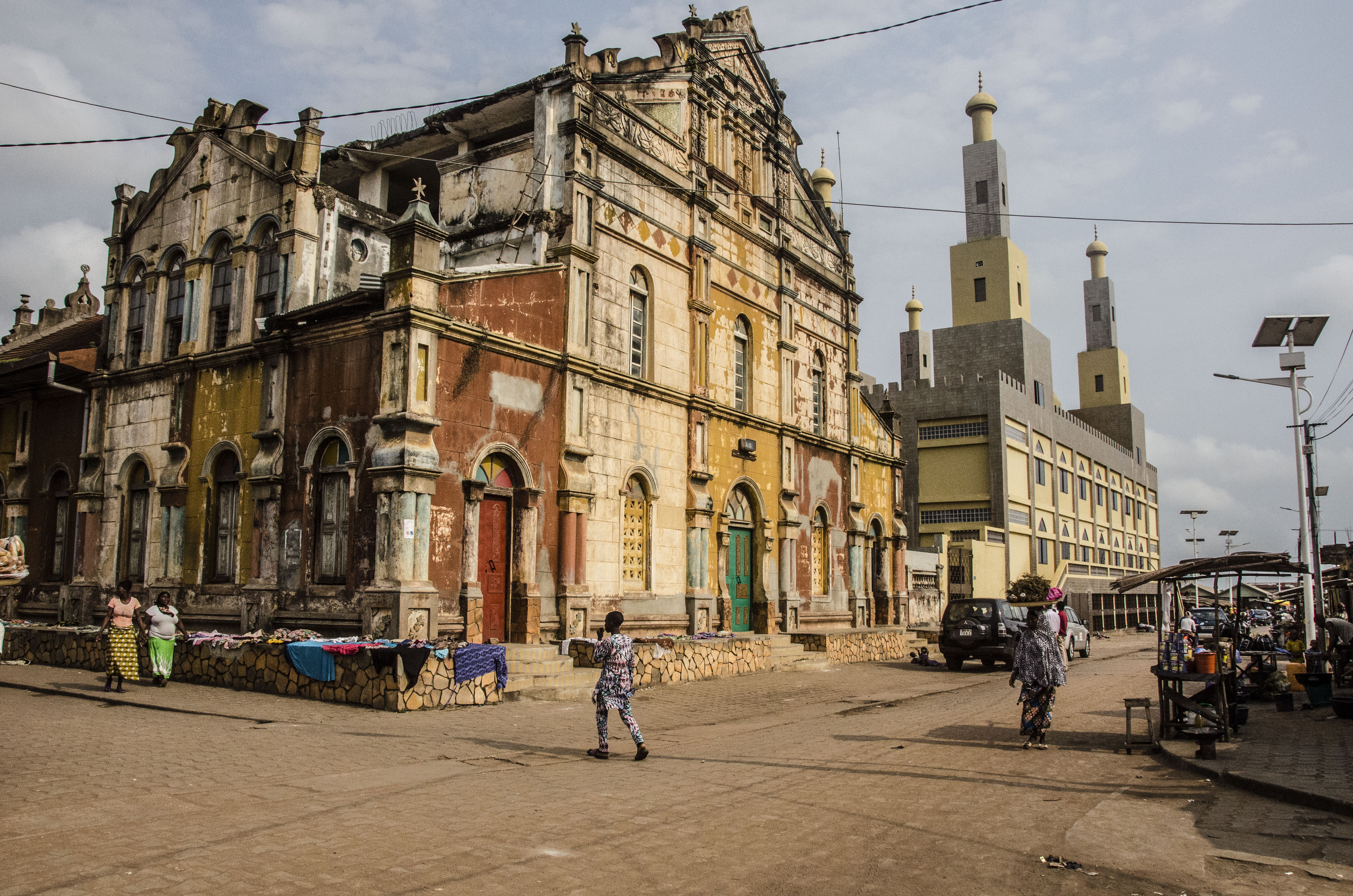
Porto-Novo is the official capital of Benin and yet one of its most low-key and charming cities. While Cotonou takes all the noise, the port and the business, Porto-Novo keeps an unhurried pace, tree-lined streets and a surprising heritage: peeling colonial houses, Afro-Brazilian mansions, museums set in former royal palaces and a fascinating mosque that looks like a Baroque church. It is the ideal city for strolling without hurry and discovering Benin at its most cultured and serene.
Its great distinguishing feature is its mix of cultures. Founded by the Gun people and deeply shaped by Yoruba culture — thanks to its closeness to Nigeria — Porto-Novo also received a strong Afro-Brazilian influence from the 'Agudás', descendants of freed slaves who returned from Brazil bringing with them surnames, trades, cuisine and an unmistakable architectural style. The result is a city of three names (Hogbonou, Adjatchè, Porto-Novo) and many layers, where vodun, Islam, Christianity and Yoruba traditions coexist in plain sight.
This guide takes Porto-Novo at a gentle pace: which museums to visit (the royal Honmé, the ethnographic Adandé, the Afro-Brazilian da Silva), why its Grande Mosquée is unique, how to read its colonial and Agudá architecture, and how to plan a day trip from Cotonou. Porto-Novo doesn't dazzle at first sight, but it rewards the curious traveller with one of the richest and most authentic cultural experiences in all of Benin.
Porto-Novo was founded around the 16th century by the Gun (Goun) people, who called it Hogbonou, and it became the capital of a kingdom that prospered through trade, including the slave trade, thanks to its lagoon and its proximity to the Yoruba and to the coast. The Portuguese named it 'Porto-Novo' and the returning Brazilians (Agudás) gave it its Afro-Brazilian stamp. In 1863 its king requested a French protectorate to defend himself against the Kingdom of Dahomey and the British, and Porto-Novo eventually became the administrative capital of the colony of Dahomey and, after independence, the official capital of Benin. Its story is told on our history page.
Read the full history ↓Benin's official capital and its Yoruba world: the kingdom of Hogbonou, the Afro-Brazilian legacy of the Aguda and ancient city-kingdoms such as Kétou, close to the border with Nigeria.
Read the history of Porto-Novo and the Yoruba south-east →No exact prices: a scale from $ (budget) to $$$$$ (luxury), with 2-3 options per category.
Origins, formation and what the sources say.
Porto-Novo was born with another name: Hogbonou. The city was founded around the 16th century by the Gun (or Goun) people, an Adja-Ewe-speaking group related to the Fon, who settled beside the lagoon that connects with the coastal lagoon system and, through it, with the sea. Tradition links its founding to migrations of people from Allada, one of the historic kingdoms of the south, from which the founders of Dahomey are also said to descend. Hogbonou was organised as an independent kingdom, with its court, its neighbourhoods and its commercial life.
Its position beside the lagoon, a short distance from the ocean and on the cultural frontier with the Yoruba world of neighbouring Nigeria, made Hogbonou an important trading centre. The Yoruba presence left a deep mark on the city: the Yoruba language, its cults, the Egúngún masks —the spirits of the ancestors— and a whole worldview became intertwined with the original Gun culture. That is why the city also has a Yoruba name, Adjatchè, by which its neighbours to the east know it.
Like so many cities on this coast, Hogbonou took part in the Atlantic trade, including the slave trade, which enriched its kingdom between the 17th and 19th centuries. Captives were brought from the interior and channelled towards the ports of embarkation; the kingdom of Hogbonou, with its lagoon and its contacts, was one more link in that brutal economy, which left its mark on the whole region and whose memory and consequences the city still carries.
The city's third name arrived by sea. In the 16th century, Portuguese traders sailing along the coast in search of slaves and goods named Hogbonou 'Porto-Novo', 'New Port', comparing it —according to tradition— to the city of Porto, in Portugal. That Portuguese name, a symbol of the European presence on the coast, would end up prevailing on maps and in the administration, even though the inhabitants kept using Hogbonou and Adjatchè.
The deepest and most visible trace of that Atlantic connection was left by the 'Agudás': descendants of enslaved Africans who, after being freed in Brazil, returned to the coast of Benin throughout the 19th century. They brought with them Portuguese surnames —da Silva, de Souza, Paraiso—, the skills of craftsmen and builders, the Catholic religion, a mixed cuisine and, above all, an architectural style: Brazilian colonial Baroque. Porto-Novo, together with Ouidah, filled up with Brazilian-style houses and buildings put up by these returnees.
From that crossover came the city's most famous architectural marvel: the Grande Mosquée, built between 1912 and 1925 with the shape, towers and colours of a Baroque church from Bahia, but intended for Muslim worship. Porto-Novo's mosque-church sums up, like no other building, the mixed identity of the city, where Gun heritage, Yoruba culture, Portuguese and Brazilian influence, Islam, Christianity and Vodun all meet.
In the 19th century, the kingdom of Porto-Novo found itself caught between greater powers: the expanding kingdom of Dahomey, which threatened to subdue it, and the European powers —French and British— competing for the coast. Seeking protection from Dahomey and from British pressure out of Lagos, the king of Porto-Novo, Sodji, and his successors chose to move closer to France. In 1863 a first French protectorate agreement was signed, and it would be consolidated over the following decades.
That decision proved decisive for the city's fate. When France conquered the kingdom of Dahomey in the 1890s and organised the colony of Dahomey, it chose Porto-Novo as the administrative capital, partly because of its early alliance and its more manageable character compared with proud Abomey. The city filled with colonial buildings, offices, missions and schools, and served as the political centre of the colony throughout the French period.
Even so, economic weight gradually shifted towards Cotonou, with its port and its railway. Porto-Novo kept its status as capital but ceded the dynamism to its neighbour. That duality —Porto-Novo the political capital, Cotonou the economic capital— would continue after independence and lasts to this day, defining the somewhat paradoxical role of a quiet capital in the shadow of the big commercial city.
When Dahomey became independent from France on 1 August 1960, Porto-Novo remained the capital of the new state, and kept that role when the country changed its name to the People's Republic of Benin in 1975 and, later, to the Republic of Benin. Today it is still the official and constitutional capital, seat of the National Assembly, although in practice the Presidency, the ministries and economic life gravitate towards Cotonou.
That rather low-key role has, however, had an advantage: Porto-Novo has largely escaped the chaotic growth and demographic pressure of Cotonou, preserving its heritage and its calm atmosphere. Its museums —the Honmé in the former royal palace, the ethnographic Adandé, the Afro-Brazilian da Silva—, its colonial and Agudá houses, its mosque-church and its strong Yoruba identity make it one of the most interesting cities in the country from a cultural point of view.
In recent years, heritage restoration and cultural initiatives, such as the Centre Ouadada and museum projects, have sought to showcase that richness and turn Porto-Novo into a leading cultural destination. City of three names, crossroads of the Gun, Yoruba and Afro-Brazilian worlds, official capital of a country whose economic heart beats elsewhere, Porto-Novo offers travellers the most reflective and mixed side of Benin: layers of history stacked on top of one another that only reveal themselves to those who wander slowly.