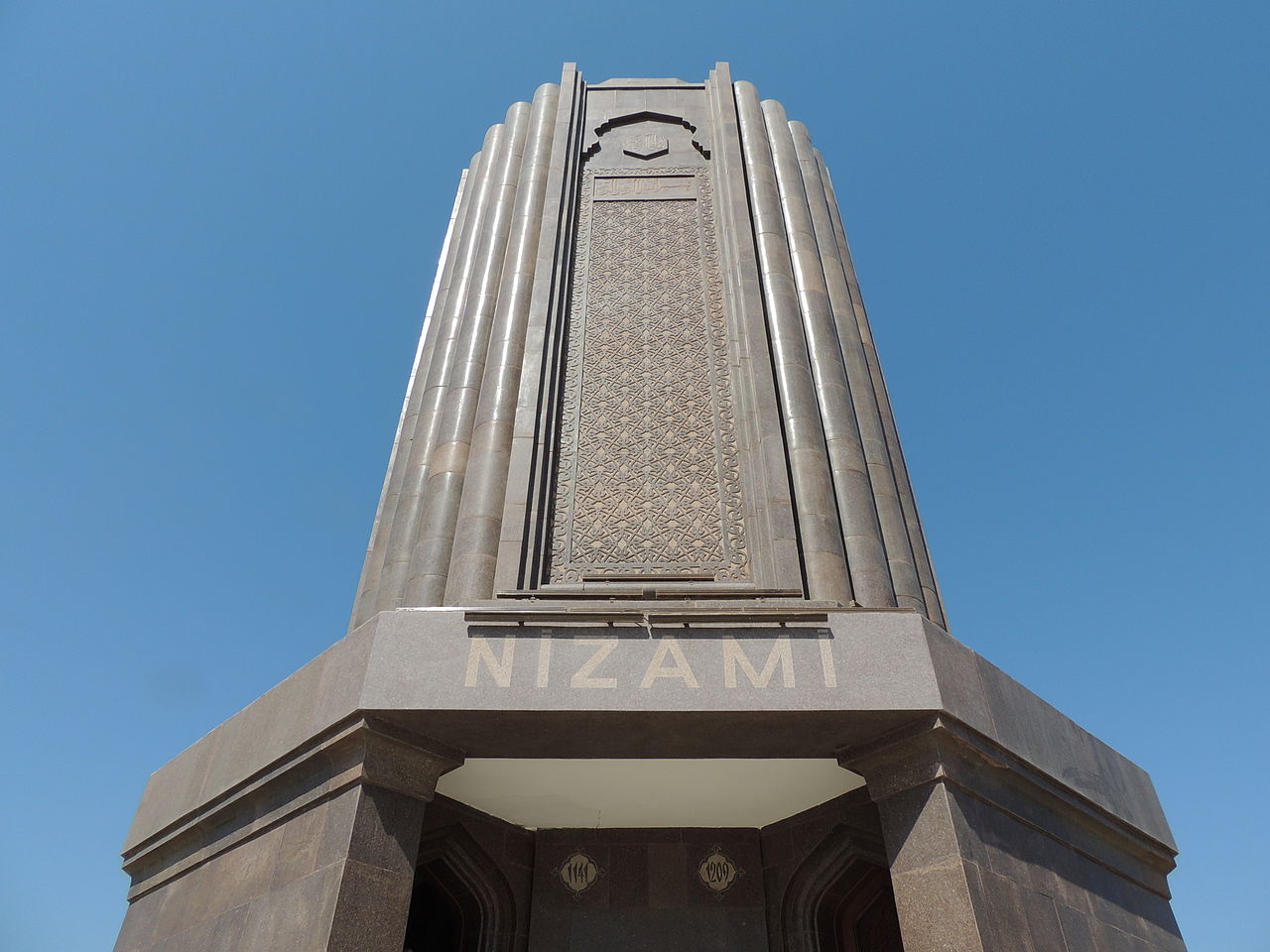
Ganja is Azerbaijan's second city and one of the oldest and best-loved in the country, even though many travellers skip it on their way elsewhere. At the foot of the Lesser Caucasus, leafy and calm, it is the opposite of Baku's oil-fuelled glitter: a city with a provincial feel, wide avenues, parks, red-brick mosques and a history going back more than fifteen hundred years. It was here, in the 12th century, that Nizami Ganjavi was born, one of the greatest poets of the Persian language, whose mausoleum rises on the outskirts as a symbol of the city.
Walking around Ganja means stumbling on layers of history and unexpected curiosities: the Juma Mosque that Shah Abbas had built in 1606, the tiled Imamzadeh complex with its blue domes, an old Silk Road caravanserai, the lively pedestrian Javad Khan Street, and the eccentric Bottle House, a home covered in tens of thousands of glass bottles that a local man built in memory of his brother, who went missing in the war. All with the calm of a city that does not live off tourism.
This guide helps you make the most of Ganja: what to see in the old centre, how to get there from Baku by train, how much things cost, where to eat the food of western Azerbaijan and how to escape to beautiful Lake Goygol in the nearby mountains. It is an authentic, inexpensive stop, ideal for getting to know a deeper, more unhurried Azerbaijan, and a good base for exploring the centre and west of the country.
Ganja is one of Azerbaijan's oldest cities: it was founded around the 5th-6th century and grew as the centre of the Arran region, on the trade route between East and West. It was rich and cultured under various Muslim dynasties, and in the 12th century it gave the world Nizami Ganjavi, the summit of Persian poetry. Destroyed by an earthquake in 1139 and rebuilt, it passed through the hands of the Seljuks, the Mongols, the Safavid Persians (who built the Juma Mosque in 1606) and the Ottomans. In the 18th century it was the capital of the Ganja Khanate, ruled by Javad Khan, who died defending it against the Russians in 1804, when the Russian Empire took the city and renamed it Elizavetpol. In 1918 it was the provisional capital of the short-lived Azerbaijan Democratic Republic, and in Soviet times it was called Kirovabad, until it got its name back. That long history of splendour, poetry and conquest is told on our history page.
Read the full history ↓Azerbaijan's historic heartland: Ganja, city of the poet Nizami; Shamakhi, capital of the old kingdom of Shirvan, with one of the oldest mosques in the Caucasus; and unusual Naftalan, where the signature treatment is a bath in crude oil.
Read the history of The centre: Ganja, Shamakhi and Naftalan →No exact prices: a scale from $ (budget) to $$$$$ (luxury), with 2-3 options per category.
Origins, formation and what the sources say.
Some cities are remembered for their walls or their battles. Ganja is remembered, above all, for a poet. In the 12th century, in this city in western Azerbaijan, lived and died Nizami Ganjavi, one of the greatest poets in all of Persian literature, whose verses are still recited from memory eight centuries later, from the Balkans to India. That a provincial city should be famous for giving the world such a figure says a lot about its history: for a long time, Ganja was a centre of culture, trade and learning.
Azerbaijan's second city, at the foot of the Lesser Caucasus, Ganja is more than fifteen hundred years old. It stood at the crossroads of the routes linking East and West, it was rich and coveted, and like so many cities in the region it was destroyed and rebuilt again and again by earthquakes and conquerors. Persians, Arabs, Seljuks, Mongols, Ottomans and Russians all left their mark on it, and each of them renamed it or reshaped it in their own way.
This is the story of a city that survived everything (earthquakes, invasions, changes of name and of empire) and kept its own identity and a cultural pride you can still feel today in its quiet, tree-lined streets. The history of Ganja is, to a large extent, the history of Azerbaijan.
Ganja was founded around the 5th–6th centuries AD, in the historical region of Arran, the fertile plain between the Kura and Aras rivers. Its location was ideal: on the road linking the Mediterranean and Persian worlds with Central Asia and the Caucasus, right in the middle of the Silk Road network. That helped it grow into a centre of trade and crafts, famous for its silk, its textiles and its metalwork.
Under the Arab caliphates and later under local Muslim dynasties, Ganja enjoyed centuries of prosperity. It became one of the most important cities in the Caucasus, with mosques, madrasas, bazaars and walls. It was in this learned, cosmopolitan setting that Nizami's poetry flourished in the 12th century: his work, written in Persian (the literary language of the time), draws on the richness of that mercantile, scholarly Ganja.
That golden age suffered a brutal blow in 1139, when a violent earthquake destroyed the city and killed tens of thousands of people. The same quake brought down part of a nearby mountain and dammed a river, creating the stunning Lake Goygol, today one of the region's great natural treasures. Ganja rebuilt itself, as it would do so many times, and remained a leading centre under the Seljuks and the dynasties that followed.
Like almost every city in the region, Ganja was caught in the Mongol storm of the 13th century. The hordes of Genghis Khan and his successors swept across the Caucasus, and Ganja, which resisted, was destroyed and plundered. Once again it rose from its ruins. Over the following centuries it was fought over by the great empires that carved up the area: the Turkomans, the Safavid Persians and the Ottomans.
The Safavid period left Ganja one of its best-loved monuments: the Juma Mosque, also known as the Shah Abbas Mosque, commissioned in 1606 by Shah Abbas I the Great. It is an elegant red-brick mosque with two minarets that still presides over the city's central square and is still in use. Caravanserais and baths were built alongside it, a testament to the commercial Ganja of the time.
In the 18th century, as Persian power weakened, semi-independent khanates emerged in the region. Ganja became the capital of the Ganja Khanate, ruled by its own dynasty. It was a period of relative autonomy, in which the city and its surroundings were just one more piece on the board of small states competing over the eastern Caucasus, always in the shadow of the great neighbouring powers.
At the beginning of the 19th century, the Russian Empire set out to conquer the Caucasus, pushing south at the expense of Persia and the local khanates. In 1804, Russian troops under General Tsitsianov laid siege to Ganja. The city was led by Javad Khan, the last khan of Ganja, who refused to surrender and chose to defend it. During the assault, Javad Khan died fighting alongside his sons, and the city fell into Russian hands.
That episode turned Javad Khan into a hero of Azerbaijani memory, a symbol of resistance against conquest. Today, the main pedestrian street in the city centre bears his name. The capture of Ganja was one of the steps in Russia's annexation of present-day Azerbaijan, which was consolidated by the treaties of Gulistan (1813) and Turkmenchay (1828), under which Persia ceded these territories to the Russian Empire.
Under Russian rule, Ganja was renamed Elizavetpol, in honour of Empress Elizabeth, and transformed: wide streets were laid out, European-style buildings went up (many of which can still be seen on Javad Khan Street) and the railway arrived. The city modernised, but it kept its identity and its Azerbaijani population, which kept its language and traditions alive under the new imperial regime.
The collapse of the Russian Empire in 1917 opened a brief window of hope. In 1918 the Azerbaijan Democratic Republic was born, the first parliamentary, secular republic in the Muslim world, which gave women the vote before many European countries did. Baku was under occupation at the time, and Ganja served as the young republic's provisional capital during its first months, a role the city is still proud of.
Independence did not last: in 1920 the Red Army entered Azerbaijan and the country was absorbed into the Soviet Union. That same year, Ganja was the scene of a bloody uprising against Bolshevik rule, which was harshly crushed. Under the Soviet regime the city was renamed once again, this time Kirovabad, after the Bolshevik leader Sergei Kirov, and it was industrialised, with factories, universities and urban growth.
For decades, Ganja was just another Soviet city, with its working life, its institutions and its mix of peoples. The eccentric Bottle House, built in the 1960s by a local resident in memory of his brother, who went missing in the Second World War, is a small monument to the everyday life and the wounds of that era. With perestroika and the national revival of the late 1980s, the city finally got its historical name back: Ganja.
With Azerbaijan's independence in 1991, Ganja regained its name and its place as the country's second city. Far from the oil-fuelled glitter and sheer scale of Baku, Ganja has kept its character as a quiet, leafy, provincial city, with a remarkable historical heritage and its cultural pride intact: the birthplace of Nizami, the city of Javad Khan, the short-lived capital of the first republic.
In recent decades the city has been renewing itself and opening up to tourism, restoring monuments, pedestrianising Javad Khan Street and promoting its attractions, from the Juma Mosque and the tiled Imamzadeh complex to Lake Goygol in the nearby mountains. In 2016 it was European Youth Capital, a sign of that drive to look outward.
Today, Ganja offers travellers a different Azerbaijan from the one in the capital: slower, more authentic, cheaper and deeply hospitable. Strolling its streets at sunset, having tea in a çayxana, gazing at the tower of the Nizami Mausoleum or escaping to the turquoise waters of Lake Goygol is a window onto the long, rich history of a country that here, in its second city, shows its most serene soul. Ganja is, perhaps, Azerbaijan's first city in history and in poetry.