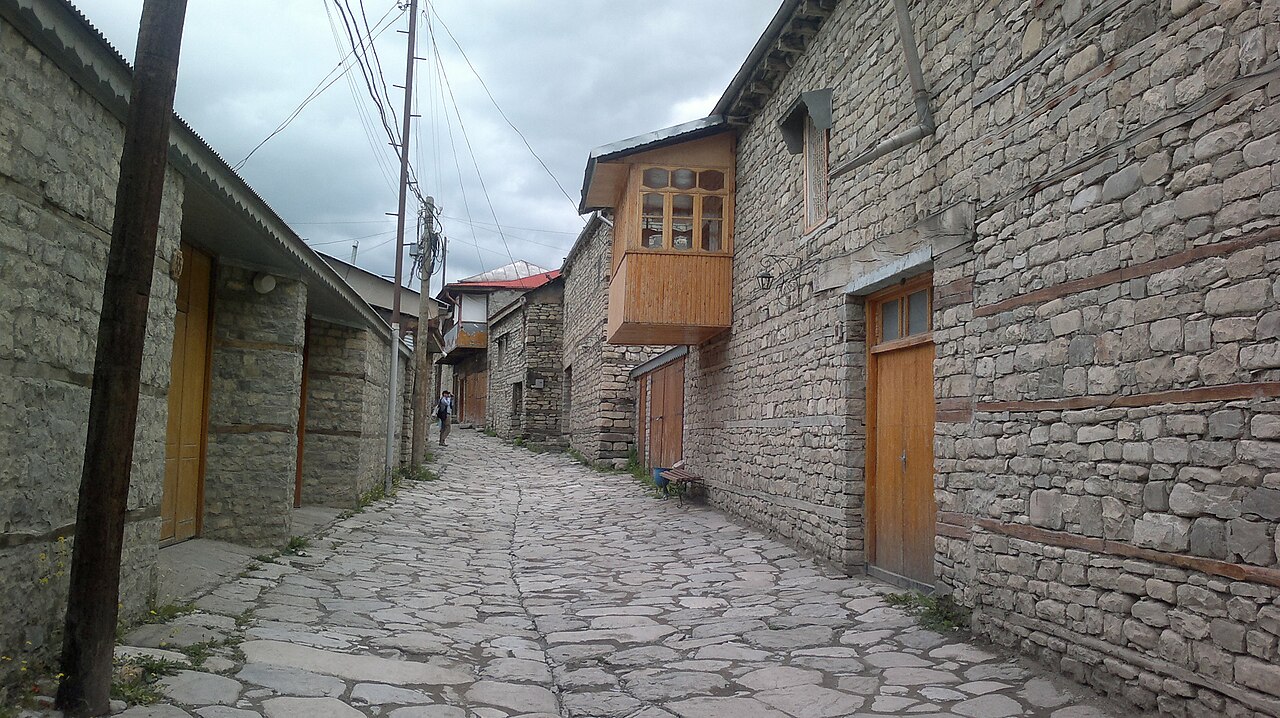
Lahij is one of those places that stay with you: a stone village clinging to the mountains of the Greater Caucasus, with cobbled streets that have echoed for centuries with the tapping of the coppersmiths' hammers. Here, at 1.375 metres up and on the banks of a mountain river, time seems to have stopped at the best of moments: that of craftsmen working copper by hand, in workshops open to the street, just as their grandparents and their grandparents' grandparents did.
Copper is the soul of Lahij. For centuries the village was a major metalworking centre, famous throughout the Caucasus for its weapons, its utensils and its copper objects finely decorated with the chisel. That craft, the craft of the Lahij coppersmiths, is recognised by Unesco as Intangible Cultural Heritage of Humanity, and it's still alive: you can still watch the masters hammering, tinning and engraving their pieces, and buy them straight from the workshop. Alongside the copper, the village amazes with its old medieval water and drainage system, its stone houses and its atmosphere from another time.
This guide helps you plan your visit to Lahij with a practical eye: how to get there (which has its trick, via Ismayilli), when to go, where to watch the coppersmiths at work and buy quality copper, where to sleep to enjoy the village without the crowds, and what to do in the surroundings. It's an escape to the most authentic, craft-rich mountains of Azerbaijan, a village with centuries of history in every stone and every hammer blow.
Lahij is an old mountain village of very ancient origin, whose people keep a language of Iranian roots (Tat or Lahiji), a legacy of Persian settlements from more than a thousand years ago. Isolated in a valley of the Greater Caucasus, from the Middle Ages it specialised in metalworking, above all in copper: its coppersmiths produced weapons, cauldrons, jugs and utensils sold throughout the Caucasus and beyond, and the village developed a highly organised guild system of craftsmen, with quarters devoted to different trades. Lahij also amazes with its engineering: an underground water supply and sewer system centuries old, remarkable for a mountain village. The craft of the Lahij coppersmiths was recognised by Unesco in 2015 as Intangible Cultural Heritage. That history, from Persian origins to the copper guilds, is told on our history page.
Read the full history ↓Azerbaijan's mountainous north-west, among the forests of the Greater Caucasus and old Silk Road stops: Sheki, home to the World Heritage Khan's Palace; Gabala, capital of ancient Albania; and coppersmith villages such as Lahij.
Read the history of The north-west: Sheki and Zaqatala →A local guide tells you in half an hour what no sign at the site will ever explain. We look ours up on Civitatis: guided in Spanish and booked online with no fuss. They have 9 activities in Baku. And there are free tours here: you book without paying and tip the guide whatever you think at the end, so trying one costs you nothing. Have a look below: tap any of them to see them all.
They depart from Baku, 137 km away. If you book from this link we earn a commission and you pay no more.
No exact prices: a scale from $ (budget) to $$$$$ (luxury), with 2-3 options per category.
Origins, formation and what the sources say.
Lahij is a village with a singular identity within Azerbaijan, starting with its people and their language. Many of Lahij's inhabitants speak, as well as Azerbaijani, Tat or Lahiji, a language of Iranian roots (related to Persian), very different from the Turkic Azerbaijani spoken across most of the country. That linguistic detail is the tip of the iceberg of origins that reach deep into the Persian world.
Tradition and several studies link the founding of Lahij to settlements of people of Iranian origin who arrived in these mountains more than a thousand years ago, possibly from regions in the north of present-day Iran. The village's name itself has been linked to Persian place names. These settlers made their home in a remote, well-protected valley of the Greater Caucasus, where over time they built a community with a strong personality, with its own language, traditions and way of life, somewhat isolated from its surroundings.
That relative isolation, in a hard-to-reach valley, was paradoxically one of the keys to Lahij's preservation: far from the major routes and the cities, the village kept its language, its architecture and its crafts for centuries with hardly any mixing, and so it has come down to us today like a time capsule. Knowing that Lahij has Persian roots and an Iranian language helps explain why, as you walk through it, it feels like a different place, with a character all its own within Azerbaijan.
If one thing made Lahij great, it was metalwork, and above all copperwork. From the Middle Ages onwards, the village specialised in making metal objects, and its fame as a centre of coppersmiths and armourers spread across the Caucasus and beyond. Out of Lahij's workshops came weapons (swords, daggers, chain mail, rifle barrels), cauldrons, jugs, plates, samovars and all kinds of copper utensils, finely decorated with chiselled engraved motifs that became a recognisable hallmark.
What stands out is how that production was organised. Lahij ran on a highly developed guild system: the village was divided into quarters (mahalla), and the different trades and specialities were grouped by area, each with its workshops, masters, apprentices and rules. There were coppersmiths, armourers, tanners, shoemakers, potters and other craftsmen, in an urban economy remarkably complex for a mountain village. That level of organisation, together with the quality of the pieces, turned Lahij into a genuine centre of craft industry in its day, whose products were sold at fairs and markets throughout the region.
The craftsmen's prosperity shows in the wealth of the village itself: its stone houses, its neighbourhood mosques, its fountains and its famous water infrastructure are all the fruit of those good times. The trade was handed down from parents to children, generation after generation, and that unbroken transmission is what still makes it possible today to watch Lahij's coppersmiths hammering copper just as they did centuries ago. In 2015, UNESCO recognised Lahij's copper craftsmanship as Intangible Cultural Heritage of Humanity.
Lahij's sophistication wasn't limited to its crafts: the village also developed a remarkable level of engineering and urban planning, surprising for a mountain community. The most often cited example is its water supply and sewage system, an underground network of pipes, channels and drains made of stone and ceramic, which carried drinking water to the village fountains and took wastewater away. This system is thought to be centuries old, dating from a time when many European cities had nothing like it. It was, in essence, an advanced urban sanitation system in the heart of the rural Caucasus.
Another sign of that technical know-how is the village's architecture, designed to withstand the earthquakes that are frequent in this seismic area. Lahij's traditional builders raised stone walls with layers or beams of wood inserted at intervals, a technique that gives the walls flexibility and lets them absorb tremors without collapsing. Thanks to this vernacular earthquake engineering, many houses have survived the quakes that have shaken the region over the centuries, and the village as a whole has been remarkably well preserved.
These works reveal an organised, prosperous community with a great deal of accumulated knowledge, able to solve complex problems of water, sanitation and construction on its own, in its isolation. These are no minor details: they are an essential part of what makes Lahij an exceptional place, a village that was much more than a handful of houses in the mountains. Walking its cobbled streets and seeing its fountains and walls, you are looking at the result of centuries of collective ingenuity.
Like so many mountain villages, Lahij faced the challenges of modernity in the 20th century: industrial production of metal goods made demand for handmade copper drop, emigration to the cities emptied part of the village and traditional life came under threat. During the Soviet era, the craft survived partly as a cultural activity and for the budding tourist market, but the coppersmiths' trade, which had been the village's driving force, went through a difficult phase, kept alive by a handful of families who refused to let it die.
With Azerbaijan's independence and the boom in domestic tourism in recent decades, Lahij has found a new life. The village has become one of the country's best-loved destinations, a place travellers come to precisely to see that living heritage: the coppersmiths at work, the stone streets, the traditional architecture. That interest has given new value to the craft and encouraged new generations to learn the trade, and UNESCO's recognition in 2015 strengthened the prestige and protection of the tradition.
Today Lahij walks the fine line between preserving its authenticity and living off the tourism that this very authenticity attracts. It is still a lived-in village, with its language, its crafts and its way of life, not a museum, and that is its great strength. Walking its streets, hearing the hammering of copper, chatting with a master craftsman and spending a night within its stone walls is a glimpse into a history of more than a thousand years that, against all odds, still beats in the mountains of the Greater Caucasus.