Viajá con Gus
Home › Australia › Kakadu National Park
Kakadu National Park
🇦🇺 Australia · Northern Territory (NT)

Kakadu National Park

🪪 What do I need to enter Australia?Pick your citizenship and we tell you the visa, the days and the paperwork, with the official source.

By leaving your email and citizenship you agree to receive the documents you asked for and weekly travel news. You can unsubscribe whenever you want. How we handle your data.
Jump to what you need
📌State
Northern Territory (NT). Kakadu is Australia's largest land-based national park (about 19,800 km², almost the size of Slovenia or a third of Tasmania), in the Top End region, some 150-250 km east of Darwin. It is a UNESCO World Heritage Site for both its natural and cultural values, one of the few mixed sites in the world, and it is still home to the Bininj/Mungguy peoples, its Traditional Owners.
📌Best time to go
The dry season (May to October) is the best time to visit: roads and trails are open, skies are clear, days are warm (28-34 °C) and nights are cool; it is also peak season for prices and cruises. The wet season (November to April) brings sweltering heat, humidity, spectacular storms and waterfalls in full flow, but many gravel roads and southern attractions (Jim Jim, Twin Falls) close because of flooding. The Bininj recognise six seasons, not two.
📌Suggested days
At least 2 days to see the essentials (Ubirr, Nourlangie and a Yellow Water cruise); ideally 3 to 5 days to add waterfalls, natural swimming holes, the Warradjan cultural centre and trips into Arnhem Land. On a quick 1-day tour from Darwin you see very little. Kakadu is huge and the distances between areas are long.
📌Getting there
By car from Darwin along the Arnhem Highway (sealed): about 2.5-3 h to Jabiru and 3-4 h to Cooinda. There is no regular public transport; most people arrive in a hire car/4WD or on an organised tour (1 to 5 days) from Darwin. There are also charter and scenic flights to the Jabiru airstrip.
📌Getting around
With your own or a hire vehicle; for the southern attractions and the waterfalls you need a high-clearance 4WD. There is no bus or train network inside the park; driving between Ubirr, Jabiru, Nourlangie and Cooinda takes 30 to 90 minutes. Without a car, the only way to explore it is by booking tours from Darwin, Jabiru or Cooinda.
📌Language and currency
English; Australian dollar (AUD, A$). Several Aboriginal languages are also spoken (Kunwinjku, Gundjeihmi, Jawoyn and others). Cards are accepted in Jabiru, Cooinda and at the lodges; it is worth carrying some cash for remote stretches. Mobile signal is limited outside Jabiru/Cooinda.
💱 AUD exchange rate
Loading rate…
🌤️ Weather in Kakadu National Park
Loading weather…

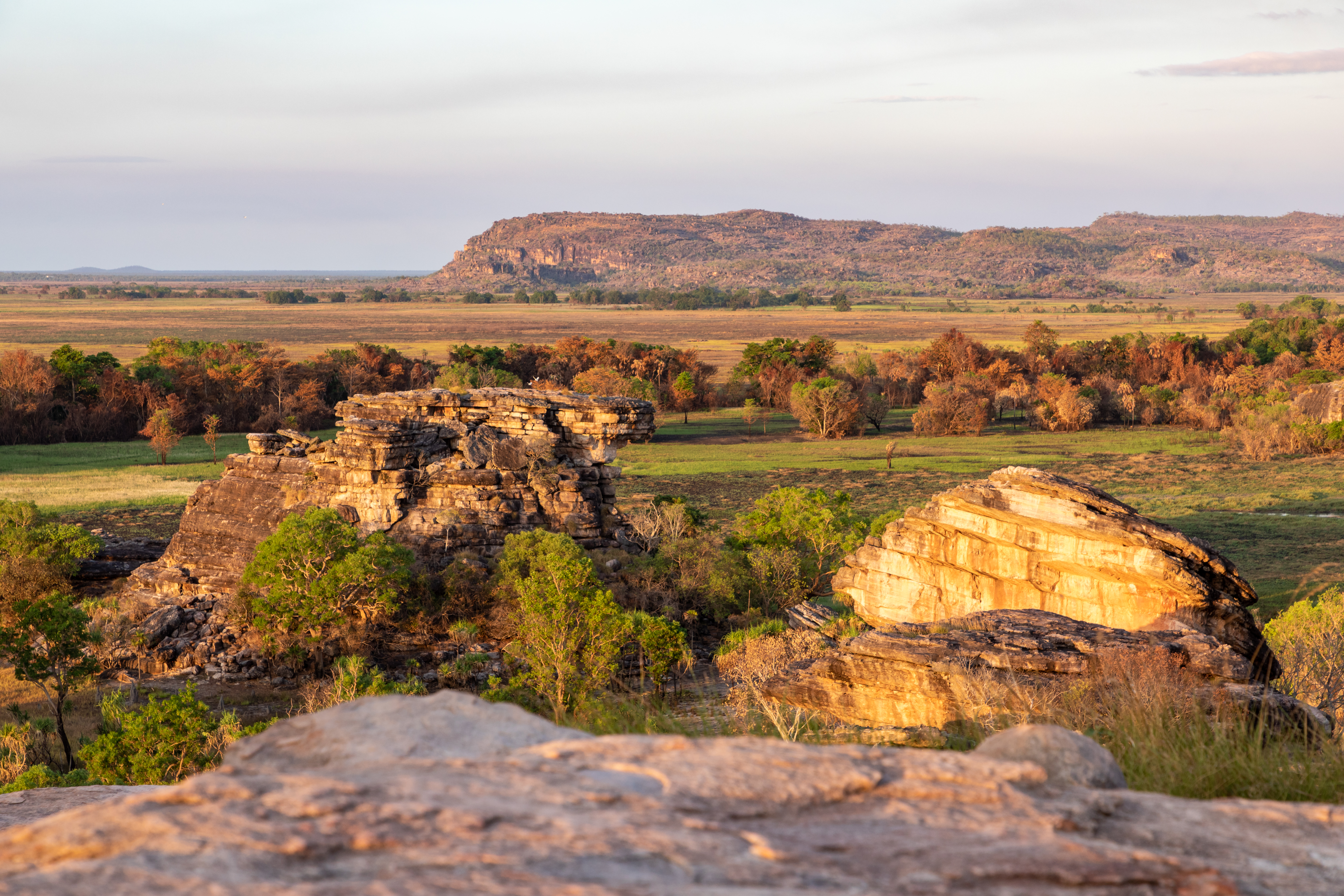
Kakadu National Park is the great natural and cultural treasure of northern Australia: almost 20,000 square kilometres of wetlands teeming with life, golden savannas, sandstone gorges, breathtaking waterfalls and an ancient escarpment that rises like a wall above the plain. But Kakadu is not just scenery: it is a living land, cared for over more than 65,000 years by the Bininj/Mungguy peoples, one of the oldest continuously inhabited places on the planet. That is why UNESCO listed it as a World Heritage Site for both its nature and its culture, a double distinction that very few places in the world hold.

Here you'll find saltwater crocodiles lurking in the billabongs, thousands of birds darkening the sky at dusk, and rock art galleries up to 20,000 years old at Ubirr and Nourlangie, where the paintings tell Dreamtime stories, depict Namarrgon, the Lightning Man, and even record the arrival of the first ships. Exploring Kakadu means stepping into an open-air museum the size of a small country, ideally guided by the people who have lived here since time immemorial.

This guide walks you through the essentials and practicalities of Kakadu: what to see (from the art galleries to the waterfalls and the Yellow Water cruises), how to get around a huge park with no public transport, how much the park pass and tours cost, when to go depending on the dry or wet season, and how to visit respectfully towards the Traditional Owners. Kakadu rewards those who give it time: the slower you explore it, the more it gives back.

📖 History of Kakadu National Park

Kakadu is the ancestral home of the Bininj (in the north) and Mungguy (in the south) peoples, who have lived on and cared for this land for more than 65,000 years; the Madjedbebe site, near the park, is the oldest known site of human occupation in Australia. Its thousands of rock art sites make up one of the longest continuous historical records of humankind. The name 'Kakadu' comes from 'Gaagudju', one of the region's languages. European arrival was followed by buffalo hunters, missionaries and, in the 1970s, the discovery of large uranium deposits, which sparked decades of conflict with the Traditional Owners over the Ranger and Jabiluka mines. The park was created in stages between 1979 and 1991, was declared a World Heritage Site in 1981 and today is jointly managed by the Bininj/Mungguy and Parks Australia. In 2024, after a historic fight led by the Mirarr people, Jabiluka was permanently incorporated into the park so that it will never be mined. The full story is on our history page.

Read the full history ↓

🏛️ Kakadu National Park is in Northern Territory

The red, tropical heart of Australia: the territory with the highest proportion of Aboriginal people in the country, home to the rock art of Kakadu and to the sacred monolith of Uluru, handed back to its Anangu owners in 1985. From Darwin, bombed in 1942, to the Red Centre of Alice Springs.

Read the history of Northern Territory →

🗺️ What to see

1
Ubirr and its rock art
One of the most famous rock art galleries in the world, with an unforgettable sunset lookout over the floodplains.
Leer más ↓
Ubirr is Kakadu's great cultural icon and a must-see. At the foot of the Arnhem Land escarpment, in the northern part of the park, an easy one-kilometre loop walk passes several rock art galleries painted and repainted over thousands of years by the Bininj. Highlights include animals painted in 'X-ray' style (showing bones and internal organs), such as the barramundi, the wallaby and the long-necked turtle, and spiritual figures such as the Rainbow Serpent. Some paintings even record the arrival of boats and non-Aboriginal people, a unique record of contact. The finishing touch is the final 250-metre climb to the Ubirr lookout, one of the most celebrated sunsets in Australia: from the rock a 360° view opens over the Nadab floodplains, which turn gold and violet as the birds return to the billabongs. It was a filming location for 'Crocodile Dundee'. Getting there: about 40 km north of Jabiru, on a sealed road, near Cahills Crossing. Best time: dry season (opening depends on water levels); arrive in the early afternoon for the sunset. Tips: bring water, insect repellent and a torch for the walk down; Bininj rangers often give free talks next to the art.
ℹ️ Distance: About 40 km north of Jabiru, sealed road · Best time to go: Dry season; afternoon to sunset. Opening depends on water levels · Admission: Included in the Kakadu park pass; ranger talks are free (verified July 2026) · Duration: 1.5 to 2 hours including sunset
2
Nourlangie / Burrungkuy and the Lightning Man
Rock shelters with paintings of Namarrgon, the Lightning Man, and lookouts over the Arnhem Land escarpment.
Leer más ↓
Nourlangie, whose correct name in the local language is Burrungkuy, is Kakadu's other great rock art gallery, in the central part of the park. A loop of about 1.5 km leads through rock shelters that served as refuge and canvas for millennia. The star painting is at the Anbangbang Gallery: ancestral Dreamtime figures repainted in 1964, among them Namarrgon, the Lightning Man, a being with stone axes on his joints who creates the violent monsoon storms, one of the most reproduced images in Australian Aboriginal art. From the Gunwarddehwardde lookout you can take in the imposing wall of the Arnhem Land escarpment, and nearby Anbangbang Billabong and Nawurlandja rock round off the visit with more scenery and birdlife. It is a deeply sacred site and, at the same time, very accessible. Getting there: about 30 km south of Jabiru on a sealed road. Best time: dry season; first thing in the morning or late afternoon because of the heat. Tips: easy to combine with Nawurlandja and Anbangbang Billabong; respect the sacred site signs and do not touch the paintings.
ℹ️ Distance: About 30 km south of Jabiru, sealed road · Best time to go: Dry season; early morning or at sunset · Admission: Included in the Kakadu park pass (verified July 2026) · Duration: 1.5 to 2 hours
3
Yellow Water Cruise (Ngurrungurrudjba)
Kakadu's most famous boat trip, among crocodiles, water lilies and thousands of birds on a dreamlike billabong.
Leer más ↓
The Yellow Water Billabong (Ngurrungurrudjba) cruise, at Cooinda, is Kakadu's most popular wildlife experience and one of the best in Australia for spotting birds and crocodiles. In an open boat, a guide takes you through a maze of still waters covered in water lilies, pandanus and paperbarks, where saltwater crocodiles lurk and hundreds of bird species gather: jabirus, whistling ducks, sea eagles, kingfishers and magpie geese in huge flocks. It is a wetland system of global importance, part of why Kakadu is a World Heritage Site. There are 1.5 h and 2 h departures; the sunrise and sunset ones are the most spectacular for the light and animal activity, and they sell out fast. Cruises leave from the Cooinda jetty, next to the lodge and the Warradjan cultural centre. Getting there: at Cooinda, in the south of the park, about 50 km southwest of Jabiru. Best time: year-round; sunrise for the most wildlife. Tips: book ahead, especially the sunrise cruise; bring binoculars, a hat and insect repellent.
ℹ️ Distance: Cooinda, southern area; about 50 km southwest of Jabiru · Best time to go: Year-round; sunrise or sunset for more wildlife · Admission: 1.5 h cruise A$ 105 adult / A$ 75 child; 2 h A$ 130 adult / A$ 90 child (source: kakadu.gov.au / Kakadu Tourism, verified July 2026) · Duration: 1.5 to 2 hours
4
Guluyambi Cultural Cruise (East Alligator River)
A boat trip on the East Alligator River guided by a Bininj local, with living culture and a landing in Arnhem Land.
Leer más ↓
The Guluyambi cultural cruise travels along the East Alligator River, the natural border between Kakadu and Arnhem Land, guided by a local Bininj. Unlike the Yellow Water wildlife cruise, the focus here is living culture: the guide explains local mythology, traditional uses of plants and animals, the river's food chain and bush survival techniques. Passengers also step ashore briefly on the Arnhem Land bank (usually restricted-access land) for a demonstration of traditional hunting and gathering weapons and tools. It is one of the most authentic cultural experiences in the park, in small groups, and a direct way to hear Kakadu's story from its Traditional Owners. Getting there: departs from the Cahills Crossing / Upstream boat ramp area, near Ubirr, in the north of the park. Best time: dry season (May to October). Tips: book ahead (groups limited to 25 people); combine it with a visit to Ubirr on the same day.
ℹ️ Distance: East Alligator River, near Ubirr, north of the park · Best time to go: Dry season (May to October) · Admission: A$ 92 adult / A$ 58 child (4-14 years); infants free (source: Kakadu Cultural Tours, current 2026 rates, verified July 2026) · Duration: About 1.75 hours
5
Southern waterfalls and swimming holes (Gunlom, Maguk)
Waterfalls and swimming holes in the southern part of the park, including Gunlom's iconic infinity pool.
Leer más ↓
The southern part of Kakadu holds the park's most famous waterfalls and natural swimming holes. Gunlom is the best known: a waterfall with a natural pool at the top of the escarpment that forms a kind of 'infinity pool' with panoramic views over the park (the one from the 'Crocodile Dundee' scene). It reopened after years of closure due to works and cultural disputes, opening to the public again around Territory Day (1 July) 2026. Maguk (Barramundi Gorge) is another gem: a trail through monsoon forest leads to a deep, crystal-clear pool at the foot of a waterfall, ideal for swimming in safe waters. These attractions are on gravel roads that usually require a 4WD and only open in the dry season, once the waters drop and it is confirmed there are no saltwater crocodiles. Always respect the signs: not every swimming hole is safe to swim in. Getting there: south of the park, via the Kakadu Highway and gravel turn-offs (Gunlom is ~37 km of gravel; Maguk from Cooinda). Best time: dry season only. Tips: check the official 'Kakadu Access Report' before you go; take a 4WD, water and plenty of fuel.
ℹ️ Distance: South of the park; gravel turn-offs from the Kakadu Highway (4WD) · Best time to go: Dry season only; check openings · Admission: Included in the Kakadu park pass; check closures in the official Access Report (verified July 2026) · Duration: Half a day to a full day each
6
Warradjan Cultural Centre and Bowali
Two centres that explain Bininj/Mungguy culture and the park's nature, ideal for starting your visit.
Leer más ↓
To understand what you see in Kakadu, it pays to start at its interpretive centres. The Warradjan Aboriginal Cultural Centre, next to Cooinda (a few minutes from the Yellow Water jetty), is shaped like a warradjan (pig-nosed turtle) and tells, first-hand and in the voice of the Bininj, about their culture, their six seasons, their law and their connection to Country; there are exhibits, stories, crafts and an ethically certified Aboriginal art shop. The Bowali Visitor Centre, near Jabiru, works as the park's modern gateway: maps, exhibits on nature and geology, up-to-date information on access and closures, a café and a bookshop. It is the best place to plan your route according to road conditions. Getting there: Warradjan at Cooinda (south); Bowali near Jabiru (centre). Best time: year-round, ideally at the start of your visit. Tips: check road conditions at Bowali before heading south; only buy art from centres with ethical provenance.
ℹ️ Distance: Warradjan at Cooinda; Bowali near Jabiru · Best time to go: Year-round; at the start of your visit · Admission: Free entry to both centres (verified July 2026) · Duration: 45 min to 1.5 hours each
7
Cahills Crossing and the crocodile crossing
A river crossing famous for its concentration of saltwater crocodiles, with a viewing platform.
Leer más ↓
Cahills Crossing, on the East Alligator River, is a ford linking Kakadu with Arnhem Land and, above all, one of the best places in the world to see saltwater crocodiles ('salties') in the wild. When the tide rises, fish (mainly barramundi) push up over the crossing and the crocodiles gather to hunt, an impressive natural spectacle watched from a raised, safe platform built for the purpose. It is a dangerous place: every year there are incidents with vehicles and people who underestimate the current and the crocodiles, so it should only be crossed in a 4WD, at low tide and with a permit to enter Arnhem Land. For the average visitor, the best option is simply to watch from the platform. Getting there: next to Ubirr, north of the park, near the Border Store. Best time: dry season; check the tide table to see the most activity. Tips: do not approach the water or try to cross on foot; keep your distance from the bank at all times.
ℹ️ Distance: Next to Ubirr, north of the park · Best time to go: Dry season; check the tide table to see crocodiles · Admission: Free (viewing from the platform); included in the park pass (verified July 2026) · Duration: 30 to 60 minutes
📶I have never landed without internet. I arrive and my phone connects to the strongest network in the country I am visiting: I can say I landed, sort out transport, book tours and keep posting, at a seriously good price. I always use the Maya eSIM — check their plans by clicking the banner.See plans →Maya Mobile eSIM — download, install, go
What nobody tells you

💵 Prices

Tickets

TypePrice
Pase de Kakadu — temporada alta / seca (15 may – 31 oct), adulto 16+⚠️ Not charged in 2026: Parks Australia advises that passes bought to visit the park between 1/7 and 31/10/2026 are charged at the wet season rate, i.e. A$ 25 per adult instead of A$ 40. The dry season list price is A$ 40. Northern Territory residents do not pay for a pass (kakadu.gov.au/plan/passes/, Parks Australia, checked 08/08/2026)
Pase de Kakadu — temporada alta / seca, niño 5-15⚠️ In 2026 the wet season rate applies from 1/7 to 31/10: A$ 12.50 per child, A$ 65 per family (2 adults and 2 or more children) and A$ 19 concession, instead of the list prices of A$ 20 / A$ 100 / A$ 30. Concession applies to people receiving an Australian age or disability pension, their carer, Australian Seniors Card holders and veterans. NT residents do not pay for a pass (kakadu.gov.au/plan/passes/, Parks Australia, checked 08/08/2026)
Pase de Kakadu — temporada baja / húmeda (1 nov – 14 may), adulto 16+A$ 25 per adult, A$ 12.50 per child aged 5 to 15, A$ 65 per family and A$ 19 concession. These are also the amounts Parks Australia is charging between 1/7 and 31/10/2026, even though it is the dry season. NT residents do not pay for a pass, and the Kakadu pass is not valid for Uluṟu-Kata Tjuṯa or for NT Government parks (kakadu.gov.au/plan/passes/, Parks Australia, checked 08/08/2026)
Menores de 5 años y residentes del NTFree (source: kakadu.gov.au, verified July 2026)
Validez del paseValid for 7 days from the first day of use (source: kakadu.gov.au, verified July 2026)
🔄 updated monthlyOfficial / reference values · double-check when buying

Activities and tours

Yellow Water Cruise (1.5 h)
Duration1.5 hours
OperatorKakadu Tourism / Cooinda
Price
A$ 105 adult for the 1.5 h cruise and A$ 130 for the 2 h one; child rate on request when booking (source: Kakadu Tourism, official booking engine —the park does not sell the cruises—, verified August 2026)
Yellow Water sunrise or sunset cruise (2 h)
Duration2 hours
OperatorKakadu Tourism / Cooinda
Price
A$ 130 adult / A$ 90 child (source: kakadu.gov.au, verified July 2026)
Guluyambi Cultural Cruise (East Alligator)
Duration1.75 hours
OperatorKakadu Cultural Tours (Bininj)
Price
A$ 92 adult / A$ 58 child (source: Kakadu Cultural Tours, verified July 2026)
1-day Kakadu tour from Darwin
DurationFull day
OperatorDarwin operators
Price
About A$ 250-320 per person depending on the operator (range from Viator/GetYourGuide, verified July 2026)
2-3 day Kakadu tour from Darwin
Duration2 to 3 days
OperatorAAT Kings, Kakadu Tours & Travel and others
Price
A$ 600-1,100 per person depending on level and nights (range from operators, verified July 2026)
Scenic flight over Kakadu (helicopter/light aircraft)
Duration20 min to 1 h
OperatorKakadu Air / local operators
Price
A$ 150-450 per person depending on duration (range based on Jabiru/Cooinda operators, verified July 2026)
🔄 updated monthlyOfficial / reference values · double-check when buying

🚌 How to get there and distances

Getting around

Hire car / 4x4
DurationVariable
Price
4x4 hire from A$ 90-180/day in Darwin (range based on agencies, verified July 2026)
Notes
The only practical way to explore Kakadu on your own. There are no buses or trains inside the park. For the waterfalls and plunge pools in the south (Gunlom, Maguk, Twin) you need a high-clearance 4x4, and only in the dry season. Fill up with fuel in Jabiru/Cooinda.
Apps and navigation
Free
DurationVariable
Notes
The NT has no state public transport app for Kakadu (unlike Opal in NSW or myki in Melbourne). Use Google Maps and, above all, the official 'Kakadu Access Report' from Parks Australia (kakadu.gov.au) to see which roads are open or closed in real time. Mobile signal is limited outside Jabiru/Cooinda, so download offline maps.
Tours from Darwin, Jabiru or Cooinda
PriceFrom A$ 250 for a full day (verified July 2026)
Duration1 to 5 days
Notes
Without a car, the way to get around is by booking tours: from 1-day express trips to 5-day tours from Darwin, or one-off excursions (cruises, rock art) from the lodges in Jabiru and Cooinda. Ideal if you don't want to drive on gravel roads.
Flights and transfers to Jabiru
Depends on operator
DurationVariable
Notes
There are charter and scenic flights to the Jabiru airstrip, and some lodges offer transfers. There is no regular public ground transport between Darwin and the park.
🔄 updated monthlyOfficial / reference values · double-check when buying

How to get there

RouteAirlines / operatorsAvg. priceDuration
Darwin → Jabiru (Kakadu) via the Arnhem HighwayOwn or hire car/4x4; toursFuel; hire from A$ 90/day (verified July 2026)2,5 to 3 hours (about 250 km)
Darwin → Cooinda (southern Kakadu)Car/4x4; toursFuel; depends on tour3 to 4 hours
Organised tour from DarwinAAT Kings, Kakadu Tours & Travel, Ethical Adventures and othersA$ 250-320 (1 day); A$ 600-1.100 (2-3 days) (verified July 2026)1 to 5 days
Charter/scenic flight Darwin → JabiruKakadu Air and local operatorsDepends on operator and routeApprox. 30-40 min flight
🔄 updated monthlyOfficial / reference values · double-check when buying

🏨 Where to stay

No exact prices: a scale from $ (budget) to $$$$$ (luxury), with 2-3 options per category.

Luxury / boutique
Price$$$$$
Recommended options
A$ 300-550 per night (range based on Booking.com, verified July 2026). The iconic Mercure Kakadu Crocodile Hotel in Jabiru (shaped like a crocodile when seen from the air) and the Yellow Water Villas glamping in Cooinda are the most upmarket options in the park
Mid-range
Price$$$$$
Recommended options
A$ 169-300 per night in season (range based on Booking.com, verified July 2026). Cooinda Lodge (hotel-style rooms, run by Accor) and Aurora Kakadu Lodge in Jabiru, both well placed for cruises and rock art
Budget / camping
Price$$$$$
Recommended options
A$ 15-45 per campsite; cabins and canvas 'Outback Retreats' from A$ 90-160 (range based on kakadu.gov.au and the lodges, verified July 2026). Parks Australia campgrounds (some free, some paid) and sites in Cooinda and Jabiru

🍴 Where to eat

Restaurantes de lodge
Price$$$$$
Options / signature dish
A$ 25-45 per dish (range based on lodge menus, verified July 2026). Meals at Cooinda Lodge (with touches of bush food and local barramundi), at the Crocodile Hotel in Jabiru and at Aurora Kakadu; the best option for dinner inside the park
Bistró / bar de Cooinda (Barra Bar & Bistro)
Price$$$$$
Options / signature dish
A$ 20-35 per dish (verified July 2026). Burgers, barramundi and chips, pizzas and beer by the Cooinda pool, a relaxed atmosphere after the cruise
Café / take-away
Price$$$$$
Options / signature dish
A$ 8-20 (verified July 2026). Cafés at the Bowali Visitor Centre, the Border Store (near Ubirr) and Jabiru service stations for breakfast, coffee and snacks on the road

📖 History of Kakadu National Park

Origins, formation and what the sources say.

Bininj and Mungguy: 65,000 years caring for Country

Some places are measured in centuries, and some are measured in the geological eras of human memory. Kakadu belongs to the second kind. When visitors stand before the paintings at Ubirr or Burrungkuy and feel the dizziness of facing something ancient, they are still underestimating it: the peoples who live on this land have been here for more than 65,000 years, a cultural continuity so long it defies the imagination. There are not many places on the planet where you can say, with evidence in hand, that the same families have walked the same ground since before Homo sapiens reached Europe.

Kakadu's Traditional Owners broadly identify as Bininj in the north of the park and Mungguy in the south, terms that in their languages simply mean 'person' or 'people'. Under these names live several language groups and clans (Kunwinjku, Gundjeihmi, Jawoyn, Mirarr, Gaagudju and others), each with its own territory (its Country), its own law and its own responsibilities. For them, the land is neither a backdrop nor a piece of property: it is a living relative, a web of sacred sites, stories and obligations inherited from the Creation Time.

In that primordial time, the Bininj say, ancestral beings travelled across a formless world and shaped it. Warramurrungundji, the Earth Mother, emerged from the sea and created people, languages and laws. Ginga, the giant crocodile, shaped the rocky gorges. And Namarrgon, the Lightning Man, with stone axes on his knees and elbows, still rules the violent storms of the monsoon: every wet season, when the sky splits with lightning over the escarpment, it is Namarrgon striking the clouds. These are not 'legends' from a dead past but a living system of knowledge that organises the calendar, hunting, fire and social life. The Bininj recognise six seasons, not two, read in the flowering of plants, the wind and the behaviour of animals.

The physical evidence of this antiquity lies in the ground. At Madjedbebe (formerly called Malakunanja II), a sandstone rock shelter on the edge of Kakadu, excavations carried out together with the Mirarr Traditional Owners revealed human occupation going back at least 65,000 years, along with the world's oldest ground-edge axes and some of the earliest seed-grinding tools. It is, to this day, the oldest known human home in Australia. Kakadu is not a park with Aboriginal history: it is a civilisation that is still standing.

Rock art: a gallery of humanity

If the land keeps memory beneath the ground, Kakadu's rocks put it on display. Along the Arnhem Land escarpment and in thousands of rock shelters lies one of the most important and oldest concentrations of rock art in the world: some 5,000 sites have been recorded, and another 10,000 are thought to exist that have not yet been catalogued. Together they form one of the longest continuous historical records of any people on the planet, a painted archive spanning tens of thousands of years of the relationship between humans and their environment.

The paintings are not a single style or a single period: they are layers upon layers. The oldest include dynamic figures of hunters in motion and depictions of animals now extinct or gone from the region, such as the Tasmanian tiger (thylacine), which vanished from the mainland thousands of years ago yet appears painted on the rock, proof that the artist saw it with their own eyes. Then came the 'X-ray' style, Kakadu's most famous, which shows the bones, spine, heart and internal organs of barramundi, wallabies, turtles and fish, an astonishing anatomical knowledge of the animals that sustained the community.

At Burrungkuy (Nourlangie), the Anbangbang gallery shows Namarrgon the Lightning Man and ancestral figures last repainted in 1964 by the artist Nayombolmi (also known as Barramundi Charlie), one of the great masters of Kakadu art. At Ubirr, alongside the X-ray animals, are the so-called 'contact' figures: European ships, people smoking pipes and with their hands in their pockets, rifles. They are the record, through Aboriginal eyes, of the arrival of outsiders: first Macassan fishermen from present-day Indonesia, who had been trading trepang (sea cucumber) for centuries, and then the Europeans. Rarely in the history of art can you read the exact moment two worlds collided, told by those who lived it. For the Bininj, many of these paintings remain active and sacred, and caring for them is a ceremonial responsibility, not a museum conservation job.

Buffalo, missionaries and the arrival of the balanda

The permanent arrival of Europeans (the balanda, a word the Bininj took from the Macassan term for 'Dutch') transformed the Top End within a few generations. Before the British, there had already been long-standing and largely peaceful contact with Macassan fishermen from the Indonesian archipelago, who came every monsoon to harvest trepang along the coasts and left their mark on language, songs and art. But colonial settlement was something else.

Throughout the 19th century, the British government tried several times to establish outposts on the north coast, nearly all of them failures due to the climate, disease and isolation. The deepest and most lasting impact on Kakadu's lands came from an animal: the Asian water buffalo, brought to those settlements and later gone feral in their thousands across the floodplains. From the 1880s and for almost a century, commercial buffalo-hide shooting became an industry in the Mary and Alligator rivers region. White shooters and Aboriginal workers roamed the plains in the dry season; the buffalo trampled the wetlands and altered the environment, but it also tied many Bininj families to a new economy as trackers and labourers.

Alongside the shooters came missionaries, gold prospectors and, in the 20th century, safari camps for sport hunters, such as the one at Nourlangie in the 1950s. Official Australian policy towards Aboriginal people in this period was devastating: displacement, missions, poorly paid work and, above all, the assimilation policies that took children of mixed descent from their families, the national tragedy of the Stolen Generations. Many Bininj were removed from their Country, putting at risk the passing on of stories, languages and ceremonies. That this knowledge survived, and is now being taught to young people in Kakadu again, is in itself an act of cultural resistance. The name 'Kakadu' that everyone uses today was actually born of a misunderstanding: it comes from 'Gaagudju', one of the area's languages, which the naturalist Baldwin Spencer loosely applied to the whole region in the early 20th century.

Uranium, Ranger and Jabiluka: the great struggle

In the 1960s and 70s, as the country was beginning to recognise Aboriginal land rights, something was discovered beneath Kakadu that would put this land at the centre of a decades-long battle: huge uranium deposits at Ranger, Jabiluka and Koongarra. The discovery coincided with two opposing forces: the boom in nuclear energy and the emerging land rights movement of First Nations peoples.

The government commissioned an inquiry, the Ranger Inquiry (Fox Inquiry), which in 1977 recommended allowing mining at Ranger under strict conditions while also creating a large national park around it. This gave rise to a paradox that would define Kakadu: a uranium mining enclave, Ranger, completely surrounded by a World Heritage park but legally separate from it. The Ranger mine began operating in 1980 and ran for four decades, processing uranium until 2021, when it shut down for good and entered a long and costly rehabilitation phase that aims to return the site to the standard of the surrounding park.

But the deepest wound was Jabiluka. In the 1990s, Energy Resources of Australia (ERA), part of the Rio Tinto group, wanted to open a second mine at Jabiluka, on Mirarr clan land, against the express wishes of its Traditional Owners, led by senior woman Yvonne Margarula. In 1998 one of the largest acts of environmental civil disobedience in Australian history broke out: the Jabiluka blockade, eight months of peaceful protest involving more than 5,000 people, with hundreds of arrests. The Mirarr cause took the conflict to two parliamentary inquiries, to a high-level UNESCO mission concerned about the World Heritage site, and even to resolutions of the European Parliament and the US Congress. It was a textbook David and Goliath: an Aboriginal clan against a multinational mining company. And, against all odds, the clan won: the mine was never built.

The park, World Heritage and joint management

Alongside the uranium battles, Kakadu was gradually becoming the national park we know today, but in a way that was very unusual for Australia: by recognising that the land belonged to its Aboriginal owners. Much of the park was handed back to First Nations peoples under the Aboriginal Land Rights (Northern Territory) Act (1976), and then leased by them to the government to be managed as a national park. This 'hand back and lease back' model changed the relationship between conservation and Indigenous peoples.

Kakadu was declared a national park in stages: Stage 1 was proclaimed in 1979-1981, and the following stages were added in 1987 and 1991, until it covered the nearly 20,000 km² it spans today. In 1981 UNESCO inscribed it on the World Heritage List, one of Australia's first entries, and with a very rare distinction: it was recognised for both its natural values (the wetlands, the biodiversity, the geology) and its cultural values (the rock art and the living Bininj/Mungguy culture). Kakadu is one of the very few mixed sites on the planet, and later extensions of its listing confirmed its outstanding universal value.

Today Kakadu is jointly managed. Since the late 1980s, the Kakadu Board of Management, with a majority of Traditional Owners, has decided together with Parks Australia how the park is cared for: where people can go, how 'cultural burning' is done (the controlled fires the Bininj have used for millennia to regenerate the land), which sacred sites stay closed and how the stories are told. It is not always an easy balance (there were tensions over the closure of sites such as Gunlom, which only reopened around 2026 after years of dispute over damage to a sacred place), but it is a pioneering model showing that a World Heritage site can be managed through Indigenous knowledge, not in spite of it.

Kakadu today: Jabiluka safe forever

Kakadu's recent history had an ending few dared to imagine. In July 2024, after almost three decades of resistance by the Mirarr people, the Jabiluka mining lease was not renewed: the land that ERA and Rio Tinto had wanted to drill was freed from all mining rights, and the process began to add it permanently to Kakadu National Park. The Jabiluka uranium deposit, one of the richest untapped deposits in the world, will never be mined. Rio Tinto acknowledged it would not develop it without Mirarr consent, and the Mirarr said no, as they always had. 'We always said no to this mine,' said Yvonne Margarula; 'today I feel very happy that Jabiluka is safe forever.'

The gesture carries enormous weight: within the Jabiluka area lies Madjedbebe, the oldest human home in Australia, along with hundreds of rock art galleries and sacred sites. Protecting it means protecting the very evidence of those 65,000 years. It was a victory won through patience, Aboriginal law, international campaigns and a peaceful stubbornness that outlasted governments and multinationals. Meanwhile, the rehabilitation of the old Ranger mine continues, with the goal of one day blending that enclave back into the landscape of the park around it.

The Kakadu of today, then, is many things at once: one of the world's great natural destinations, with its waterfalls, wetlands and crocodiles; an archive of art tens of thousands of years old; and, above all, a living Country cared for by its owners. For travellers, the best way to honour all of this is simple: take your time, listen to the Bininj guides, respect the sacred sites and the signs that sometimes ban swimming or photography, and understand that you are not visiting an empty landscape but the home of the oldest living cultures on the planet. You don't just tour Kakadu: you listen to it.

📚 Bibliography

  • Parks Australia — «Kakadu National Park» (official site): https://kakadu.gov.au/
  • UNESCO World Heritage Centre — «Kakadu National Park»: https://whc.unesco.org/en/list/147/
  • DCCEEW (Australian Government) — «Kakadu National Park» (World Heritage): https://www.dcceew.gov.au/parks-heritage/heritage/places/world/kakadu
  • Wikipedia (EN) — «Kakadu National Park»: https://en.wikipedia.org/wiki/Kakadu_National_Park
  • Wikipedia (EN) — «Madjedbebe»: https://en.wikipedia.org/wiki/Madjedbebe
  • Wikipedia (EN) — «Uranium mining in Kakadu National Park»: https://en.wikipedia.org/wiki/Uranium_mining_in_Kakadu_National_Park
  • Wikipedia (EN) — «Ranger Uranium Mine»: https://en.wikipedia.org/wiki/Ranger_Uranium_Mine
  • Gundjeihmi Aboriginal Corporation (Mirarr) — «Kakadu» and «Uranium Mining»: https://www.mirarr.net/
  • Commons Library — «The Jabiluka Blockade – 22 years on»: https://commonslibrary.org/the-jabiluka-blockade-22-years-on/
  • Ministers for the Dept. of Industry, Science and Resources — «Work begins to add Jabiluka site to Kakadu National Park» (2024): https://www.minister.industry.gov.au/ministers/king/media-releases/work-begins-add-jabiluka-site-kakadu-national-park
  • University of Queensland — «Kakadu find confirms earliest Australian occupation» (2017): https://www.uq.edu.au/news/article/2017/07/kakadu-find-confirms-earliest-australian-occupation
  • Odyssey Traveller — «Aboriginal history and culture of Kakadu National Park»: https://www.odysseytraveller.com/articles/aboriginal-history-and-culture-of-kakadu-national-park-northern-territory/

❓ Frequently asked questions

How many days do I need to see Kakadu?+
At least 2 days for the essentials (Ubirr, Nourlangie and a Yellow Water cruise), but 3 to 5 days is ideal so you can add the southern waterfalls, the Guluyambi cultural cruise, the interpretation centres and a scenic flight. Kakadu is huge (almost 20.000 km²) and the distances between areas are long: a 1-day tour from Darwin leaves you wanting more.
How do I get to Kakadu from Darwin without a car?+
There is no regular public transport to the park. Without a car, the only option is an organised tour from Darwin (1 to 5 days) or flying to Jabiru and doing excursions from the lodges. By car, it takes 2,5-3 h along the sealed Arnhem Highway to Jabiru; for the southern waterfalls you need a 4x4.
When is the best time to visit Kakadu?+
The dry season (May to October) is the best: roads are open, skies are clear and every attraction is accessible; it's also the high season. The wet season (November to April) brings heat, humidity and waterfalls in full flow, but many gravel roads and southern attractions close due to flooding. The Bininj recognise six seasons.
How much is the entry fee for Kakadu?+
The list price is A$ 40 per adult in the dry season and A$ 25 in the wet season, but ⚠️ Parks Australia notes that passes bought to visit the park between 1/7 and 31/10/2026 are charged at the wet-season rate: A$ 25 per adult, A$ 12,50 per child, A$ 65 per family and A$ 19 concession (kakadu.gov.au/plan/passes/, Parks Australia, checked 08/08/2026). Children under 5 and NT residents get in free. Cruises (Yellow Water from A$ 105) and tours are paid separately.
Can you swim in Kakadu? Are there crocodiles?+
Yes, there are saltwater crocodiles, which are very dangerous, in the rivers and billabongs, so you can NOT swim anywhere salties might be. Swimming is only allowed in some natural plunge pools in the south (such as Maguk or Gunlom) during the dry season, and only once Parks Australia confirms they are crocodile-free. Always follow the signs: they could save your life.
Is Kakadu worth it?+
Absolutely. It's World Heritage-listed for both its natural and cultural values, with rock art thousands of years old, wetlands teeming with life, waterfalls and a living Aboriginal culture more than 65.000 years old. It's not a park for quick postcard shots: it rewards those who give it time, explore it slowly and ideally do so with Bininj/Mungguy guides.

More places in Australia

Parque Nacional KarijiniParque Nacional LitchfieldParque Nacional MungoPenínsula de EyrePenínsula de MorningtonPerth
See every place in Australia →The history of Australia →
Sources consulted (12)
Still planning?
Explore more destinations in Australia
See all destinations →
Image credits
Photos from Wikimedia Commons, each under its own licence (CC BY, CC BY-SA or public domain). Open each file to see its author and licence.
Kakadu (AU), Kakadu National Park, Nadap Lookout -- 2019 -