Viajá con Gus
Home › Australia › Mungo National Park
Mungo National Park
🇦🇺 Australia · New South Wales (NSW)

Mungo National Park

🪪 What do I need to enter Australia?Pick your citizenship and we tell you the visa, the days and the paperwork, with the official source.

By leaving your email and citizenship you agree to receive the documents you asked for and weekly travel news. You can unsubscribe whenever you want. How we handle your data.
Jump to what you need
📌State
New South Wales (NSW), in the outback of the state's south-west, within the Willandra Lakes Region World Heritage Area. A system of lakes that dried up more than 40,000 years ago and is key to Australia's human history
📌Best time to go
Autumn (March-May) and winter (June-August), with mild days and cold nights, ideal for the desert. Summer is very hot (over 40 °C), and avoid rain, which can close the dirt roads
📌Suggested days
1 to 2 days: a full day for the visitor centre, the Walls of China at sunset and the driving loop; stay a night in the park to make the most of the sunrise and the starry sky
📌Getting there
By car from Mildura (~116 km) or Balranald (~155 km); there is no public transport. Much of the road is dirt (unsealed) and can close after rain; you can also get there on tours from Mildura or Broken Hill
📌Getting around
Your own or a rental car inside the park (self-guided loop of ~70 km). There is no public transport or city app; in good weather a regular vehicle (2WD) will do, but check road conditions first. Guided tours available
📌Language and currency
English; Australian dollar (AUD, A$). Entry is paid by self-registration (envelope) in cash/card depending on the current system; bring cash for the remote areas
💱 AUD exchange rate
Loading rate…
🌤️ Weather in Mungo National Park
Loading weather…

Mungo National Park is one of the most extraordinary places in Australia, even though hardly anyone knows it: here, on a dry lake in the New South Wales outback, the oldest human remains on the continent were found. Mungo Lady and Mungo Man, around 42,000 years old, revealed an Aboriginal presence going back millennia and what is considered the world's oldest evidence of ritual cremation. Setting foot in Mungo means walking over one of the longest continuous human stories on the planet.

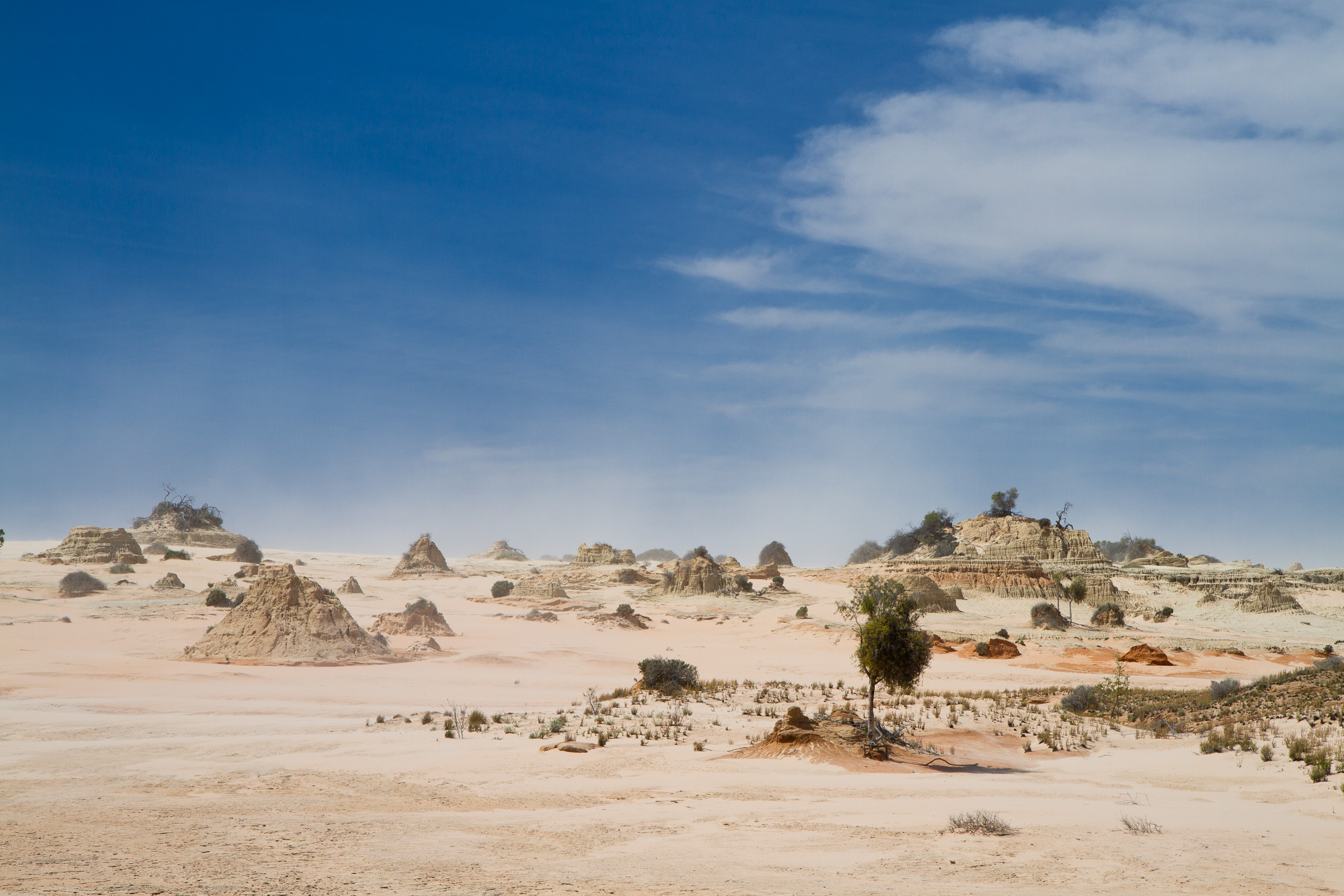
Its landscape is out of this world: the Willandra Lakes Region, a World Heritage Area, is a system of lakes that dried up around 20,000 years ago and are now dusty plains surrounded by wind-sculpted dunes. The visual highlight is the Walls of China, a large lunette of white and ochre sand and clay that the wind has shaped into spectacular forms, especially magical at sunset.

Mungo is, above all, a sacred place for three Aboriginal peoples — the Paakantji (Barkandji), the Ngiyampaa and the Mutthi Mutthi — its Traditional Custodians, who take part in caring for it and offer guided tours. It is a remote destination with no public transport, explored by car or on a tour, and it combines science, nature and the living culture of Australia's First Peoples like few other places.

📖 History of Mungo National Park

Mungo is part of the lands of three Aboriginal peoples — Paakantji (Barkandji), Ngiyampaa and Mutthi Mutthi — who lived around the Willandra Lakes for tens of thousands of years, when they were full of water, fish and life. In 1968, geologist Jim Bowler found the remains of Mungo Lady, and in 1974 those of Mungo Man: at around 42,000 years old, they are among the oldest modern human remains outside Africa and the oldest known evidence of ritual cremation, with the body dusted in red ochre. The finds revolutionised our understanding of human history in Australia. After long negotiations with the Traditional Custodians, Mungo Lady returned to the site in 1992, and both were reburied in 2022. The full story is on our history page.

Read the full history ↓

🏛️ Mungo National Park is in New South Wales

The birthplace of modern Australia: the First Fleet landed at Sydney Cove in 1788, on the lands of the Eora people. The country's most populous state and home to Sydney and its Opera House, it was the trunk from which all the other colonies branched off and the setting for the first gold rush.

Read the history of New South Wales →

🗺️ What to see

1
Walls of China (the lunette)
The great wall of white and ochre sand and clay sculpted by the wind on the edge of the dry lake. Mungo's icon, not to be missed at sunset.
Leer más ↓
The Walls of China is Mungo's most famous image and one of the most striking in the Australian outback. It is a lunette: a long crescent-shaped ridge, about 30 km long, made of layers of white, grey and ochre sand and clay that the wind has sculpted over millennia on the eastern edge of dry Lake Mungo. Its whimsical shapes — pinnacles, gullies, rounded walls — change colour with the light and look like a lunar landscape. It is also an archive of human and environmental history: in these layers of sediment, wind erosion keeps uncovering bones of extinct megafauna, stone tools and hearths tens of thousands of years old. It was right here, in the lunette, that Mungo Man and Mungo Lady were found. Because of its enormous scientific and cultural value, you cannot walk freely on the Walls of China: there is an accessible viewing platform (wheelchair-friendly) with fabulous views, and to enter the lunette itself you have to go on an Aboriginal guided tour. The best time is sunset, when the low sun sets the sand glowing in gold and pink tones and casts long shadows over the formations. Sunrise is also spectacular and much quieter. Bring water, a hat, sunscreen and something warm for when the sun goes down (source: NSW National Parks, verified July 2026).
ℹ️ What it is: Lunette (crescent) of sand and clay, ~30 km · Free access: Only up to the viewing platform (accessible) · Entering the lunette: Only on an Aboriginal guided tour · Best time: Sunset (and sunrise, quieter)
2
Mungo Visitor Centre
The best introduction to the park: exhibits on 40,000+ years of human history, the geology of the Willandra Lakes and the culture of the three custodian peoples.
Leer más ↓
The Mungo Visitor Centre is the essential gateway to the park and the best place to understand what you're about to see. Its exhibits tell Mungo's extraordinary story in a clear and respectful way: more than 40,000 years of continuous human occupation, the discovery of Mungo Lady and Mungo Man, the geological formation of the Willandra Lakes and how they dried up, and the living culture of the Paakantji, Ngiyampaa and Mutthi Mutthi peoples. It is also the starting point for guided tours and the place to register your entry payment (by self-registration). Next to the centre there are toilets, picnic tables and information panels. Starting your visit here gives meaning to everything else: without this context, the Walls of China is just a pretty landscape; with it, it becomes one of the most significant places in human history. The centre is open Monday to Friday from 8:30 to 16:30 (hours may vary; best to check). Nearby are the historic Mungo Woolshed (a 19th-century cypress pine shearing shed) and the Shearers' Quarters, reminders of the era of the great sheep stations. Together they help you understand the different layers of the site's history (source: NSW National Parks, verified July 2026).
ℹ️ Opening hours: Mon-Fri 8:30-16:30 (check; may vary) · What it offers: Exhibits, entry registration, tour departure point · Nearby: Historic Mungo Woolshed and Shearers' Quarters · Tip: Start your visit here to understand the site
3
Mungo Track self-guided drive (~70 km)
The park's great driving route: a loop of about 70 km with signposted stops at dunes, lookouts and the different environments of the ancient lake.
Leer más ↓
The Mungo Track is the great route for exploring the park on your own: a one-way driving loop of about 70 km that circles dry Lake Mungo and links a series of signposted stops with interpretive panels. You pass through the different environments of the ancient lake system: the lake bed, shifting dunes, belah and rosewood woodlands, and several lookouts with wide views over the landscape. Stops include places like Zanci Homestead (the remains of an old sheep station, with its well and buildings), lookouts over the dunes and the back of the lunette. It's a relaxed, flexible way to see Mungo, stopping at each point to read, take photos and walk a little. Combined with a visit to the centre and the Walls of China, it makes for a full and rewarding day. The loop can be done in a regular vehicle (2WD) when the road is dry, but it is unsealed and can become impassable after rain; always check road conditions before heading in. Bring plenty of water, enough fuel (there are no service stations in the park), food and everything you need for the outback. Drive slowly: there's wildlife, loose sand and washed-out sections (source: NSW National Parks, verified July 2026).
ℹ️ Length: ~70 km (one-way loop) · Vehicle: 2WD in good weather; impassable after rain · Stops: Dunes, lookouts, Zanci Homestead, panels · Heads-up: No fuel or services inside the park
4
Aboriginal guided tour of the Walls of China
The way to enter the lunette itself, led by guides from the custodian peoples who share the history and culture of the place. Mungo's most profound experience.
Leer más ↓
The heart of a visit to Mungo is the Aboriginal guided tour. Because the Walls of China lunette is a site of enormous scientific and sacred value, you can't explore it freely: you can only enter accompanied by guides from the custodian peoples — Paakantji (Barkandji), Ngiyampaa and Mutthi Mutthi — who lead visitors among the formations and share the geological history, the archaeological finds and, above all, their people's living connection with this Country. Walking among the sand pinnacles while a guide tells you what the lakes were like tens of thousands of years ago, how their ancestors lived fishing and hunting megafauna, and what it means to them that Mungo Man and Mungo Lady have come back to rest here, is an experience that completely transforms the visit. It's the difference between seeing a landscape and understanding a sacred place. The lunette tour fee (Walls of China / Mungo lunette) is around A$50 per adult, A$35 concession/seniors and A$35 per child (5-16 years) (source: NSW National Parks, verified July 2026). Tours leave from the visitor centre and must be booked; availability can be seasonal, so it's best to plan ahead. It is, without a doubt, the best investment of a visit to Mungo.
ℹ️ Price: A$50 adult · A$35 concession · A$35 child 5-16 (verified July 2026) · Guides: Aboriginal custodians (Paakantji, Ngiyampaa, Mutthi Mutthi) · Gives access to: The Walls of China lunette (not accessible on your own) · Booking: From the visitor centre; best to book ahead
5
Sunrise, sunset and starry skies
With no city lights for hundreds of kilometres, Mungo offers one of the darkest, starriest skies in Australia, plus unreal sunrises and sunsets over the dunes.
Leer más ↓
One of Mungo's great luxuries is its sky. Being deep in the outback, far from any city, light pollution is practically zero: on a clear night, the Milky Way stretches from horizon to horizon with a sharpness most people have never seen. It's one of the best places in Australia for naked-eye astronomy, and spending a night in the park just for this is worth it. Sunrises and sunsets are just as memorable. At dawn, the low light over the Walls of China and the dunes paints the landscape in pinks and golds, in total silence broken only by birds; at that hour it's also common to see kangaroos and emus. Sunset, as mentioned, lights up the lunette and is the most photographed moment in the park. Both ends of the day are when Mungo shows its most magical side. To enjoy it you need to stay overnight in or near the park, as the distances make it impossible to come and go for sunrise. Bring warm clothes (desert nights are cold, even in summer) and a torch, and respect the natural darkness by avoiding bright lights. A thermos, a blanket and some patience are all you need for one of the best starry nights of your life (source: NSW National Parks / Visit NSW, verified July 2026).
ℹ️ Sky: Among the darkest in Australia (Milky Way to the naked eye) · Sunrise: Light over the dunes + kangaroos and emus · Sunset: The lunette aglow, the star moment · Requires: Staying overnight in or near the park; bring warm clothes
6
Wildlife and plants of the ancient lake
Red and grey kangaroos, emus, wombats, reptiles and birds adapted to the semi-desert, among dunes, belah woodlands and saltbush scrub.
Leer más ↓
Although at first glance Mungo may look like an empty desert, it is full of life adapted to aridity. Red and grey kangaroos, emus, southern hairy-nosed wombats, echidnas, several reptile species and rich birdlife live in and around the park, making use of its different environments: the bed of the ancient lake, the dunes, belah and rosewood woodlands, and saltbush and bluebush scrub. The best times to see animals are sunrise and sunset, when temperatures drop and wildlife comes out to feed. It's common to come across mobs of kangaroos and emus walking across the plains, especially near the driving loop. The vegetation, adapted to scarce water, changes with the soil type and also tells part of the site's story: where there was once plenty of water, today there are drought-resistant species. This semi-arid landscape is a reminder of how the region has changed: tens of thousands of years ago, when the Willandra Lakes were full, the area teemed with fish, freshwater mussels and now-extinct megafauna that sustained the Aboriginal peoples. Drive carefully, especially at dawn and dusk, because wildlife crosses the roads, and always watch from a distance without feeding the animals (source: NSW National Parks, verified July 2026).
ℹ️ Wildlife: Red and grey kangaroos, emus, wombats, reptiles, birds · Best time: Sunrise and sunset · Environments: Lake bed, dunes, belah woodlands, saltbush · Take care: Wildlife on the roads; don't feed animals
📶I have never landed without internet. I arrive and my phone connects to the strongest network in the country I am visiting: I can say I landed, sort out transport, book tours and keep posting, at a seriously good price. I always use the Maya eSIM — check their plans by clicking the banner.See plans →Maya Mobile eSIM — download, install, go
What nobody tells you

💵 Prices

Tickets

TypePrice
Entrada al Parque Nacional Mungo (por vehículo, por día)A$8 per vehicle per day, by self-registration (envelope) at the visitor centre (source: NSW National Parks, verified July 2026)
Tour guiado aborigen a la Walls of China / lúnula — adultoA$50 per person (source: NSW National Parks, verified July 2026)
Tour guiado a la lúnula — concesión/jubiladosA$35 per person (with concession card) (source: NSW National Parks, verified July 2026)
Tour guiado a la lúnula — menor (5-16 años)A$35 per person (source: NSW National Parks, verified July 2026)
Centro de visitantes y circuito autoguiado del Mungo TrackIncluded with park entry (only the vehicle is charged) (source: NSW National Parks, verified July 2026)
🔄 updated monthlyOfficial / reference values · double-check when buying

Activities and tours

ActivityPriceDurationOperator
Aboriginal guided tour of the Walls of China (lunette)A$50 adult · A$35 concession · A$35 child 5-16 (source: NSW National Parks, verified July 2026)1.5 to 2 hNSW National Parks / Aboriginal custodian guides
Mungo Track self-guided drive (~70 km)Park entry only (A$8 per vehicle) (source: NSW National Parks, verified July 2026)2 to 3 h with stopsOn your own (2WD in good weather)
Full-day tour to Mungo from MilduraApprox. A$180-260 per person depending on operator (source: Mildura tour operators, verified July 2026)Full day (with transfer)Mildura tour operators
Stargazing and astronomyFree on your own (dark sky); some guided tours by operators (source: Visit NSW, verified July 2026)Night-timeOn your own / occasional operators
🔄 updated monthlyOfficial / reference values · double-check when buying

🚌 How to get there and distances

Getting around

ModePriceDurationNotes
Your own or a rental carRental from ~A$55-90/day (source: Mildura/Broken Hill agencies, verified July 2026)
Guided tours from Mildura or Broken HillA$180-260 per person (full day from Mildura) (source: local operators, verified July 2026)
Self-guided loop inside the parkIncluded with entry (A$8 per vehicle) (source: NSW National Parks, verified July 2026)
🔄 updated monthlyOfficial / reference values · double-check when buying

How to get there

RouteAirlines / operatorsAvg. priceDuration
Mildura (VIC) → Mungo National ParkOwn/rental car or tour from MilduraFuel; tour A$180-260 per person (source: Mildura operators, verified July 2026)~116 km (~1.5 to 2 h; partly unsealed)
Balranald (NSW) → Mungo National ParkOwn/rental carFuel (source: NSW National Parks, verified July 2026)~155 km (mostly unsealed)
Broken Hill → Mungo National ParkOwn/hire car or tourFuel; depends on tour (source: local operators, verified July 2026)~300 km (several hours; outback roads)
🔄 updated monthlyOfficial / reference values · double-check when buying

🏨 Where to stay

No exact prices: a scale from $ (budget) to $$$$$ (luxury), with 2-3 options per category.

Luxury/Mid-range
Price$$$$$
Recommended options
Mungo Lodge, next to the park, with rooms and a restaurant: approx. A$150-260/night (range per Booking.com, verified July 2026); Mildura offers higher-category hotels as a base
Mid-range
Price$$$$$
Recommended options
Mungo Shearers' Quarters (historic accommodation inside the park, with kitchen and showers): nightly rate set by NSW National Parks (book online); Mildura hotels and motels as a base (range per NSW National Parks / Booking.com, verified July 2026)
Budget
Price$$$$$
Recommended options
Main Campground and Belah Campground inside the park (toilets, tables): low NSW National Parks camping fee (book online, verified July 2026)

🍴 Where to eat

Restaurante de lodge
Price$$$$$
Options / signature dish
Mungo Lodge restaurant (the only place to eat near the park): mains A$25-45 (range based on reviews, verified July 2026)
Autoservicio / provisiones
Price$$$$$
Options / signature dish
There are no shops inside the park: bring food, water and supplies from Mildura or Balranald (verified July 2026)
Gastronomía en Mildura (base)
Price$$$$$
Options / signature dish
Restaurants, cafés and wineries in Mildura, ~116 km away: A$20-45 per person (range based on reviews, verified July 2026)

📖 History of Mungo National Park

Origins, formation and what the sources say.

When Mungo was a lake full of life

Standing today amid the dust and dunes, it's hard to imagine, but for tens of thousands of years Lake Mungo was full of fresh, deep, cool water. Between roughly 50,000 and 19,000 years ago, the Willandra Lakes system (a chain of lakes fed by an ancient river) was teeming with life. Forests lined the shores, and the waters were full of fish such as Murray cod and golden perch, along with freshwater mussels, frogs and yabbies (freshwater crayfish). Now-extinct megafauna roamed the lake edges, including the largest kangaroo that ever lived.

Aboriginal peoples lived in this generous landscape. The evidence shows a human presence in the Willandra Lakes Region for at least 50,000 years, making it one of the oldest sites of continuous human occupation on the planet. Its inhabitants camped and fished on the dunes along the shores, gathered mussels and plants, hunted lizards, wallabies and wombats, and collected duck and emu eggs. The remains of their hearths, meals and tools were buried in layers of sand that erosion is now slowly uncovering.

Around 40,000 years ago, water levels began to drop and fluctuate. When the last ice age reached its peak, between 22,000 and 18,000 years ago, the freshwater supply was cut off completely: the Willandra Lakes dried up and their beds became covered in gypsum. The wind then began its slow work as a sculptor, building and shaping the dunes and the great lunette we know today as the Walls of China. Beneath that sand, unknown to anyone for millennia, lay an extraordinary archive of human history.

en.wikipedia.org · Willandra Lakes Regionenvironment.nsw.gov.au · Willandra lakes regiondcceew.gov.au · Willandra

1968 and 1974: Mungo Lady and Mungo Man change history

The discovery that put Mungo on the world map began with a geologist walking among the dunes. In 1968, Jim Bowler, a researcher from the University of Melbourne, was studying the geology of the Willandra Lakes when he found human remains that erosion had exposed. They were the bones of a woman who had been cremated, and she was named Mungo Lady. The analysis revealed something astonishing: the remains were tens of thousands of years old and were the oldest known evidence in the world of ritual cremation, a sophisticated funerary practice full of meaning.

Six years later, in February 1974, Bowler made a second, even more striking find. The shifting dunes had exposed another body: a man buried with his hands crossed and sprinkled with red ochre, a pigment that had to be brought from far away. He was named Mungo Man. The careful burial, with ochre, pointed to complex symbolic and spiritual thought. Dating, refined over the years, placed Mungo Man and Mungo Lady at around 42,000 years old, among the oldest remains of anatomically modern humans (Homo sapiens) found outside Africa.

The impact was enormous. Until then, the age of the Aboriginal presence in Australia had been underestimated; Mungo showed, with irrefutable scientific evidence, that First Peoples had lived on the continent for tens of thousands of years, with rich cultures and complex ritual practices. The Willandra Lakes Region was inscribed on the UNESCO World Heritage List in 1981, in recognition of both its natural value and its extraordinary cultural value. Mungo became a worldwide symbol of the depth of human history in Australia.

en.wikipedia.org · Lake Mungo remainsbritannica.com · Lake Mungoen.wikipedia.org · Mungo National Park

Footprints in the mud: a snapshot from 20,000 years ago

As if the remains of Mungo Man and Mungo Lady weren't enough, the Willandra Lakes Region holds another treasure unique in the world. On a mud surface that was once the damp edge of an ephemeral lake, hundreds of fossilised human footprints were preserved, dated to around 19,000 to 23,000 years ago. With at least 124 identified footprints (and almost 460 tracks in total), it is the largest known collection of Pleistocene human footprints on the planet.

What makes these footprints so moving is how intimate and everyday they are. They were left by adults, teenagers and children who walked, ran and hunted across the soft mud of a waterhole. Scientists, working alongside Aboriginal trackers, were able to 'read' entire scenes: a group on the move, someone running at great speed, people of different ages moving together. It is a snapshot of a day in the life of these peoples, frozen for twenty millennia and only discovered in 2003.

This record adds to a landscape that is, in itself, an open book of prehistory. Alongside the megafauna fossils (including the largest kangaroo that ever lived), leaves, seeds, pollen and insects were preserved, making it possible to reconstruct what the environment was like when the lakes were full: a world of forests, carnivorous reptiles and large herbivores, very different from today's semi-desert. Recent studies show that modern humans and megafauna coexisted in the area for at least 17,000 years. All this knowledge continues to be cared for and studied, always in dialogue with the custodial peoples.

pubmed.ncbi.nlm.nih.govnationalgeographic.com · Willandra lakes region unesco world heritageen.wikipedia.org · Willandra Lakes Region

The custodians, repatriation and Mungo today

Mungo's story isn't just about the remote past: it is also the story of how Australia learned, with difficulty, to respect First Peoples. When Mungo Lady and Mungo Man were discovered, they were removed from the site and taken to scientific institutions for study, without consulting Aboriginal communities. For the custodial peoples (the Barkandji/Paakantyi, the Mutthi Mutthi and the Ngiyampaa), these were their ancestors, and their removal was felt as a deep wound.

For decades, the communities called for their ancestors to be returned. That call was part of a wider movement for the repatriation of Aboriginal remains and for recognition of First Peoples' rights and voice over their heritage. After long negotiations with the elders of the three traditional groups, Mungo Lady was returned to Lake Mungo in 1992, and finally, on 24 May 2022, Mungo Lady and Mungo Man were reburied on their Country. The process was not free of tensions and disagreements within the communities themselves about the best way to honour the ancestors, a legitimate and complex debate that continues.

Today, the management of Mungo reflects those lessons: the three custodial peoples take an active part in caring for the park alongside the state parks service, and they are the ones who guide visitors across the sacred lunette of the Walls of China. That living presence is the greatest gift of a visit to Mungo: it is not a museum of an extinct past, but a living Country whose Traditional Owners remain connected to it.

Exploring Mungo means travelling through one of the longest human stories on Earth: from the lakes teeming with life and the first inhabitants 50,000 years ago, through Mungo Lady and Mungo Man and the footprints in the mud, to the repatriation of the ancestors and the role of their descendants as custodians today. Few places in the world pack so much time, so much science and so much living culture into a handful of golden dunes in the Australian outback.

en.wikipedia.org · Lake Mungo remainsiblog.iup.edu · Mungo man and mungo lady repatriation and…mpra.com.au · Lake mungonationalparks.nsw.gov.au · Mungo national park

📚 Bibliography

  • Wikipedia — «Lake Mungo remains»: https://en.wikipedia.org/wiki/Lake_Mungo_remains
  • Wikipedia — «Mungo National Park»: https://en.wikipedia.org/wiki/Mungo_National_Park
  • Wikipedia — «Willandra Lakes Region»: https://en.wikipedia.org/wiki/Willandra_Lakes_Region
  • Britannica — «Lake Mungo»: https://www.britannica.com/place/Lake-Mungo
  • National Geographic — «Willandra Lakes Region UNESCO World Heritage»: https://www.nationalgeographic.com/travel/article/willandra-lakes-region-unesco-world-heritage
  • PubMed — «Pleistocene human footprints from the Willandra Lakes»: https://pubmed.ncbi.nlm.nih.gov/16343597/
  • Department of Climate Change, Energy, the Environment and Water (DCCEEW) — «Willandra Lakes Region»: https://www.dcceew.gov.au/parks-heritage/heritage/places/world/willandra
  • NSW Environment & Heritage — «Willandra Lakes Region»: https://www.environment.nsw.gov.au/topics/parks-reserves-and-protected-areas/protected-areas/world-heritage-listed-areas/willandra-lakes-region
  • Murdi Paaki Regional Assembly — «Lake Mungo»: https://www.mpra.com.au/lake-mungo
  • NSW National Parks — «Mungo National Park»: https://www.nationalparks.nsw.gov.au/visit-a-park/parks/mungo-national-park

❓ Frequently asked questions

Why is Mungo National Park so important?+
Because this is where Australia's oldest human remains were found: Mungo Lady (1968) and Mungo Man (1974), around 42,000 years old. They are among the oldest remains of modern humans outside Africa, and Mungo Lady is the oldest known evidence of ritual cremation, while Mungo Man's body was sprinkled with red ochre. They prove an Aboriginal presence going back tens of thousands of years and changed how we understand human history on the continent. All of it lies within the Willandra Lakes Region, a World Heritage Site.
How do I get to Mungo? Can I do it in a regular car?+
There's no public transport: you get there by car or on a tour. The nearest bases are Mildura (~116 km) and Balranald (~155 km). Much of the road is unsealed and, in good weather, can be driven in a regular 2WD vehicle; but after rain the roads become impassable and the park may close. Always check road conditions before you go and bring fuel, water and supplies, because there are no services inside the park.
How much does it cost to enter and visit Mungo?+
Park entry costs A$8 per vehicle per day, paid by self-registration (envelope) at the visitor centre. The self-guided Mungo Track drive (~70 km) is included. The Aboriginal-guided tour of the Walls of China costs A$50 per adult, A$35 concession/seniors and A$35 per child aged 5 to 16 (source: NSW National Parks, verified July 2026).
Can I walk freely around the Walls of China?+
No. Because of its scientific and sacred value, the Walls of China lunette can only be explored on a tour guided by the Traditional Custodians (Paakantji/Barkandji, Ngiyampaa and Mutthi Mutthi peoples). Without a tour, you can reach an accessible viewing platform with excellent views, ideal at sunset. The guided tour is highly recommended: it transforms the visit by connecting the landscape with the history and living culture of the place.
When is the best time to visit Mungo and how many days do I need?+
Autumn (March-May) and winter (June-August) are ideal: mild days and cold desert nights. Summer is very hot (over 40 °C). 1 or 2 days is enough: one day for the visitor centre, the drive loop and the Walls of China at sunset. Ideally, stay overnight in or near the park for the sunrise and the starry sky, one of the darkest in Australia.
Where can I stay at Mungo?+
There are several options in or next to the park: Mungo Lodge (with rooms and a restaurant), the historic Mungo Shearers' Quarters (accommodation with kitchen and showers, run by NSW National Parks) and the Main Campground and Belah Campground campsites. Many visitors also stay in Mildura and visit as a day trip, although staying over lets you enjoy the sunrise, sunset and stars.

More places in Australia

Península de EyrePenínsula de MorningtonPerthPhillip IslandPort ArthurPort Douglas
See every place in Australia →The history of Australia →
Sources consulted (8)
Still planning?
Explore more destinations in Australia
See all destinations →
Image credits
Photos from Wikimedia Commons, each under its own licence (CC BY, CC BY-SA or public domain). Open each file to see its author and licence.
MungoNationalParkWallsOfChina