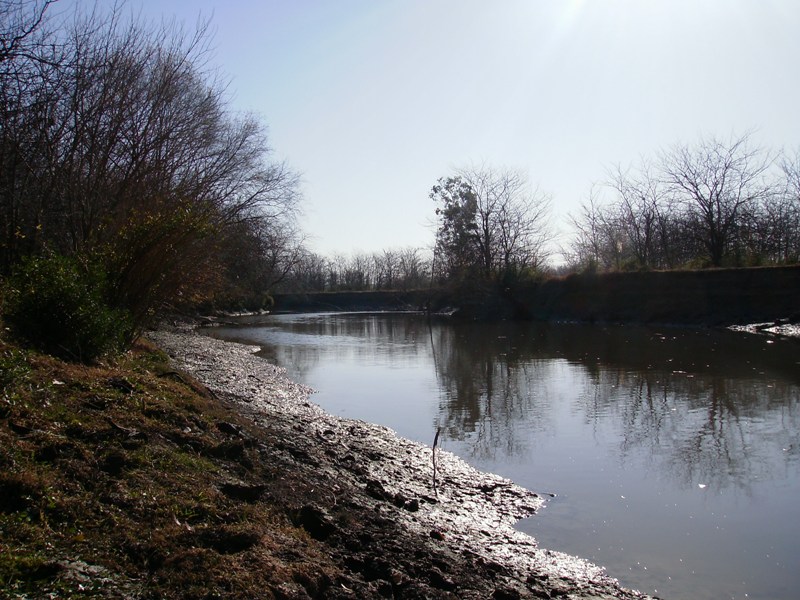
The Otamendi Nature Reserve — today the heart of Ciervo de los Pantanos National Park, managed by the National Parks Administration — is a protected area in the northeast of Buenos Aires province, in the Campana district, on the edge of the lower delta of the Paraná river. It protects a valuable mosaic of habitats: the talar (tala woodland) on the bluff, the pampas grasslands, the marshes and the delta wetlands, in one of the few national protected areas in the pampas region, very close to the city of Buenos Aires.
It's a must for nature lovers and, above all, for birdwatchers: the reserve holds hundreds of species, which makes it one of the best birding sites near the capital. It has interpretive trails, viewpoints over the bluff and the lowlands, and a visitor centre. Its proximity to Buenos Aires (a little over an hour) makes it ideal for a day trip in contact with the wetlands and the pampas grasslands, with the bonus that access is free.
This guide covers the essentials of the Otamendi Nature Reserve with a practical eye: its habitats and trails, birdwatching and wildlife, the viewpoints over the delta, how to get there from Buenos Aires and what to keep in mind for your visit. It's an accessible window onto the nature of the lower delta and the last well-preserved talares and grasslands in the northeast of Buenos Aires province.
The area was protected on 10 October 1990 as the Otamendi Strict Nature Reserve (Decree 2149), on land that had belonged to the engineer Rómulo Otamendi (1852–1934), under the National Parks Administration, to conserve the surviving fragments of tala woodland, pampas grassland and wetlands of the lower Paraná delta, habitats heavily altered everywhere else in the region. In 2018, under Law 27456, this land — together with the Río Luján Nature Reserve — became part of the new Ciervo de los Pantanos National Park, named after its flagship species, the largest deer in South America. The full story is on our history page.
Read the full history ↓The agro-export heart of Argentina: the endless pampa that was the land of the Querandí and the Pampa peoples, the domain of governor Rosas, the engine of cattle and wheat with La Plata as its purpose-built capital, cradle of the gaucho and of the Atlantic Coast where the whole country spends its summer.
Read the history of Buenos Aires Province →A local guide tells you in half an hour what no sign at the site will ever explain. We look ours up on Civitatis: guided in Spanish and booked online with no fuss. There are not many in Tigre Y El Delta, but the ones there are worth it. And there are free tours here: you book without paying and tip the guide whatever you think at the end, so trying one costs you nothing. Tap the cards below and have a look.
They depart from Tigre Y El Delta, 37 km away. If you book from this link we earn a commission and you pay no more.
No exact prices: a scale from $ (budget) to $$$$$ (luxury), with 2-3 options per category.
Origins, formation and what the sources say.
Less than an hour and a half from the skyscrapers of Buenos Aires, a deer weighing over a hundred kilos — the largest in all of South America — wades silently through the reed beds of a wetland almost nobody associates with Buenos Aires province. It's the marsh deer, and its presence in the Otamendi Nature Reserve is proof that, right up against the country's largest metropolis, a nearly intact fragment of the original pampa survives: tala woodland, untouched grassland and delta marshes, all together, in just a few thousand hectares.
The Otamendi Nature Reserve protects some of the most characteristic and, at the same time, most threatened habitats in the northeast of the pampas region. The first is the talar: a native woodland dominated by the tala tree, which grew along the old bluffs and shores of the Paraná river. These woodlands, which once formed belts along the river frontage of Buenos Aires province, were felled on a massive scale for firewood, charcoal and farmland, until they were reduced to scattered remnants. Otamendi preserves one of those remnants.
The second great habitat is the pampas grassland, the original vegetation of the plain, today almost entirely replaced by farming and livestock across much of the pampa. Well-preserved grasslands are extremely rare, and with them go the species that depend on them, in particular many grassland birds, some seriously threatened. The reserve is one of the few places where these grasslands and their wildlife survive under protection.
The third component is the wetland of the lower Paraná delta: the marshes, reed beds and floodable grasslands that spread out at the foot of the bluff, an ecosystem extraordinarily rich in aquatic life. The combination of these three habitats — tala woodland, grassland and wetland — in a relatively small area very close to Buenos Aires explains Otamendi's enormous conservation value and its fame among naturalists and birdwatchers.
The reserve's name comes from the engineer Rómulo Otamendi (1852–1934), a figure tied to the expansion of the railways in Argentina. Otamendi worked on laying out rail routes across the country, and the land the protected area now occupies was part of his property. The nearby town and the railway station — Ingeniero Rómulo Otamendi — also carry his surname, a record of the mark the railway left on this corner of the northeast of Buenos Aires province.
After the engineer's death, the property was bequeathed and passed through various hands over the 20th century. By the 1980s the land was largely abandoned, which paradoxically helped many of its natural habitats — the tala woodland on the bluff, the grasslands and the marshes — to survive in better shape than the neighbouring land, heavily transformed by farming, livestock and urban growth.
That was when the national government recognised the value of the site. The presence of remnants of pampas habitats and delta wetlands, combined with its closeness to the great metropolis, made this land an ideal candidate for the national protected areas system. The executive branch decided to transfer control of the property to the National Parks Administration, laying the groundwork for the formal creation of the protected area.
On 10 October 1990, through Decree 2149, the Argentine state established the protected area, originally under the category of Otamendi Strict Nature Reserve, covering some 4,088 hectares, within the national protected areas system run by the National Parks Administration. It was an important step: bringing into the national system a representative example of the pampas region and the lower delta, habitats historically underrepresented in the country's protected areas.
The strict nature reserve category meant a high level of protection, aimed at conserving the ecosystems and at scientific research, with regulated public use. The reserve thus sat in a strategic spot: very close to the great Buenos Aires metropolis — which makes it accessible and gives it enormous educational and recreational value — and representative of ecosystems in clear retreat.
Protection made it possible to conserve the tala woodland on the bluff, the grasslands and the wetlands below, and with them their wildlife, especially the birds. The reserve became a reference site for birdwatching and for research into pampas habitats, as well as a place for environmental education, bringing residents of the metropolitan area closer to a nature that, paradoxically, they have right on their doorstep but which has largely vanished from their everyday surroundings. Its importance as a wetland also earned it recognition as a Ramsar site of international importance.
Recognition of the site's value took a qualitative leap on 10 October 2018, when the National Congress passed Law 27456, creating Ciervo de los Pantanos National Park. The new park was made up mostly of the land of the Otamendi Nature Reserve and the nearby Río Luján Nature Reserve, raising the protection category and giving it its own identity within the Argentine national parks system.
The name honours the area's flagship species and natural monument: the marsh deer (Blastocerus dichotomus), the largest of South America's deer, which finds in the wetlands of the lower delta one of its last refuges near Buenos Aires. The park was created to guarantee the conservation of this threatened species and of the set of habitats — tala woodland, grassland and wetland — that sustain it, along with other vulnerable species such as the neotropical otter and various grassland birds.
In the years that followed, the park's boundaries were expanded: on 16 November 2021 its area grew from around 3,000 hectares to more than 5,561 hectares, strengthening protection of the wetlands and grasslands. Today Ciervo de los Pantanos National Park — with the historic Otamendi Reserve at its heart — is one of the youngest national parks and one of the closest to the capital, a symbol of the will to conserve the nature of the pampas and the delta at the very gates of the big city.
Blastocerus dichotomus, commonly known as the marsh deer, is the largest deer in South America: adult males can stand over a metre at the shoulder and weigh more than 100 kilos, with a distinctive branching set of antlers. It's adapted to life in wetlands — it has large, splayed hooves that let it walk on soft, flooded ground — and it is now listed as a threatened species across much of its historic range, which stretched from northern Argentina to southern Brazil. The population surviving in the Otamendi marshes is one of the southernmost and one of the closest to a major urban centre anywhere in its range, which makes the conservation of this wetland a case study: it's practically the last refuge of the species this close to a South American capital.
Alongside the deer, the reserve is famous in the Argentine birdwatching world. Historical records and observers' surveys have accumulated several hundred bird species in the area, an extremely high number for a relatively small surface on the edge of Greater Buenos Aires. Here you find grassland birds — such as the dark-throated seedeater and other species in the seedeater family, several of them in serious decline because of the loss of natural grasslands across the pampa — tala woodland birds such as the dusky-legged guan and the solitary black cacique, and an enormous diversity of water and marsh birds: herons, ducks, coots, southern screamers and raptors such as the long-winged harrier. Because of that unique combination of habitats within such a small radius, birding clubs from Buenos Aires organise regular outings to Otamendi, and the place regularly appears on lists of the best birdwatching sites near the city.
Such sensitive wildlife coexisting with a megacity of more than 15 million people is neither an accident nor automatic: it's the direct result of more than three decades of formal protection, first as a strict reserve and then as a national park. Without that protected-area status, the property, farming and infrastructure pressure surrounding Greater Buenos Aires would probably have wiped out both the tala woodland and the grasslands, and much of the wildlife you can still see there, a step away from the capital.