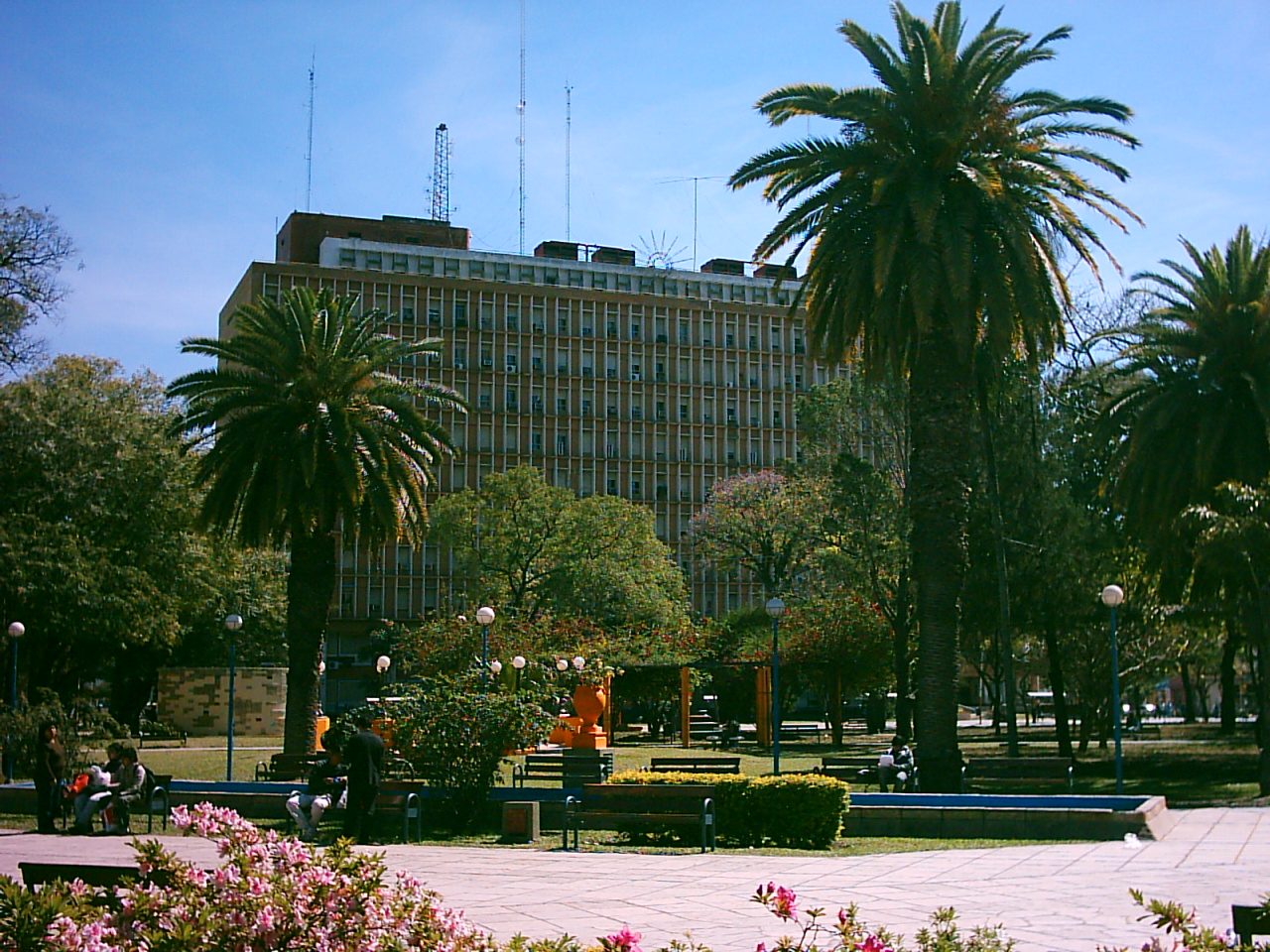
Resistencia is a provincial capital with a cultural identity unlike anywhere else in Argentina: it's the 'City of Sculptures', an open-air museum where hundreds of sculptural works fill its streets, squares, pavements and public spaces. Walking through Resistencia means finding sculptures at every turn, the fruit of a long artistic tradition centred on the celebrated International Sculpture Biennial, one of the country's great cultural events.
As the capital of Chaco, Resistencia is also the gateway to a province of imposing nature: the Chaco scrub forest, the wetlands, Chaco National Park and, further west, the vast and rugged El Impenetrable. The city, set on the Río Negro and joined to Corrientes by the General Belgrano bridge, combines its cultural and artistic profile with its role as the service hub of a region with a strong natural character and Indigenous (Qom, Wichí, Moqoit) and creole roots.
This guide covers the essentials of Resistencia with a practical, warm eye: how to discover its sculptural heritage and the Biennial, what to see in the city and its cultural venues, how it works as the gateway to deep Chaco, when to go (watch the heat), where to eat and stay. Resistencia is a destination for lovers of art and culture, and the prelude to the nature of Chaco.
Resistencia was founded in 1878 in the territory of Chaco, a region with a strong Indigenous presence (Qom/Toba, Wichí, Moqoit/Mocoví) and difficult to colonise. Its name evokes the idea of 'resistance' on that frontier. The city grew with the arrival of immigrants — especially Friulian Italians — and with the exploitation of quebracho and tannin, the region's economic engine. In 1943 Aldo Boglietti founded El Fogón de los Arrieros, a legendary cultural venue that drove the city's sculptural tradition, seeding works in the streets. That artistic calling was cemented by the International Sculpture Biennial, which made Resistencia the 'City of Sculptures'. The full story is on our history page.
Read the full history ↓The province of the Gran Chaco: impenetrable scrubland of quebracho and carob, land of the Qom, Wichí and Moqoit peoples, of tannin and cotton, marked by the Napalpí Massacre of 1924, with a frontier history that the state only opened up in the twentieth century.
Read the history of Chaco →If you book from here we earn a commission and you pay no more. Prices and availability come from Civitatis.
No exact prices: a scale from $ (budget) to $$$$$ (luxury), with 2-3 options per category.
Origins, formation and what the sources say.
On 27 January 1878, a group of Friulian families landed at the port of San Fernando, on the Río Negro, after almost two months' voyage from Genoa. There were some 39 families — 43, by some records — 184 people in all, men, women and children who had left Italian Friuli behind a promise impossible in their homeland: to own the land they worked. What they found was dense scrub forest, heat, insects and a contested frontier. Resistencia was born of that outsized gamble.
The site wasn't untouched: between 1750 and 1767 the mission of San Fernando del Río Negro had operated there, founded on 26 August 1750 in honour of San Fernando Rey to gather the peoples of the Gran Chaco under colonial control. The mission was dissolved after the expulsion of the Jesuits, but it left the place name — San Fernando, which today names the department — and the memory that this bend of the Río Negro, a tributary of the Paraná, was a strategic point of entry into Chaco.
Throughout the 19th century, Chaco remained one of the hardest regions in Argentine territory to colonise: thick scrub forest, a harsh climate and the firm resistance of the Indigenous peoples who lived there — Qom (Toba), Wichí, Moqoit (Mocoví) — who defended their land against the creole advance. In that context, on 27 January 1878 the state approved the survey of the new colony, carried out by Arturo Seelstrang and Enrique Foster, and days later, on 2 February — the date now celebrated as the city's anniversary — the arrival of the first Friulian colonists was recorded. The chosen name was no accident: Resistencia evoked the tenacity of an outpost that 'resisted' on the Chaco frontier, although history keeps the irony that those who resisted most were the Indigenous peoples, subdued in the military campaigns of the following decades, with their load of violence and dispossession.
For much of its history, the economy of Chaco and of Resistencia was shaped by a tree: the red quebracho, named for the hardness of its wood ('axe-breaker'). The quebracho was an extraordinary treasure of the Chaco scrub forest, prized for two reasons: its extremely hard timber, used for posts, railway sleepers and construction, and above all the tannin extracted from it, a substance essential for tanning leather in industry worldwide.
Quebracho logging and tannin production became the region's great economic engine for decades. Factories and logging camps were set up, the railway arrived to move the output, and the activity drew workers and fuelled the growth of Resistencia and other Chaco towns. It was a boom tied to this natural resource, and it left behind towns, infrastructure and an identity bound to working the forest.
But the exploitation had its dark side and its limit. The logging camps meant brutally hard working conditions, and intensive felling gradually exhausted the quebracho stands, in an extractive model that wasn't sustainable. In time, the tannin crisis — worsened in the mid-20th century by competition from African mimosa and synthetic tanning agents — and deforestation marked the end of that boom, and the region had to reorient its economy first towards cotton and later towards services. The mark of the quebracho, however, remained etched in the history and the landscape of Chaco; a later appreciation of what was left of the forest would lead to the creation of protected areas such as Chaco National Park and, in this century, El Impenetrable.
In 1943 a man from Rosario named Aldo Boglietti — who had come to Chaco with his brother Efraín to promote Aerolíneas Argentinas flights — hung a sign on the door of a narrow house at Brown 188: 'Today, Tuesday, 10 p.m., coffee and entry free'. The invitation was to come and hear whatever anyone — friend, passer-by or stranger — had to say. Out of those gatherings came the most influential cultural venue in northeastern Argentina: El Fogón de los Arrieros, named at the suggestion of the sculptor Juan de Dios Mena, a nod to friends gathering around the fire.
El Fogón moved in 1955 to its permanent home at Brown 350 and became a phenomenon all its own: club, temple of friendship, museum and cultural powerhouse, visited by artists and intellectuals from all over the country and filling up with works by great names of Argentine art such as Emilio Pettoruti, Lucio Fontana and Raúl Soldi. In 1968 Boglietti donated the property and all its holdings to create the Fundación Cultural El Fogón de los Arrieros, guaranteeing that the house would stay everyone's.
But El Fogón's greatest legacy was an idea revolutionary for its time: take art out of the salons and plant it in the street. From the 1950s and 1960s, El Fogón pushed for sculptures and murals on the pavements and squares of Resistencia, beautifying a frontier city with no monumental tradition. That seed — public art, free, woven into everyday life — is the direct origin of the identity that defines Resistencia to the world today.
In 1988 the Chaco sculptor Fabriciano Gómez and a dozen colleagues organised something unheard of: an open-air sculpture contest right on Plaza 25 de Mayo, where the artists carved live into urunday logs, a fine reddish hardwood from the Chaco forest. The result outdid all of them: more than 200,000 people came to watch the sculptors work over the course of a week. That collective experience gave rise to the Fundación Urunday — named after the wood used in those first contests — and, over the years, to the event that put Resistencia on the world's cultural map: the Chaco International Sculpture Biennial.
The Biennial is held every two years, in even years, and works like a World Cup of sculpture: artists from five continents, selected from hundreds of applicants, create their works live over a week in front of huge crowds, and the finished pieces join the city's heritage. The 2026 edition, for instance, brought together 10 established sculptors chosen from 439 applicants from 70 countries. Thanks to that accumulation over decades, Resistencia today displays more than 600 sculptures in streets, on pavements, in squares and parks: an open-air museum, open 24 hours and free, unique in Latin America.
Formal recognition came in October 2006, when the National Congress passed Law 26.157 declaring Resistencia the 'National Capital of Sculptures'. Since then the city has also been pushing its candidacy before Unesco as cultural heritage of humanity. Few Argentine urban stories show so clearly how culture can transform an identity: the old quebracho frontier colony is today, in the eyes of the world, the city where art is touched, walked through and lived in the street.
For much of its history Chaco was not a province but a National Territory: a region administered directly by the central government, without the political autonomy of the provinces. Resistencia, designated capital of the territory, was the administrative centre of that vast region of northeastern Argentina, which grew with agricultural colonisation, quebracho logging and the arrival of immigrants.
The big change came in the mid-20th century: in 1951 the National Territory of Chaco became a province under the name Provincia Presidente Perón, renamed Chaco after the 1955 coup. Resistencia was confirmed as its capital. Provincial status meant setting up its own institutions — legislature, government, courts — and gave the city new institutional weight, reinforcing its role as the political, administrative and service centre of the whole Chaco region.
Through the second half of the 20th century, as the quebracho economy declined, Resistencia diversified: administrative capital, education and health centre, service hub for the countryside and the nature of Chaco and, in a very singular way, a cultural pole thanks to El Fogón de los Arrieros and the Sculpture Biennial. Today the city forms with Corrientes — linked by the General Belgrano bridge over the Paraná since 1973 — a twin-core metropolitan area unique in the country: two provincial capitals facing each other, separated by a river and joined by everyday life. And it remains what it has been since 1878: the gateway to deep Chaco, a forest that today, instead of quebracho stands to fell, offers national parks, reintroduced jaguars and a living Indigenous culture that is an essential part of its identity.