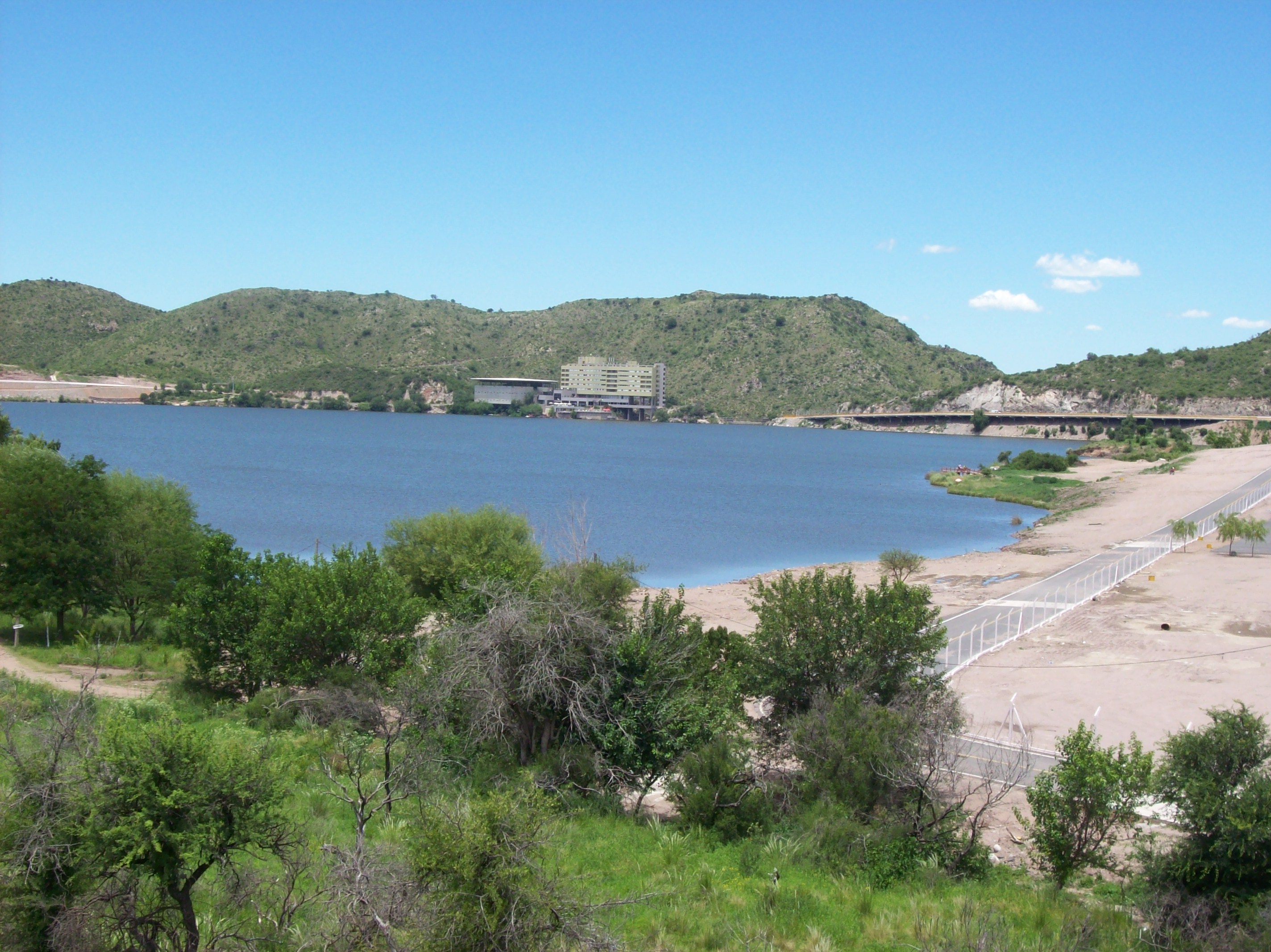
Potrero de los Funes is a San Luis mountain village set around a reservoir ringed by hills, just 19 km from the provincial capital. It is one of the most popular outings in the province, famous for its lake, its natural setting and, very particularly, for the Circuito Internacional Potrero de los Funes, a racing circuit unique in the world that runs along the water's edge.
The reservoir, formed on the Potrero river by one of the oldest dams in South America, is the centre of life here: it invites watersports, fishing, walks around its perimeter and simply enjoying the mountain scenery. The famous circuit that surrounds it — which hosted the FIA GT Championship and the TC2000, and is now driven freely as a scenic road — is an attraction in itself, and the village offers accommodation, food and nature activities in a peaceful setting. A few kilometres away, the Salto de la Moneda adds a mountain waterfall of crystal-clear water.
This guide runs through the essentials of Potrero de los Funes: the lake and the racing circuit, the watersports and nature activities, the Salto de la Moneda, the viewpoints and mountain walks, the closeness to the city of San Luis, the prices and the food at the water's edge. An ideal destination for a relaxed mountain break or a day trip from the San Luis capital.
Potrero de los Funes grew up around one of the oldest dams in South America: the law to build it was passed in 1855, the first dam of 1860 was destroyed by a flood, it was rebuilt in 1876 and in 1927 replaced by the present one. Its name recalls the Funes family, settlers in the area since colonial times. Barely 19 km from the capital, it established itself as a lakeside resort and a provincial tourist centre. Its worldwide fame came with the circuit that runs around the lake: used from 1978, abandoned after a tragedy in 1987 and rebuilt in 2008 as an international circuit, it hosted the FIA GT Championship (2008, 2010 and 2011) and the TC2000, until a court ruling on noise pollution put an end to the racing. Today it is a scenic road open to the public. The full version is on the history page.
Read the full history ↓The 'Gateway to Cuyo' between the sierras and the plain: land of Comechingones and Ranqueles, contributor to the Army of the Andes, home of Colonel Pringles, of the Sierras de los Comechingones and of the red canyon country of the Sierra de las Quijadas.
Read the history of San Luis →If you book from here we earn a commission and you pay no more. Prices and availability come from Civitatis.
No exact prices: a scale from $ (budget) to $$$$$ (luxury), with 2-3 options per category.
Origins, formation and what the sources say.
There is one racing circuit in the world where a driver who ran wide at the wrong corner did not end up in the gravel: he ended up in a lake. The place exists, it is 19 kilometres from an Argentine provincial capital, and its story is stranger than it looks: it was a race track, the scene of a tragedy, the venue of a world championship and, finally, a scenic road where anyone can now drive on the same tarmac the fastest GT1s on the planet once used. It is called Potrero de los Funes, and to understand how a mountain village in San Luis came to appear on the world motor racing calendar alongside Spa-Francorchamps you have to start much earlier, with the water.
Potrero de los Funes sits in a valley of the Sierras de San Luis, at about 1,000 metres of altitude, in a region of granite hills and streams inhabited for millennia by indigenous peoples — among them groups related to the Comechingones and the Huarpes — before the Spanish arrived. The name says almost everything: a 'potrero' was a piece of mountain grazing land, and 'de los Funes' refers to the family that occupied this land from colonial times, when the valley was divided among estancias raising cattle on the slopes of the Sierras Puntanas.
For centuries that is what it was: a rural spot you passed through, with scattered huts, cattle and streams running down from the hills. What changed the valley for good was a decision taken in 1855, when the province passed the law to build a dam on the Potrero river. Nobody imagined then that the reservoir would end up ringed by an FIA-homologated race track.
The Potrero de los Funes reservoir is no ordinary dam: it is one of the oldest in South America. The law approving its construction was passed on 9 May 1855, barely two years after the national constitution, when Argentina was still arguing over how to organise itself as a country. The first dam was built in 1860, at a time when major hydraulic works were an absolute rarity on the continent. The mountain, however, did not let itself be tamed easily: a flood destroyed that first dam, which had to be rebuilt in 1876.
The definitive dam came in 1927, when the 19th-century structure was replaced by the present one, which holds back the waters of the Potrero river — fed by mountain streams such as Los Molles and La Bolsa — in a sheet of water up to 33 metres deep. The result was an unexpected sight in the San Luis landscape: a mountain lake ringed by hills, half an hour from the provincial capital.
That lake changed the fate of the valley. What had been a cattle spot became, over the decades of the 20th century, the favourite lakeside resort of the people of San Luis: first with carp and silverside anglers, weekend shacks and family picnics; then with inns, campsites and cabins. The village grew hugging the perimeter of the lake, along the road that rings it — a planning detail that decades later would prove decisive, because that ring of tarmac, a little over six kilometres long, had, without anyone planning it, the exact shape of a racing circuit.
The idea of racing around the lake took shape in 1978, when the reservoir's perimeter road was adapted as a semi-permanent circuit of 6,206 metres. For almost a decade, Potrero de los Funes hosted Argentine motor racing in a setting like no other: the grandstands were the hillsides, and the lake acted as a natural trap for braking errors. Turismo Carretera, the country's most popular category, raced there before crowds that came from across the region.
The party ended abruptly on 15 August 1987. That day, during a Turismo Carretera round, two crashes killed two spectators and left a driver injured. The shock was such that the circuit was abandoned: the layout went back to being simply the village road, and for twenty years motor racing vanished from Potrero de los Funes. The lake kept drawing tourists — anglers, families, water sports people — but the track remained an awkward memory.
The revival came courtesy of the provincial purse. In early 2008, the San Luis government — which had been investing heavily in tourism and sports infrastructure — took on a complete rebuild of the layout: ten months of work and 56 million pesos of the day (some 18 million dollars) to turn the old road into a modern circuit of 6,270 metres, homologated by the Fédération Internationale de l'Automobile as grade 2, with capacity for 52,000 spectators. On 23 November 2008 the brand-new Circuito Internacional Potrero de los Funes opened with a historic meeting: the FIA GT Championship, the TC2000, Fórmula Renault Argentina and the Copa Mégane, all on the same weekend.
The international debut made an impact. Stéphane Ratel, the French businessman behind the FIA GT Championship, was so struck by the setting that he placed Potrero de los Funes among the 'great circuits of the world', comparing it with La Sarthe (Le Mans), Spa-Francorchamps and Mount Panorama (Bathurst). It was no exaggeration: the Maseratis, Ferraris, Lamborghinis and Corvettes of world GT racing running between mountain hills, with the lake metres from the tarmac, produced some of the most spectacular images in the history of South American motor racing.
The FIA GT returned in 2010 and 2011, by then with the status of GT1 World Championship — the only rounds of that world championship held in Argentina. In parallel, the circuit became a fixture of the national calendar: the TC2000 (later Súper TC2000) raced there without a break between 2008 and 2014, alongside Fórmula Renault. For the village the impact was enormous: every race weekend filled hotels and cabins from San Luis to Merlo, and the name Potrero de los Funes travelled the world on international broadcasts.
But the very feature that made the circuit unique — being literally inside a village, on its streets — was its downfall. Local residents, who had chosen Potrero precisely for its mountain calm, took legal action against the province over noise pollution and the impact of the events in an area designated for rest. The courts found in their favour: the racing was over. The last speed event was in 2018, and since then the Circuito Internacional cannot be used for motor racing competitions.
Beyond the tarmac and the engines, the deep identity of Potrero de los Funes lies in the landscape of the Sierras de San Luis, part of the Sierras Pampeanas, one of the oldest mountain formations in the country. These granite hills, covered in native woodland of molle, espinillo and churqui, hold corners that no world championship could eclipse.
The most famous is the Salto de la Moneda, a waterfall of about 15 metres that the stream carved into a granite gorge, dropping into crystal-clear pools up to 5 metres deep. Its original name was 'Salto Grande', but people renamed it after a curious effect: the mica in the rocks on the bottom catches the sun as though someone had thrown silver coins into the water. You reach it after a trek of some 3 kilometres among molle trees and ferns, always with licensed guides, and in summer its pools are the best cure for the San Luis heat.
For mountaineers, the surroundings offer bigger challenges: Cerro Valle de Piedra (1,953 m), climbed in a day following the Los Molles stream, and Cerro Retana (2,152 m), one of the highest summits in the Sierras de San Luis, whose full-day traverse rewards you with views stretching from the Salinas del Bebedero to the Sierras de las Quijadas.
Today Potrero de los Funes is living a second, calmer life: hotels beside the water — including the glazed floating suites of the Hotel Potrero, the first in Argentina, opened in 2016 —, kayaks and sails on the lake, grills serving San Luis kid goat and a world-championship circuit turned into the most original scenic drive in the country. The village that once roared with GT1s chose, in the end, the sound of water on granite. And perhaps that is why it is more worth visiting than ever.