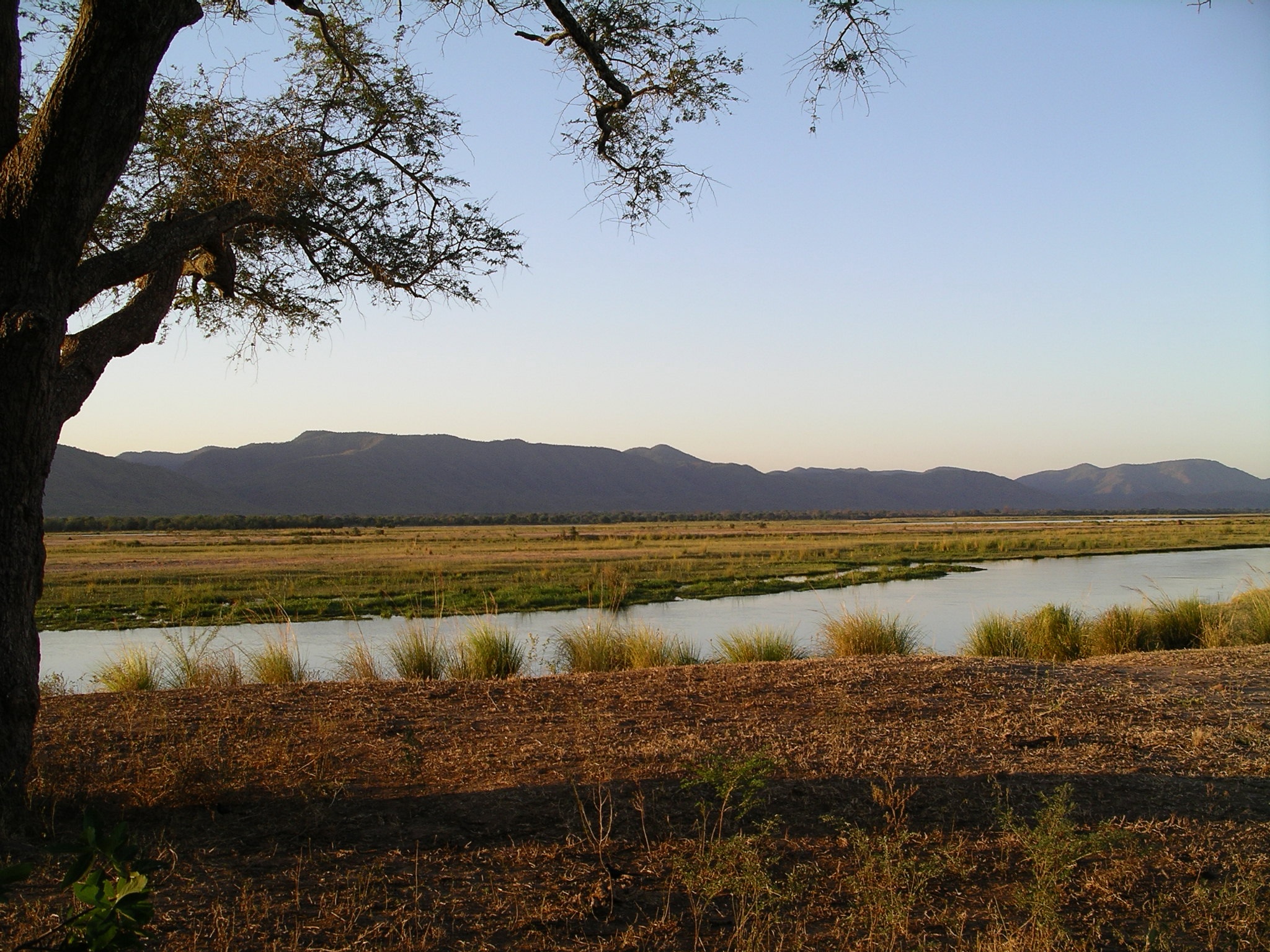
Mana Pools National Park is, for many, the purest and wildest safari in Zimbabwe and one of Africa's great secrets. In the far north of the country, on the southern bank of the Zambezi, it is a land of tall, luminous woodlands, floodplains and four large permanent pools —'mana' means 'four' in Shona— that the river left behind as it shifted over the millennia. A World Heritage Site since 1984, it is one of the last true wilderness areas left in the world.
What makes Mana Pools unique is that here you can walk. Unlike almost every other African park, where you can only explore by vehicle, in Mana Pools walking safaris are allowed, and you can even walk on your own, responsibly: get close to elephants standing on their hind legs to reach acacia pods, follow a pack of wild dogs on foot, or paddle a canoe past hippos and crocodiles on the Zambezi. It is an intimate, adrenaline-filled and life-changing experience, with the wildlife at eye level.
This guide takes a practical look at Mana Pools: how to reach this remote corner, when to go (and when the park closes for the rains), which permits you need, what the walking and canoe safaris are like, where to stay, from luxury lodges to the ZimParks campsite, and the natural and human history of the place, from the meaning of its name to its listing as a World Heritage Site. A logistically demanding but unforgettable destination, for safari-goers looking for the wildest experience.
The name 'Mana Pools' comes from the Shona word 'mana', meaning 'four', after the four large permanent pools —Green Pool, Chisasiko, Chine and Long Pool— that the Zambezi River left behind as it gradually shifted its course northwards over millennia, across a broad floodplain. This landscape of woodlands and pools, which draws wildlife together in extraordinary numbers in the dry season, was protected as a national park and, in 1984, declared a Unesco World Heritage Site together with the neighbouring Sapi and Chewore safari areas. Its full story is told on our history page.
Read the full history ↓Southern Africa's great river: from the man-made lake that drowned the land of the Tonga people and their god Nyaminyami to the walking safaris of Mana Pools, a World Heritage Site.
Read the history of The Zambezi Valley →They depart from Lusaka, 112 km away. If you book from this link we earn a commission and you pay no more.
No exact prices: a scale from $ (budget) to $$$$$ (luxury), with 2-3 options per category.
Origins, formation and what the sources say.
The park's name holds its geological history. 'Mana' means 'four' in Shona, the most widely spoken language in Zimbabwe, and refers to the four large permanent pools at the heart of the park: Green Pool, Chisasiko, Chine and Long Pool. These are no ordinary ponds. They are the marks left by the Zambezi itself as it changed course over thousands of years.
The process is fascinating. In its middle stretch, the Zambezi runs across a wide floodplain at the foot of the valley escarpment. Over geological time, the river has slowly shifted its bed northwards, leaving behind meanders and channels that were cut off from the main course. Those old meanders became pools that fill during the rainy season. Unlike other seasonal pans, they hold water for much of the dry season, fed by the water table.
So while the rest of the valley dries out during the long African winter, the four pools of Mana remain as oases of permanent water. That one geographical detail changes everything. In the dry season, wildlife from a vast area heads towards these pools and the banks of the Zambezi to drink, creating extraordinary concentrations of animals. Without meaning to, the river's geology carved out one of Africa's great wildlife stages.
The middle Zambezi valley, where Mana Pools lies, has been inhabited by humans since very early times. First hunter-gatherer communities, and later Bantu-speaking farming and herding peoples, drew on the river's riches for thousands of years: its fish, its water, its fertile alluvial soils and its wildlife. The valley was part of the wider Shona cultural world and of the trade routes linking the interior with the Indian Ocean coast.
Even so, the lower and middle Zambezi valley was always a hard place for dense, permanent settlement. The extreme heat, the seasonal floods and above all the tsetse fly limited intensive settlement. The fly carries trypanosomiasis, which is deadly for cattle and dangerous for people. Paradoxically, the very fact that the valley was fairly inhospitable to humans was a blessing for wildlife: it stayed a wild territory, with huge populations of elephants, buffalo and other animals.
When the colonial authorities of Southern Rhodesia began organising wildlife conservation in the 20th century, the Zambezi valley, with its almost untouched nature, was an obvious candidate. The area was protected first as a controlled hunting area and later as a national park. This preserved one of the last great stretches of wilderness in southern Africa, just before the rise of global conservation recognised how exceptional it was.
International recognition came in 1984, when Unesco added Mana Pools National Park, together with the neighbouring Sapi and Chewore safari areas, to the World Heritage List. The site protects a vast stretch of the Zambezi valley, more than 6,700 km² across the three areas combined. It is recognised for its exceptional natural value: the beauty of its riverside landscapes, the richness and concentration of its wildlife, and its status as an almost untouched river ecosystem.
Unesco gave special mention to the spectacular concentrations of large mammals in Mana Pools during the dry season, when elephants, buffalo, zebras and antelope crowd around the pools and the riverbank, followed by their predators. It also recognised the site's importance for threatened species and its role in a cross-border ecosystem shared with Zambia on the other side of the river, home to Lower Zambezi National Park.
This listing confirmed Mana Pools as one of Africa's natural gems and gave it protection and international visibility. It also came with a commitment: to balance strict conservation of a wilderness area with low-impact tourism that lets travellers experience the place without damaging it. Mana Pools chose exclusive tourism, with few visitors and deep immersion. That is very different from mass tourism, and true to the park's wild character.
What finally made Mana Pools world-famous was a bold and unusual policy: allowing walking safaris and, even more, letting experienced visitors walk on their own, at their own risk. In almost no other major African park are you allowed to get out of the vehicle and walk freely among the wildlife. In Mana Pools you are, and that turned the park into a magnet for seasoned safari-goers, legendary guides, and wildlife photographers and filmmakers.
Being this close on foot made possible images that travelled the world. The best known show elephants that learned to stand on their hind legs to reach the nutritious pods of the Acacia albida trees on the high branches. The most famous was Boswell, a huge bull who for years delighted visitors with his acrobatic technique, and other elephants later copied the behaviour. Mana Pools also became one of the best places on the planet to watch, and track on foot, packs of African wild dogs, the stars of well-known documentaries.
The professional guides of Mana Pools, trained under a demanding certification system, are a key part of this story. Their knowledge of animal behaviour is what makes it possible to approach elephants and lions on foot safely. Walking in silence beneath the tall trees, with light filtering through in shafts and an elephant browsing a few metres away, is the experience that defines Mana Pools and sets it apart from any other safari.
Today Mana Pools is still one of Africa's most sought-after and most protected destinations. It is remote and hard to reach, with few places to stay and deliberately limited tourism, and it keeps its character as a last wilderness. It is home to elephants, buffalo, lions, leopards, cheetahs, hyenas and one of the continent's best populations of wild dogs, along with hippos, crocodiles and around 350 bird species, all set among its matchless riverine forests and pools.
The challenges today are serious. Poaching, above all for ivory, is a constant threat in such a vast and remote area and calls for costly anti-poaching efforts. There is also pressure from extractive and development projects in the Zambezi valley, including oil, gas and mining exploration in nearby areas at various times. This has alarmed conservationists, who fear for the integrity of the ecosystem and for its World Heritage status. Climate change, with more severe droughts, adds uncertainty about water and wildlife.
Even so, those who make it to Mana Pools find something ever rarer in the world: a piece of Africa as it must once have been. Here you can walk in silence among elephants under a cathedral of trees, paddle the great Zambezi alongside hippos and feel the pulse of the wild directly, with nothing in between. From the ancient meaning of its name, 'the four pools', to its status as a treasure of humanity, Mana Pools is the very essence of the African safari in its purest form.