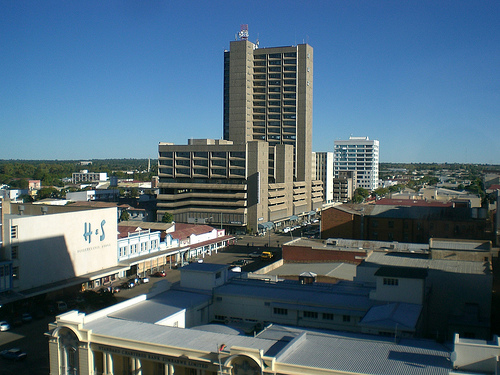
Bulawayo is Zimbabwe's most stately and relaxed city, and for many the most charming. The country's second city and the capital of Matabeleland, in the south-west, it has a character all its own, very different from Harare's: extremely wide avenues lined with jacarandas and flamboyant trees, elegant colonial buildings from the early 20th century, an unhurried pace and a strong Ndebele identity. It is known as the 'City of Kings', because it was the capital of the powerful Ndebele kingdom before the colonial conquest.
Born on the ashes of King Lobengula's royal kraal, burned in 1893, Bulawayo became the great industrial and railway centre of Rhodesia, and you can feel that heritage in its magnificent Railway Museum and in its planned-city layout. Today it is a first-rate cultural and historical base: it is home to the Natural History Museum, the best in Zimbabwe, and is the gateway to two nearby gems, the surreal Matobo National Park and the Khami Ruins, a World Heritage Site.
This guide covers Bulawayo with a practical eye: what to see in the city, how to use it as a base for Matobo and Khami, how to get around and where to stay and eat, plus its intense history, from the Ndebele kingdom of Mzilikazi and Lobengula to the conquest by the British South Africa Company, and from the industrial boom to the difficult episodes in Matabeleland after independence. A city of deep history, a relaxed atmosphere and warm people, ideal for getting a feel for southern Zimbabwe.
Bulawayo was the capital of the Ndebele kingdom, founded by King Mzilikazi Khumalo after fleeing Shaka's Zululand in the 1820s. His son Lobengula established his royal kraal here around 1870-1881; the name 'koBulawayo' is usually translated as 'the place of slaughter' or 'of the one who is persecuted'. After the clashes with Cecil Rhodes's British South Africa Company, Lobengula fled and set fire to his capital in 1893, and the settlers founded modern Bulawayo on its ashes in 1894. The city grew as an industrial and railway centre, and after independence it lived through the harsh years of the Gukurahundi repression. Its full story is told on our history page.
Read the full history ↓The land of King Mzilikazi: from the Ndebele capital with its wide avenues to the sacred granite of Matobo with Rhodes's grave, and the stone terraces of Khami.
Read the history of Bulawayo and Matabeleland →No exact prices: a scale from $ (budget) to $$$$$ (luxury), with 2-3 options per category.
Origins, formation and what the sources say.
Bulawayo's story begins far from here, in Zululand in southern Africa, in the days of the great king Shaka Zulu. In the 1820s, amid the wars and upheaval of the 'Mfecane' (the period of violence and migration that reshaped the south of the continent), a powerful military chief called Mzilikazi Khumalo, who had served under Shaka, broke with him and fled north with his followers. Over years of migration and war, Mzilikazi gathered peoples together and forged a new nation: the Ndebele (or Matabele).
After crossing the Limpopo River, Mzilikazi and his people settled around 1840 in the highlands of what is now south-western Zimbabwe, a region of good pasture and a healthy climate that would become Matabeleland. There he founded the Ndebele kingdom, a powerful and well-organised military state. Its army of fearsome regiments ('amabutho') dominated the region and collected tribute from neighbouring peoples, including many Shona groups on the plateau.
Mzilikazi ruled with a firm hand until his death in 1868. His kingdom was one of the great African powers in the region, with a royal capital, a king with absolute authority and a martial, cattle-herding culture inherited from the Zulu world. After the founder's death the throne would pass to one of his sons, Lobengula, who would lead Bulawayo to its height and also to its tragic end.
Lobengula Khumalo came to the Ndebele throne around 1870, after a period of uncertainty over who would succeed his father Mzilikazi. He set up his royal kraal, his capital, in the Bulawayo area, first at a spot known today as Old Bulawayo and later at a new site. The name 'koBulawayo' is usually translated as 'the place of slaughter' or 'the place of the one who is persecuted/killed'. It is thought to refer to power struggles within the Ndebele royal house, an echo of the blood spilt in succession disputes.
Lobengula's capital was a great African royal city: a huge compound of dwellings and cattle pens surrounding the king's residence, home to thousands of people, cattle, warriors and advisers. Lobengula was a shrewd and powerful monarch. He ruled a vast kingdom and received the European hunters, traders, missionaries and concession seekers who had started to prowl his lands, drawn by gold and by rumours of riches. Bulawayo was the political centre of all Matabeleland.
But a growing threat hung over the kingdom: British imperial expansion from the south, embodied by Cecil Rhodes and his British South Africa Company (BSAC). In 1888, through the famous (and deceptive) Rudd Concession, Rhodes's agents obtained mining rights from Lobengula, who never believed he was signing them all away. It was the beginning of the end of Ndebele independence.
Tensions between the Ndebele kingdom and the British South Africa Company erupted in 1893 in the First Matabele War. The BSAC's armed columns, equipped with Maxim machine guns, advanced on Matabeleland and defeated the Ndebele regiments in several bloody battles. As the enemy advanced, in November 1893, King Lobengula ordered his own capital, Bulawayo, to be set on fire so that it would not fall intact into the invaders' hands, and fled north. He died soon afterwards, in 1894, in circumstances that are still not entirely clear, and with him ended the independent Ndebele kingdom.
On the ashes of the royal capital, European settlers founded modern Bulawayo in 1894. Cecil Rhodes himself wanted the new town built exactly where Lobengula's kraal had stood, as a symbol of conquest. The town was laid out with its famous, extremely wide avenues and grew quickly. In 1896 the Ndebele and the Shona rose up together in the First Chimurenga (or Umvukela) against Company rule. The rebellion was crushed harshly after fierce fighting, partly in the Matobo Hills, where Rhodes negotiated peace with the Ndebele chiefs.
As a colonial city, Bulawayo prospered thanks to the railway, which arrived in 1897 and made it the great rail and industrial hub of Southern Rhodesia. Workshops, factories, shops and warehouses made it the economic engine of the colony for decades, and its elegant Edwardian and art deco architecture still defines the city centre today. Bulawayo was a booming city, although, like all of colonial Rhodesia, it was deeply segregated and unequal.
Bulawayo and all of Matabeleland played a central role in Zimbabwe's long struggle for independence. The region was a stronghold of ZAPU, led by Joshua Nkomo, an Ndebele leader and one of the great figures of African nationalism, whose guerrilla army (ZIPRA) fought Ian Smith's white-minority regime during the Bush War of the 1970s. After independence in 1980, however, the rivalry between Nkomo's ZAPU and Robert Mugabe's ZANU, whose base was mostly Shona, turned into a tragedy.
Between 1983 and 1987, Mugabe's government unleashed the campaign known as Gukurahundi on Matabeleland. It was a brutal crackdown, carried out mainly by the army's North Korean-trained Fifth Brigade, against supposed ZAPU 'dissidents'. An estimated 20,000 people were killed, most of them Ndebele civilians, alongside mass detentions, torture and forced starvation. Bulawayo and its region were marked forever by the massacre. It was officially hushed up for decades and remains an open wound and a demand for justice.
In 1987 the Unity Accord merged ZAPU with ZANU (forming ZANU-PF) and ended the violence, but it did not heal the wounds. In the decades that followed, Bulawayo also suffered the industrial decline and economic crisis that hit all of Zimbabwe, with many factories closing and heavy emigration. The city keeps a sense of grievance and an Ndebele identity distinct from the capital's, along with a historical memory that celebrates its glorious royal past and calls for recognition of the Gukurahundi tragedy.
Today Bulawayo is Zimbabwe's second city and one of the most loved by those who know it: the 'City of Kings', which keeps alive the memory of the Ndebele kingdom and the charm of its colonial architecture. Its wide avenues, Edwardian and art deco buildings, leafy parks and unhurried pace give it a stately, easy-going character that contrasts with the bustle of Harare. It is also the cultural capital of the south, with a strong Ndebele identity, music, the arts and a notable tradition of festivals and comedy.
The city is home to first-rate institutions such as the Natural History Museum of Zimbabwe, the best in the country, and the Railway Museum, which celebrate the country's natural wealth and its railway saga respectively. Its location also makes it the essential gateway to some of the country's greatest treasures: Matobo National Park, with its granite landscapes and ancient rock art, and the Khami Ruins, a World Heritage Site and capital of the kingdom that succeeded Great Zimbabwe.
Despite its ongoing economic difficulties (industrial decline, chronic water shortages in this semi-arid region, emigration), Bulawayo keeps its dignity, its beauty and its strong sense of community. From the royal kraal of Mzilikazi and Lobengula to today's garden city, by way of its industrial boom and the Gukurahundi tragedy, Bulawayo sums up the deep and contradictory history of Zimbabwe like few other places, and it welcomes travellers with a warmth and charm that stay with you.