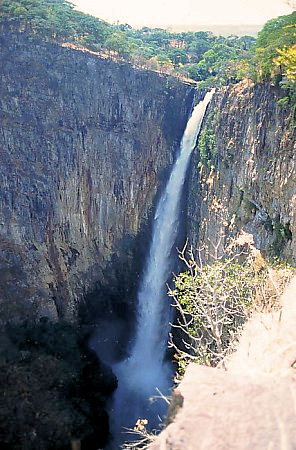
Kalambo Falls is one of Africa's great natural secrets: a ribbon of water leaping into the void from about 221 metres up (almost twice the height of Victoria Falls) into an imposing gorge in Zambia's remote north, on the border with Tanzania. It is the second-highest uninterrupted single-drop waterfall on the continent, and yet hardly anyone knows it: getting here, on dirt roads at the far edge of the country, is part of the magic.
But Kalambo is much more than a spectacular waterfall. The site is one of the most important archaeological sites in the world: on its terraces beside the river, archaeologists found a sequence of human occupation spanning hundreds of thousands of years, and in 2023 an astonishing discovery was announced there: the oldest known worked wooden structure, about 476,000 years old, predating even our own species. Kalambo brings together, in one place, the grandeur of the landscape and the deepest roots of humankind.
This guide explains how to visit Kalambo Falls: when to go, how to get there from Mbala or Lake Tanganyika, what to see (the falls, the gorge, the archaeological site, the birds) and how to combine it with the rest of Zambia's remote north. It's a destination for adventurous, curious travellers who love epic landscapes, deep history and the satisfaction of reaching an extraordinary place that very few people ever get to see.
Kalambo Falls is a place where nature and prehistory meet. The drop, about 221 metres, was formed by the geology of the Rift Valley, on the edge of the Lake Tanganyika basin. But its scientific fame comes from below: on its terraces, archaeologist Desmond Clark excavated, in the mid-20th century, one of the longest sequences of human occupation in Africa, with tools hundreds of thousands of years old. In 2023, a team from the University of Liverpool announced the discovery there of the world's oldest worked wooden structure, about 476,000 years old, made by hominins that came before Homo sapiens. That story is told on our history page.
Read the full history ↓Zambia's far north: the sandy beaches of Lake Tanganyika, one of the deepest and oldest lakes on the planet, and Kalambo Falls, next to one of humanity's key archaeological sites.
Read the history of The remote north →No exact prices: a scale from $ (budget) to $$$$$ (luxury), with 2-3 options per category.
Origins, formation and what the sources say.
Kalambo Falls is a product of the geology of the Great Rift Valley. The Kalambo River, which forms a natural border between Zambia and Tanzania, runs across a plateau until it reaches the edge of the huge depression that holds Lake Tanganyika. There the land breaks off sharply, and the river plunges in a single drop of about 221 metres (up to 235, according to some measurements) to the floor of a canyon. From there it carries on through the gorge towards the lake.
That unbroken drop makes Kalambo the second-highest free-falling waterfall in Africa, after the Tugela Falls in South Africa. It is almost twice as high as the famous Victoria Falls, although it carries far less water, and its flow changes a lot with the seasons: powerful and spectacular after the rains, thin at the height of the dry season. The canyon the river has carved over thousands of years is a natural monument in its own right.
The tectonic forces that pulled the plates apart and opened the Tanganyika basin, together with the slow work of water wearing down rock, shaped this landscape of plateau, cliff and gorge. But Kalambo is not world-famous only for what you see from the edge. It is also famous for what lies hidden in the sediment terraces beside the river, above the falls.
The banks of the Kalambo River, just above the falls, hold one of the most complete records of human prehistory in Africa. Over thousands of years, the river's floods laid down layers of sediment that buried and preserved what was left behind by each group of people who lived here. The result is an unusually long sequence of layers, a true natural archive of human history.
The key figure in studying the site was the British archaeologist J. Desmond Clark, one of the most important names in African archaeology. He excavated the site in the mid-20th century, mainly in the 1950s and 1960s. His work uncovered a long series of stone tool industries. They run from the Lower Palaeolithic, with its large Acheulean hand axes, to much more recent periods, and they show how different groups of people lived at the site over hundreds of thousands of years.
What makes Kalambo truly exceptional is that the water level beside the river has always stayed high, so organic materials survived that almost never last at sites this old: wood, seeds, fruit, charcoal. The wet ground worked like a time capsule. It preserved evidence of how our ancestors lived that would have rotted away long ago at other sites.
In September 2023, Kalambo made headlines around the world. A team of archaeologists from the University of Liverpool, working on the 'Deep Roots of Humanity' project, announced that they had found two logs at the site. The logs had been deliberately shaped and fitted together at right angles, with a notch cut to join them. Dating showed they were astonishingly old: about 476,000 years.
The discovery is groundbreaking. It is the oldest known worked wooden structure in all of human history, and it is hundreds of thousands of years older than our own species, Homo sapiens, which appeared about 300,000 years ago. So the people who built it were hominins who came before us. Stone tool marks on the wood show that it was shaped and joined on purpose, probably as the base of a platform, a raised walkway or part of a dwelling.
The find forced researchers to rethink what those early humans could do. Until then, it was believed that hominins in that distant age used wood only for simple things, like making spears or keeping a fire going. Kalambo showed that they could already shape large logs and join them to build structures. It also suggested they may not have been as nomadic as was thought, and could settle near reliable water sources like this river. It offered a unique window into the minds of our most distant ancestors.
The region's history doesn't stop with prehistory. The town nearest the falls, Mbala, known in colonial times as Abercorn, was an important outpost in the north of what was then Northern Rhodesia. Set in the highlands near Lake Tanganyika, it played a part in some of the major events of the 20th century.
One of the most notable came at the end of the First World War. The German colonial forces in East Africa, led by General von Lettow-Vorbeck, had fought a long guerrilla campaign and were never defeated in battle. When news of the European armistice of November 1918 arrived, these troops finally surrendered at Mbala (Abercorn), days after the war had officially ended. It was one of the last acts of the conflict anywhere in the world, and a small monument marks the event.
Today Mbala still carries that historical legacy. It is also home to the Moto Moto Museum, one of the best ethnographic museums in Zambia, devoted to the culture of the Bemba people and other groups of the north. Founded by missionaries, it holds a rich collection of ritual objects, instruments and tools that help explain the life and traditions of the region. This makes Mbala the cultural and historical gateway to a corner of Zambia where the deepest prehistory sits side by side with much more recent history.
Today Kalambo Falls is a destination that combines a grand landscape with a deep human history like few others. On top of its natural value (the second-highest free fall in Africa, a spectacular canyon, birds such as marabou storks), it is an archaeological site of world importance. It is on UNESCO's Tentative List as a candidate for World Heritage status.
And yet Kalambo is still a remote, little-visited place with almost no tourist infrastructure. Getting there means heading down dirt roads in the far north of Zambia, with a 4x4 and a local guide. The lack of development comes at a price, with few services and difficult access. But it also has great charm: you may get to see a giant waterfall all to yourself, and stand where our ancestors lived almost half a million years ago.
From the 221-metre drop carved by the Rift to the Acheulean hand axes and the 476,000-year-old worked logs, Kalambo packs in a story that runs from deep geology to the very origins of humankind, with a stop at the Great War's final surrender in nearby Mbala. For the traveller who makes the effort to get there, it is much more than a waterfall. It is a journey to the roots of humanity in the heart of Africa.