
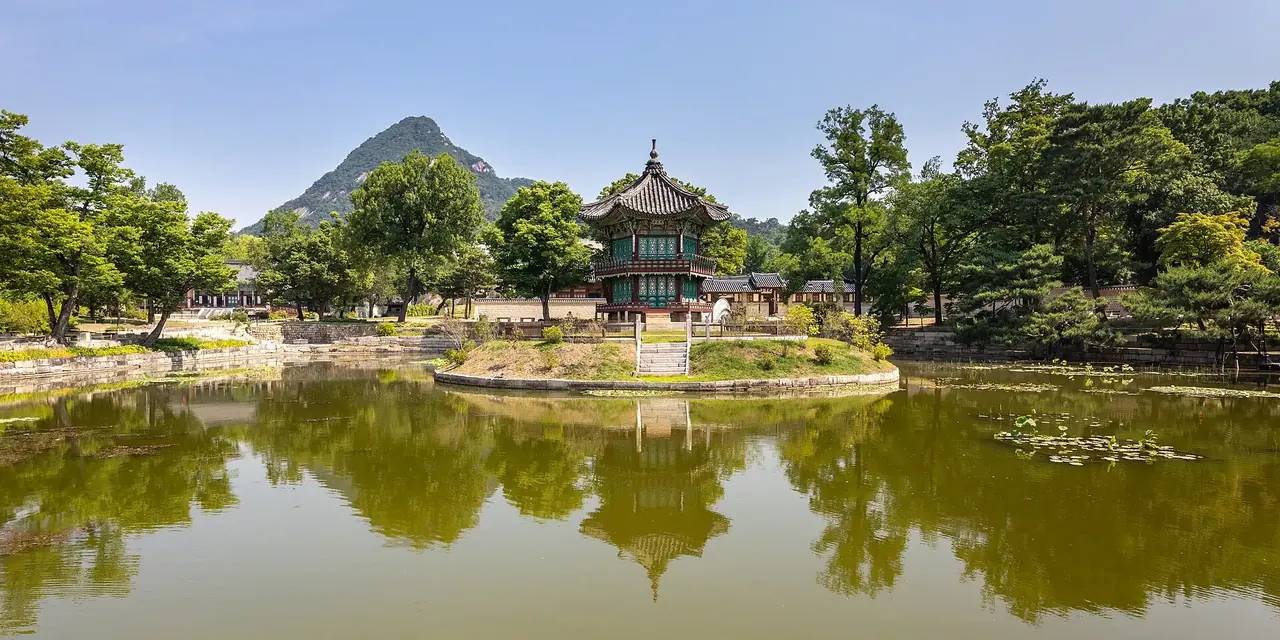
 Photo: Basile Morin · CC BY-SA 4.0 · source
South Korea city guide for Working Holiday: where should you land?
By Gus · Viaja con Gus
Seoul, Busan, Incheon, Daegu, Jeju… Korea is small on the map but every city plays differently for a Working Holiday. Here is an honest guide to each one: real cost of living in won (goshiwon and one-room), what work you'll find, how the dreaded deposit (보증금) works, the climate season by season, neighbourhoods where young people and foreigners live, transport, Latin community, and the pros and cons with no smoke and mirrors.

🧭 Here is the process. Looking for where to do your 88 days? Hotels, farms and mines in an eligible postcode, with each one's contact. →
The first decision of your Working Holiday in Korea isn't the visa (the H-1), it's where to land. And even though the whole country fits inside Argentina several times over, it doesn't make no difference which you pick. Almost half the population lives in the greater Seoul metropolitan area, so the capital carries enormous weight: most of the work, the Korean study options and the (small but real) Latin American community are there. But Busan gives you beaches and a milder climate, Jeju gives you an island and nature, Daegu gives you low prices and Incheon keeps you close to Seoul while spending less.
In this guide we go city by city through what really matters for a WH: how much you'll spend (rent for a goshiwon, those tiny rooms, or a one-room 원룸, which is what most people pay), what work you'll find with little Korean or with English, what the weather is like in each season (Korea has all four clearly marked: humid summers with the monsoon and sub-zero winters), which neighborhoods young people and foreigners gather in, how you get around (spoiler: the transport is from another planet), and how big the Latin American network is for making contacts quickly.
One key fact before you start, because it's the thing that surprises everyone: renting in Korea works differently. Almost everything is paid under the wolse (월세) system: a deposit (보증금) that can run from ₩5 to ₩10 million (yes, million) PLUS a monthly rent. The bigger the deposit, the lower the rent. As a newcomer without that cushion, the logical way out is the goshiwon (a tiny room, sometimes without a window, sometimes a shared bathroom, but WITHOUT a deposit and with rice and kimchi included) or a sharehouse for foreigners. The prices below are reference values; the market moves, so always confirm at the time.
✅ Requirements
💰 Money context (read this first)
So the numbers below make sense: the legal minimum wage in Korea is around ₩10,030-10,320 per hour (2025-2026), the same for all sectors. A full-time job (209 hours/month) gives a minimum of around ₩2.1 million gross per month. As a WH holder you'll start near the minimum in hospitality, cafés, factories or kitchens; with good English and teaching languages you can jump to ₩15,000-25,000/hour. || The big expense is NOT just the monthly rent: it's the deposit (보증금). A typical one-room asks for a ₩5-10 million deposit + ₩400,000-700,000 in rent. That's why newcomers almost always start in a goshiwon (no deposit, ₩250,000-550,000/month depending on the city) or sharehouse, and only move to a one-room once they've saved up. || Add food separately (eating out is cheap and delicious: ₩6,000-9,000 a dish; cooking is even cheaper), transport (with the T-money card, ₩1,400-1,600 a trip, among the cheapest in the developed world) and phone/internet. Rule of thumb: arrive with at least USD 2,500-3,500 as a cushion for a small deposit or a goshiwon, the first month and getting by until your first paycheck.
🏙️ Seoul (수도권)
Who it's for: the capital and the center of EVERYTHING. Ideal if you want the most job openings, the best academies for studying Korean, 24/7 city life and the largest Latin American community in the country. If in doubt, start here. || Typical jobs: language teaching (mostly English, in hagwons, the private academies, and private lessons; Spanish is more of a niche but there is demand in academies and private classes because of the K-pop wave and interest in Latin America), hospitality, cafés and bars, kitchen work, office jobs for Spanish speakers/bilinguals, modeling and extras for productions, and factories on the outskirts (Gyeonggi). English opens far more doors than basic Korean. || Cost of living: the most expensive. Goshiwon ₩400,000-600,000/month (no deposit); one-room (원룸) ₩500,000-750,000/month rent + a ₩5-10 million deposit; a room in a sharehouse for foreigners ₩450,000-650,000. || Climate: four sharply defined seasons. Summer (Jun-Aug) is hot and very humid, 28-33°C, with the rainy season (jangma) in July; winter (Dec-Feb) is dry, biting cold, -10 to 2°C, with snow; spring (cherry blossoms in early April) and autumn (foliage in Oct-Nov) are spectacular and the best time to arrive. || Young/foreigner neighborhoods: Hongdae (university area, art, the best nightlife), Itaewon (the most international neighborhood, the epicenter of the foreign and Latin American community, with restaurants and clubs), Yeonnam and Mangwon (cool, quiet, somewhat more affordable), Sinchon (university area), Gangnam (modern and expensive). || Transport: one of the best metro systems in the world, clean, punctual, cheap, everything signposted in English, plus a huge bus network, all with the T-money card. You don't need a car for anything. || Latin American community: the largest in Korea (which is still small in absolute terms), concentrated in Itaewon and Hongdae. There are Argentine/Latin American groups on Facebook and KakaoTalk, Latin American restaurants, Masses in Spanish and events. You get work tips and build a network quickly. || Pros: the most job and study options, unbeatable transport, endless cultural life, the biggest Latin American network. || Cons: the most expensive (the deposit is the big filter), an intense and competitive pace, sticky summers and very harsh winters.
🌊 Busan (부산)
Who it's for: the country's second city and the best if you want beaches, a milder climate and a more relaxed pace than Seoul without giving up a truly big city. A port city, hilly and by the sea. || Typical jobs: hospitality and tourism (strong in beach season), cafés, language teaching (a good hagwon market, a bit less saturated with foreigners than Seoul), logistics and the port (it's one of the largest ports in the world), and seasonal summer work in Haeundae and Gwangalli. || Cost of living: quite a bit cheaper than Seoul. Goshiwon ₩300,000-450,000/month; one-room ₩400,000-600,000 + a ₩3-7 million deposit (lower than in Seoul). || Climate: the mildest in mainland Korea thanks to being on the sea. Summer (Jun-Aug) is hot and humid, 27-31°C, with possible typhoons in Jul-Sep; winter (Dec-Feb) is mild by Korean standards and rarely drops far below 0°C near the coast; spring and autumn are ideal. || Young neighborhoods/areas: Haeundae (the iconic beach, modern and touristy), Gwangalli (a beach with the best nightlife and a view of the bridge), Seomyeon (the commercial and transport hub), Nampo-dong (traditional, markets), and the Kyungsung/Pukyong University area (Kyungsung Univ., bars and students). || Transport: a good metro (less extensive than Seoul's but enough), buses and the same T-money. The city is long and hilly, so trips sometimes take a while. || Latin American community: it exists but it's small; more of an international/traveler circuit than a big colony. || Pros: beach and sea, a friendlier climate, cheaper than Seoul, a relaxed atmosphere, a good base for the south of the country. || Cons: fewer job openings than Seoul, a small Latin American community, a city very spread out among hills, seasonal tourism (it drops in winter).
✈️ Incheon (인천)
Who it's for: anyone who wants to be next to Seoul while spending quite a bit less, or who prioritizes work tied to the airport and logistics. It's the city of the big international airport (ICN) and of Songdo, the ultramodern 'smart city'. About 1 hour from Seoul by metro. || Typical jobs: airport and logistics (one of the largest air hubs in Asia), factories and industrial parks, hospitality, and language teaching (Songdo has international schools, global universities (Incheon Global Campus) and families looking for lessons). Many people live in Incheon and work in Seoul. || Cost of living: cheaper than central Seoul. Goshiwon ₩300,000-450,000/month; one-room ₩400,000-600,000 + a ₩3-7 million deposit. Living here and commuting to Seoul is a classic strategy for saving money. || Climate: practically the same as Seoul (four seasons), with a bit more wind and humidity because it's on the west coast. || Neighborhoods/areas: Songdo (planned, green, modern, with Central Park; it feels new and orderly, sometimes half empty), Bupyeong (commercial, young, very well connected), Guwol-dong (administrative center), and Chinatown/Wolmido (the tourist and traditional area near the port). || Transport: integrated with the Seoul metro (lines 1, 7, Suin-Bundang and the AREX Airport Railroad), plus buses and T-money. Excellent connection to the capital and the airport. || Latin American community: small; part of the greater Seoul circuit. || Pros: cheaper than Seoul, ideal as a base for the capital, plenty of airport/logistics/factory work, a modern and quiet Songdo. || Cons: less 'soul' and life of its own than Seoul or Busan, everything is quite spread out, Songdo can feel impersonal, you depend on Seoul for the big nightlife.
🏭 Daegu (대구)
Who it's for: anyone looking for a big city that is much cheaper and more authentic, with little competition from foreigners and a solid market for teaching languages. The country's fourth city, in the southeastern interior, traditional and full of students. || Typical jobs: language teaching (a good hagwon market and, with fewer foreigners than in Seoul/Busan, it's sometimes easier to stand out), textiles and manufacturing (Daegu is the historic textile capital), hospitality and cafés. Less varied openings than the big coastal cities, but the teaching niche is real. || Cost of living: the most economical of the big cities. Goshiwon ₩250,000-400,000/month; one-room ₩350,000-500,000 + a ₩3-6 million deposit. Your money goes noticeably further. || Climate: famous for being the hottest city in Korea, since it sits in a basin with no access to the sea. Summer (Jun-Aug) is stifling, 33-36°C and humid, among the harshest in the country; winter (Dec-Feb) is cold and dry; spring and autumn are good. || Neighborhoods/areas: Dongseong-ro (the big shopping and pedestrian center, the young heart of the city), the Kyungpook National University area (Kyungpook Nat'l Univ., student-oriented with bars), Suseong (well-off residential), Duryu (park and leisure). || Transport: metro (three lines), buses and T-money. A manageable city, more compact than Seoul. || Latin American community: very small; you'll build your network mostly with the general foreign community and at work. || Pros: cheap, authentic and traditional, a good teaching market with little foreign competition, a truly big city with low costs. || Cons: brutally hot summers, much less international nightlife and an almost nonexistent Latin American community, less varied job openings than on the coast.
🍊 Jeju (제주)
Who it's for: people who come for the island lifestyle, nature and a slow pace rather than for maximizing their pay. A volcanic island off the south of the country and Korea's top tourist destination, with Mount Hallasan, beaches, waterfalls and the famous Seongsan Ilchulbong. || Typical work: tourism and hospitality full-on (hotels, cafés, guesthouses, diving, tours), seasonal farm work (the 'gyul' mandarin is the island's symbol; also green tea in the Osulloc fields), and many working holidaymakers do guesthouse work in exchange for accommodation. Work exchange (hostel staff) is more common than a big salary. || Cost of living: variable and very seasonal. In high season tourist accommodation shoots up; outside it, a one-room costs ₩400,000-600,000 + deposit, or you can live in a guesthouse or on a farm. Food and getting around are similar to the mainland. || Climate: the mildest and warmest in Korea, almost subtropical. Mild winters (it rarely snows, except at the top of Hallasan) at 5-10°C; humid summers at 28-31°C, and WATCH OUT for typhoon season (Jul-Sep), which hits the island hard. Very windy all year round. || Neighborhoods/areas: Jeju City (제주시, the main city in the north, urban, with the airport and everyday life), Seogwipo (서귀포, in the south, more touristy, warm and quiet), and the rural inland and coastal areas for farm/guesthouse work. || Transport: no subway; you get around by bus (the network has improved a lot) or, ideally, with a rented car/scooter, especially if you work outside the city. The island is best explored by car. || Latin community: minimal; the scene is made up of international travelers and Koreans. || Pros: spectacular nature, relaxed pace, a unique experience, plenty of seasonal work in tourism and farming, mild climate. || Cons: isolated (you arrive by plane or ferry), seasonal work and low wages in tourism, little 'city' and almost no Latin community, typhoons and constant wind.
💡 Consejos
- Define your priority and choose accordingly: maximum job supply, Korean-language study and a Latin network? → Seoul. Beach and mild weather without giving up a big city? → Busan. Saving money while living near Seoul? → Incheon. Low prices and a good teaching market with little competition? → Daegu. Nature, island life and a slow pace? → Jeju.
- Understand the rental system BEFORE you travel: almost everything is paid through wolse (a large 보증금 deposit + monthly rent). As a newcomer without that cushion, your best friend is the goshiwon (no deposit, rice and kimchi included) or a sharehouse for foreigners; only once you've saved some money do you move on to a one-room of your own.
- Keep the four seasons in mind: summer (Jun-Aug) is humid, with monsoon rains and typhoons; winter (Dec-Feb) is dry and cold, and on the mainland it drops below 0°C. The best times to arrive and look for work/accommodation are spring (March-May, with the cherry blossoms) and autumn (September-November).
- For teaching: English is king of the language market, but Spanish is growing thanks to interest in Latin America and Latin culture. Watch out for the legal side: formal teaching jobs at a hagwon often come with requirements; with the Working Holiday H-1 visa you can work in most fields, but always confirm what your visa allows before accepting.
- Download KakaoTalk (it's the Korean WhatsApp and you need it for everything), Naver Map or KakaoMap (Google Maps only half works in Korea) and get a T-money card as soon as you arrive. Look for accommodation in 'Argentines/Latinos in Korea' groups, in Korean apps and in sharehouses for foreigners; be wary of anyone who asks you to transfer a deposit without seeing the place.
- Big city (Seoul) = more work, more network and more study options, but more expensive and more competitive. Smaller city or island (Daegu, Jeju) = cheaper and less competition, but less variety of work and almost no Latin community. There is no 'best' option: there's the option that fits YOUR goal and budget.
🔗 Enlaces oficiales
📋 Korea Visa Portal — visa H-1 Working Holiday https://www.visa.go.kr/📋 HiKorea — immigration procedures and foreigner registration https://www.hikorea.go.kr/ℹ️ Korea Working Holiday Info Center (MOFA) https://whic.mofa.go.kr/ℹ️ Minimum Wage Commission — salario mínimo oficial https://www.minimumwage.go.kr/
❓ Frequently asked questions
What's the cheapest city for a Working Holiday in Korea?
Daegu is the cheapest big city (goshiwon from ~₩250,000/month and lower deposits), followed by Incheon and Busan. Seoul is by far the most expensive, mainly because of the deposit (보증금) that one-rooms require. In Jeju it depends a lot on the tourist season. In any city, the goshiwon (no deposit) is the cheapest way to get started.
Which city is best to arrive in as soon as I land?
For most people, Seoul: it has the largest job supply, the best Korean-language academies and the biggest Latin community, so it's the easiest place to start building a network and finding work. If your priority is beach and mild weather, Busan; if you want to save money near the capital, Incheon; if you're after nature and lifestyle, Jeju.
What is the deposit (보증금) and why is it so important?
It's the particular feature of Korean rentals. Most one-rooms are rented with wolse: a deposit (보증금) of between ₩5 and ₩10 million PLUS monthly rent; the higher the deposit, the lower the rent. As a newcomer you probably won't have that cushion, so the way out is the goshiwon (a small room with NO deposit, rice and kimchi included) or a sharehouse for foreigners, until you've saved some money.
Can I teach Spanish or English on a Working Holiday?
English dominates the teaching market (hagwons and private lessons); Spanish is more of a niche but is growing thanks to interest in Latin America. With the Working Holiday H-1 visa you can work in most fields. Watch out: formal teaching at academies often has its own requirements (degree, native speaker, etc.), so always verify what your visa allows before accepting a position.
Where is the biggest Latin American and Argentine community?
In Seoul, by far: it is concentrated in the Itaewon and Hongdae neighborhoods, with Latin restaurants, Spanish-language Masses, events and active groups on Facebook and KakaoTalk. In Busan there is some, mostly part of the international scene. In Daegu and Jeju the Latin community is minimal, so you'll mostly network with the general foreign community and at work.
Do I need a car in Korea?
In Seoul, Busan, Incheon and Daegu, not at all: public transport (subway + buses with the T-money card) is among the best and cheapest in the world, and everything is signposted in English. Where a car or scooter really helps is in Jeju, especially if you work on a farm or at a guesthouse outside the city, because the island is easier to get around on wheels.
🔀 Otras opciones
🧳
Back to Working Holiday South Korea
Requirements, form and everything you need to apply
→
📚 Sources
- Minimum Wage Commission (최저임금위원회) — salario mínimo 2025-2026: https://www.minimumwage.go.kr/
- Korea Working Holiday Info Center (MOFA): https://whic.mofa.go.kr/
- Korea Visa Portal — Working Holiday (H-1): https://www.visa.go.kr/
- HiKorea — Immigration & registro de extranjeros: https://www.hikorea.go.kr/
- Numbeo — Cost of Living / Rent in Seoul, Busan and Daegu (2025-2026): https://www.numbeo.com/cost-of-living/
Última verificación: July 2026.
← Back to Working Holiday South Korea
Ad - paid Remitly Ambassador.
Remitly · Send money home in minutes, with low fees
When you work in another country, sooner or later you will want to send money home: to help your family, cover a bill or put your savings away. That is what I use Remitly for, and why I recommend it. It is very fast: it connects to any local account in your home country and the money arrives in minutes.
You can choose between different ways to send, depending on what suits you, and the fees are low. On top of that, my ambassador code AMB6M8 gets you USD 20 off your first transfer. It applies to transfers from the countries where Remitly operates. The code AMB6M8 does not apply in Australia, the United Arab Emirates or France. Check in the app whether the code works in yours before you send.
AMB6M8 See benefits →
Photos from Wikimedia Commons, each under its own licence: North view of Sydney Opera House, the Rocks and Sydney CBD
