
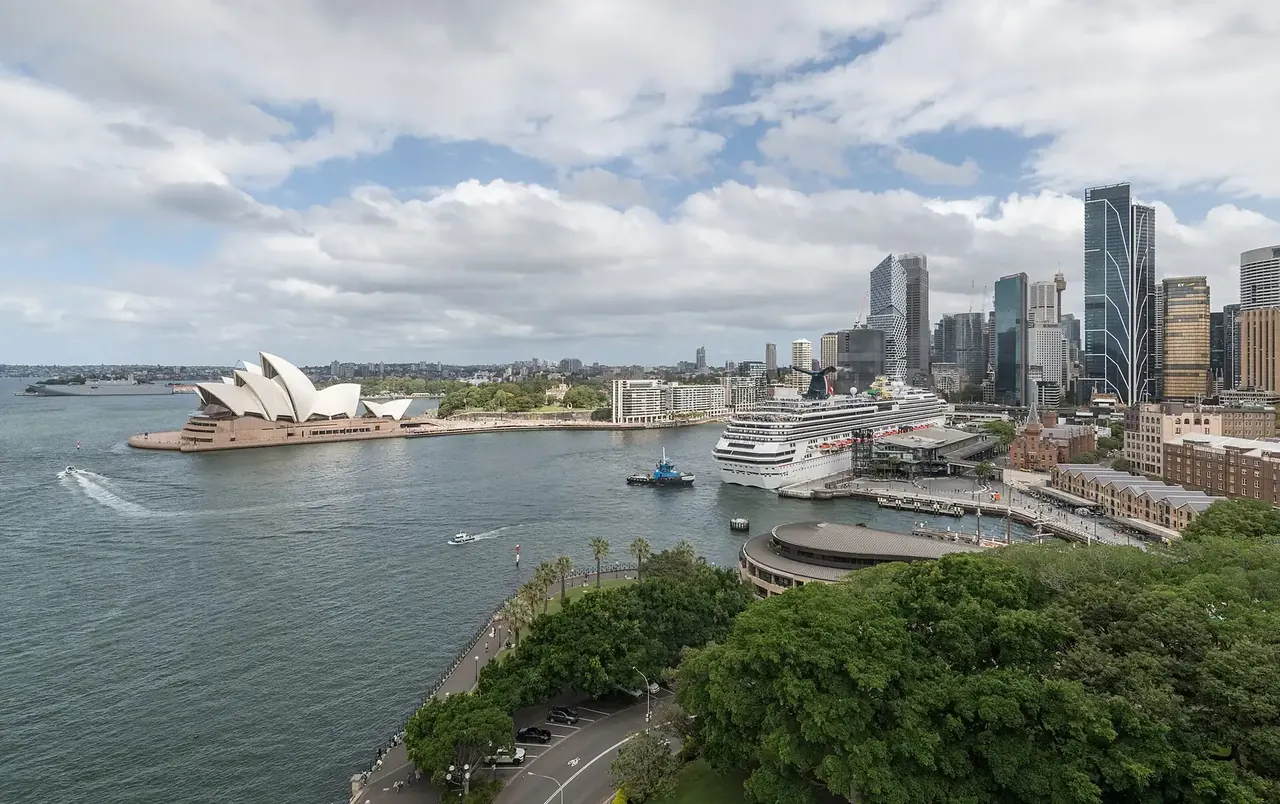
 Photo: DXR · CC BY-SA 4.0 · source
Australia city guide for Working Holiday: where should you land?
By Gus · Viaja con Gus
Sydney, Melbourne, Brisbane, Perth, Cairns and more: which city to land in on the Working Holiday, what work there is and how to choose according to your plan.

🧭 Here is the process. Looking for where to do your 88 days? Hotels, farms and mines in an eligible postcode, with each one's contact. →
The first big decision of your Working Holiday in Australia isn't the visa: it's where to arrive. And it makes a difference. Australia is an entire continent, about the size of the United States, with cities thousands of kilometres apart, opposite climates and very different job markets. Landing in Sydney in the middle of January (summer, everything expensive, everyone looking for the same thing) is a completely different experience from arriving in Perth, in Adelaide or going straight to a farm in Queensland.
In this guide we go through it city by city and cover what really matters for a Working Holiday: how much you'll actually spend (rent for a shared room in AUD, which is what most people pay), what work you'll find with little English or a lot, what the weather is like in each season (note: southern hemisphere, so December–February is summer and June–August is winter), which neighbourhoods young people and travellers gather in, how you get around, and how big the Latin community is for building a network quickly.
One key fact before you start: for the second and third visas (the 88 and 179 days of specified work), hospitality work only counts in Northern Australia or in Remote and Very Remote areas, according to Home Affairs. That rules out Sydney, Melbourne and Brisbane's CBD. That's why many do something logical: start in a big city, save money and improve their English, and then go to a regional area or the north to do the days. Always check the exact postcode with Home Affairs before accepting a job. The rest of this guide is my criteria for choosing, not official data.
✅ Requirements
💰 Money context (read this first)
Home Affairs asks you to show about AUD 5,000 for the initial stay, plus the ticket out of Australia. My advice is to arrive with more: the biggest expense is always rent, and the first month goes on the deposit (bond), the first weeks and getting started. Almost all Working Holiday makers live in a shared room, not in a flat of their own. In Australia rent is quoted per week: keep that in mind when you compare. According to the Fair Work Ombudsman, the national minimum wage is AUD 26.44 an hour from 1 July 2026, and a 25% loading (casual loading) is added for the casuals it covers; since casual is the norm, keep that in mind. Today's figure is given by Fair Work's Pay Calculator.
🏙️ Sydney (NSW)
Who it's for: for me, the most iconic and the most expensive. For me it's the option if you want the postcard (Opera House, Bondi) and you're after a big city with lots on offer. || Typical work: hospitality (waiter, barista, kitchen hand, bartender), retail, construction, cleaning, au pair, delivery. Lots on offer but also lots of competition because every WH lands here. English opens doors: with good English you jump from kitchen hand to waiter/barista and earn more. || Cost of living: among the highest in the country, and rent is the big filter. Check the current figures. || Climate: hot and humid summer, cool winter; autumn and spring are the most pleasant. || Young/traveller neighbourhoods: Bondi, Coogee and Maroubra (backpackers and beach in the east), Newtown/Enmore/Marrickville (Inner West, alternative, good nightlife and somewhat cheaper), Surry Hills (cool and expensive), Manly (northern beach). || Transport: network of trains, buses and ferries with the Opal card; for me it works well, although it isn't cheap; my advice is to live near a train line. || Latin community: large, one of the largest in the country along with Melbourne, according to the guides; there are Argentine groups, asados, football and plenty of Latin nightclubs. You get a network and job leads quickly. || Pros: lots of work on offer, beaches, vibrant city, big Latin network. || Cons: very expensive, lots of competition for jobs and long distances. For the specified work of the second visa, Sydney hospitality doesn't count.
🎭 Melbourne (VIC)
Who it's for: popular with young, artistic and coffee-loving people. If you care more about culture, coffee and music than the beach, I'd start here. || Typical work: lots of coffee culture (an experienced barista earns well), hospitality in general, retail, events, construction, warehouse, delivery. A very good job market, somewhat less saturated than Sydney in some sectors. || Cost of living: expensive, but a step below Sydney. Eating and going out are somewhat more affordable than in Sydney. || Climate: changeable. Hot and dry summer; cold, grey and rainy winter. Always carry a jacket. || Young/traveller neighbourhoods: Fitzroy and Collingwood (hipster, art, bars), Brunswick (multicultural and cheaper), St Kilda (beach and backpackers), Carlton (university and Italian), Footscray (cheap and diverse). || Transport: for me, the most comfortable in Australia. Iconic tram network —free in the CBD—, trains and buses with the Myki card. || Latin community: large, on a par with Sydney. Lots of Argentines, events, milongas, football, very active Facebook groups. || Pros: lots of culture and city life, coffee and food, very walkable and well connected, big Latin network, a bit cheaper than Sydney. || Cons: the cold, grey winter weighs on your mood, it isn't a beach city, and as in Sydney its hospitality doesn't count for specified work.
☀️ Brisbane (QLD)
Who it's for: the balance. A big but relaxed city, with warm weather almost all year, more affordable than Sydney and Melbourne and with a good young scene. For me it's the option for anyone who wants sun without the rent eating them alive. || Typical work: hospitality, retail, construction, cleaning, warehouse. A good market, less saturated than the two big southern cities. || Cost of living: more affordable than Sydney and Melbourne. || Climate: subtropical. Hot and very humid summer, with storms; dry, mild winter. || Young/traveller neighbourhoods: West End (bohemian, multicultural, lots of Latinos), Fortitude Valley 'the Valley' (nightlife), New Farm, South Brisbane, Woolloongabba. || Transport: good network of buses, trains and the CityCats (catamarans on the Brisbane River, a great touch). Go card. More dependent on the bus than Melbourne. || Latin community: large and very active; Brisbane is a classic of the Latin circuit in Australia, with lots of Brazilians, Colombians and Argentines. || Pros: warm weather, cheaper than the south, relaxed atmosphere, a good starting point for the Gold Coast, Sunshine Coast and north Queensland. || Cons: less imposing than Sydney or Melbourne, heavy summers because of the humidity, smaller nightlife. Careful: hospitality in Brisbane's CBD doesn't count for specified work; in north Queensland it can, depending on the postcode.
🏄 Gold Coast (QLD)
Who it's for: anyone who's going to work in hospitality or tourism and wants to live in beach mode. Surf, skyscrapers facing the sea and nightlife. Very popular with young Working Holiday makers. || Typical work: tourism and hospitality in full swing (hotels, bars, restaurants, theme parks such as Movie World/Dreamworld), retail, construction, cleaning, promotion. Strong seasonal work in summer. || Cost of living: mid-range, more affordable than Sydney, but it goes up in high season. || Climate: subtropical, with hot, humid summers and mild winters. || Neighbourhoods/areas: Surfers Paradise (touristy, expensive, party), Broadbeach (tidier), Burleigh Heads (surfer, cool, good vibe), Southport, Coolangatta (to the south, quieter). || Transport: there is a train to Brisbane and the G:link tram along the coast; you combine it with the bus. Many get around better with a car or bike. || Latin community: solid and growing, mostly Brazilians and Argentines in the hospitality and surf circuit. || Pros: beach and sun all year, young party atmosphere, lots of seasonal tourism work, a good base for southern Queensland. || Cons: the economy depends on tourism (seasonal work) and Surfers Paradise can feel very touristy. If your plan is to renew the visa, check the postcode: hospitality in a touristy coastal area doesn't necessarily count.
🌅 Perth (WA)
Who it's for: anyone who can put up with isolation in exchange for less competition from other Working Holiday makers and a relaxed lifestyle, with beaches. It's a big city quite isolated from the rest of the country. || Typical work: hospitality, retail, construction, and above all the differentiator: mining and its services (FIFO —fly in fly out—), which pay very well although they usually ask for certifications. Also hospitality in northern WA (Broome, Kununurra) which DOES count for specified work. Less competition = you find work more easily. || Cost of living: cheaper than Sydney/Melbourne on rent. Wages tend to be good because of the mining economy. || Climate: Mediterranean and sunny. Hot, dry summer; mild, rainy winter. || Young/traveller neighbourhoods: Fremantle 'Freo' (port, bohemian, with a lot of character), Northbridge (nightlife and hostels), Scarborough and Cottesloe (beach), Leederville, Mount Lawley. || Transport: good train and bus network (Transperth) with a free zone in the centre; the city is spread out, having a car helps. || Latin community: it exists and is great, but quite a bit smaller than on the east coast. Less network, but also less saturation. || Pros: high wages (especially with mining/construction), postcard beaches, lots of sun, little competition for work, gateway to northern WA for specified work. || Cons: total isolation (travelling to the rest of Australia is expensive), smaller Latin community, smaller nightlife, everything is far away.
🍷 Adelaide (SA)
Who it's for: anyone who wants a quiet, cheap, manageable city, with the wine region next door. || Typical work: hospitality, retail, and strong seasonal farm work around it (Barossa Valley, McLaren Vale and Adelaide Hills vineyards: grape harvest, pruning, winery) which can also count for specified work in eligible postcodes. Warehouse and factory work too. || Cost of living: among the cheapest capitals. Money goes much further here. || Climate: Mediterranean, similar to Perth. Very hot, dry summer; cool, rainy winter. || Young/traveller neighbourhoods: the city is compact and laid out on a grid. North Adelaide, the CBD's West End, Glenelg (beach, with a tram), Norwood and Prospect. || Transport: manageable; tram to Glenelg, trains and buses (Metrocard). A small, walkable city. || Latin community: smaller than in the big cities, but it exists. || Pros: affordable, quiet, very liveable, a good base for the grape harvest and the region's farm work. || Cons: fewer city jobs than the big ones, smaller nightlife and 'scene', extremely hot summers, it may feel 'small' if you want lots of action.
🐠 Cairns (QLD)
Who it's for: anyone going for the Great Barrier Reef and the tropics, who also wants to be in an area of north Queensland, a classic base for renewing the visa with hospitality or farm work. || Typical work: tourism and hospitality (diving, reef tours, hostels, bars) and farm work in the region. In the north, hospitality can add days for the second and third visas: always check the exact postcode. || Cost of living: more affordable than the big cities. || Climate: tropical, with two seasons. The dry season (roughly May to October) is, for me, the best time, and it is peak tourist season. The wet season, November to April, brings heat, humidity, heavy rain and cyclone risk, and brings jellyfish (stingers). Spain's MAEC recommends swimming only in marked areas on beaches all over Australia, because of sharks and jellyfish. || Neighbourhoods/areas: it's a small city; most WHs live near the CBD and the Esplanade (with its free public lagoon to swim in). || Transport: compact city, you walk; local buses. For farm work inland, a car or the employer's transport is best. || Latin community: present in the backpacker circuit; lots of sharing of farm work leads. || Pros: tropics, the Great Barrier Reef next door, hospitality that counts for specified work, an ideal base for northern farm work. || Cons: the wet season is tough (heat, humidity, cyclones, jellyfish), a small city with less variety, very seasonal tourism work (drops in the wet).
🐊 Darwin (NT)
Who it's for: the adventurer. Capital of the Northern Territory, tropical and remote. For me it's a good base for adding specified work days in the north: according to Home Affairs, the entire Northern Territory is on the list of Remote and Very Remote areas. || Typical work: hospitality (which here can count for specified work), farm work (mango), construction and fishing. Careful: mining isn't among the approved industries for the 462 days (Home Affairs, 12 October 2026), however well it pays; in a camp, what can count is a hospitality job. || Cost of living: mid-range; rent isn't cheap because it's a remote area. || Climate: tropical, with two seasons. The dry is the good season and peak season; the wet («the Wet») brings extreme heat and humidity, storms and cyclone risk. || Neighbourhoods/areas: small city; most people live near the CBD, Nightcliff, Fannie Bay and Parap. || Transport: small city with limited buses; a car is very useful to get around and reach the attractions (Kakadu, Litchfield). || Latin community: small but supportive; very much backpacker circuit. || Pros: hospitality DOES count for specified work, lots of farm work (mango) and work in the north, little competition, wild nature (Kakadu, Litchfield). || Cons: remote and costly to connect with the rest of the country, the wet season is tough. Spain's MAEC asks for special caution in the camping areas of the north (Queensland, Northern Territory) because of crocodiles.
🌈 Byron Bay (NSW)
Who it's for: anyone after the hippie-surfer-wellness lifestyle. A coastal town in northern NSW, near the Queensland border. A particular vibe, but expensive and with limited work. || Typical work: hospitality and tourism (cafés, bars, hostels, shops), and farm work in the hinterland, which can count for specified work depending on the postcode. City work is seasonal and competitive because everyone wants to live there. || Cost of living: high for how small it is; the demand to live in Byron pushes prices up and there is little housing available. || Climate: subtropical, pleasant. Warm, humid summer, which is peak season; mild, sunny winter. || Neighbourhoods/areas: the town is small; you live in town, in nearby areas (Suffolk Park, Ewingsdale) or in hinterland towns (Bangalow, Mullumbimby). || Transport: no train; you depend on cycling, walking and the bus. Having a car helps a lot. || Latin community: there is a strong traveller and international scene, with a Latin presence, very backpacker/wellness. || Pros: its own lifestyle (beach, surf, yoga, markets, nature), young and international atmosphere, farm work in the area that can count for specified work. || Cons: expensive and with little housing available, limited and seasonal city work, small (it may fall short), far from a big airport (the nearest is Gold Coast/Ballina).
🏔️ Hobart (Tasmania)
Who it's for: anyone who wants wild nature, quiet and an island of landscapes, and isn't afraid of the cold. Tasmania's capital is small and has a temperate to cold climate. Much chosen for seasonal farm work that counts for specified work. || Typical work: hospitality, retail and lots of seasonal farm work across the island (cherry, apple, grape, berries, salmon, packing). Summer is the peak harvest season. Check the postcode for specified work. || Cost of living: among the most affordable capitals on rent, along with Adelaide. || Climate: temperate to cold, cool for a capital. Mild summer; cold winter, with snow on the nearby mountains and short days. || Neighbourhoods/areas: a very small, walkable city; North Hobart (food), Battery Point, Sandy Bay and the centre near Salamanca. || Transport: no train; buses and lots of walking. For farm work on the island, a car is almost essential. || Latin community: small but warm; present in the farm work circuit. || Pros: affordable, nature, quiet, farm work across the island, the Salamanca market and the MONA museum. || Cons: cold in winter with short days, small and with fewer city jobs, isolated (you have to fly or take the Spirit of Tasmania ferry), 'not much city' for anyone after a scene.
🌤️ Honourable mentions: Sunshine Coast and Newcastle
Sunshine Coast (QLD): north of Brisbane, an hour's drive. Lovely beaches (Noosa, Mooloolaba, Maroochydore), a sunny subtropical climate and a calmer, more family vibe than the Gold Coast. Good seasonal hospitality/tourism work and construction. Ideal if you want Queensland's beach and sun with less partying than the Gold Coast. Careful: as a touristy coastal area, hospitality doesn't count for specified work. || Newcastle (NSW): A surf coast, a relaxed university atmosphere, and quite a bit cheaper than Sydney. A good market for hospitality, retail and some industry/port work. For me, an alternative if you want to be near Sydney without paying its prices, and with beaches. Newcastle and the Hunter Valley region (vineyards, next door) have areas that can count for agricultural specified work.
🌾 Go straight to a farm / regional work (the shortcut to the 2nd visa)
Some people don't even pass through the big city: they arrive and go straight to a regional area to do farm work, to start adding up the 88 days of specified work for the second visa (or the 179 for the third) right away. It's the fastest way to renew and, if city work scares you because of English, farm work usually asks for less language. || Who it's for: anyone who wants to secure the renewal as soon as possible, save (you spend less in the countryside), and doesn't mind physical work. || What it is: harvesting, packing and pruning of fruit and vegetables in eligible regional areas. According to Home Affairs, plant and animal cultivation is the harvesting or packing of fruit and vegetables, and the immediate processing of animal products; it has to be your main task, and general garden maintenance doesn't count. You're paid by the hour or by the piece (piecework), and it has to meet Australian labour standards: check the minimum pay in Fair Work's Pay Calculator. || How you find it: apps and websites (Backpacker Job Board, Harvest Trail / Jobs and Skills Australia, each town's Facebook groups), or by arriving at a local working hostel (they give you a bed + connect you with the farm, although they charge a commission: check it's legal and that the postcode counts). || Pros: you add days for the visa from day one, you save and build an international network quickly. || Cons: physical work under the sun, variable income (especially with piecework) and small towns with little to do. Beware of scams: never pay upfront for a job, check yourself that the industry and postcode count (don't just trust the employer) and insist on payslips and being paid through the bank. According to Home Affairs, without evidence of the work (payslips, bank statements, piecework agreement) the days aren't counted. || Where: the season changes with the fruit and the area. The Australian Government's Harvest Trail lists seasonal farm jobs.
📮 Does that job count toward your 88/179 days?
The postcode alone isn't enough: the same town can work for farm work and not for a hotel. Enter the four digits and the type of work, and we'll tell you whether those days count toward the second visa (88 days) or the third (179).
🌾 Farm work: harvest, pruning, packing, dairy, shearing🏨 Tourism and hospitality: hotel, bar, restaurant, tour🏗️ Construction🎣 Fishing and pearling🌲 Forestry and logging⛏️ Mining🔥 Bushfire recovery🌀 Recovery after flood, cyclone or storm🏥 Critical health work (COVID-19)My visa is the 462 (Work and Holiday)My visa is the 417 (Working Holiday)
Check if it counts
The 462 is the visa most of our readers use (Argentina, Chile, Uruguay, Peru, Ecuador…). The 417 is for Italy and other European citizenships with an agreement (Spain goes through the 462): they use the same postcodes, but not the same industries. Always confirm on the official source before you accept the job.
💡 Consejos
- Define your number one priority and choose accordingly: save money and renew your visa fast? → go straight to farm/regional areas or the north (Cairns, Darwin). Maximum job supply and a Latin community? → Sydney or Melbourne. Warm weather and a good balance of price and lifestyle? → Brisbane or Gold Coast. Cheap and quiet? → Adelaide or Hobart. High wages with less competition? → Perth.
- The classic, recommended strategy: arrive in a big city (Sydney, Melbourne, Brisbane) for the first 3-6 months, save money, improve your English and build a network; then move to a regional/northern area to do the 88 days. The best of both worlds.
- Remember the southern hemisphere: December-February is SUMMER (high season, everything pricier and busier) and June-August is WINTER. If you arrive in the middle of summer in Sydney, you'll find everything very expensive and saturated; arriving in autumn (March-May) is usually easier for finding accommodation and work.
- Hospitality in Sydney, Melbourne and the Brisbane CBD does NOT count as specified work. If your plan is to renew, don't lose months waiting tables in the CBD thinking it adds up: it doesn't. The work that renews your visa is in the countryside and in the north.
- Start in a hostel (1-2 weeks) while you find a sharehouse. Look for a room on Flatmates.com.au, Facebook Marketplace and 'Argentines/Latinos in [city]' groups. Be wary of anyone who asks for a deposit by bank transfer without you seeing the place: it's a classic scam aimed at newly arrived working holidaymakers.
- Big city = more work but more expenses and competition. Small city or regional area = lower costs and a better chance of getting hired, but less variety and nightlife. There's no 'best' option, only the option that fits YOUR goal and budget.
- If you're heading to the tropical north (Cairns, Darwin) or to a farm, check the season: the wet season (Nov-Apr) in the north is tough and tourism drops; each fruit's harvest has its own window. Arrive when there's work, not when there's a cyclone.
- Spain's MAEC (last updated 12 May 2026) puts no specific restrictions on travelling to Australia. It recommends swimming only in marked areas on beaches all over Australia, because of sharks and jellyfish; taking special care in the camping areas of the north (Queensland, Northern Territory) because of crocodiles; and warns of a considerable risk of bushfires in the hottest months, particularly from November to March.
- Traveller assistance (travel insurance): 50% OFF plus 20% OFF. I always recommend travelling with traveller assistance (travel insurance). My recommendation: GO! Assistance. 50% OFF from GO! plus an extra 20% OFF from Viaja con Gus. Affiliate link: we earn a commission.
🔗 Enlaces oficiales
📋 Work and Holiday visa (462) — Home Affairs https://immi.homeaffairs.gov.au/visas/getting-a-visa/visa-listing/workℹ️ Specified work and eligible areas/postcodes (Home Affairs) https://immi.homeaffairs.gov.au/visas/getting-a-visa/visa-listing/workℹ️ Harvest Trail — seasonal farm work (Australian Government) https://www.jobsandskills.gov.au/harvest-trailℹ️ Fair Work Ombudsman — your workplace rights and minimum wage https://www.fairwork.gov.au/
❓ Frequently asked questions
Which is the cheapest city for a Working Holiday?
I have no rent figures from an official source, so I'm not giving you amounts. According to unofficial rent information, the most affordable capitals are Adelaide and Hobart, and the most expensive, Sydney and Melbourne. And cheap also depends on the work: in the countryside you spend less, although there's less to do.
Which city is best to arrive in as soon as I land?
It depends on your plan. If you want maximum job supply and a Latin network to get started, Sydney, Melbourne or Brisbane. If you want to secure the 2nd visa from day one, it's best to go straight to a regional/farm area or the north (Cairns, Darwin). A very common route: start in a big city for a few months and then move to do the 88 days.
In which cities does work count for the 2nd visa?
Specified work (the 88 days) isn't done in the big southern cities: hospitality in Sydney, Melbourne and Brisbane's CBD doesn't count. According to Home Affairs, hospitality counts in Northern Australia and in Remote and Very Remote areas; farm work and construction, in Northern Australia and in certain regional areas. Mining isn't among the approved industries for the 462. Always check the exact postcode with Home Affairs before accepting a job.
Where is the biggest Latin American and Argentine community?
Sydney and Melbourne have the largest Latin communities, with events, football, asados and very active groups. Brisbane and Gold Coast also have a good Latin scene (lots of Brazilians and Colombians). In Perth, Adelaide, Hobart and the north the community is smaller but warm and very much part of the backpacker circuit.
How much do I need for the first month in a big city?
The minimum Home Affairs asks for is in «Money context». I'd arrive with more, and even more for Sydney: the first month goes on the deposit, the first weeks of rent and the start-up costs, until you get your first pay.
Sydney or Melbourne?
Sydney: spectacular beaches, a warmer climate, the biggest city with the most opportunities, but also the most expensive. Melbourne: more cultural, with great coffee and very walkable, a notch cheaper, better public transport, but with cold, grey winters and no city beach. If you put sun and beach first, Sydney; if you put culture, coffee and city life first, Melbourne.
Is a small city or a big one better?
Big (Sydney, Melbourne, Brisbane): more work, more going on, more network, but more expensive and more competition. Small or regional (Adelaide, Hobart, Cairns, Darwin, farm): cheaper, easier to get hired, but less variety and less to do. To save money and renew your visa, small/regional wins; for the maximum city experience and job supply, big.
🔀 Otras opciones
🏨
Accommodation where your work counts for the 2nd/3rd visa
Directory of hotels in eligible areas
→
🧳
Back to Working Holiday Australia
Requirements, application form and everything for the 1st year
→
📚 Sources
- Home Affairs: Work and Holiday visa (462): https://immi.homeaffairs.gov.au/visas/getting-a-visa/visa-listing/work-holiday-462 (funds of about AUD 5,000)
- Home Affairs: Specified work for the 462: https://immi.homeaffairs.gov.au/what-we-do/whm-program/specified-work-conditions/specified-work-462 (page updated on 12 October 2026)
- Fair Work Ombudsman, Annual Wage Review 2026: «From 1 July 2026, the national minimum wage is $1004.90 based on a week of 38 ordinary hours ($26.44 per hour)»: https://www.fairwork.gov.au/about-us/workplace-laws/annual-wage-review/annual-wage-review-2026; 25% casual loading according to the pay guide of the Hospitality Industry (General) Award MA000009, in force from 1 July 2026 (level 1: $26.44 full-time or part-time, $33.05 casual);
- Jobs and Skills Australia: Harvest Trail: https://www.jobsandskills.gov.au/harvest-trail
- Australian Bureau of Statistics — Latest insights into the rental market: https://www.abs.gov.au/articles/latest-insights-rental-market
- Spain's Ministry of Foreign Affairs, Travel recommendations: Australia (updated 12 May 2026): https://www.exteriores.gob.es/es/ServiciosAlCiudadano/Paginas/Detalle-recomendaciones-de-viaje.aspx?trc=Australia
Última verificación: July 2026.
← Back to Working Holiday Australia
Ad - paid Remitly Ambassador.
Remitly · Send money home in minutes, with low fees
When you work in another country, sooner or later you will want to send money home: to help your family, cover a bill or put your savings away. That is what I use Remitly for, and why I recommend it. It is very fast: it connects to any local account in your home country and the money arrives in minutes.
You can choose between different ways to send, depending on what suits you, and the fees are low. On top of that, my ambassador code AMB6M8 gets you USD 20 off your first transfer. It applies to transfers from the countries where Remitly operates. The code AMB6M8 does not apply in Australia, the United Arab Emirates or France. Check in the app whether the code works in yours before you send.
AMB6M8 See benefits →
Photos from Wikimedia Commons, each under its own licence: North view of Sydney Opera House, the Rocks and Sydney CBD
