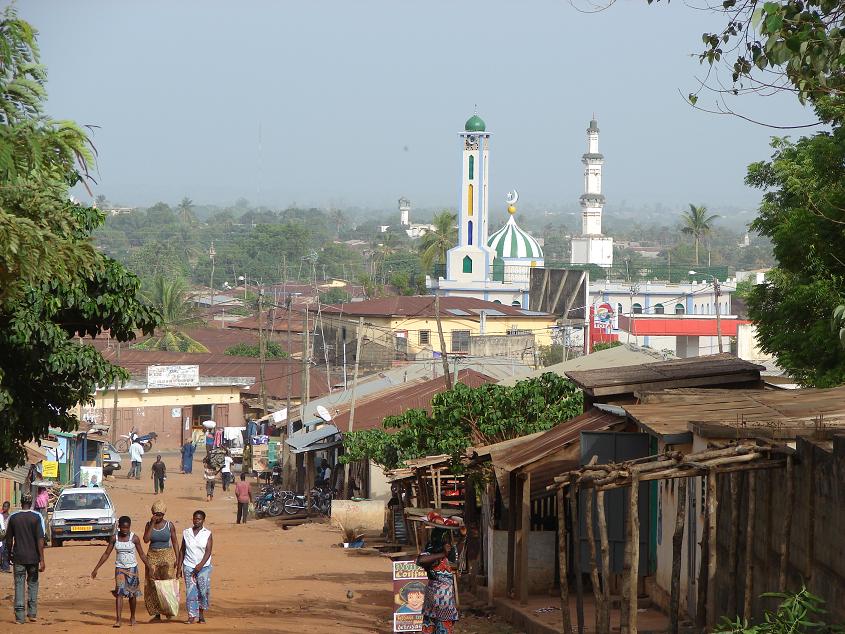
Sokodé is the big city of central Togo and the cultural capital of the Tem people, also known as the Kotokoli. The country's second city, it is the heart of Muslim Togo: a city of mosques, a large market, cotton weavers and a vibrant traditional life that culminates in the Adossa-Gadao, the fire and knife festival, one of the most impressive cultural spectacles in West Africa.
Located at the crossroads of the old trade routes that linked the forests of Ghana with Hausa country in northern Nigeria, Sokodé was for centuries a caravan hub for kola nuts, salt and textiles, and a gateway for Islam into Togo. That heritage can be felt in its cosmopolitan, commercial atmosphere, its embroidered boubous, its handmade textiles and its festivals, where Tem culture and the Muslim Didaouré community celebrate together.
This guide explores Sokodé with a practical eye: what to see in the city —market, mosques, traditional chiefdoms, weavers' quarter—, how to experience the Adossa-Gadao festival with its famous fire dance, where to stay and eat, and how to use it as a base or stopover on the journey to northern Togo. A crossroads city, deeply Muslim and proud of its culture, that surprises travellers who decide to stop.
Sokodé grew as a trading hub of the Tem (Kotokoli) people, who settled in the Tchaoudjo region between the 17th and 18th centuries and founded a chiefdom there. Its position on the kola-nut caravan routes —which linked the forests of present-day Ghana with Hausa land in northern Nigeria— made it a prosperous crossroads through which Islam and Sudanese merchants (Mandinka and Hausa) arrived. Under German and French colonial rule it was the administrative capital of the centre of the country, and today it is Togo's second city, the heart of Muslim Togo and the birthplace of the Adossa-Gadao fire festival.
Read the full history ↓Muslim Togo of the Tem people around Sokodé and the fire festival, with the country's largest natural park, Fazao-Malfakassa, between savannah and mountain forest.
Read the history of Central Region →No exact prices: a scale from $ (budget) to $$$$$ (luxury), with 2-3 options per category.
Origins, formation and what the sources say.
The history of Sokodé can't be separated from that of the Tem people, better known as the Kotokoli. The Tem settled in this region of central Togo between the 17th and 18th centuries, during the great migrations that reshaped West Africa at the time. According to tradition, they came from the north and north-west (areas of present-day Burkina Faso and the Voltaic world), driven by conflict and in search of land. They settled in the area that now forms the prefecture of Tchaoudjo, whose name gives the city its traditional political framework.
There they founded a chiefdom, Tchaoudjo, with its own political organisation: a supreme chief (the Uro-Esso, or chief of kings) and a network of local chiefdoms that structured village life. Sokodé grew as the centre of this Tem community, in a wooded savannah landscape right at the geographical heart of Togo. Tem society combined farming, herding and, above all, trade, an activity that would prove decisive in its history.
That migratory origin and that system of chiefdoms are still alive. Even today, the traditional Tem chefferies, such as the famous one at Kparatao, where the tombs of the former chiefs are kept, retain prestige and moral authority. They are part of the cultural heritage visitors can discover. Tem identity, with its language, its institutions and its festivals, is the soul of Sokodé and of the whole Centrale Region.
Sokodé's great asset was its location. The city grew up where old trade routes crossed. These routes linked the forest regions of the south (the forests of present-day Ghana, which produced the prized kola nut) with Hausaland in northern Nigeria and, beyond it, with the Sahel and the Sahara. Caravans travelled these routes trading kola nuts for salt, iron, cloth, livestock, rubber and food. In the tragic economy of the time, they also traded slaves.
This long-distance trade made Sokodé a prosperous, cosmopolitan hub long before European colonisation. Sudanese merchants and craftsmen, Mandinka (Dyula) and Hausa, arrived in the city bringing not only goods but also their religion: Islam. From the 16th century onwards, and increasingly in the centuries that followed, Islam spread among the Tem through these traders and through the conversion of the elites. Tradition links the Islamisation of a key group, the Mola, to the reign of Uro-Djobo Boukari of Kparatao.
Sokodé thus became one of the great centres of Islam in Togo and the country's most strongly Muslim city. Mosques multiplied, Arabic and Islamic culture became intertwined with Tem tradition, and the city took on the character of a commercial and religious crossroads that it keeps to this day. The coexistence of Islam and Tem traditions can even be seen in its main festival, the Adossa-Gadao. It brings together the Tem celebration of abundance and the ritual of the Muslim Didaouré community.
When Germany established the protectorate of Togoland (1884), Sokodé's size and commercial importance made it a key administrative centre for controlling the centre and north of the territory. The Germans set up their administration there, built roads and sought to make the most of the city's strategic position on the routes running through the colony from south to north. Sokodé became one of the seats of colonial rule in the Togolese interior.
After Germany's defeat in the First World War, Togoland was divided up and Sokodé ended up in the eastern part, under French mandate. The French kept it as the administrative capital of the centre of the country and developed its urban infrastructure: schools, services, markets. The city kept growing around its role in trade and as the link between Togo's coastal south and its Sahelian north, cementing its position as the territory's second city.
During the colonial period and the later path to independence, Sokodé kept its strong Tem and Muslim identity, distinct from that of the Ewe south and of the far north. That distinct character, commercial, Islamic and proud of its traditions, made it an important player in Togolese life. When the country became independent in 1960, Sokodé became the capital of the Centrale Region, one of Togo's five main regions.
The event that has made Sokodé internationally famous is its traditional festival, known as Adossa-Gadao or the 'festival of knives'. It actually brings together two Tem celebrations. The Gadao celebrates abundance and asks for good harvests for the Tem people. The Adossa is the festival of knives, belonging to the strongly Islamised Didaouré community. Together they make up one of the most striking ritual spectacles in all of West Africa.
The high point is the dance of fire and knives. To the frenzied rhythm of the drums, the men enter a trance and perform astonishing feats. They run sabres, knives and razor blades over their bodies, rub their faces with shards of glass and handle fire, all without cutting or burning themselves. The community sees this display of spiritual strength and bodily control as the work of the protective forces they invoke. The whole city throws itself into the celebration, with parades, music, colour and an infectious energy.
The Adossa-Gadao is much more than a show for tourists. It is an affirmation of Tem identity, a moment of community cohesion and a way of passing values from one generation to the next. It is held towards the end of the year, on a date that varies with the traditional and Islamic calendars, and it draws visitors from all over the country and abroad. For travellers lucky enough to be there at the right time, it is an unforgettable experience and one of the best reasons to stop in Sokodé.
Today Sokodé is Togo's second city, with more than a hundred thousand inhabitants, and the capital of the Centrale Region. It is still the main urban centre in the heart of the country. North–south traffic passes through it on National Road 1, and it is an important market for the surrounding savannah. Its economy combines the trade it has always lived on, the region's farming (cotton, yams, cereals) and the services of a regional capital.
The city has kept its strong character intact. It is the heart of Muslim Togo, with its many mosques and the call to prayer marking the rhythm of the day. It is also the cultural capital of the Tem-Kotokoli people, famous for their cotton weaving, their boubous, their traditional chiefdoms and their festivals. This gives it a different feel from the Ewe and Christian south, and makes Sokodé a culturally rich stop on any trip through Togo.
For visitors, Sokodé is both a destination and a springboard. It is a destination for its market, its mosques, its weavers and, above all, its fire festival. It is a springboard because from here you continue north to Kara, the base for Koutammakou and Evala wrestling, and on to the far north of the country. A city of caravans and mosques, of trances and looms, Sokodé sums up central Togo: Muslim, commercial, proud and welcoming.