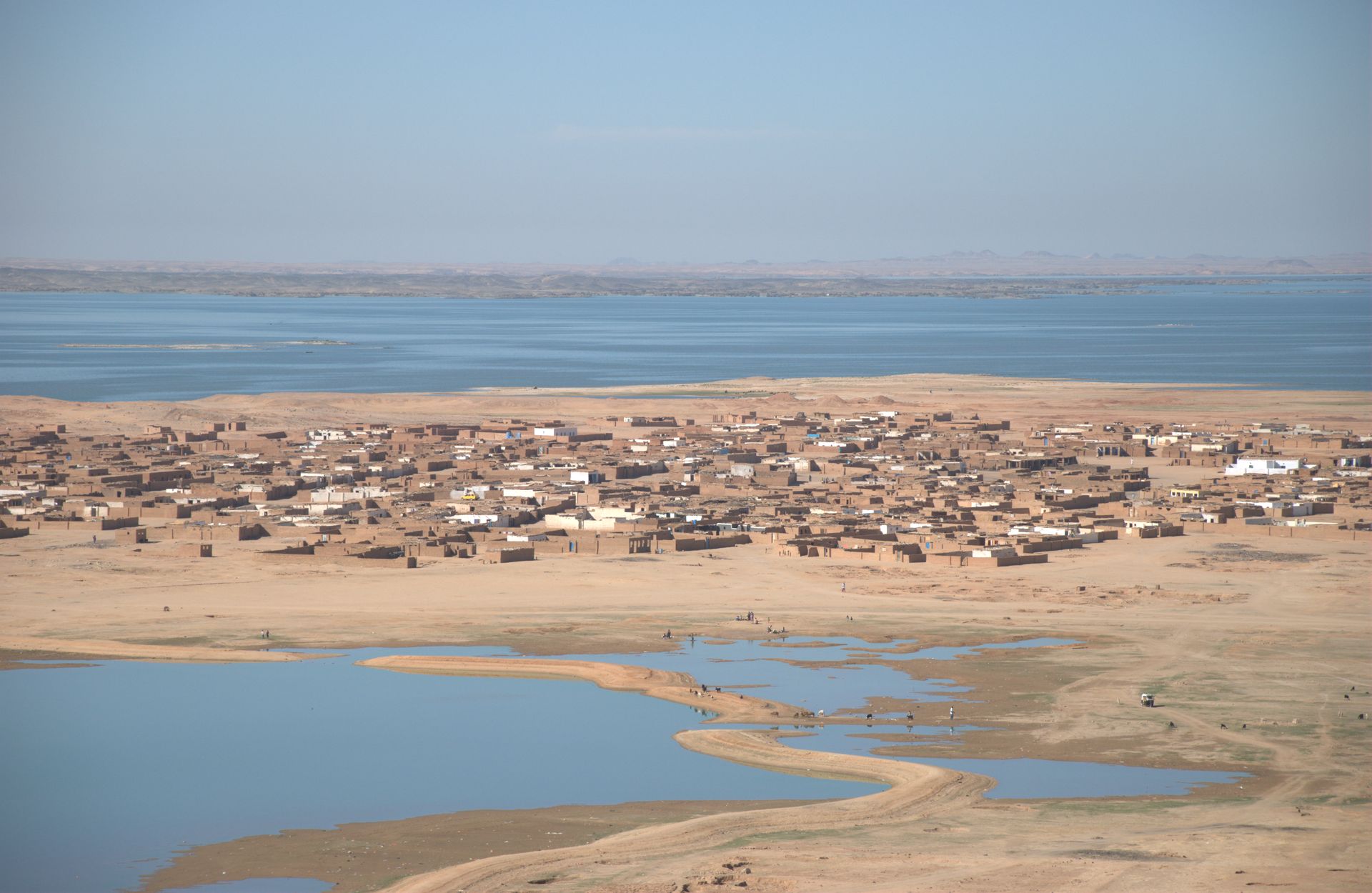
Wadi Halfa is a small town in a vast place: the far north of Sudan, where the desert, the lake and the border with Egypt all meet. It has no monuments to visit in the usual sense. Even so, it is one of the most meaningful places in the Nile Valley, because this is where the Nubia that no longer exists begins (or ends).
Old Wadi Halfa went under the water in 1964. The Aswan Dam, built downstream in Egypt, created a gigantic reservoir whose Sudanese end is called Lake Nubia. That reservoir flooded the town, dozens of villages, palm groves and cemeteries, and a string of pharaonic fortresses at the second cataract (Buhen, Mirgissa, Semna, Kumma and Askut), which were among the best-preserved military complexes of the ancient world. Some fifty thousand Sudanese Nubians were resettled more than a thousand kilometres away, in New Halfa, near Khashm el Girba, in the east of the country. Some of the heritage was saved by UNESCO's International Campaign to Save the Monuments of Nubia, which took entire temples apart and moved them.
For travellers who crossed Africa overland before the war, Wadi Halfa was also a legendary name: the ferry across the lake from Aswan, the customs post, the train to Khartoum. None of that applies today. Sudan has been at war since April 2023, all travel to the country is advised against, and Wadi Halfa works as a humanitarian crossing. Hundreds of thousands of people have passed through it fleeing to Egypt and, since 2025, coming back. This guide explains what this place is and what lies under the water.
For thousands of years Wadi Halfa was the gateway between Egypt and Nubia, next to the second cataract of the Nile. This stretch of rapids formed a natural border, and the pharaohs of the Middle Kingdom fortified it with a chain of mudbrick fortresses (Buhen, Mirgissa, Semna, Kumma and Askut) unlike anything else in the ancient world. The modern town grew up in the 19th century as a Nile steamer port and became strategically important during the Anglo-Egyptian campaign against the Mahdist State. In 1897 the military railway that crossed the Nubian Desert to Abu Hamed started here, and it kept Kitchener's advance supplied. The turning point came in the 1960s with the construction of the Aswan Dam. The reservoir flooded the town and the whole of Sudanese Lower Nubia, and in 1964 some 50,000 Nubians were resettled in New Halfa, near Khashm el Girba, in the east of the country. UNESCO's International Campaign to Save the Monuments of Nubia rescued temples and recorded sites before the flooding. The new Wadi Halfa was built on the lakeshore and remained the railway terminus and the port for the ferry to Aswan.
Read the full history ↓A hundred thousand square kilometres of volcanic cones and wells inside the great bend of the Nile, the railway town that gave birth to Sudanese trade unionism, and the border where a whole stretch of Nubia ended up underwater.
Read the history of The Bayuda Desert and the Upper Nile →No exact prices: a scale from $ (budget) to $$$$$ (luxury), with 2-3 options per category.
Origins, formation and what the sources say.
Before there was a town, there was a frontier. On the stretch of the Nile where Wadi Halfa stands today, the river crashed against a barrier of rock known as the Second Cataract: kilometres of rapids, islands and channels that made navigation impossible without unloading and reloading. For millennia, that physical barrier served as the natural boundary between Egypt and Nubia.
Middle Kingdom Egypt, between the 20th and 18th centuries BC, turned that frontier into a military system with no equal in the ancient world. Under the pharaohs of the 12th Dynasty, especially Senusret III, a chain of mud-brick fortresses went up along the cataract: Buhen, Mirgissa, Semna, Kumma, Askut and others. They were huge fortifications, with walls several metres thick, projecting bastions, dry moats, bent entrances, storerooms, barracks and temples, built both to hold back Nubian raids and to control the trade moving up and down the river.
Buhen was the largest and probably the most impressive: a feat of military engineering still cited in handbooks on ancient defensive architecture. At Semna and Kumma, stelae were also set up to record the levels of the Nile flood, a hydrological archive spanning centuries.
The network gradually lost its role in later periods, but the spot remained a place everyone had to pass through. Nubian gold, ivory, ebony, incense and the troops of everyone who wanted to control the corridor between Egypt and the African interior all moved through here.
Modern Wadi Halfa is a product of the 19th century. It grew up as the port for Nile steamers, the point where navigation from Egypt had to stop because of the cataract and where goods and passengers changed boats. That logistical role gave it importance and population.
Its strategic moment came with the Mahdist wars. After the fall of Khartoum in 1885 and the death of Charles Gordon, Britain withdrew from Sudan but kept Wadi Halfa as Egypt's forward frontier post and as a stronghold. When the campaign to retake Sudan was launched in 1896 under Herbert Kitchener, the town became its base of operations.
It also became the starting point of one of the most frequently cited engineering works in colonial Africa. In 1897, construction began at Wadi Halfa on the military railway that crossed the Nubian Desert in a straight line to Abu Hamed, cutting through the interior instead of following the Nile's enormous bend. The track was laid over virgin sand, with no water or settlements along the way, at a pace that amazed observers at the time, and it was what allowed the army's advance to be sustained all the way to Omdurman in 1898. That line is still the backbone of Sudan's rail network heading north today.
During the Anglo-Egyptian period, Wadi Halfa served as the country's gateway: customs post, railway station, river port and garrison. It was a prosperous Nubian town, with palm groves and farmland along the riverbank, in the heart of Sudanese Lower Nubia.
In 1960 Egypt began building the Aswan High Dam, a colossal project designed to regulate the Nile flood and generate electricity. The resulting reservoir — Lake Nasser in Egypt, Lake Nubia on its Sudanese stretch — was going to flood hundreds of kilometres of valley, including all of Sudanese Lower Nubia.
The process was carried out with the administrative brutality of the time. In 1964, old Wadi Halfa and dozens of riverside villages went under water, and around fifty thousand Sudanese Nubians were resettled in New Halfa, near Khashm el Girba, in Kassala State: more than a thousand kilometres away, on an irrigated farming scheme that had nothing to do with their life by the river. In one stroke, the community lost its land, its cemeteries, its palm groves and its landscape. It is one of the great infrastructure-driven displacements of the 20th century, and it remains a central wound in Sudanese Nubian identity.
The heritage met a similar fate. All the archaeology of Lower Nubia — the Second Cataract fortresses, temples, medieval churches, cemeteries, settlements from every period — was set to disappear. The response was the International Campaign to Save the Monuments of Nubia, launched by UNESCO in 1960 and running for twenty years: the largest archaeological rescue operation in history, with dozens of missions from around the world excavating and documenting against the clock.
In Egypt, the campaign produced the spectacular relocations of Abu Simbel and Philae. In Sudan, it allowed hundreds of sites to be excavated urgently and several temples to be dismantled and moved, many of which were reassembled in the garden and galleries of the National Museum of Sudan in Khartoum, which opened in those very years. The Nubia campaign is also the direct origin of the modern concept of world heritage and of the 1972 Convention.
The new Wadi Halfa was later built on the lakeshore: low-rise, whitewashed, functional, organised around the port, the station and the market. Its population is around 15,700 according to 2007 estimates. It is one of the driest and sunniest places on the planet, with about 0.5 millimetres of rain a year and sunshine figures reaching 4,300 hours annually.
For decades, Wadi Halfa was a name with an almost mythical ring for anyone crossing Africa overland. The only regular passenger link between Egypt and Sudan was the weekly ferry across Lake Nasser between Aswan and Wadi Halfa: an overnight crossing with the deck packed with people, luggage and cargo, ending at Sudanese customs and, the next day, the train or bus to Khartoum. For many travellers, that crossing was the rite of passage between North Africa and sub-Saharan Africa.
The service stopped around 2019, due to a mix of technical problems, costs and the steady deterioration of the situation in Sudan. In January 2026, the authorities announced it would resume after six years, with the vessel "Sinai" ready for passenger service.
While the ferry was out of action, traffic shifted to the land crossings: Argeen, in the desert west of the lake, and Qustul/Ashkeet on the eastern shore. Argeen is now the main road route between the two countries.
The town also keeps its railway role: it is the terminus of the line that crosses the Nubian Desert to Abu Hamed, Atbara and Khartoum, although passenger service had been in severe decline for decades. And it has a local economy tied to fishing on Lake Nubia, cross-border trade and transport.
On 15 April 2023, war broke out in Khartoum between the Sudanese Armed Forces and the Rapid Support Forces, and within weeks the whole country was on the move. Millions of people were displaced inside Sudan and hundreds of thousands crossed the borders. Egypt became one of the main destinations: more than a million people fled north, and Wadi Halfa ended up right at the centre of that exodus.
The town, which never had the capacity for anything like it, became a transit point for a constant flow of people. Organisations working on the ground have documented very long waits at the border crossings, poor sanitary conditions, a lack of basic services and an unequal entry regime: Sudanese women and children do not need a visa to enter Egypt through the land crossings, but men aged 16 to 50 do, with slow, overloaded processing that split up many families.
The flow also runs the other way. Egypt has deported undocumented Sudanese people to Wadi Halfa, and since July 2025 organised return trips have been running: a train from Ramses Station in Cairo to Aswan and, from there, river transport to the port of Wadi Halfa. These returns sped up as the army regained control of Khartoum in 2025, but they are happening in a country where the war is still going on — fighting continues in Darfur and Kordofan — and where the food and services crisis is severe.
For travellers, the conclusion is simple and leaves no room for nuance: Wadi Halfa is not a tourist gateway to Sudan today. Foreign ministries advise against all travel to the country and urge their nationals to leave; Spain has also suspended public services at its embassy in Khartoum, so there is no consular assistance on the ground. What this place offers today is not an itinerary but a story: that of a town that went under water, of a community displaced a thousand kilometres from its river, and of a border through which much of this war's suffering has passed.