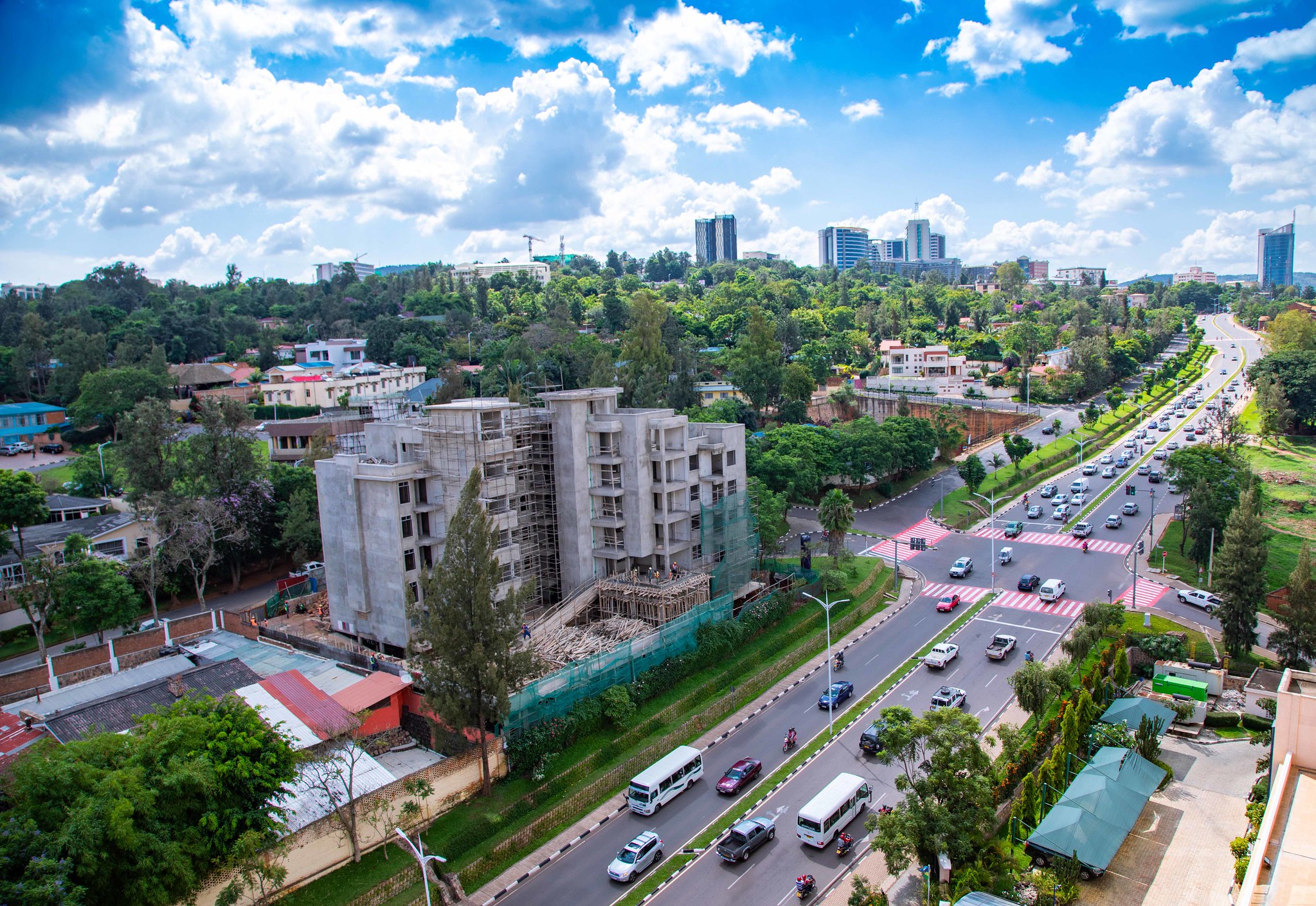
Kigali is one of Africa's most surprising capitals and the best possible introduction to Rwanda. Spread over a sea of green hills, it is clean, orderly and safe to a degree that disconcerts anyone arriving with preconceptions about the continent: the streets are free of litter (plastic bags have been banned since 2008), traffic is calm, and you can walk around at night without any trouble. In just three decades it went from being the epicentre of one of the greatest tragedies of the 20th century to becoming a model of reconstruction, safety and modernity.
The city combines that modern face (the dome of the Kigali Convention Centre lit up at night, the specialty cafés, the art centres, the lively markets) with essential places of remembrance. The Kigali Genocide Memorial, in Gisozi, where more than 250.000 victims are laid to rest, tells with great rigour and respect what happened in 1994 and how the country rose again afterwards. It is a hard but necessary visit for understanding Rwanda, and it is done with the sobriety and dignity the subject deserves.
This guide explores Kigali with a practical eye: what to see between memory, art and everyday life; how to get around the hills by motorbike taxi; where to drink some of the best coffee in Africa; how to use the capital as a logistics base for the gorillas in the north and Lake Kivu in the west; and how to make the most of a city that, with one or two well-planned days, stops being a mere stopover and becomes a memorable part of the trip.
Kigali was founded in 1907 by the German colonist Richard Kandt as an administrative post, and throughout the colonial period (first German, then Belgian) it was little more than a small town, since the traditional power of the Kingdom of Rwanda was in Nyanza and the Belgian administration in Butare. Only with independence, in 1962, was Kigali chosen as the capital because of its central location. In 1994 it was the epicentre of the genocide against the Tutsi, which in a hundred days left close to a million dead across the country. Since then, driven hard by the state, the city has undergone a reconstruction and transformation that turned it into a symbol of the 'new Rwanda'. The whole story is told on our history page.
Read the full history ↓The heart of Rwanda: a clean, modern capital spread over the hills, and the memorials that keep the memory of the 1994 genocide with rigour and respect.
Read the history of Kigali and the centre →A local guide tells you in half an hour what no sign at the site will ever explain. We look ours up on Civitatis: guided in Spanish and booked online with no fuss. They have 7 activities in Kigali. And there are free tours here: you book without paying and tip the guide whatever you think at the end, so trying one costs you nothing. Have a look below: tap any of them to see them all.
If you book from here we earn a commission and you pay no more. Prices and availability come from Civitatis.
No exact prices: a scale from $ (budget) to $$$$$ (luxury), with 2-3 options per category.
Origins, formation and what the sources say.
Long before Kigali existed as a city, the area it now covers was part of the Kingdom of Rwanda, a centralised and sophisticated monarchy that had ruled these highlands since at least the 15th century. The kingdom was governed by a king, or 'mwami', of the Nyiginya dynasty. His court moved from place to place, and its traditional capitals lay in the south-centre of the country, around places such as Nyanza. Rwandan society was organised into three broad categories: Hutu, Tutsi and Twa. At the time these worked more like flexible social and economic classes, tied above all to owning cattle. They were not yet the rigid, opposing 'ethnic groups' that colonialism would later turn them into.
Rwanda was one of the last corners of Africa's interior that Europeans reached. In 1897 the kingdom became part of German East Africa with hardly any resistance. The Germans used a system of indirect rule that respected the mwami and the structure of the kingdom. In 1907 a German explorer and administrator, the physician Richard Kandt, chose a spot among the hills in the centre of the country for his residence and an administrative post. That first house, today the Kandt House Museum, marks the birth of Kigali. For a long time it remained little more than a modest administrative settlement.
After the First World War, Germany lost its colonies and Rwanda passed to Belgium. Belgium ran it first as a League of Nations mandate and later as a UN trust territory, joined to Burundi as 'Ruanda-Urundi'. The Belgians deepened indirect rule through the mwami, but they also hardened the differences between Hutu and Tutsi and turned them into racial ones. In the 1930s they made ethnic identity cards compulsory, and they favoured the Tutsi minority in government posts and education. In doing so they sowed the seeds of future conflict. Meanwhile, Kigali was still a minor town compared with the administrative capital, Butare (Astrida).
In the late 1950s the Belgian colonial system fell into crisis, and the tensions it had fed boiled over. In 1959 the so-called 'social revolution', or 'Hutu revolution', overthrew the Tutsi-dominated monarchy. There was violence and there were massacres, and tens of thousands of Tutsi fled to neighbouring Uganda, Burundi, Congo and Tanzania. Decades later, that exile would have huge consequences. The monarchy was abolished, and on 1 July 1962 Rwanda became independent from Belgium as a republic, by then separate from Burundi.
The new country then had to decide where to put its capital. Butare, the old colonial capital, was the most developed city, but it lay off-centre in the south. Kigali was chosen precisely because of its central position in the heart of Rwanda, roughly equidistant from every region. A town that until then had only a few thousand residents suddenly became the capital of a nation. Kigali grew steadily over the following decades as the seat of government. Even so, it was still a small, modest city compared with other African capitals.
From the start, independent Rwanda was shaped by ethnic tension that politicians used for their own ends. Successive Hutu governments kept the Tutsi as second-class citizens, with quotas and discrimination, and blocked exiles from returning. The first was Grégoire Kayibanda's, followed from 1973 by that of Juvénal Habyarimana, who took power in a coup. The Tutsi refugees, especially those settled in Uganda, eventually organised into an armed movement, the Rwandan Patriotic Front (RPF). In 1990 the RPF invaded the north of the country and set off a civil war. Habyarimana's government responded with extremist anti-Tutsi propaganda that grew ever more virulent and prepared the ground for catastrophe.
On the night of 6 April 1994, a missile shot down the plane carrying President Juvénal Habyarimana as it approached Kigali airport, killing everyone on board. Who fired it is still debated, but the consequences were immediate and had been planned in advance. Within hours, a planned genocide against the Tutsi population and moderate Hutu began in the capital itself. Extremist militias, the 'Interahamwe', joined by part of the army and by civilians stirred up by hate radio (the infamous RTLM), set up roadblocks in Kigali's streets and began killing Tutsi systematically.
For about a hundred days, from April to July 1994, one of the fastest and most intense mass killings in history took place. An estimated 800,000 to one million people were murdered across the country, the vast majority of them Tutsi. They were killed with machetes, clubs and firearms, often by neighbours, colleagues or people they knew. Kigali was one of the epicentres. The world largely stood by. The UN had a peacekeeping force on the ground (UNAMIR), but it had neither the mandate nor the means to step in. On the first day ten Belgian peacekeepers were murdered, and they are remembered today at the Camp Kigali Memorial. Belgium then withdrew its troops, and the international community looked away.
Even amid the horror, there were acts of humanity. In Kigali, the Hôtel des Mille Collines, run by Paul Rusesabagina, sheltered more than a thousand people from death, a story the film 'Hotel Rwanda' (2004) made widely known. The genocide ended in July 1994, when the Rwandan Patriotic Front, the Tutsi rebel army led by Paul Kagame, took Kigali and the rest of the country by force and stopped the killing. This in turn drove some two million Hutu to flee to Congo and other neighbouring countries. Many of them had taken part in the genocide, mixed in with terrified civilians, and a huge humanitarian crisis followed.
In July 1994 Kigali was a city in ruins: emptied, traumatised and strewn with bodies. The country as a whole had lost close to a million people, and its social fabric had been torn apart. Victims, survivors and perpetrators now lived side by side on the same land. Rebuilding started, quite literally, from year zero. A new government of national unity took on a huge task of physical, institutional and human reconstruction. The RPF was its dominant force, and Paul Kagame was first its strongman and vice-president, then president from 2000.
One of the biggest challenges was justice. Hundreds of thousands of people were accused of taking part in the genocide, far too many for a collapsed court system to try. Rwanda combined three approaches. The International Criminal Tribunal for Rwanda, based in Arusha, Tanzania, tried those most responsible. The ordinary courts handled other cases. Above all, there were the traditional community courts, the 'gacaca'. Held outdoors on every hill between 2002 and 2012, they let neighbours judge millions of cases, seeking punishment, truth and reconciliation at the same time. The government also pursued a policy of national unity that officially abolished ethnic categories. Today, in law, there are no Hutu or Tutsi, only Rwandans.
On that foundation, Kigali went through an astonishing physical transformation. The city adopted strict rules on order and cleanliness: a ban on plastic bags (2008), 'Umuganda' monthly community work, urban planning and tighter security. Within a few decades it went from devastation to being described as one of the cleanest, most orderly and safest cities in Africa. It also began to attract investment, international organisations and tourism. None of this is without debate. Human rights organisations point out that this order also rests on a strongly authoritarian government that leaves little room for opposition or a free press. In that sense, Kigali is a symbol of the 'Rwandan miracle' that is as admired as it is disputed.
Twenty-first-century Kigali looks firmly ahead without giving up its memory. Its best-known landmark is the lit-up dome of the Kigali Convention Centre, which opened in 2016. It has made the city a regular host of African Union summits, Commonwealth meetings and major international events. The capital has become a conference, business and tourism hub for East Africa. It has international hotels, a growing airport and a reputation for efficiency and safety that breaks many stereotypes about the continent.
At the same time, the city has a thriving cultural and food scene. There are contemporary art centres such as Inema and Niyo, and a world-class specialty coffee scene supplied by the country's coffee cooperatives. There are lively markets such as Kimironko and neighbourhoods with a character all their own, such as Nyamirambo. All of this sits alongside the places of memory: the Gisozi Memorial, Camp Kigali and the Presidential Palace with the wreckage of the plane. They are a reminder of where this city comes from and why its rebirth carries so much symbolic weight.
For travellers, Kigali is the natural gateway to Rwanda, and it deserves far more than a stopover. From here you set off for the mountain gorillas of Volcanoes National Park, the shores of Lake Kivu and the culture of the south. The city is also a destination in its own right: a small, green, calm capital full of history. In a couple of days you can go from the shock of the memorial to the pleasure of a coffee on a terrace overlooking the hills. Few cities in the world pack so tragic a history and so remarkable a recovery into so short a time.