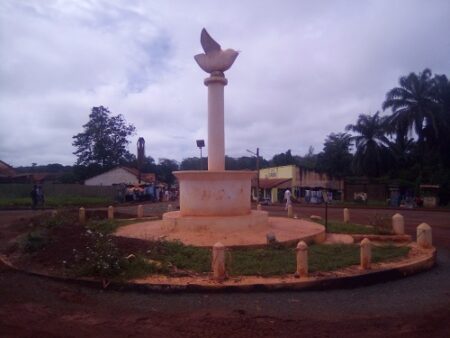
Bambari sits in the exact centre of the country, on the Ouaka River, and that position explains almost everything about it. It is a prefecture capital, the junction of the routes linking Bangui with the east, the seat of a Catholic diocese and one of the largest cities in the Central African interior, with just over forty thousand inhabitants according to the 2012 census.
That same centrality made it, between 2012 and 2021, one of the most contested places in the Central African armed conflict. For much of that period, the Ouaka River served as a dividing line through the city, and Bambari changed hands repeatedly. This is information you need to understand the place, and this guide handles it with due restraint: dated, attributed facts, no sensationalism and no taking sides.
It is also a city with an earlier history: Félix Éboué served there as colonial administrator from 1919, and years later became the first Black governor-general in the French empire and the first colonial authority to join Free France. It was Éboué who shifted the local economy away from rubber gathering towards food and cash crops, and who opened the main road between Bambari and Bangui. This page tells that story: there are no verifiable tourist services in the city, and official travel advisories advise against travelling to the country altogether.
Bambari took shape during the French colonial period as an administrative post on the Ouaka River, in the centre of Oubangui-Chari. In 1919, administrator Félix Éboué — later governor-general and the first French colonial authority to rally to Free France in 1940 — was posted there and reoriented the area's economy from rubber gathering towards food and cash crops such as groundnuts and cotton, while also promoting mineral prospecting and the opening of the road to Bangui. The Ouaka prefecture was re-established on 23 January 1961 with Bambari as its capital, and the city got electricity in 1970. Between December 2012 and February 2021, the city was one of the epicentres of the Central African conflict, with control passing back and forth between armed coalitions and government forces.
Read the full history ↓The Zande and Nzakara sultanates of the 19th century lay between the Ouaka and the Mbomou. In the 21st century, the centre and the east were at the heart of the war for control of the land and its revenues.
Read the history of The centre and the east →No exact prices: a scale from $ (budget) to $$$$$ (luxury), with 2-3 options per category.
Origins, formation and what the sources say.
Bambari stands on the Ouaka River, in the exact centre of the Central African Republic, at 465 metres above sea level. The Ouaka is a tributary of the Ubangi that flows south from the country's central watershed, crossing the wooded savannah that covers the whole middle belt of the territory: tall grasslands dotted with trees, with dense gallery forests along the watercourses.
That central position is the key to everything that came after. The Ouaka region is where the routes between the west and east of the country cross, and between the Ubangi basin to the south and the dry savannahs of the north. Before colonisation, the trade routes linking the Congo basin with the Sudanese zones ran through here. So did the routes used in the 19th century by slave-raiding expeditions from the north and east, which broke apart many of the region's societies.
The peoples of the area are mostly Banda and related groups who speak Ubangian languages. As across this whole belt of the continent, pre-colonial life was organised around farming villages, kinship networks and small local chiefdoms. There were none of the large states that did exist in the country's northeast.
When France occupied the interior of Oubangui-Chari in the early 20th century, Bambari became an administrative post and a control point on the routes through the centre of the territory. Like the rest of the country, the region first fell under the concession companies and forced rubber collection. The coercion and death rates were bad enough to cause a scandal even in metropolitan France.
The most remarkable episode of that period is Félix Éboué's time in Bambari. Born in Cayenne, French Guiana, in 1884, Éboué was posted to Bambari as administrator in 1919. There he deliberately changed the economic course: he moved activity away from rubber collection towards food and cash crops (groundnuts, cassava, rice, sesame, cotton), encouraged prospecting for minerals and opened a major road between Bambari and Bangui, the colonial capital.
His time in central Oubangui-Chari was one stage in a career that would turn out to be historic. Éboué became governor of Chad and, in 1940, he was the first French colonial official to break with the Vichy regime and join Free France. That move gave de Gaulle his first territorial base in Africa and changed the course of the war on the continent.
Cotton, which Éboué had promoted, became over the years the compulsory cash crop of the country's whole central belt. A system of forced cultivation and controlled purchasing shaped rural life for decades. It left behind a network of roads, ginneries and trade circuits that can still be seen today.
After independence in 1960, the new state reorganised its administration, and the prefecture of Ouaka was re-established on 23 January 1961 with Bambari as its capital. The town then grew into the main urban centre of the central region, with the administration, trade, services and the seat of a Catholic diocese. Electricity arrived in 1970.
The following decades brought the slow erosion of the Central African state. One coup followed another, public finances collapsed and roads and services fell apart. The interior became more and more cut off from the capital. Even so, Bambari remained a hub, because geography doesn't change: it still sits at the crossroads between east and west.
The region holds an underground resource that has never been put to use. Iron ore deposits near Bambari, and others at Bakala, have been documented for decades. But the distance to the sea, about 1,500 kilometres to the nearest port, and the lack of any railway make mining them unviable. It is one of the clearest examples of how being landlocked shapes the Central African economy.
The Central African crisis that began in late 2012 hit Bambari hard, precisely because of its central position. What follows is a timeline based on the available records. It makes no judgements and assigns no responsibility beyond what the sources state.
On 23 December 2012, the Séléka coalition took the town as it advanced on Bangui. On 24 June 2014, anti-balaka fighters attacked Bambari, and according to the records the attack left 46 dead and 28 wounded. During 2015 the town was split in two, with anti-balaka groups in the western sector and ex-Séléka forces in the east, and the Ouaka River served as the dividing line.
On 22 February 2017, the rebel forces withdrew from the town. Between 10 and 17 January 2019, the UPC group launched an attack that government forces drove back. Between December 2020 and February 2021, during the election period, there were new incursions, until government forces regained full control of the town on 18 February 2021.
Throughout this period, Bambari was one of the main bases of the United Nations mission in the country (MINUSCA, deployed since 2014) and one of the largest humanitarian operations centres in the interior. Large numbers of people were displaced, and moving staff and aid depended entirely on the UNHAS air service.
Since 2021, Bambari has been back under the control of the Central African authorities, and the state has regained a presence across much of the country. General elections were held in December 2025. Voting took place on 28 December in a climate described as mostly calm, except in places where attacks prevented people from voting. On 5 January 2026, President Faustin-Archange Touadéra was declared re-elected, and the Constitutional Council later confirmed the result.
The security situation is still precarious, however, and armed groups remain active in several regions. Official travel advice has not been relaxed. Spain's Ministry of Foreign Affairs still names Bambari among the country's especially dangerous towns and advises against travel under any circumstances. The United States Department of State keeps the Central African Republic at Level 4, “Do Not Travel”, in its advisory of 15 January 2026.
For Bambari, this means a town that is still what it has always been: the hub at the centre of the country, capital of the Ouaka, seat of a diocese and a regional market. But it has no tourist infrastructure and no services for visitors that can be verified. Its value today is as a key place for understanding how a state in Central Africa works, and how it breaks down.