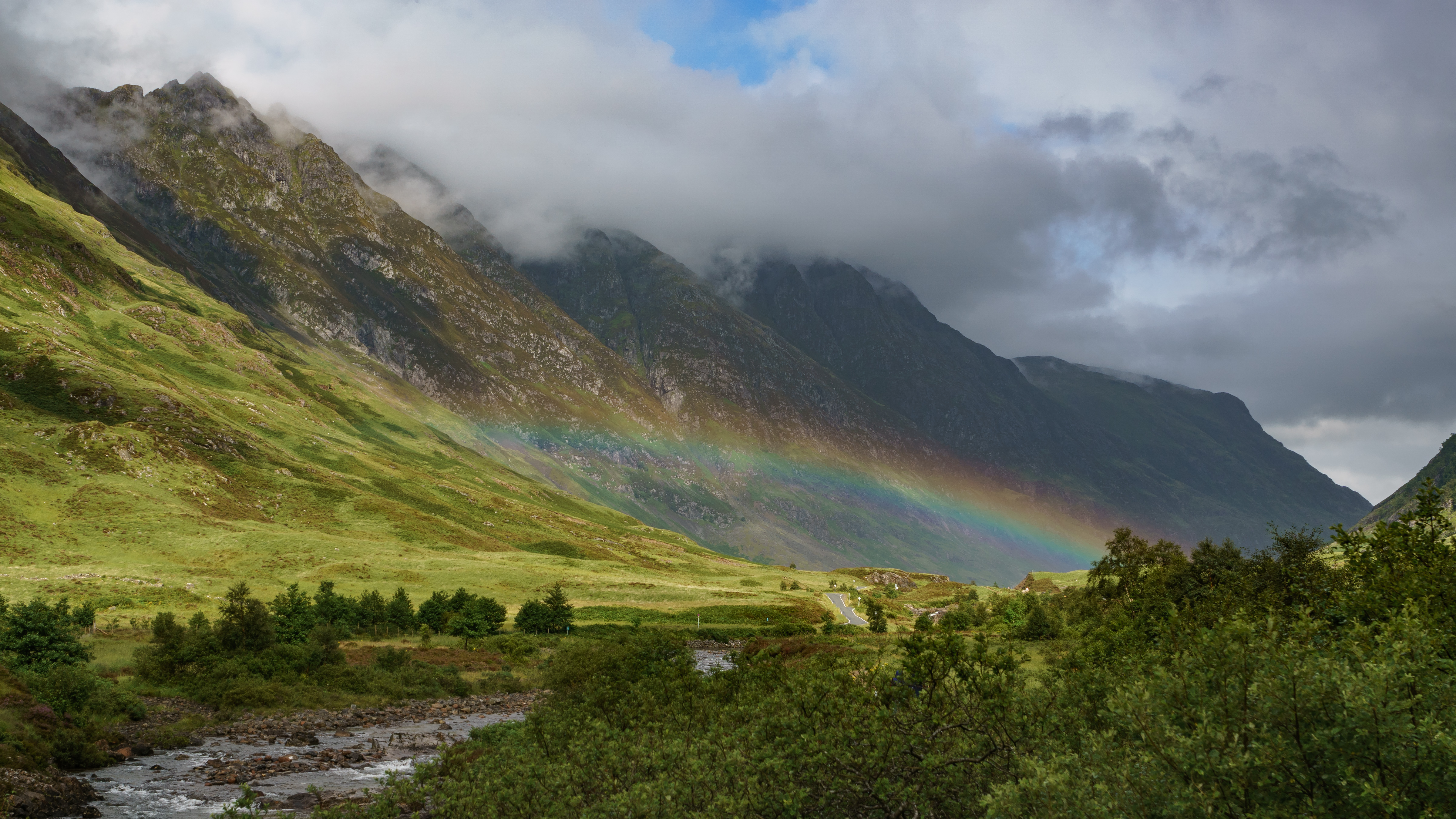
The Scottish Highlands are one of those places that seem invented for the movies and yet exist: dark mountains sinking into endless lochs, glacial valleys where the silence weighs on you, ruined castles leaning over the water and stone villages with a distillery and a pub. This is wild Scotland, the Scotland of the clans, the bagpipes and the legends, an immense, empty territory in the north of the United Kingdom where the weather changes every half hour and the light, when it appears, turns everything golden.
It is not a single-postcard destination but a jigsaw of landscapes: the dramatic valley of Glencoe, Ben Nevis (the highest peak in the whole United Kingdom), enigmatic Loch Ness with Urquhart Castle, the Glenfinnan Viaduct crossed by the Jacobite steam train, beautiful Inverness on the banks of the River Ness, the forests and rounded summits of the Cairngorms, the whisky distilleries of Speyside and the legendary coastal route of the North Coast 500. All of it linked by slow, narrow roads that are, in themselves, part of the adventure.
This guide covers the Highlands with a practical and honest eye: what to see without trying to cover everything, how to get around (spoiler: almost always by car), how to handle single-track roads, when and how to protect yourself from midges, which distilleries to visit and how to make the most of the loveliest train ride in Britain. It is a trip to take slowly, with an umbrella to hand and the camera always ready.
The history of the Highlands is the history of the Picts and the Gaels, of the clans and their tribal world, of the Jacobite wars that ended at the Battle of Culloden (1746) and in the brutal repression that followed, and of the Highland Clearances, the mass evictions of the eighteenth and nineteenth centuries that emptied the glens and pushed thousands of families to emigrate to America and Oceania. It is also the story of Scottish Gaelic, a language persecuted and today slowly recovering, and of a landscape that, behind its beauty, holds the memory of dispossession and depopulation. We tell it in full on our history page.
Read the full history ↓The northern nation: from the Picts and Rome's failure to Wallace and Bruce, Mary Queen of Scots, the Union of 1707, the Jacobites and Culloden, the Highland Clearances, the Scottish Enlightenment and the new Parliament of 1999.
Read the history of Scotland →They depart from Oban, 51 km away. If you book from this link we earn a commission and you pay no more.
No exact prices: a scale from $ (budget) to $$$$$ (luxury), with 2-3 options per category.
Origins, formation and what the sources say.
Behind the silent beauty of the Highland glens lies a long and often harsh history that begins well before Scotland existed as a country. The first settlers arrived after the ice retreated, some 9,000 years ago, and left stone circles, burial cairns and brochs (round stone towers) scattered across the landscape. When the Romans invaded Britain in the first century AD, they never managed to fully subdue the north: they called these lands 'Caledonia' and nicknamed their inhabitants, warriors who painted or tattooed their bodies, 'Picts' ('the painted ones'). The emperor Hadrian preferred to build a wall to the south rather than get entangled in these mountains.
The Picts dominated much of the north and east for centuries, leaving their enigmatic carved stones with symbols that are still not fully deciphered. From the west, around the fifth and sixth centuries, came the Gaels or 'Scoti', a people of Irish origin who founded the kingdom of Dál Riata on the west coast and the islands, bringing with them the Gaelic language and, with missionaries such as St Columba (who founded the monastery of Iona in 563), Celtic Christianity. From the slow fusion of Picts and Gaels would come, in the ninth century, the kingdom of Alba, the seed of medieval Scotland.
The Norse were added to that mix. From the end of the eighth century, the Vikings raided and then colonised the coasts and islands of the north and west, leaving a deep mark on the place names, the bloodlines and the culture of the Hebrides and the coastal lands. For almost four centuries, much of the Western Isles was under Norwegian rule or influence, until the Treaty of Perth (1266) formally transferred them to the Scottish crown. From that melting pot of Picts, Gaels and Norse would emerge the distinctive world of the Highlands.
Through the Middle Ages and much of the early modern period, the Highlands lived by a social system unique in Western Europe: that of the clans. The word 'clann' means 'children' or 'offspring' in Gaelic, and each clan was, in theory, a large extended family sharing a surname, a chief ('ceann-cinnidh'), a territory and a loyalty. In practice, clans brought together both blood relatives and families who had placed themselves under the protection of a powerful chief. Names such as MacDonald, MacLeod, Campbell, Fraser, MacKenzie and Cameron organised life, war and politics in the Highlands.
The chief distributed the land among his kin and tenants in exchange for loyalty and men for war; around him were the 'tacksmen' (a kind of minor nobility who managed the land) and, at the base, the peasants who worked the land communally. It was a warrior society, proud and often violent, marked by ancestral rivalries, cattle raids and shifting alliances. The mountain landscape, with its isolated glens, encouraged this fragmentation into small semi-independent powers that the king of Scotland, distant and weak in the north, controlled only with difficulty.
One of the great powers in this world was the Lordship of the Isles, a Gaelic-Norse maritime domain ruled by the MacDonalds that came to rival the Scottish crown itself before being dismantled at the end of the fifteenth century. With its fall, the old rivalries between clans — such as the long and bloody feud between the MacLeods and the MacDonalds — went unchecked. This universe of tartans, bagpipes, loyalties and vengeance is the one nineteenth-century Romanticism would turn into legend, but which in its own time was above all a fragile and often brutal way of life.
The fate of the Highlands was tied to a political and dynastic cause: Jacobitism. When in 1688 the Catholic James II (James VII of Scotland) was deposed by the 'Glorious Revolution', many Highland Scots — out of loyalty, religion or rejection of the 1707 union with England — went on supporting the exiled House of Stuart. 'Jacobite' comes from 'Jacobus', the Latin form of James. There were several risings (1689, 1715, 1719) up to the most famous and most tragic: that of 1745.
That year, the young Charles Edward Stuart — 'Bonnie Prince Charlie', grandson of the deposed king — landed in the west of Scotland and, on 19 August 1745, raised his standard at Glenfinnan, on the shore of Loch Shiel, calling the clans to arms. The rising had surprising early successes: the Jacobites took Edinburgh and invaded England as far as Derby, a few days' march from London. But without the support they had hoped for, they withdrew north, pursued by the government army.
The end came on 16 April 1746 on Culloden Moor, near Inverness. In barely an hour, the government army, better armed and commanded by the Duke of Cumberland, annihilated the exhausted Jacobite forces. It was the last pitched battle fought on British soil. What followed was worse than the defeat: Cumberland — nicknamed 'the Butcher' — ordered the wounded to be finished off and the fugitives hunted down without mercy. In the following weeks, hundreds of Highlanders were executed, and Prince Charles fled as a fugitive across the Highlands and islands — with the famous help of Flora MacDonald on Skye — until he escaped to France. Culloden was not just a military defeat: it was the beginning of the end of an entire world.
After Culloden, the government in London set out to destroy clan society at the root, seeing it as a breeding ground for rebellion. The Acts of Proscription (the Act of Proscription of 1746 and supplementary laws) banned wearing tartan and the kilt, carrying weapons and — on the traditional reading — playing the bagpipes, and sought to dismantle the power of the chiefs: the hereditary jurisdiction that gave them almost sovereign authority over their lands was abolished. The wearing of tartan was banned for decades (the law was repealed in 1782). The aim was clear: to break clan loyalty and assimilate the Highlands into the rest of Britain.
But the deepest and most lasting blow came not from the laws but from the economy. Through the late eighteenth century and much of the nineteenth came the Highland Clearances ('Fuadaich nan Gàidheal', the expulsion of the Gaels): the mass eviction of tenant farmers from lands their families had worked for generations. The clan chiefs, transformed into British-style landlords and in need of money, discovered that sheep farming — above all the Cheviot and Blackface breeds — was far more profitable than tenants. Thousands of families were driven out of the inland glens to make room for the flocks, sometimes brutally: houses were burned with people still inside the townships, as in the notorious Sutherland clearances directed by factors such as Patrick Sellar.
Those cleared were resettled on tiny, poor coastal plots (the 'crofts'), where they had to survive on fishing or gathering seaweed, or were simply pushed to emigrate. When the potato famine struck the Highlands and islands in the 1840s — as in Ireland — emigration turned into an exodus. Hundreds of thousands of Highlanders left for Canada, the United States, Australia and New Zealand, often on overcrowded ships, leaving behind glens that are still empty today. The ruins of abandoned townships you see all over the Highlands are the visible scar of this dispossession. It is worth telling without romanticising: the Clearances were a process of forced eviction and human suffering that emptied a whole region and broke its traditional culture, and their memory is still alive in Scotland and in the diaspora.
Not all the violence against the Highlands waited for Culloden. An earlier episode is remembered as the symbol of betrayal: the Massacre of Glencoe, in February 1692. After the fall of James II, clan chiefs were required to swear loyalty to the new king William III before a deadline. The chief of the MacDonalds of Glencoe was delayed by various circumstances, and the authorities used the pretext to make an example. A detachment of soldiers, many of them from Clan Campbell, was billeted for almost two weeks as guests of the MacDonalds; one morning before dawn, breaking the sacred laws of Highland hospitality, they rose and murdered some 38 people, while others died of cold fleeing through the snow. Glencoe became a byword for state treachery.
Alongside these blows, the Highlands' own language — Scottish Gaelic ('Gàidhlig') — entered a long decline. Persecuted after Culloden, sidelined in schools (where for generations children were punished for speaking it) and eroded by emigration and depopulation, Gaelic went from being the majority language of the north and west to being spoken only in pockets of the islands and the coast. If in 1901 the census still recorded more than 230,000 speakers in Scotland, today there are around 60,000. In recent decades, however, there has been a real revival effort: Gaelic immersion schools, a television channel (BBC Alba), bilingual signage and official recognition of the language all aim to keep it alive.
The nineteenth century also brought a paradox: while the Clearances emptied the glens, Romanticism — driven by Walter Scott's novels and by the fascination of Queen Victoria, who bought Balmoral in the Cairngorms — reinvented the Highlands as a wild paradise of tartans, castles and noble mountaineers. So the tourist myth was born, sitting uneasily alongside the reality of dispossession. Today the Highlands are both that idealised landscape drawing millions of visitors and a real territory dealing with depopulation, housing, mass tourism in places such as Loch Ness and Glencoe, and the slow recovery of its language and identity. Travelling here means crossing a landscape of overwhelming beauty which, looked at closely, is also an enormous monument to the memory of those who were driven out of it.