Viajá con Gus
HomeUnited KingdomThe Cotswolds
The Cotswolds
🇬🇧 United Kingdom · Central and Southern England

The Cotswolds

Jump to what you need
📍Region
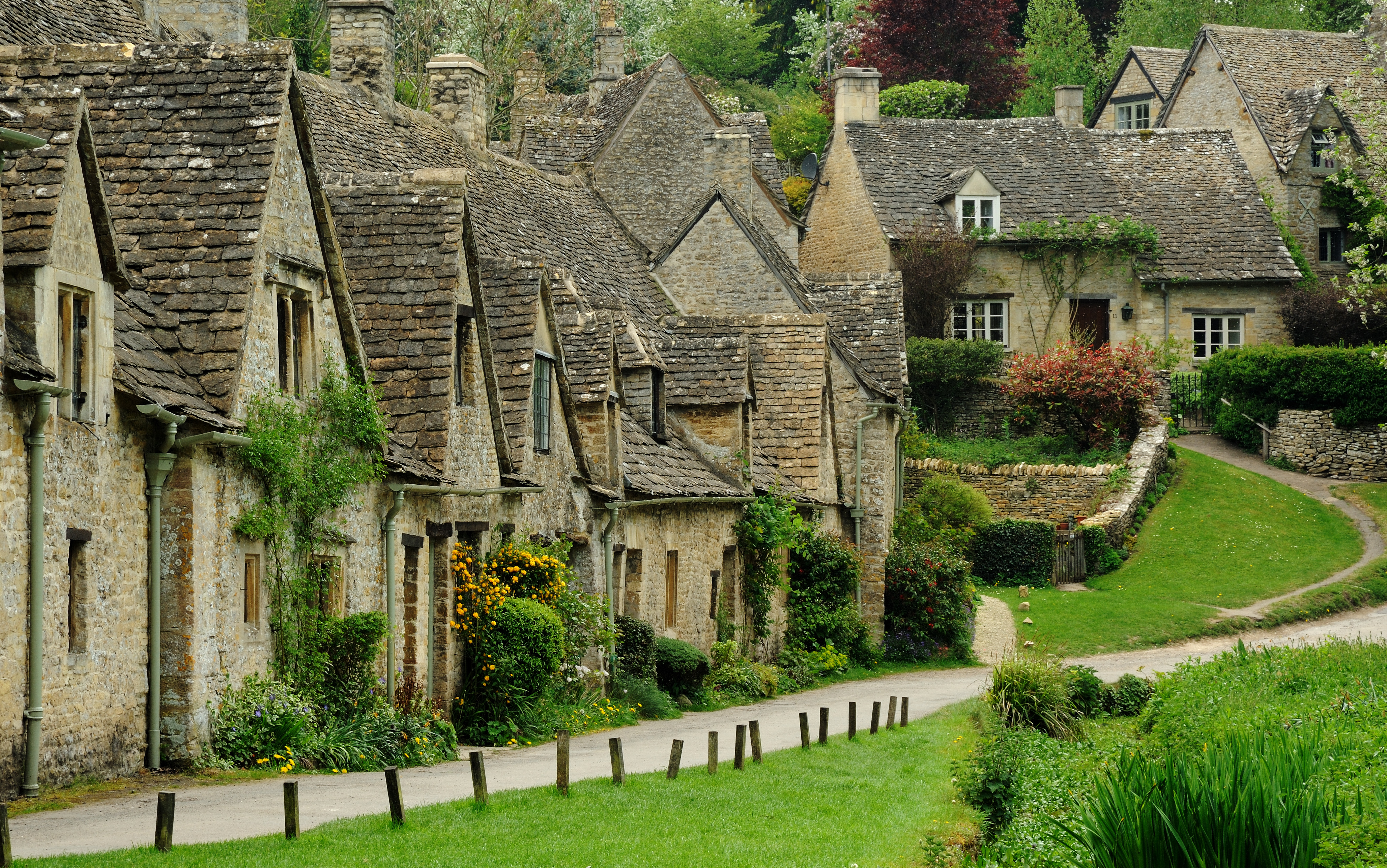
The Cotswolds are a region of gentle hills in south-central England, designated an Area of Outstanding Natural Beauty (AONB, today a 'National Landscape'). At some 2,038 km², it is the largest of its kind in England and Wales, and it spreads across five counties (above all Gloucestershire and Oxfordshire, plus Warwickshire, Wiltshire and Worcestershire). It is the archetype of the English countryside: villages of golden limestone, medieval churches, rolling meadows, sheep and hedgerows, a little over an hour and a half from London.
📌Best time to visit
The best time is April to October. Spring brings wildflowers, lambs in the fields and gardens in bloom; summer is high season, with very long days and big crowds in the most famous villages; and autumn gives you golden woods and quieter footpaths. Winter is cold and grey, with many shops and attractions on reduced hours, though the villages under snow and the pub fires have their charm. If you can, avoid summer weekends in Bibury and Bourton-on-the-Water, which get overwhelmed.
📌Suggested days
With 1 day you can make a trip from London, Oxford or Bath and see two or three villages (for example Bourton-on-the-Water, Bibury and Stow-on-the-Wold). But the Cotswolds are really enjoyed with 2 to 4 days, sleeping in one of the villages, walking sections of the Cotswold Way, visiting Blenheim Palace and getting lost in lesser-known hamlets. With a car you have complete freedom; without one, you have to plan train and bus times carefully.
📌Getting there
By train from London Paddington on GWR's Cotswold Line (Great Western Railway): to Moreton-in-Marsh (~1 h 35 min), Kingham (~1 h 20 min) or Charlbury, the gateways to the north of the region; and to Stroud/Kemble in the south. You can also come by car on the M40/A44 (from London/Oxford, about 2 h) or the M4/M5 (from Bath/Bristol). Many visitors combine the Cotswolds with Oxford, Bath or Stratford-upon-Avon.
📌Getting around
The Cotswolds are RURAL: there is no metro and public transport is thin on the ground. The most comfortable way to get around is a hire car, which you can pick up in London, Oxford, Bath or at the railway stations. Without a car you combine Cotswold Line trains with infrequent local buses (such as the Pulhams 801 between Moreton-in-Marsh, Stow, Bourton and Cheltenham) and taxis; on Sundays buses barely run at all. Many villages are linked by footpaths ideal for short walks.
📌Language and currency
Language: English. Currency: pound sterling (£, GBP). As of July 2026, 1 pound is worth a little over 1.15 euros (the exchange rate moves: check before you travel). Almost everything is paid by contactless card, even small amounts; it is worth carrying some cash for rural pubs, markets or village car parks that sometimes only take coins or apps.
💱 GBP exchange rate
Loading rate…
🌤️ Weather in The Cotswolds
Loading weather…

If there is one postcard image of the English countryside, it is the Cotswolds. This region of gentle hills in south-central England brings together everything you imagine about the British countryside: villages of golden limestone houses, medieval churches, little bridges over streams, meadows with sheep, pubs with open fires and gardens spilling over with flowers. Designated an Area of Outstanding Natural Beauty (the largest in England and Wales), it is a little over an hour and a half from London and one of the country's favourite rural escapes.

The secret of its charm is underground: the local oolitic limestone, 'Cotswold stone', of a warm honey colour that tints every wall, every church and every cottage with a unique golden tone, especially at sunset. With that stone — and with the enormous wealth wool brought in the Middle Ages — villages such as Chipping Campden, Stow-on-the-Wold, Bourton-on-the-Water, Bibury, Broadway and Castle Combe were built, today so well kept that they look frozen in time. Nearby is also the grand Blenheim Palace, a World Heritage Site.

This guide covers the Cotswolds with a practical and honest eye: which villages are worth it and which get swamped with tourists, how to get around a region where public transport is thin (spoiler: a car helps), where to walk sections of the famous Cotswold Way, how much the big attractions cost and how to dodge the crowds in Bibury and Bourton. It is the ideal destination for slowing down, driving country lanes and discovering the prettiest, quietest England.

📖 History of The Cotswolds

The Cotswolds owe their appearance to wool. During the Middle Ages, the 'Cotswold Lion' breed of sheep produced one of the finest and most sought-after wools in Europe, and the merchants who traded it amassed colossal fortunes in the fourteenth and fifteenth centuries. With that money they built manor houses and, above all, enormous, sumptuous churches — the famous 'wool churches' — in villages such as Chipping Campden, Northleach and Cirencester, a luxury out of all proportion to rural villages that still astonishes visitors. When the textile industry moved north and wool lost its value, the region was left out of industrial progress and its villages froze in time, keeping their golden stone houses. At the end of the nineteenth century, that arrested beauty drew the Arts and Crafts movement: William Morris spent his summers at Kelmscott Manor and his followers settled in the area, raising the standing of handwork and traditional architecture. In 1966 the Cotswolds were designated an Area of Outstanding Natural Beauty, the largest in England and Wales, and since 2023 they have carried the name 'National Landscape'. The full story is on our history page.

Read the full history ↓

🏛️ The Cotswolds is in Central and Southern England

The green, ancient heart of England: Stonehenge and the prehistory of Salisbury Plain, Bath and its Roman and Georgian baths, and the Cotswolds, whose hills grew rich on medieval wool.

Read the history of Central and Southern England →

🗺️ What to see

1
Bibury and Arlington Row
One of the most photographed villages in England, with the famous row of stone cottages at Arlington Row.
Bibury is, for many people, the prettiest village in the Cotswolds, and its image is one of the most reproduced views of the English countryside. Its great icon is Arlington Row, a row of fourteenth-century golden stone cottages (originally a wool store, converted in the seventeenth century into weavers' homes) looking out over a meadow beside the stream. It is so emblematic that it appears inside the British passport. Beside the water lie Rack Isle, a wet meadow where wool was once dried, and the River Coln, with trout and ducks. Bibury's problem is its own fame: it is a tiny village that receives crowds, especially in summer and at weekends, when cars and tour coaches compete for very few parking spaces. The village has gone as far as announcing restrictions on coaches. The advice is clear: arrive early in the morning (ideally before 9, better before 8) or at the end of the afternoon, when the day trippers leave, so you can enjoy it in peace and get the photo without people in it. Beyond Arlington Row, you can walk beside the stream, see the historic trout farm (Bibury Trout Farm) and have a drink at the historic Swan Hotel. It is a short but essential stop. Getting there: by car (very limited parking); without a car it is hard, with infrequent buses from Cirencester. Best time: spring and autumn, early or at sunset. Tips: there is not much to 'do' beyond strolling and taking photos; combine it with Cirencester or other nearby villages.
ℹ️ Distance: Gloucestershire, ~11 km from Cirencester; by car (very limited parking) · Best time: Early in the morning or at sunset, to avoid the crowds · Admission: Walking around the village and Arlington Row is free. Bibury Trout Farm charges £9.50 adult, £8.50 over-60s, £8 children aged 3 to 15 and £49.50 family; parking costs £10 on top (biburytroutfarm.co.uk, checked 07/08/2026) · Duration: 1 to 2 hours
2
Bourton-on-the-Water, 'the Venice of the Cotswolds'
A village crossed by the River Windrush and its little stone bridges, with attractions for the whole family.
Bourton-on-the-Water is one of the most popular and most visited villages in the Cotswolds, nicknamed 'the Venice of the Cotswolds' because the River Windrush runs right through the middle of it, crossed by a series of low stone bridges that give it a charming air. On both sides of the river run wide green verges, golden stone houses, shops, tea rooms and pubs, which makes it very pleasant to walk around. It is a particularly good village for families, because it has several paid attractions: the Model Village (a 1:9 scale stone replica of Bourton itself, built in the 1930s), Birdland (a bird park with penguins), the Cotswold Motoring Museum & Toy Collection (vintage cars and toys) and the Dragonfly Maze. None is essential, but they keep children entertained. Its huge popularity comes at a cost: in summer and at weekends Bourton fills with people and can feel overwhelming. The trick, as in Bibury, is to arrive early — before 9:30 the village is quiet and photogenic — or to stay the night so you can enjoy it once the day trippers have gone. Getting there: by car (there is paid parking) or on the Pulhams 801 bus from Moreton-in-Marsh, Stow and Cheltenham. Best time: spring and autumn, or early in summer. Tips: it is a good base for exploring the north of the region; combine it with Stow-on-the-Wold and the nearby 'Slaughters'.
ℹ️ Distance: Gloucestershire; by car or Pulhams 801 bus (Moreton-Stow-Bourton-Cheltenham) · Best time: Early (before 9:30) to avoid crowds; spring and autumn · Admission: Walking around is free. Birdland £14.95 adult, £13.95 over-60s and students, £11.50 children aged 3 to 15 at the gate (£13.95 / £12.95 / £10.50 buying online, plus £1.50 booking fee). For the Model Village and the Motoring Museum we could not confirm a rate from an official source: check them on arrival (birdland.co.uk, checked 07/08/2026) · Duration: Half a day
3
Stow-on-the-Wold and the 'Slaughters'
The highest market town in the Cotswolds, with its historic square, plus the idyllic hamlets of Lower and Upper Slaughter.
Stow-on-the-Wold is one of the most characterful towns in the northern Cotswolds. It is the highest in the region, perched some 240 metres up on a hill, at the crossing of ancient routes including the Roman Fosse Way. Its heart is a large Market Square, surrounded by stone houses, old coaching inns, pubs, art galleries and antique shops. It was an important sheep trading centre: it is said that tens of thousands of animals were sold at its great fairs. A famous corner is the north door of St Edward's church, flanked by two old yew trees that intertwine over the wood, a magical image many people associate with a fantasy portal. The church itself has history: it served as a prison after a battle in the English Civil War. A few minutes away are the twin hamlets of Lower Slaughter and Upper Slaughter, two of the most idyllic and peaceful corners of the Cotswolds, with stone houses, a crystal-clear stream crossed by little bridges and an old mill. Their name, despite sounding sinister in English, actually derives from an old word meaning 'muddy place' or 'stream'. They are perfect for a short, quiet walk. Getting there: by car or the 801 bus; the Slaughters are best reached by car or on foot from Bourton. Best time: all year; autumn is lovely. Tips: Stow is an excellent base for an overnight stay; combine it with Bourton and the Slaughters in the same day.
ℹ️ Distance: Gloucestershire, ~6 km from Bourton; by car or Pulhams 801 bus · Best time: All year; autumn especially pretty · Admission: Free (open-access villages); paid parking in Stow · Duration: Half a day with the Slaughters
4
Chipping Campden and its wool church
One of the best-preserved market towns, cradle of the Arts and Crafts movement, with its great 'wool church'.
Chipping Campden is, for many people, the most beautiful and best-preserved market town in the Cotswolds, and an essential stop for understanding the region's history. Its long, curving main street, lined with golden stone houses from different periods, ends at the Market Hall, an open arcaded building from 1627 where country produce was sold, today one of the most photographed buildings in the town. Here medieval wool left its most visible mark: the church of St James is one of the great 'wool churches', an enormous, sumptuous building put up in Perpendicular Gothic with the fortunes of the wool merchants in the fifteenth century, when the wool industry around Campden was at its height. Its size and elegance are astonishing in such a small town and speak of the wealth of those traders. Chipping Campden is also the Cotswolds' cradle of the Arts and Crafts movement: in 1902 Charles Robert Ashbee moved his Guild of Handicraft here from the East End of London, installing craftspeople, silversmiths and cabinetmakers who raised the standing of handwork. The town is also the northern end of the Cotswold Way footpath, which starts right here heading for Bath. Getting there: by car; without a car, with infrequent buses from Moreton-in-Marsh. Best time: spring to autumn. Tips: walk the High Street from end to end, go into St James and, if you like walking, do the first stretch of the Cotswold Way up to the Dover's Hill viewpoint.
ℹ️ Distance: Gloucestershire, ~6 km from Moreton-in-Marsh; by car or local bus · Best time: Spring to autumn · Admission: Free (open-access town and church, a donation is appreciated) · Duration: 2 to 3 hours
5
Broadway and Broadway Tower
The elegant 'jewel of the Cotswolds' and its folly tower on top of the hill, with immense views.
Broadway is one of the most elegant and charming villages in the Cotswolds, sometimes nicknamed the 'jewel of the Cotswolds'. Its wide main street (the 'broad way' that gives it its name) is lined with golden stone houses and shops, historic hotels, tea rooms, design shops and art galleries. It is a prosperous, well-kept village, ideal for strolling, eating well and doing a bit of shopping. Dominating the landscape from a nearby hill is Broadway Tower, a neo-Gothic folly built in 1798-1799 for the Countess of Coventry, on the second highest point in the Cotswolds. Designed by James Wyatt, from its roof it offers panoramic views that on clear days take in as many as 16 counties. It had illustrious guests: it was a retreat and a source of inspiration for William Morris and other artists of the Arts and Crafts movement, and today it houses a small museum. Around it stretches a park with deer. Climbing the tower and going through its rooms is a simple but very photogenic experience, and the walk through the park combines nature and views. You can get there on foot from Broadway along a stretch of the Cotswold Way (a demanding but rewarding climb) or by car to the nearby car park. Getting there: to the village, by car or bus; to the tower, by car or on foot from Broadway (~30-40 min uphill). Best time: clear days for the views. Tips: combine the village with the tower; wear comfortable shoes if you walk up.
ℹ️ Distance: Worcestershire; by car or bus. The tower, ~2 km uphill from the village · Best time: Clear days for the panoramic views · Admission: The village is free. Broadway Tower does NOT publish its rates on its official site (they only appear inside the booking system), so we give no figure: check at broadwaytower.co.uk/tickets before you go. What it does publish is parking: £3 for up to 4 hours and £6 for the whole day (broadwaytower.co.uk, checked 07/08/2026) · Duration: Half a day (village + tower)
6
Castle Combe, 'the prettiest village in England'
A storybook hamlet with no modern buildings in sight, a film location, in the southern Cotswolds.
Castle Combe is one of those hamlets that look like something out of a fairy tale, and it regularly appears on lists of 'the prettiest village in England'. Set in the southern Cotswolds, in Wiltshire, it is tiny and so well preserved that you barely see any modern building in it: there are no aerials or cables in sight and many houses keep their centuries-old appearance, which has turned it into a natural film set. Scenes from films such as Spielberg's 'War Horse', 'Stardust' and 'The Wolfman' were shot here. Its most famous view is the street running down to the little bridge over the Bybrook, with the row of golden stone cottages behind, perhaps the most photographed village view in the region alongside Bibury. In the centre are the medieval Market Cross and the church of St Andrew, with a very old faceless clock. Since the whole place is residential and fragile, visitors are asked for respect and quiet. The village is minuscule and can be seen quickly, but the surroundings invite walks along the stream. Like other famous villages, it gets swamped in high season and parking is limited (there is a car park at the entrance to the village from where you walk down). Getting there: by car (park in the upper car park and walk down). Best time: early or out of season. Tips: combine it with Bath, which is nearby; you cannot park inside the village.
ℹ️ Distance: Wiltshire, southern Cotswolds, near Bath; by car · Best time: Early or out of season; it gets swamped in summer · Admission: Free (open-access hamlet); paid parking in the car park at the entrance · Duration: 1 to 2 hours
7
Blenheim Palace (World Heritage Site)
The monumental Baroque palace, birthplace of Winston Churchill, with grounds designed by Capability Brown.
On the eastern edge of the Cotswolds, beside the town of Woodstock, stands Blenheim Palace, one of the grandest buildings in England and the only non-royal, non-episcopal house in the country to carry the title 'palace'. A Unesco World Heritage Site, it was built at the beginning of the eighteenth century as a gift from the nation to John Churchill, first Duke of Marlborough, in gratitude for his victory at the Battle of Blenheim (1704) against France. It is a masterpiece of English Baroque, designed by the architect John Vanbrugh. Its greatest worldwide fame is as the birthplace of Winston Churchill, who was born here in 1874 and is buried nearby, in the church at Bladon. The palace houses an exhibition devoted to him, along with sumptuous state rooms, the library, the chapel and an impressive collection of tapestries, furniture and portraits. The setting is as spectacular as the building: more than 800 hectares of landscaped park designed by the celebrated Lancelot 'Capability' Brown, with a great lake, formal gardens, a maze (the Marlborough Maze), a cascade and kilometres of paths. You can spend a whole day between the palace and the gardens. Getting there: by car (~13 km from Oxford), or by bus from Oxford to Woodstock. Best time: spring and summer for the gardens. Tips: admission is valid for a year; palace prices are high, so make the most of the day.
ℹ️ Distance: Woodstock, Oxfordshire, ~13 km from Oxford; by car or bus from Oxford · Best time: Spring and summer for the gardens · Admission: Palace, Park & Gardens £41 adult, £24 child and £110 family; Park & Gardens only £31 adult, £15 child and £85 family; Palace, Park & Gardens + Adventure Play £51 adult and £165 family. Palace tickets are converted into an annual pass at no extra cost (blenheimpalace.com/tickets, checked 07/08/2026) · Duration: Full day
8
Walking the Cotswold Way and the golden limestone
The 164 km national trail between Chipping Campden and Bath, along the Cotswold escarpment.
The best way to feel the Cotswolds is to walk them. The Cotswold Way is a National Trail of 164 km (102 miles) running from Chipping Campden in the north to the city of Bath in the south, following for much of the route the western escarpment (edge) of the hills, with wide views towards the Severn valley and the Malvern Hills. Walking the whole thing takes about 7 to 10 days, but you do not have to do it all: you can walk short stretches of an hour or two between villages. The landscape is the archetype of the English countryside: rolling meadows, beech woods, ancient Neolithic barrows, manor houses and grazing land, all dotted with honey-coloured stone villages. That stone — the local oolitic limestone, 'Cotswold stone' — is the visual key to the region: quarried for centuries locally, it gives the houses, walls and churches their characteristic golden tone, especially warm in the late afternoon light. Some popular stretches for short walks are Chipping Campden–Dover's Hill (with viewpoints), Broadway–Broadway Tower (the climb to the tower) and the area around Painswick. Anyone reasonably fit can do them, though the frequency of steep climbs is surprising. The network of country footpaths is dense: almost every village is connected on foot. Getting there: the two ends are Chipping Campden (north) and Bath (south), both reachable by car or public transport. Best time: April to October. Tips: bring walking boots, a map or OS Maps and rain gear; check the official site (nationaltrail.co.uk).
ℹ️ Distance: 164 km between Chipping Campden and Bath; short sections accessible from many villages · Best time: April to October (spring and autumn are ideal) · Admission: Free (public open-access footpath) · Duration: From 1-2 h (sections) to 7-10 days (the whole route)
9
Cirencester and the wool churches of the south
The 'capital of the Cotswolds', with Roman roots, and the grand wool churches such as Northleach.
Cirencester is the largest town in the Cotswolds and is often called the region's 'capital'. It has a very long history: in Roman times it was Corinium, the second most important city in Britain after Londinium, a past you can explore at the excellent Corinium Museum, with Roman mosaics and objects. In the Middle Ages it prospered thanks to wool, and that wealth shows in its imposing parish church of St John the Baptist, one of the greatest 'wool churches', with a spectacular three-storey porch facing the market place. The centre keeps its medieval streets, a lively market and independent shops, and beside it stretches Cirencester Park, an enormous private park open to the public. It is a good base for exploring the southern Cotswolds and less touristy than the postcard villages of the north. Near Cirencester is Northleach, a small town with another of the great wool churches: St Peter and St Paul, rebuilt in the fifteenth century in Perpendicular style and nicknamed 'the cathedral of the Cotswolds' for its scale and its light. These churches, so out of proportion to such small places, are the most eloquent testimony to the fortune wool brought to the region. Getting there: by car; there are buses from Kemble (railway station) and other towns. Best time: all year. Tips: combine Cirencester with Bibury (nearby) and with Northleach; go into the churches to understand the wool story.
ℹ️ Distance: Gloucestershire, southern Cotswolds; by car or bus from Kemble/Cheltenham · Best time: All year · Admission: Town and churches free (a donation is appreciated). Corinium Museum £8.70 adult, £5.50 concessions, £4 children aged 5 to 16 and £23.10 family (up to 2 adults and 4 children); open Monday to Saturday from 10 to 16 and Sundays from 14 to 16 (coriniummuseum.org, checked 07/08/2026) · Duration: Half a day
Advertisements
What nobody tells you

💵 Prices

Tickets

TypePrice
Blenheim Palace (Palace, Park & Gardens)£41 adult, £24 child, £110 family. Blenheim treats palace admission as a donation to its foundation and automatically converts it into an annual pass at no extra cost (blenheimpalace.com/tickets, checked 07/08/2026)
Blenheim Palace (Park & Gardens only)£31 adult, £15 child, £85 family (blenheimpalace.com/tickets, checked 07/08/2026)
Broadway Tower (tower, museum, nuclear bunker and park)No rate published on the official site: Broadway Tower only shows prices inside its booking system. The only thing published is parking, £3 for up to 4 hours and £6 for the full day (broadwaytower.co.uk, checked 07/08/2026)
Bibury Trout Farm£9.50 adult, £8.50 over-60s, £8 children aged 3 to 15, £49.50 family. Parking is charged separately, £10 (biburytroutfarm.co.uk, checked 07/08/2026)
Bourton Model VillageNo rate verified from an official source: the Model Village site did not respond at the time of checking (07/08/2026). Check at the entrance
Birdland (Bourton-on-the-Water)£14.95 adult, £13.95 over-60s and students, £11.50 children aged 3 to 15 at the gate; online £13.95 / £12.95 / £10.50 plus £1.50 booking fee. Under-3s free. Open daily from 10 to 17, last entry 16 (birdland.co.uk, checked 07/08/2026)
Corinium Museum (Cirencester)£8.70 adult, £5.50 concessions, £4 children aged 5 to 16, £23.10 family (up to 2 adults and 4 children). Open Monday to Saturday from 10 to 16 and Sundays from 14 to 16 (coriniummuseum.org, checked 07/08/2026)
Villages, churches and the Cotswold WayFree (open access; donations are appreciated in the churches)
🔄 updated monthlyOfficial / reference values · double-check when buying

Activities and tours

ActivityPriceDurationOperator
Day trip to the Cotswolds from London, Oxford or Bath£55-110 per person (2026, organised tour with transport)Full dayGo Cotswolds, Evan Evans, Golden Tours and similar
Car hire (essential to explore properly)From £35-60 a day depending on category and season (verified July 2026)Per dayEnterprise, Hertz, Europcar and similar (pick-up in London, Oxford, Bath or at stations)
Guided walk on sections of the Cotswold Way or between villagesFree on your own; guided tours from £15-40 per person (2026)1 to 4 h (or full days)Local guides; National Trail (nationaltrail.co.uk)
Visit to Blenheim Palace and its gardensFrom £41 per person (2026)Full dayBlenheim Palace (Woodstock)
Afternoon tea or a country pub with a Sunday roast£25-60 per person (2026)1.5 to 2 hCoaching inns and historic pubs in the villages
Visit to Kelmscott Manor (William Morris's house)About £14-18 adult; open only on certain days (verified July 2026)1.5 to 2 hSociety of Antiquaries (kelmscottmanor.org.uk)
🔄 updated monthlyOfficial / reference values · double-check when buying
Advertisements

🚌 How to get there and distances

Getting around

ModePriceDurationNotes
Hire car (the most recommended option)From £35-60 a day (2026)VariableThe Cotswolds are rural and public transport is thin: a car gives you complete freedom to reach the most remote villages and hamlets. They drive on the left; the lanes are narrow and lined with stone walls. Almost every village charges for parking (paid car parks, sometimes by app or coins), and in the most famous ones (Bibury, Bourton, Castle Combe) spaces are very limited
Cotswold Line train (GWR)From London Paddington: Advance fares from ~£15-25 if bought ahead, much dearer on the day (verified July 2026, gwr.com)~1 h 20 min to Kingham; ~1 h 35 min to Moreton-in-MarshGreat Western Railway's (GWR) Cotswold Line links London Paddington with Oxford, Charlbury, Kingham, Moreton-in-Marsh and Stroud/Worcester. 'Advance' tickets bought ahead cost a fraction of the on-the-day price. There is no metro in the region. From the stations you have to continue by bus, taxi or car
Local buses (Pulhams 801 and others)A fare per journey, a few pounds; in England a cap of £2-3 per bus journey applies on many routes (check it still applies, July 2026)VariableThe Pulhams 801 bus connects Cheltenham, Bourton-on-the-Water, Stow-on-the-Wold, Moreton-in-Marsh and Chipping Norton, roughly hourly from Monday to Saturday, with a much reduced service on Sundays. There are other routes (Stagecoach, etc.), run by several companies, with infrequent timetables. IMPORTANT: on Sundays there are hardly any buses; plan carefully
The Robin (on-demand minibus) and taxisDepends on the journey (verified July 2026)Variable'The Robin' is an on-demand minibus service covering rural areas and hamlets with no regular bus in part of the Cotswolds; you have to book it. Taxis are useful for short hops between villages or from the stations, but it is worth booking them in advance in rural areas
On foot and by bicycleFree on foot; bike hire from £20-35 a day (2026)VariableMany villages are linked by signposted country footpaths, ideal for walks of an hour or two (for example between Bourton and the Slaughters, or along stretches of the Cotswold Way). Cycling is another good option, though there are demanding climbs
🔄 updated monthlyOfficial / reference values · double-check when buying

How to get there

RouteAirlines / operatorsAvg. priceDuration
London Paddington → Moreton-in-Marsh / Kingham (northern Cotswolds)GWR (Cotswold Line)Advance from ~£15-25 booked ahead; much dearer on the day (verified July 2026)~1 h 20 min to Kingham; ~1 h 35 min to Moreton-in-Marsh
London Paddington → Kemble / Stroud (southern Cotswolds)GWRAdvance from ~£20-30 booked ahead (verified July 2026)~1 h 20 min to Kemble
Oxford → Cotswolds (Charlbury, Kingham, Moreton) or Woodstock/BlenheimGWR (train) and Stagecoach busesTrain from a few pounds; the bus to Woodstock is cheap (verified July 2026)20-40 min by train; ~30 min by bus to Woodstock
By car from LondonOwn or hire car (M40/A44)Fuel + minimal tolls + parking in the villages~2 to 2.5 h to the heart of the Cotswolds
From Bath or Bristol (south)Car (A46/A429) or train + busVariable (verified July 2026)~45 min to 1 h by car to Castle Combe / the south of the region
🔄 updated monthlyOfficial / reference values · double-check when buying

🏨 Where to stay

No exact prices: a scale from $ (budget) to $$$$$ (luxury), with 2-3 options per category.

CategoryPriceRecommended options
Luxury / coaching inns and historic country houses$$$$$£250-600+ a night; the Cotswolds have some of the most famous country hotels in England, such as The Lygon Arms (Broadway), Lords of the Manor (Upper Slaughter), Bourton Hall and The Wild Rabbit (Kingham), with spas, good restaurants and gardens (2026)
Mid-range with character (pubs with rooms and B&Bs)$$$$$£100-200 a night; there are plenty of coaching inns and pubs with rooms in Stow-on-the-Wold, Broadway, Chipping Campden and Bourton, plus family-run bed and breakfasts in stone houses (2026)
Country houses and holiday cottages$$$$$£120-300 a night (depending on size); renting a stone cottage for a few days is one of the best ways to experience the Cotswolds, especially with family or in a group (2026)
Budget / hostels and campsites$$$$$£25-70 a night; a limited choice of hostels (YHA in Stow-on-the-Wold, for example) and campsites; book ahead in high season (2026)

🍴 Where to eat

TypePriceOptions / signature dish
Traditional country pubs (gastropubs and Sunday roast)$$$$$£14-25 for a main course; the soul of the Cotswolds: stone pubs with open fires where you can have a pint of local ale and eat classics such as fish and chips, pies, and the hearty Sunday roast (2026)
Tea rooms and afternoon tea$$$$$£8-25 per person; scones with clotted cream and jam, homemade cakes and tea, in charming stone tea rooms in Bourton, Broadway, Bibury and almost every village (2026)
Fine dining and starred country restaurants$$$$$£60-150+ per person; the Cotswolds have a strong country food scene, with restaurants in rural hotels and some with Michelin stars, using local produce (2026)
Farm shops and local produce$$$$$£5-15 for a picnic; farm shops (such as the famous Daylesford Organic, near Kingham) sell cheeses, breads, charcuterie and artisan products, ideal for a picnic or for food souvenirs (2026)
Advertisements

📖 History of The Cotswolds

Origins, formation and what the sources say.

A land shaped by golden stone

To understand the Cotswolds you have to start with the ground. These hills in south-central England sit on a thick layer of Jurassic oolitic limestone, formed some 150 to 170 million years ago, when the region was covered by a warm, shallow sea. That rock, soft when quarried and hardening with time, ranges in colour from deep gold in the north to creamy white in the south, and it is responsible for the region's most unmistakable feature: honey-coloured villages that seem to grow out of the landscape.

The word 'Cotswolds' probably combines old terms referring to sheep enclosures ('cot') on the open uplands ('wold'), a name that already hints at what this land's destiny would be: sheep farming. The western escarpment of the Cotswolds drops sharply to the valley of the River Severn, offering wide views towards Wales and the Malvern Hills, while to the east the hills fall away gently in a mosaic of fields, hedgerows and beech woods.

People have lived in these hills for millennia. Neolithic burial mounds such as Belas Knap remain, and the Romans left a deep mark: they founded Corinium (today's Cirencester), which became the second most important city in Roman Britain after Londinium, and laid roads such as the Fosse Way, which still traces the line of modern routes and along which villages such as Stow-on-the-Wold stand. But the real transformation of the Cotswolds would come in the Middle Ages, and it would have a single driver: wool.

The wool that built the villages

Between the thirteenth and fifteenth centuries, the Cotswolds lived through an era of extraordinary wealth thanks to one thing: wool. The sheep grazing these hills, a sturdy breed nicknamed the 'Cotswold Lion' for its great size and thick, curly fleece, produced one of the finest, longest and most sought-after wools in all of Europe. That wool was exported in enormous quantities to the textile centres of Flanders (today's Belgium) and Italy, where it was turned into luxury cloth.

The trade moved colossal fortunes. The Cotswold wool merchants — the 'woolmen' — grew rich to levels astonishing for mere country traders. It was said at the time that in Europe the best cloth is made from English wool, and the best English wool is from the Cotswolds. Wool was so central to the English economy that, as a symbol of that wealth, the presiding officer of the House of Lords still sits today on the 'Woolsack', a cushion stuffed with wool.

These merchants spent their fortunes in two ways that still define the landscape. First, they built themselves manor houses of golden stone, solid and elegant, which survive in villages such as Chipping Campden. And second — the most spectacular part — they funded the building or rebuilding of enormous, sumptuous churches, far beyond anything a rural village could justify. These are the famous 'wool churches'.

The church of St James in Chipping Campden, that of St John the Baptist in Cirencester with its majestic three-storey porch, and that of St Peter and St Paul in Northleach — nicknamed 'the cathedral of the Cotswolds' — are the most dazzling examples: Perpendicular Gothic churches, soaring and full of light, raised in the fifteenth century with woolmen's money, many of whom left their names and images engraved on 'wool brasses', commemorative brass plates in the church floors, often with a sheep or a woolsack at their feet. It was their way of thanking God — and of securing their own memory — for the wealth wool had given them.

Decline and the villages frozen in time

The golden age of wool did not last for ever. From the sixteenth century and especially the seventeenth, the business began to change. England stopped exporting raw wool in order to make its own cloth, and the textile industry gradually shifted to other regions. With the Industrial Revolution of the eighteenth and nineteenth centuries, cloth production concentrated in the great mechanised mills of northern England — Yorkshire, Lancashire — powered by coal and water, leaving the Cotswolds' handlooms unable to compete.

Some valleys in the south of the region, such as Stroud, kept a specialised textile industry going for a while (famous for its red cloth for military uniforms and for the green baize of billiard tables), but the Cotswolds as a whole were left out of industrial progress. With no factories, no important railways, no big cities, the region sank into a long economic slumber.

Paradoxically, that stagnation was its aesthetic salvation. Since nobody had money to demolish and rebuild, the villages kept their medieval, Tudor and Stuart houses, their wool churches, their inns and their streets. Time stopped. While other parts of England filled up with chimneys, red brick and suburbs, the Cotswolds stayed a capsule of the past, of golden stone and green meadows. What was once poverty and neglect became, centuries later, their greatest treasure: the intact image of pre-industrial rural England.

William Morris and the craft revival

At the end of the nineteenth century, that arrested beauty drew a movement that would change the way people looked at the Cotswolds: the Arts and Crafts movement. Against ugly, dehumanised mass industrial production, this movement championed handwork, the quality of materials, honesty of design and a connection with tradition and nature. And the Cotswolds, with their old trades, their stone architecture and their untouched landscape, were its ideal paradise.

Its central figure was William Morris (1834-1896), designer, poet, craftsman and socialist thinker, the great soul of the movement. In love with the region, from 1871 until his death in 1896 he rented Kelmscott Manor, an Elizabethan stone house beside the Thames, near Lechlade. He spent his summers there, drew inspiration from the local flora and landscape for his famous wallpaper and textile designs, and gave the house's name to his craft publishing house, the Kelmscott Press, with which he sought to recover the beauty of the printed book. Morris considered Kelmscott 'a heaven on earth' and wanted to be buried in the village churchyard, where he lies under a simple stone.

Morris's followers put his ideas into practice by settling in the region. Ernest Gimson and the brothers Ernest and Sidney Barnsley, cabinetmakers and architects, set up near Cirencester to produce furniture and handmade objects. And in 1902, Charles Robert Ashbee moved his Guild of Handicraft from the East End of London to Chipping Campden, bringing with him dozens of silversmiths, jewellers and cabinetmakers with their families, in a utopian experiment in communal life and work. Although the guild failed financially a few years later, it left a lasting mark: it raised the standing of local craft, cemented the Cotswolds' reputation as the cradle of Arts and Crafts design and helped its villages start to be seen not as backward hamlets but as treasures to be preserved.

Protection, fame and overtourism

The twentieth century established the Cotswolds as a worldwide byword for the English countryside. The arrival of the car, first, and of mass tourism, later, put these villages within reach of millions of people. Writers, painters and, later, film and television spread their idyllic image across the planet. Villages such as Castle Combe became film locations (Spielberg's 'War Horse', 'Stardust'), and Bibury, with its row of cottages at Arlington Row, became such an icon that its image was included inside the British passport.

To protect this unique landscape from development pressure, in 1966 the Cotswolds were designated an Area of Outstanding Natural Beauty (AONB). At some 2,038 km², it is the largest in England and Wales, bigger than many national parks, and it spreads across five counties. In 2023, after a government review of landscape designations, all the AONBs in England were renamed with the clearer title of 'National Landscape', although their legal protection still rests on the 1949 act. It is now officially known as the 'Cotswolds National Landscape'.

That fame has its dark side. In recent decades, tourist success has brought a very real problem of overtourism to the most famous villages. Bibury and Bourton-on-the-Water take in crowds in summer and at weekends that overwhelm their tiny streets and their very limited parking, creating tension with residents: Bibury has gone as far as announcing restrictions on tour coaches, and locals complain of jammed streets and lost peace and quiet. At the same time, the region's enormous appeal has pushed house prices up sharply, driving many young locals out of their own villages.

Today the Cotswolds live with that tension between being a place that is lived in and worked — with its farms, its farm shops, its sheep still on the hills — and a globally famous tourist destination. The challenge is to preserve the beauty that wool built and that neglect preserved, without the crowds who come to admire it ending up smothering it. For travellers, the key is to visit with respect: arrive early, get away from the three or four most congested villages, walk the footpaths and discover that, behind the postcard, there is a living region with more than a thousand years of history carved into its golden stone.

📚 Bibliography

  • Wikipedia (EN) — «Cotswolds»: https://en.wikipedia.org/wiki/Cotswolds
  • Wikipedia (EN) — «Cotswold sheep»: https://en.wikipedia.org/wiki/Cotswold_sheep
  • Cotswolds National Landscape (oficial): https://www.cotswolds-nl.org.uk/
  • Great British Life — «Exploring the legacy of the Cotswolds Wool churches»: https://www.greatbritishlife.co.uk/magazines/cotswold/25978089.exploring-legacy-cotswolds-wool-churches/
  • Cotswold Charm — «The Origins of the Chipping Campden Arts and Crafts Movement»: https://www.cotswoldcharm.com/chipping-campden-arts-and-crafts
  • Cotswold Journeys — «The Arts & Crafts Movement»: https://cotswoldjourneys.com/blog/the-arts-crafts-movement/
  • Kelmscott Manor (oficial, Society of Antiquaries): https://www.kelmscottmanor.org.uk/
  • National Trail — «Cotswold Way»: https://www.nationaltrail.co.uk/en_GB/trails/cotswold-way/
  • Cotswolds Tourism — «Cotswolds AONB / National Landscape»: https://www.cotswoldstourism.org/cotswolds-aonb-national-landscape/
  • The Cotswolds Guide — «Arts and Crafts»: https://www.thecotswoldsguide.com/arts-and-crafts
  • The Telegraph / Yahoo — «The grim reality of living in a Cotswold village overrun by tourists»: https://www.yahoo.com/lifestyle/grim-reality-living-cotswold-village-060000702.html

❓ Frequently asked questions

How many days do I need for the Cotswolds?+
With 1 day you can make a quick trip from London, Oxford or Bath and see two or three villages (for example Bourton-on-the-Water, Bibury and Stow-on-the-Wold). But to enjoy them properly it is worth giving them 2 to 4 days, sleeping in one of the villages, visiting Blenheim Palace, walking sections of the Cotswold Way and discovering lesser-known hamlets. With a car you get much more out of your time.
How do I get around the Cotswolds without a car?+
It is possible but takes planning, because the Cotswolds are rural and there is no metro. You combine GWR Cotswold Line trains (to Moreton-in-Marsh, Kingham, Charlbury or Kemble) with infrequent local buses, such as the Pulhams 801 (Cheltenham-Bourton-Stow-Moreton), taxis and walks between nearby villages. Note: on Sundays there are hardly any buses. If you can, hire a car: it gives you far more freedom to reach the most hidden hamlets.
What is the best time to visit the Cotswolds?+
April to October. Spring brings flowers, lambs and gardens in bloom; summer has very long days but big crowds in the famous villages; and autumn gives you golden woods and quieter footpaths. Winter is cold and grey, with reduced opening hours, though the snowy villages and the pubs with open fires have their charm. To avoid crowds, steer clear of summer weekends in Bibury and Bourton.
How do I avoid the crowds in Bibury and Bourton-on-the-Water?+
These two villages are so famous that they fill up with tourists and coaches in summer and at weekends, with very limited parking. The trick is to arrive early in the morning (before 9 or 9:30, even before 8 in Bibury) or at the end of the afternoon, when the day trippers leave. Staying in the area also helps you enjoy the villages when they are quiet. And consider visiting lesser-known hamlets, such as the Slaughters, Snowshill or Guiting Power.
How much is the train from London and how can I save?+
GWR's Cotswold Line connects London Paddington with Moreton-in-Marsh (~1 h 35 min) and Kingham (~1 h 20 min). The trick to saving is to buy 'Advance' tickets ahead: they can cost a fraction of the same-day price. If you are going to travel by train several times around the United Kingdom, look at a Railcard (such as the 16-25, the Two Together or the Family & Friends), which give around a third off most fares.
Is Blenheim Palace worth visiting?+
If history, architecture and gardens interest you, yes. Blenheim Palace is a World Heritage Site, a masterpiece of English Baroque, the birthplace of Winston Churchill, with sumptuous state rooms and more than 800 hectares of parkland designed by Capability Brown. Admission is expensive (from £41 for the full ticket), but it is valid for a year and lets you spend a whole day between the palace and the gardens. It is beside Woodstock, near Oxford, on the edge of the Cotswolds.
Sources consulted (14)
Still planning?
Explore more destinations in United Kingdom
See all destinations →
Advertisements
Image credits
Photos from Wikimedia Commons, each under its own licence (CC BY, CC BY-SA or public domain). Open each file to see its author and licence.
Arlington Row Bibury