Viajá con Gus
HomePortugalCoimbra
Coimbra
🇵🇹 Portugal · Central Portugal

Coimbra

Jump to what you need
📍Country / region
Coimbra is a city in central Portugal (the Centro region), on the banks of the river Mondego, halfway between Lisbon and Porto. With around 140,000 inhabitants, it was capital of the kingdom in the Middle Ages and is, above all, a university city: it is home to the Universidade de Coimbra, one of the oldest continuously operating universities in the world (founded in 1290) and a Unesco World Heritage Site since 2013. It is the birthplace of Coimbra fado, different from Lisbon's, and it breathes a student atmosphere that shapes its calendar and its character
📌Service city
Coimbra itself has all the services. It is very well connected by rail: Coimbra-B station (about 1.5 km from the centre) receives CP long-distance trains (Alfa Pendular and Intercidades) from Lisbon and Porto, and a shuttle train (or the urban services) links it with the central Coimbra-A station, right in the Baixa. There are long-distance coaches (Rede Expressos, FlixBus), a town bus network (SMTUC) and the elevador do Mercado, a funicular that climbs the slope to the upper town and the university. It is an ideal base for visiting Conimbriga and the centre of the country
📌Best time
Spring (April to June) and autumn (September and October) are the best times: pleasant weather and less heat for climbing the slopes of the upper town. A very special moment is early May, with the Queima das Fitas, the students' huge end-of-year festival, with parades, fado serenades and a unique atmosphere (though the city is packed). Summer is hot and touristy; winter is mild and rainy, with fewer people. At any time, bring comfortable shoes for the cobbled slopes
📌Suggested days
One full day covers the essentials: the Universidade de Coimbra with the Biblioteca Joanina (unmissable, with timed entry), the Sé Velha, the Mosteiro de Santa Cruz and a walk through the Baixa and along the Mondego. With 2 days you can add the Quinta das Lágrimas, the Mosteiro de Santa Clara-a-Velha, a night of Coimbra fado and a trip to the Roman ruins of Conimbriga (about 16 km away). It is a perfect stop on the way between Lisbon and Porto
📌Getting there
By CP (Comboios de Portugal) train: Alfa Pendular and Intercidades from Lisbon (about 2 h, to Coimbra-B station) and from Porto (a little over 1 h). There are also Rede Expressos and FlixBus coaches, and access by car on the A1. From Coimbra-B, a shuttle train or the urban services take you to the centre (Coimbra-A). There is no metro in the city
📌Getting around
The historic centre and the upper town (the university) are walked, with plenty of cobbled slopes. There are town buses (SMTUC), including electric minibuses through the old town, and the elevador do Mercado, a funicular that helps you up to the upper area. There is no metro. For Conimbriga there is a bus from the city
📌Language and currency
The language is Portuguese; around the university and in tourist areas English and some Spanish are spoken. The currency is the euro (€). Cards are accepted almost everywhere, but bring some cash for tascas, cafés and small shops
💱 EUR exchange rate
Loading rate…
🌤️ Weather in Coimbra
Loading weather…

Coimbra is the city of learning and of longing. Perched on a hill on the banks of the river Mondego, halfway between Lisbon and Porto, it was capital of the kingdom in Portugal's first centuries and has been, for more than seven hundred years, home to one of the oldest and most prestigious universities in Europe. Walking through its upper town, among students in black capes, means stepping into a unique atmosphere, a mix of academic tradition, medieval history and that very Portuguese melancholy which here has its own soundtrack: the fado of Coimbra.

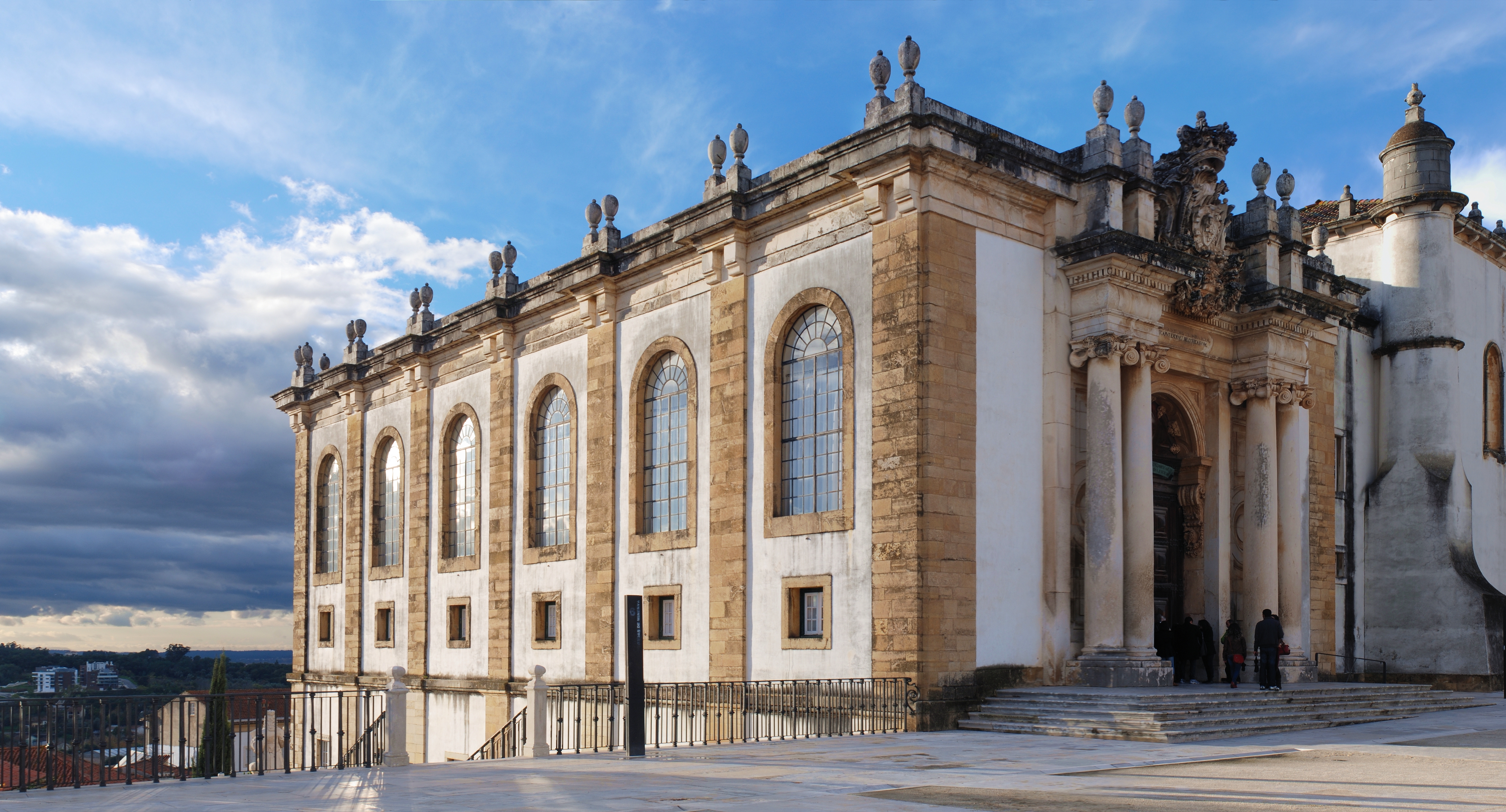
The heart of the city is the Universidade de Coimbra, a Unesco World Heritage Site, with its majestic Paço das Escolas, its bell tower and, above all, the dazzling Biblioteca Joanina, a late baroque jewel decorated in gold over lacquer, considered one of the most beautiful libraries in the world. An astonishing and entirely real detail: for more than two centuries a colony of bats has protected its valuable books by eating at night the insects that could damage the paper. Its timed, strictly capped entry is the key practical point to bear in mind when planning your visit.

But Coimbra is far more than its university. It is the Sé Velha, one of the most imposing Romanesque cathedrals in the country; the Mosteiro de Santa Cruz, where Portugal's first two kings rest; the Quinta das Lágrimas, setting of the tragic love of Pedro and Inês de Castro; and, a short hop away, the extraordinary Roman ruins of Conimbriga, among the best preserved in the peninsula. This guide walks you through the essentials with a practical eye: what to see, how to get around, what each ticket costs and how to spend a night of fado in the city that sings it in a cape by moonlight.

📖 History of Coimbra

Coimbra's past reaches back to Roman times. On the hill where the city now stands rose Aeminium, a settlement dependent on the nearby and more important Conimbriga; when the latter was sacked by Suebi and Visigoths in the 5th century, Aeminium inherited its name, which became 'Coimbra'. After centuries of Muslim rule and a shifting frontier, the city was definitively reconquered in 1064 by Fernando I of León. With the birth of Portugal, Coimbra lived its greatest moment: it was capital of the kingdom between 1131 and 1255, under the first kings of the Burgundian dynasty, and Afonso Henriques and Sancho I are buried here in the Mosteiro de Santa Cruz. In 1290 King Dinis founded the university — first in Lisbon — which after several moves between the two cities was finally installed in Coimbra in 1537, in the old royal palace. The city was also the setting for the tragic love between Prince Pedro and Inês de Castro, murdered in 1355 on the orders of King Afonso IV. In the 18th century King João V had the splendid Biblioteca Joanina built. The university shaped the city's life for centuries and, in the 20th, was a focus of tension with the Estado Novo dictatorship. Today Coimbra is a Unesco World Heritage Site (2013) and a vibrant university city. The full story is on our history page.

Read the full history ↓

🏛️ Coimbra is in Central Portugal

The Portugal of learning and faith: Coimbra and its university, one of the oldest in the world; Fátima, a great pilgrimage centre; Nazaré and its giant waves; Aveiro, the 'Portuguese Venice' of the lagoon; and Óbidos, a walled medieval village.

Read the history of Central Portugal →

🗺️ What to see

1
Universidade de Coimbra (Paço das Escolas) and the Biblioteca Joanina
The World Heritage university complex, with the tower, the Paço das Escolas and the dazzling baroque Biblioteca Joanina.
The Universidade de Coimbra is the city's star monument and one of the oldest continuously operating universities in the world (founded in 1290). Its monumental core is the Paço das Escolas, the old royal palace where the university settled for good in 1537, arranged around a large open courtyard overlooking the Mondego. The whole complex was declared a Unesco World Heritage Site in 2013. Around the courtyard you can visit the Torre da Universidade (the bell tower, with its famous bell known as 'a cabra'), the Capela de São Miguel with its spectacular baroque organ, the Sala dos Capelos (the great ceremonial hall, once the throne room) and the Royal Palace. The absolute jewel is the Biblioteca Joanina, commissioned by King João V between 1717 and 1728. It is one of the richest baroque libraries in Europe: three rooms in enfilade decorated with gilded shelving over green, red and black lacquer, painted ceilings and an atmosphere of a temple of learning that takes your breath away. It holds tens of thousands of old volumes. A real and curious fact: for more than two centuries two small colonies of bats have lived in the library and, at night, eat the insects that could damage the books and the furniture; that is why the tables are covered with leather cloths each night. Key practical note: entry to the Biblioteca Joanina is by timed slot with a strict cap (only 50 people every 20 minutes), and you have to go in exactly at the time on your ticket. Buy in advance, especially in high season, so you don't miss out on a slot. Getting there: the upper town is reached on foot up the slopes of the old quarter or with the help of the elevador do Mercado. Best time and time of day: book an early Joanina slot and leave time for the rest of the complex. Tips: the general ticket including the Joanina costs €16.50; without the library (university + Science Museum) it is €12.50.
ℹ️ Distance: In the upper town; reached on foot or with the elevador do Mercado · Best time: Book the Joanina time slot in advance; open every day (last Joanina admission 17:40) · Admission: Ticket with Biblioteca Joanina + Universidade + Museu da Ciência €16.50; without the Joanina (Universidade + Museu da Ciência) €12.50; guided visit of the Paço das Escolas €25 (source: official Turismo UC / visit.uc.pt, verified July 2026) · Duration: 2 to 3 hours
2
Sé Velha (Old Cathedral)
One of the most important Romanesque cathedrals in Portugal, both fortress and church, from the 12th century.
The Sé Velha of Coimbra is one of the best-preserved Romanesque cathedrals in the Iberian peninsula and one of the city's most imposing buildings. Construction began around 1140, in the time of the first king Afonso Henriques, when Coimbra was capital of the kingdom, and it has the sober, massive look of a fortress: thick walls, battlements and few windows, reflecting an era when the frontier with Muslim territory was still close. Its main façade, with a doorway and a window of defensive character, is unmistakable. Inside, austere and solemn, the highlights are the flamboyant Gothic high altarpiece, gilded and very beautiful, the Renaissance chapel of the Blessed Sacrament, and a quiet Gothic cloister — one of the first in Portugal — entered separately. The Sé Velha was the city's main church for centuries, until in the 18th century the bishop's seat moved to the Sé Nova (the new cathedral, beside the university). Getting there: it stands halfway up the slope, in the heart of the old quarter, climbing from the Baixa towards the university; a natural stop on the way up to the upper town. Best time and time of day: morning or mid-afternoon, during opening hours. Tips: the outdoor steps of the Sé Velha are, along with those of Santa Cruz, one of the traditional settings for Coimbra fado at night; admission to the church is cheap.
ℹ️ Distance: Halfway up the old quarter, between the Baixa and the university · Best time: Morning or mid-afternoon, during opening hours · Admission: About €2.50-3 (includes the cloister); check at the ticket desk (2026) · Duration: 45 min to 1 hour
3
Mosteiro de Santa Cruz
The pantheon of Portugal's first two kings, with a splendid façade and Manueline choir stalls.
The Mosteiro de Santa Cruz is one of the most important and history-laden monuments in Coimbra. Founded in 1131, in the years when the city was capital of the kingdom, it was a great religious and cultural centre of the Portuguese Middle Ages. Its enormous symbolic value lies in the fact that Portugal's first two kings rest here: Afonso Henriques, the founder of the nation, and his son Sancho I, whose Gothic tombs, commissioned in the 16th century by King Manuel I, preside over the high altar. The monastery was thoroughly remodelled in the Manueline period, and from that era it keeps its spectacular façade, the portico, the pulpit, the choir stalls carved with scenes of Portuguese expansion and a beautiful Renaissance cloister (the Claustro do Silêncio). It stands right in the centre, on the lively Praça 8 de Maio, and its church can be visited separately from the monastery's artistic areas. Getting there: right in the Baixa, on Praça 8 de Maio, very central and easy to reach on foot. Best time and time of day: during opening hours; there is usually a charge for the artistic areas (sacristy, cloister, upper choir and tombs). Tips: the steps of Santa Cruz are another classic setting for Coimbra fado; and in the adjoining building is the historic Café Santa Cruz, set in a former chapel, ideal for a coffee.
ℹ️ Distance: On Praça 8 de Maio, right in the centre (Baixa) · Best time: During opening hours; church and artistic areas · Admission: The church is free or by donation; the artistic areas (cloister, choir, tombs) about €3-4 (check at the ticket desk, 2026) · Duration: 45 min to 1 hour
4
Quinta das Lágrimas and the story of Pedro and Inês
The romantic gardens that set the scene for the tragic love of Pedro and Inês de Castro, with the Fonte dos Amores.
The Quinta das Lágrimas ('Estate of Tears') is an old palace with historic gardens tied to one of the most tragic and famous love stories in Portugal: that of Prince (later King) Pedro and his lover Inês de Castro. Inês, a Galician noblewoman and lady-in-waiting, had a forbidden relationship with Pedro, heir to the throne, which King Afonso IV saw as a political threat because of her family's influence. In 1355 Inês was murdered by three nobles sent by the king. When Pedro came to the throne, he took cruel revenge on the killers and proclaimed that he had married Inês in secret; legend says he even had her body crowned as queen. Tradition sets the ending of this tragedy in these gardens. Here are the Fonte dos Amores (the Fountain of Lovers), where legend says the lovers met, and the Fonte das Lágrimas (the Fountain of Tears), whose waters — so the myth goes — spring from Inês's tears, with reddish algae said to represent her spilled blood. The gardens, romantic and lush, can be explored at leisure; part of the estate is now a luxury hotel, but the historic gardens are open to visitors. Getting there: they are on the south bank of the Mondego, some way from the centre; reached by town bus, taxi or a long walk. Best time and time of day: spring and autumn, when the gardens are at their best. Tips: it is a quiet, evocative visit, ideal to combine with the Mosteiro de Santa Clara-a-Velha on the same bank, where Inês was living when she was murdered.
ℹ️ Distance: South bank of the Mondego; by town bus, taxi or a long walk from the centre · Best time: Spring and autumn, when the gardens are at their best · Admission: Gardens about €5-7.50 (check at the ticket desk, 2026) · Duration: 1 to 1.5 hours
5
Coimbra fado
Academic fado, sung only by men in black capes: different from Lisbon's, intimate and learned.
Coimbra fado is one of the city's hallmarks and an unmissable experience. Unlike Lisbon fado — more popular and bohemian, also sung by women in black shawls — Coimbra fado was born in the university world and is a learned fado, tied to student life: it sings of student loves, of love for the city and of longing. It is sung exclusively by men, traditionally students or former students, in academic dress: black trousers and gown covered by the characteristic black woollen cape. Musically it is different too: it is accompanied by the Portuguese guitar — tuned a tone lower here than in Lisbon, to carry better in the open air — and the viola (classical guitar). Traditionally it is sung at night, almost in darkness, in the streets and on the steps of the city, above all on the steps of the Sé Velha and the Mosteiro de Santa Cruz, or in serenades beneath windows. A curious custom: at the most purist performances people do not applaud but 'cough' as a sign of approval. Today you can enjoy it in dedicated venues offering intimate concerts with commentary, such as Fado ao Centro or the Casa das Caldeiras (run by the university). Getting there: the fado venues are in the centre and the upper town. Best time and time of day: at night; booking is advisable. Tips: a Coimbra fado concert usually lasts about 45-50 minutes and costs around €15-18 per person; the Queima das Fitas in May includes mass fado serenades.
ℹ️ Distance: Venues in the centre and the upper town; the steps of the Sé Velha and Santa Cruz · Best time: At night; booking advisable; May for the Queima das Fitas serenades · Admission: Fado concert about €15-18 per person (for example Casa das Caldeiras €15; source: visit.uc.pt / Fado ao Centro, verified July 2026) · Duration: The concert lasts 45-50 minutes
6
The Roman ruins of Conimbriga
One of the best-preserved Roman cities in the peninsula, with spectacular mosaics, 16 km away.
Conimbriga is one of the great Roman sites in Portugal and in the whole Iberian peninsula, and an essential day trip from Coimbra. Some 16 km to the south, near Condeixa-a-Velha, it was originally a Celtic settlement that the Romans turned, from the 1st century, into a prosperous city. For centuries it was the great urban centre of the area, while neighbouring Aeminium (the future Coimbra) was a lesser town under its influence. Its decline came with the Suebic and Visigothic invasions between 465 and 468, after which it was abandoned; to defend themselves, its inhabitants raised an imposing wall that now cuts the city in two and is one of its most characteristic sights. The most impressive things at Conimbriga are its mosaics, in astonishing condition, with hunting scenes, animals and mythological motifs. The highlights are the Casa dos Repuxos (House of Fountains), with a garden of water jets surrounded by almost 570 m² of mosaics, and the Casa de Cantaber, one of the largest residences in the western Roman world. Baths, the forum, the aqueduct and cobbled streets also survive. A dedicated museum (Museu Nacional de Conímbriga) displays the finds from the site. Getting there: by bus from Coimbra (there are services combining the round trip with time for the visit), on an organised tour, by taxi or by car. Best time and time of day: morning or mid-afternoon; allow at least 2-3 hours. Tips: the museum ticket includes the ruins and costs only €4 (€2 students), with free entry on Sundays; bring water, a hat and comfortable shoes, as there is little shade.
ℹ️ Distance: About 16 km south of Coimbra (Condeixa-a-Velha); by bus, tour, taxi or car · Best time: Morning or mid-afternoon; open 10:00 to 18:00 (ticket office closes 17:15) · Admission: €4 adult, €2 student (includes the ruins and the museum); 50% discount for 65+, 13-24 and families; free on Sundays (source: official Museu Nacional de Conímbriga, verified July 2026) · Duration: 2 to 3 hours (plus travel)
7
Mosteiro de Santa Clara-a-Velha and Portugal dos Pequenitos
The Gothic monastery rescued from the waters of the Mondego and a famous miniature park for all the family.
On the south bank of the Mondego, facing central Coimbra, are two very different and highly recommended visits. The Mosteiro de Santa Clara-a-Velha is a 14th-century Gothic monastery that for centuries was partly submerged and flooded by the river, until in the early 21st century an ambitious recovery project rescued it from the water and opened it to the public with a modern interpretation centre. Inês de Castro lived here and was murdered here in 1355, and this was her first burial place before she was moved to the Mosteiro de Alcobaça. Its Gothic arches emerging from the ground have a very particular, melancholy beauty. A few steps away is Portugal dos Pequenitos, a theme park opened in 1940 that recreates in miniature Portugal's most famous monuments and those of the former overseas territories, along with typical houses from the different regions. It is an endearing visit, very popular with families, and a fun way to see 'all of Portugal' in a short time. Getting there: on the south bank of the Mondego, across the Santa Clara bridge; reached on foot (a pleasant walk), by town bus or by taxi. Best time and time of day: morning or afternoon; they combine well with each other and with the Quinta das Lágrimas nearby. Tips: this bank gives the best panoramic views of the upper town and the university reflected in the river, ideal at sunset.
ℹ️ Distance: South bank of the Mondego, across the Santa Clara bridge; on foot, by bus or taxi · Best time: Morning or afternoon; can be combined with the Quinta das Lágrimas · Admission: Mosteiro de Santa Clara-a-Velha about €4-5; Portugal dos Pequenitos about €11.95 adult, €7.95 children (check at the ticket desk, 2026) · Duration: 1 hour each
8
Coimbra's Baixa: the Arco de Almedina, Rua Ferreira Borges and the Mondego
The commercial quarter by the river, with the medieval city gate, lively streets and the elevador do Mercado.
The Baixa is the lower, commercial part of Coimbra, on the banks of the Mondego, and the lively counterpoint to the solemn university town above. Its most famous gateway is the Arco de Almedina, the main medieval entrance through the walls, a set of arches and towers from which the climb to the old town begins along cobbled lanes. Crossing it means entering medieval Coimbra. On the flat, Rua Ferreira Borges and Rua Visconde da Luz are the commercial arteries, pedestrian and full of shops, cafés and pastry shops, linking Praça 8 de Maio (beside Santa Cruz) with the river. This is where you try local sweets such as 'pastéis de Tentúgal', 'arrufadas' and 'queijadas', and soak up the city's student atmosphere. Very close by, the Portagem and the Largo da Portagem, beside the Santa Clara bridge, make a pleasant riverside promenade with views. To get up to the upper town without walking, the elevador do Mercado is a funicular (in fact an inclined lift combined with a vertical one) that climbs from the municipal market area to the surroundings of the university. Getting there: it is the pedestrian heart of the centre, steps from Coimbra-A station. Best time and time of day: the afternoon for shopping and strolling, and sunset for the riverbank. Tips: use the elevador do Mercado to get comfortably up to the university and then walk back down through the Arco de Almedina, enjoying the corners on the way.
ℹ️ Distance: The lower part beside the Mondego, steps from Coimbra-A station · Best time: Afternoon for shopping and strolling; sunset for the riverbank · Admission: Free; the elevador do Mercado is covered by an SMTUC town transport ticket (about €1.60-2.50 depending on the type, check, 2026) · Duration: 1.5 to 2 hours of walking
Advertisements
What nobody tells you

💵 Prices

Tickets

TypePrice
Universidade de Coimbra with the Biblioteca Joanina (+ Museu da Ciência)€16.50 adult (Joanina entry by timed slot, capped at 50 people every 20 min) (source: official visit.uc.pt, verified July 2026)
Universidade de Coimbra without the Biblioteca Joanina (+ Museu da Ciência)€12.50 adult (source: official visit.uc.pt, verified July 2026)
Guided visit of the Paço das Escolas (includes the Joanina)€25 adult, 1 h 30 (source: official visit.uc.pt, verified July 2026)
Coimbra fado performance (Casa das Caldeiras)€15 per person; at Fado ao Centro about €18 (source: visit.uc.pt / Fado ao Centro, verified July 2026)
Ruins and Museu Nacional de Conímbriga€4 adult, €2 student; 50% for 65+/13-24/families; free on Sundays (source: official Museu Nacional de Conímbriga, verified July 2026)
Sé Velha (with the cloister)About €2.50-3 (check at the ticket desk, 2026)
Mosteiro de Santa Cruz (artistic areas)About €3-4; the church is free or by donation (2026)
Quinta das Lágrimas (gardens)About €5-7.50 (check at the ticket desk, 2026)
Portugal dos PequenitosAbout €11.95 adult, €7.95 children (check at the ticket desk, 2026)
🔄 updated monthlyOfficial / reference values · double-check when buying

Activities and tours

ActivityPriceDurationOperator
Guided visit to the university and the Biblioteca Joanina€25 per person (guided Paço das Escolas, 1 h 30) (2026)1.5 hTurismo UC (visit.uc.pt)
Coimbra fado concert€15-18 per person (2026)45-50 minCasa das Caldeiras (UC), Fado ao Centro (check)
Day trip to the Roman ruins of Conimbriga€4 admission + transport; guided tours from €25-45 per person (2026, indicative)Half a dayLocal agencies or the regional bus (check)
Free walking tour of the old townFree with a suggested tip of €5-10 (2026, indicative)2 hLocal free tour companies (check)
Boat trip on the Mondego€8-15 per person depending on length (2026, indicative)45 min to 1 hLocal river operators (check)
🔄 updated monthlyOfficial / reference values · double-check when buying
Advertisements

🚌 How to get there and distances

Getting around

ModePriceDurationNotes
On foot around the centre and the upper townFreeVariesThe best way to see Coimbra, though with plenty of cobbled slopes up to the university. Comfortable shoes are essential
Town buses (SMTUC)About €1.60-2.50 depending on whether you buy on board or use a rechargeable card (indicative, check, 2026)VariesA wide network across the city, including electric minibuses through the old town. Useful for the Quinta das Lágrimas, Santa Clara and the stations
Elevador do Mercado (funicular)Covered by the SMTUC town transport ticket (2026)A few minutesIt combines an inclined lift and a vertical one to climb from the market area up to the surroundings of the university, avoiding the slope
Shuttle train Coimbra-B ↔ Coimbra-AA short hop included with, or very cheap alongside, the long-distance ticket (2026)About 5 minLong-distance trains stop at Coimbra-B (1.5 km out); a shuttle or the urban services take you to the central Coimbra-A station, right in the Baixa
Taxis and apps (Bolt, Uber)Short trips from €5-8 (indicative, 2026)A few minutesHandy for the south bank (Quinta das Lágrimas, Santa Clara), at night or with luggage
🔄 updated monthlyOfficial / reference values · double-check when buying

How to get there

RouteAirlines / operatorsAvg. priceDuration
Lisbon → Coimbra by trainComboios de Portugal (CP): Alfa Pendular and IntercidadesAbout €21-32.50 depending on the train, class and how early you book (Promo fares are cheaper) (2026)Alfa Pendular ~1 h 40; Intercidades ~1 h 55 (to Coimbra-B)
Porto → Coimbra by trainCP: Alfa Pendular and IntercidadesAbout €14-22 depending on the train and how early you book (2026)About 1 h to 1 h 15 (to Coimbra-B)
Coimbra-B → the centre (Coimbra-A)CP (shuttle train) or SMTUC town busThe shuttle is included with, or very cheap alongside, the long-distance ticket (2026)About 5-10 min
Lisbon or Porto → Coimbra by coachRede Expressos, FlixBusFrom €10-18 depending on where you start and how early you book (2026)About 2 h 15 from Lisbon; 1 h 30 from Porto
Porto (OPO) or Lisbon (LIS) airport → CoimbraTrain (via Porto/Lisbon) or direct coach (FlixBus/Rede Expressos)Depending on where you start; train or coach combinations from €15-30 (2026, indicative)About 1.5-3 h depending on the airport and the mode
🔄 updated monthlyOfficial / reference values · double-check when buying

🏨 Where to stay

No exact prices: a scale from $ (budget) to $$$$$ (luxury), with 2-3 options per category.

CategoryPriceRecommended options
Historic luxury (Quinta das Lágrimas)$$$$$US$ 150-320 a night; the Hotel Quinta das Lágrimas, a palace with historic gardens and a spa, is the luxury option par excellence, tied to the legend of Pedro and Inês. Ideal for a special stay
Mid-range in the centre$$$$$US$ 60-110 a night; a good choice of hotels and apartments in the Baixa and near the university, steps from the monuments and the stations. Good value for the location
Boutique and character hotels$$$$$US$ 90-160 a night; boutique hotels in historic buildings in the old town and in grand houses, with character and good service, well placed for exploring the city on foot
Budget / hostels$$$$$US$ 22-50 a night; being a university city, Coimbra has plenty of good hostels and cheap guesthouses, popular with young travellers and those passing between Lisbon and Porto

🍴 Where to eat

TypePriceOptions / signature dish
Tascas and traditional regional cooking$$$$$€10-20 per main; for 'chanfana' (goat stewed in red wine), 'leitão' (suckling pig) from nearby Bairrada, bacalhau and home-style dishes with house wine. Plentiful in the Baixa and the old town
Chef-led restaurants and modern cooking$$$$$€20-45 per main; places that reinterpret the cooking of the Centro region with local produce, some with views over the Mondego. Booking advisable at weekends
Historic cafés and convent pastries$$$$$€1.50-6 per order; the Café Santa Cruz (in a former chapel) and the pastry shops of the Baixa, for sweets such as 'pastéis de Tentúgal', 'arrufadas' and 'queijadas de Coimbra'
Repúblicas and student canteens around the university$$$$$€6-12 per meal; student atmosphere and low prices in the university area, ideal for eating well and cheaply in the academic heart of the city
Advertisements

📖 History of Coimbra

Origins, formation and what the sources say.

The city of learning, longing and kings

Some cities are defined by a river, a monument or a battle. Coimbra is defined by an idea: knowledge. Perched on a hill on the banks of the Mondego, halfway between Lisbon and Porto, this city in central Portugal has spent more than seven centuries revolving around one of the oldest continuously operating universities in the world. Walking through its upper town, among students in black capes and centuries-old walls, means feeling the weight of generations of scholars, poets and fado singers who made Coimbra a place apart.

But before it became the great university city, Coimbra was many other things. It was a Roman town in the shadow of neighbouring Conimbriga. It was a disputed frontier between Christians and Muslims. It was, for more than a century, the capital of the young kingdom of Portugal, and the Mosteiro de Santa Cruz holds the tombs of its first two kings. It was the setting for the most tragic love story in Portuguese literature, that of Pedro and Inês de Castro. And in the 20th century it was a battleground between the university and the dictatorship.

This is the story of how a modest Roman settlement inherited the name of a neighbouring city destroyed by the barbarians; of how it became a cradle of kings; of how King Dinis installed here, intermittently and finally permanently, a 'general study' that would become the intellectual heart of an empire; and of how that university — with its gilded library guarded by bats — still sets the pulse of the city.

From Aeminium and Conimbriga: the Roman roots

The name of Coimbra hides a curious inheritance. In Roman times, the hill where the city now stands was occupied by Aeminium, an urban settlement founded around the time of Emperor Augustus, of secondary importance. The great city of the area was another: Conimbriga, some 16 km to the south, near present-day Condeixa-a-Velha. Originally a Celtic settlement, Conimbriga was Romanised from the 1st century and became a prosperous town, with a forum, baths, an aqueduct and luxurious houses decorated with mosaics of extraordinary quality, such as those of the Casa dos Repuxos and the Casa de Cantaber, today among the best preserved in the western Roman world. Aeminium was administratively dependent on it.

The fortunes of the two cities were reversed with the fall of the Roman Empire. Between 465 and 468 Conimbriga was sacked by Suebi and Visigoths; to defend themselves, its inhabitants hastily raised an imposing wall that now cuts the site in two and is one of its most striking sights. Even so, the city lost population until it was abandoned. Aeminium, better placed on its hill beside the river and easier to defend, took over as the urban and episcopal centre of the region. In time it even inherited the name of its fallen neighbour: 'Conimbriga' became 'Coimbra'.

Over the following centuries the city passed through Suebic and Visigothic hands and, from the 8th century, fell within the Muslim sphere of al-Andalus, on an unstable frontier that changed hands frequently. Coimbra was conquered and reconquered several times until, in 1064, King Fernando I of León took it definitively for the Christian world, making it a key stronghold in the advance southwards.

Capital of the kingdom: Portugal's first kings (1131-1255)

When Portugal was born as a political entity in the early 12th century, Coimbra was destined for a leading role. The first king, Afonso Henriques — who had forged independence in the north, at Guimarães, after the battle of São Mamede in 1128 — needed a base further south, close to the shifting frontier with the Muslims, from which to direct the kingdom's expansion. Coimbra, newly won for Christendom and well placed above the Mondego, was ideal. Around 1131 the city became, in practice, the capital of the young kingdom, a status it would keep until 1255.

Under the first kings of the Burgundian dynasty, Coimbra lived its period of greatest political splendour. Its great religious monuments were raised: the Mosteiro de Santa Cruz, founded in 1131, became one of the country's most important cultural and spiritual centres, and the Sé Velha, begun around 1140, rose with its fortress-like air as the city's cathedral. Santa Cruz holds the first two kings of Portugal: Afonso Henriques himself and his son Sancho I, whose Gothic tombs, commissioned centuries later by Manuel I, still preside over the high altar.

In 1255, however, King Afonso III moved the capital to Lisbon, larger, better connected to the sea and by then far from the old frontier. Coimbra lost its rank as political capital, but it was about to find the vocation that would make it famous forever: knowledge.

King Dinis's university (1290) and its back-and-forth with Lisbon

On 1 March 1290, King Dinis signed the document creating an 'Estudo Geral' (Studium Generale), that is, a university, for the kingdom of Portugal. Shortly afterwards, in August of that year, Pope Nicholas IV confirmed it by bull. It is the birth certificate of what would become the Universidade de Coimbra, one of the oldest continuously operating universities in Europe and the world. Curiously, it was not born in Coimbra but in Lisbon.

Over the following two centuries the university swung back and forth between the two cities, driven by conflicts between students and the local population and by royal decisions. It moved to Coimbra in 1308, returned to Lisbon in 1338 by order of Afonso IV, went back to Coimbra, and so on. That wandering ended in 1537, when King João III transferred it definitively to Coimbra and installed it in the city's old royal palace, the Paço das Escolas, at the top of the hill. From then on, university and city merged into a single identity.

In the centuries that followed, the Universidade de Coimbra became the great intellectual centre of the Portuguese empire, passing generations of jurists, theologians, physicians and humanists through its halls. Its most dazzling jewel arrived in the 18th century: between 1717 and 1728, King João V — the monarch of Brazilian gold and a great patron of the baroque — had the Biblioteca Joanina built, which bears his name. With its three rooms decorated in gold over green, red and black lacquer, its painted ceilings and its temple-like atmosphere, it is considered one of the most beautiful baroque libraries in Europe. To this day two colonies of bats live in it and protect its books by eating at night the insects that could damage them, an improbable alliance between nature and learning that has lasted more than two centuries.

Pedro and Inês: the tragic love that Coimbra keeps

No story is as bound to Coimbra as that of Pedro and Inês de Castro, the most famous love tragedy in Portuguese literature. Inês de Castro (around 1325-1355) was a Galician noblewoman, lady-in-waiting to the wife of Prince Pedro, heir to the throne. A forbidden passion arose between Pedro and Inês: King Afonso IV, Pedro's father, viewed the influence of the Castro family and the political danger of the relationship with enormous suspicion. Despite royal opposition, the lovers lived their romance, largely in Coimbra, and had several children.

On 7 January 1355, on the orders of Afonso IV, three nobles — Pêro Coelho, Álvaro Gonçalves and Diogo Lopes Pacheco — went to the Mosteiro de Santa Clara-a-Velha, on the south bank of the Mondego, where Inês lived, and murdered her, cutting her throat in front of her small children. Legend places the crime, or the weeping that followed it, in the gardens of today's Quinta das Lágrimas, where the Fonte dos Amores and the Fonte das Lágrimas are still shown; according to the myth, the waters spring from Inês's tears and reddish algae represent her blood.

Pedro's revenge was terrible. When he came to the throne as Pedro I in 1357, he hunted down Inês's killers, captured two of them and had them executed brutally. He also proclaimed that he had married Inês in secret before her death, recognising her as legitimate queen; legend — taken up by poets and playwrights for centuries, including Camões in 'Os Lusíadas' — even says he had her body exhumed and crowned, forcing the court to pay homage to it. His remains and Inês's now lie facing each other in the Mosteiro de Alcobaça. The story turned Coimbra into the eternal setting of a love stronger than death.

The Inquisition, the 20th century and the university against the dictatorship

Being a great intellectual and religious centre had its dark side too. Like other university cities, Coimbra lived under the long shadow of the Portuguese Inquisition, established in 1536: the enforcement of Catholic orthodoxy shaped academic life for centuries, censoring ideas and books and persecuting converts and those suspected of heresy, in a constant tension between learning and dogma that only eased with the Enlightenment reforms of the Marquis of Pombal in the 18th century, which modernised the curriculum and created new science faculties.

In the 20th century the university again became a scene of conflict, this time political. Under the Estado Novo dictatorship of António de Oliveira Salazar (1933-1974) — himself a former professor at the Universidade de Coimbra — the city and its academic life were placed under the regime's control. The university became a focus of student resistance, which erupted in the so-called 'academic crisis of 1962' and, above all, in that of 1969, when student protests over their freedoms met repression. The regime suspended student representatives, arrested numerous students and, at various points, expelled elected leaders, denying them any part in the university's governing bodies. Those struggles were part of the ferment that would lead to the Carnation Revolution of 25 April 1974, which ended the dictatorship.

Under democracy, Coimbra has strengthened its role as a great university city and has seen its heritage value recognised: in 2013 the Universidade de Coimbra — Alta and Sofia — was declared a Unesco World Heritage Site. Today the city combines its enormous historical legacy with the energy of tens of thousands of students, who keep alive traditions such as the academic dress, the student 'repúblicas', the Queima das Fitas festival in May and the unmistakable fado of Coimbra. Above the Mondego, among the tombs of kings, Roman mosaics and gilded shelves, Coimbra remains, above all, the city of learning.

📚 Bibliography

  • Wikipedia (EN) — «Coimbra»: https://en.wikipedia.org/wiki/Coimbra
  • Britannica — «Coimbra, Portugal»: https://www.britannica.com/place/Coimbra-Portugal
  • Wikipedia (EN) — «University of Coimbra»: https://en.wikipedia.org/wiki/University_of_Coimbra
  • Wikipedia (EN) — «Biblioteca Joanina»: https://en.wikipedia.org/wiki/Biblioteca_Joanina
  • Wikipedia (EN) — «Conímbriga»: https://en.wikipedia.org/wiki/Con%C3%ADmbriga
  • Wikipedia (EN) — «Inês de Castro»: https://en.wikipedia.org/wiki/In%C3%AAs_de_Castro
  • UNESCO — «University of Coimbra – Alta and Sofia»: https://whc.unesco.org/en/list/1387/
  • Museu Nacional de Conímbriga (oficial): https://museunacionaldeconimbriga.gov.pt/visitar
  • Center of Portugal — «Pedro e Inês, uma história de amor intemporal»: https://www.centerofportugal.com/article/pedro-and-ines-a-timeless-love-story
  • Participedia — «The Republics of Coimbra»: https://participedia.net/case/4982
  • The Collector — «How the Roman Aeminium Became Coimbra»: https://www.thecollector.com/history-coimbra-portugal-guide/
  • Turismo UC (oficial) — Universidade de Coimbra: https://visit.uc.pt/pt/info

❓ Frequently asked questions

How does entry to the Biblioteca Joanina work?+
The Biblioteca Joanina can only be visited with a timed ticket and a strict cap: only 50 people are admitted every 20 minutes, and you must go in exactly at the time on your ticket (you will not be admitted outside that slot). There is no individual ticket for the library alone: you buy the general ticket covering the university, the Joanina and the Science Museum (€16.50). Book ahead, especially in high season, to secure the time you want.
Is the story about the bats in the Biblioteca Joanina true?+
Yes, it is real and rather remarkable. For more than two centuries two small colonies of bats have lived in the Biblioteca Joanina. By day they sleep out of sight, and at night, once the library closes, they eat the insects that could damage the paper and the wood of the books and shelving, helping to preserve the valuable collection. Each night the staff cover the tables with leather cloths to protect them, and clean the floor the next morning.
How many days do I need in Coimbra?+
One full day covers the essentials: the university with the Biblioteca Joanina (€16.50, with a timed slot), the Sé Velha, the Mosteiro de Santa Cruz and the Baixa by the river. With 2 days you add the Quinta das Lágrimas, the Mosteiro de Santa Clara-a-Velha, a night of Coimbra fado and the trip to the Roman ruins of Conimbriga (€4). It is an ideal stop on the way between Lisbon and Porto.
How do I get to Coimbra from Lisbon or Porto?+
By CP (Comboios de Portugal) train: the Alfa Pendular and Intercidades take about 2 hours from Lisbon and a little over 1 hour from Porto, arriving at Coimbra-B station (1.5 km from the centre), from where a shuttle train or the urban services take you to Coimbra-A, right in the Baixa. Tickets from Lisbon run about €21-32.50 depending on the train and how early you book (the cheaper Promo fares are bought days in advance). There are also Rede Expressos and FlixBus coaches. There is no metro in the city.
How is Coimbra fado different from Lisbon fado?+
Coimbra fado was born in the university world and is a learned, academic fado: it is sung only by men, traditionally students or former students, in black capes, and it sings of student loves and of love for the city. Lisbon's is more popular and bohemian, and is also sung by women in black shawls. The Coimbra Portuguese guitar is also tuned lower. In Coimbra it is sung at night on the steps of the Sé Velha and Santa Cruz, and at purist performances people do not applaud: they 'cough' as a sign of approval. A concert costs about €15-18.
Is the trip to Conimbriga worth it?+
Very much so. Conimbriga, about 16 km from Coimbra, is one of the best-preserved Roman cities in the Iberian peninsula, with spectacular mosaics (the Casa dos Repuxos and the Casa de Cantaber), baths, a forum and an impressive late wall. Admission, covering the ruins and the museum, costs only €4 (€2 students) and is free on Sundays. You get there by bus, tour, taxi or car, and it deserves 2-3 hours plus travel. Bring water and a hat, as there is little shade.
Sources consulted (17)
Still planning?
Explore more destinations in Portugal
See all destinations →
Advertisements
Image credits
Photos from Wikimedia Commons, each under its own licence (CC BY, CC BY-SA or public domain). Open each file to see its author and licence.
Coimbra November 2012-7