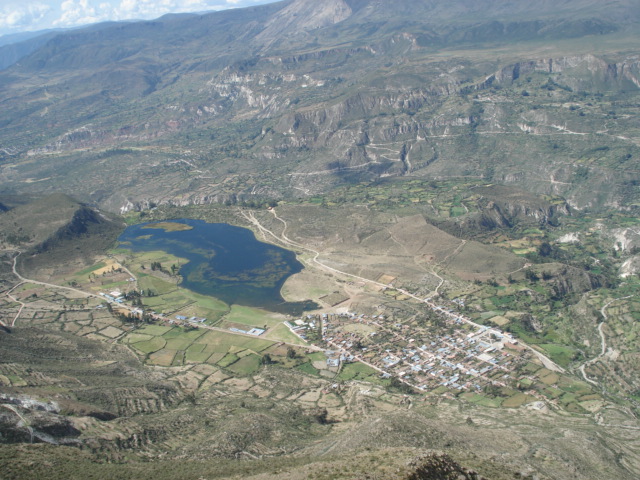
The Sondondo Valley is one of the great secrets of the Peruvian Andes: a valley in southern Ayacucho carpeted with monumental terracing, thousands of pre-Hispanic agricultural terraces climbing the slopes in a landscape of serene, almost untouched beauty. On top of that come high-altitude villages of deep tradition, viewpoints where condors glide and a history tied to the mestizo chronicler Felipe Guamán Poma de Ayala, born in this land.
Far from the mass circuits, the Sondondo offers rural tourism and nature in their purest form. The terraces —among the most extensive and best preserved in Peru— are still in use, kept up by communities that hold on to farming knowledge thousands of years old. The valley is also an excellent place for spotting Andean condors over the canyons, and for getting to know life in villages such as Andamarca, Cabana and Aucará.
This guide covers what to see and do in the Sondondo Valley —the Andamarca terraces, the condor viewpoints, the colonial villages, the lakes and the high-Andean wildlife—, how to get there from Ayacucho or Puquio, and why this remote valley is establishing itself as one of the most promising and genuine sustainable-tourism destinations in southern Peru.
The Sondondo Valley was inhabited from pre-Inca times by cultures that built its striking terracing, systems of agricultural terraces that turned the slopes into farmable land. The region was the birthplace of Felipe Guamán Poma de Ayala, the Indigenous chronicler who wrote the 'Nueva corónica y buen gobierno' (c. 1615), a key account of the Andean world after the conquest. Today the valley, with its colonial villages and living terraces, is promoted as a destination for rural and nature tourism.
Read the full history ↓The 'city of churches' where the independence of the Americas was sealed: cradle of the Wari empire, capital of Holy Week and of the retablo, and epicenter of the internal armed conflict of the twentieth century.
Read the history of Ayacucho →They depart from Nazca, 111 km away. If you book from this link we earn a commission and you pay no more.
No exact prices: a scale from $ (budget) to $$$$$ (luxury), with 2-3 options per category.
Origins, formation and what the sources say.
The Sondondo Valley is, above all, a cultural landscape: its slopes are carpeted with monumental terracing, thousands of agricultural terraces climbing the hills in one of the most extensive and best preserved sets of terraces in Peru. They were built in pre-Hispanic times by the cultures that lived in the valley, long before the Incas, and they answered a fundamental problem of the Andean world: how to farm sustainably on steep ground in a demanding climate.
The terraces solved that with remarkable ingenuity. Held up by stone walls, they created flat surfaces for growing, slowed soil erosion, held moisture and let people work different ecological tiers according to altitude. Careful water management, through channels and irrigation systems, completed this farming technology that turned the slopes into a productive garden and that is, to a good extent, still in use today.
That these terraces are still farmed is one of the great values of the Sondondo: they aren't ruins but a living heritage, kept up by communities that hold farming knowledge handed down from one generation to the next. The serene beauty of the valley, with its stepped terraces under Andean light, is the result of centuries of human work in tune with a difficult setting, and stands as an exceptional record of the farming civilization of the Andes.
Before the Inca expansion, the territory that today makes up the Sondondo Valley and its surroundings was inhabited by the Lucana people, a pre-Inca group that gave its name to the present-day province of Lucanas and that developed an identity of its own within the mosaic of societies of southern Ayacucho. The Lucanas ran a mixed economy of high-altitude farming -supported by the terracing- and camelid herding, working the different ecological tiers that this region of deep ravines and high puna offers.
Like other regional groups of the central Andes, the Lucanas were absorbed into the Tahuantinsuyo during the Inca expansion of the 15th and early 16th centuries, probably under Pachacútec or his successors, joining the mita system and the road and administrative network of the empire. Their territory, thanks to the recognized quality of its textiles and its labor, took on some standing within the imperial order, and some colonial chroniclers list the Lucanas among the ethnic groups that provided specialized services to the Cusco nobility.
The memory of the Lucanas and of the pre-Inca cultures of the valley lives on in the region's own place names -Lucanas, Sondondo, Andamarca- and in the persistence of farming practices and forms of community organization (such as collective work, or ayni) whose roots go back to times before the Incas arrived, and which in many cases also survived Spanish colonization.
The Sondondo Valley is tied to one of the most important figures in Peru's cultural history: Felipe Guamán Poma de Ayala, an Indigenous chronicler born in this region of southern Ayacucho. Around 1615, Guamán Poma completed his monumental work 'Nueva corónica y buen gobierno', an immense chronicle illustrated with hundreds of drawings, addressed to the king of Spain, in which he tells the history of the Andean world before and after the conquest and denounces in the harshest terms the abuses committed against the Indigenous population.
Guamán Poma's work is a historical source of incalculable value. His texts and, above all, his drawings offer an Andean and critical view of colonial society, Inca administration, customs, work, religion and daily life, at a moment of deep upheaval. It is one of the few accounts written by an Indigenous author that have come down to us, and his manuscript survives today as one of the great documentary treasures on early colonial America.
That a figure of such standing was born and formed in the Sondondo Valley adds a historical and symbolic dimension to a trip through its villages and landscapes. The valley isn't only an exceptional natural and agricultural setting but also the land that produced the man who best described, from the inside, the collision between the Andean and European worlds, and whose work still lights up our understanding of that crucial period.
After the Spanish conquest, the Sondondo Valley, like much of the central Andes, was reorganized under the system of 'reducciones' or Indian towns, a colonial policy that gathered a scattered population into settlements concentrated around a square and a church, making evangelization, tribute collection and administrative control easier. That policy is where the layout and the character of villages such as Andamarca, Cabana and Aucará come from, with their stone and adobe churches, their central squares and their organization around the festivals of a Catholic calendar laid over the Andean farming calendar.
Despite the strong colonial stamp visible in the religious architecture, much of daily life, the organization of communal work and the farming practices of the valley kept a remarkable continuity with the pre-Hispanic period. The terraces went on being farmed with the same inherited techniques, the patron-saint festivals took in ritual elements of Andean root under Catholic dress, and Quechua language and customs held firm in the communities, partly thanks to the valley's own geographical isolation from the main viceregal centers.
This colonial layer, on top of the pre-Hispanic inheritance and the recent turn toward tourism, makes the Sondondo a valley of stratified history: you can read pre-Inca and Inca farming in its terraces, Spanish evangelization in its churches, and in its festivals and community life the persistence of an Andean identity that came through centuries of colonial and then republican rule without ever being fully lost.
After the pre-Hispanic era, the villages of the Sondondo went through Spanish colonization, which left churches, squares and a colonial order laid over the Andean structure. Across the centuries the valley kept its farming and herding vocation and held on to deeply rooted traditions, festivals and ways of life, in a relative quiet helped along by how far it sits from the big centers and the tourist routes.
In recent decades that same isolation, which kept its landscapes and its culture intact, has become its greatest draw. The Sondondo Valley is promoted today as a destination for rural, community and nature tourism, combining the monumental terracing, condor watching, the cultural wealth of its villages and the presence of high-Andean wildlife such as the vicuña, protected in the neighboring Reserva Nacional Pampa Galeras. The bet is on sustainable, low-impact tourism that benefits the communities and conserves the heritage.
For the traveller, the Sondondo is a genuine alternative to the crowded circuits: a place where the terraces still produce, where the condors glide without crowds and where history —from the Lucanas and the cultures that raised the terraces through to Guamán Poma— is still there in the landscape and in the people. Walking it with respect, supporting the local economy and looking after its fragile setting, is the best way to help this remote valley keep its exceptional value for the generations to come.