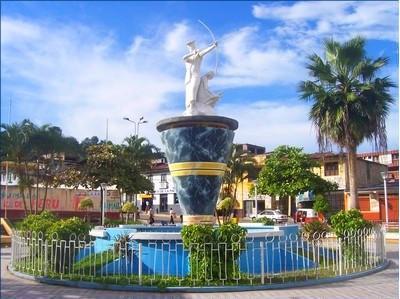
The central jungle around Chanchamayo, in the Junín region, is one of the most accessible Amazon destinations from Lima and a valley where the Andean and the Amazonian run into each other. Mist-covered mountains, coffee plantations with an intense aroma, hidden waterfalls, hanging bridges and Asháninka communities make up a lush, varied landscape. Its two gateways are La Merced, the provincial capital, and San Ramón, known for its trekking routes and its waterfalls.
Chanchamayo is one of the most important coffee valleys in Peru, and agrotourism is one of its great draws: many farms open their doors to show the full coffee process -harvest, pulping, drying, roasting- and offer tastings. Add to that waterfalls such as El Tirol, in San Ramón, some 35 meters high and very easy to reach, and the chance to visit Asháninka communities such as Pampa Michi or Bajo Marankiari, where you can see dances, music, craftwork and ancestral practices.
It's an ideal destination for a nature-and-coffee getaway a few hours from the capital. You get there by road from Lima, crossing the cordillera, on a trip usually done overnight so you arrive at dawn. This guide adds real prices for buses, admissions and tours so you can plan without surprises. Bring light quick-dry clothes, insect repellent, sunscreen, a swimsuit for the waterfalls and shoes you can walk in. Being close to Oxapampa and Pozuzo also means you can combine Chanchamayo with other destinations in the central jungle.
Chanchamayo developed as a colonization frontier of the central jungle from the 19th century on, when the Peruvian state pushed the occupation of these valleys, long inhabited by the Asháninka people, the largest Indigenous group in the Peruvian Amazon. The founding of La Merced and San Ramón and the arrival of settlers -including European immigrants- drove farming, coffee above all, which made the valley famous. Today it combines that coffee legacy with Asháninka culture and nature tourism. More detail on the history page.
Read the full history ↓The central highlands of the Mantaro valley: setting of the battle that opened the way to independence, land of the Huancas, of the highest railway in the world, of mining and of the coffee-growing central jungle.
Read the history of Junín →A local guide tells you in half an hour what no sign at the site will ever explain. We look ours up on Civitatis: guided in Spanish and booked online with no fuss. They have 5 activities in Selva Central Chanchamayo. Have a look below: tap any of them to see them all.
If you book from here we earn a commission and you pay no more. Prices and availability come from Civitatis.
No exact prices: a scale from $ (budget) to $$$$$ (luxury), with 2-3 options per category.
Origins, formation and what the sources say.
Long before La Merced or San Ramón existed, the Chanchamayo valley had already seen colonial attempts to push in. The first dates from 1635, when the Franciscan missionary friar Juan Jerónimo Jiménez entered the area and founded the settlement of San Buenaventura de Quimiri, at the confluence of the Chanchamayo and Paucartambo rivers, an early and fragile attempt to establish a permanent Spanish presence in territory that was, and would remain for centuries, the domain of the Asháninka people.
Over the following centuries it was above all the Franciscan friars of the convent of Santa Rosa de Ocopa -some 25 km from Huancayo, and still an active missionary center today- who led successive attempts to evangelize and colonize the valley. These missions ran into constant Asháninka resistance and, on several occasions, were destroyed or abandoned, which held back for generations the consolidation of a stable colonial presence in Chanchamayo.
It wasn't until the 19th century, in the republican era, that the Peruvian state took up the opening of roads into the valley with greater determination, seeking to reach the Yánesha and Asháninka peoples with the explicit aim of colonizing the region. That renewed state push laid the ground for the founding of the towns we know today as the hubs of Chanchamayo.
The founding milestone of Chanchamayo as it's known today came in 1869. That year an expedition led by colonel José Manuel Pereira Palomino pushed on toward the confluence of the Chanchamayo and Tulumayo rivers, where a military fort named San Ramón had already been raised, meant to protect settlers from possible conflict with the native population. Shortly afterward, the same expedition founded a new town, which they named La Merced, on 24 September 1869 -the date now celebrated as the city's anniversary.
That formal founding marked the start of a more systematic colonization of the valley, backed by the Peruvian state, which saw in this fertile land with its mild climate a chance to push the national farming frontier into the jungle. La Merced and San Ramón, only a few kilometers apart, became from then on the two urban poles around which all the later development of the province of Chanchamayo grew.
Alongside Peruvian colonization came, in the following decades, the arrival of European immigrants: descendants of Italians settled in strength in the basins of the Oxabamba and Chanchamayo rivers, with a particular presence in the territories of San Ramón and La Merced; later came groups of Chileans, hired as farm labor, and in the early 20th century a few Polish and French families. That mosaic of origins gradually shaped the particular identity of the valley, a mix of the Andean, the Amazonian and the migrant.
Chanchamayo's warm-temperate climate and the right altitude turned out to be ideal for a crop that would end up giving it national and international fame: coffee. Over the decades after the founding of La Merced and San Ramón, coffee plantations multiplied across the misty slopes of the valley, driven both by Peruvian settlers and by the immigrant European families who brought technique and capital to the area's emerging commercial farming.
Chanchamayo became, then, one of Peru's main coffee valleys, a status it keeps today and shares with neighboring Villa Rica, in the Pasco region. Coffee wasn't only an export crop: it turned into a central element of the valley's economic, social and cultural identity, present in the everyday life of its people and, in recent decades, in the region's growing tourism.
That coffee vocation explains today's boom in agrotourism in Chanchamayo: the coffee routes let visitors walk the family farms, see the whole process -from harvest to small-batch roasting- and taste a product that remains a source of regional pride, more than a century and a half after the founding of the valley's first towns.
Long before the settlers arrived, the Chanchamayo valley and much of the central jungle were the territory of the Asháninka people, the largest Indigenous group in the Peruvian Amazon, with a language of the Arawak family and a deep relationship with the forests and rivers of the region. The history of contact between the Asháninka and the colonizing society, from the first Franciscan attempts of the 17th century to the state colonization of the 19th, was marked by tension, dispossession of land and sustained resistance.
The most painful chapter of that history came in the 20th century, during Peru's internal armed conflict. Between 1988 and 1993 the central jungle -especially the neighboring province of Satipo- went through the worst of the violence of Sendero Luminoso, which used these territories as a fallback and control zone, with widespread looting, killings and kidnappings. The Asháninka people were among the main victims of that period: the Truth and Reconciliation Commission estimated close to six thousand deaths among the Asháninka population, some five thousand native people held captive by Sendero in conditions of slavery, and around ten thousand displaced from their ancestral lands.
Against that violence, the Asháninka themselves organized native patrols and self-defense committees, above all in the region of the Tambo and Ene rivers, which fought Sendero Luminoso directly between 1989 and 1993, later with support from the armed forces. That resistance, paid for at an enormous human cost, is today a fundamental part of the historical memory of the Asháninka people and a chapter that the communities receiving tourists -such as Pampa Michi or Bajo Marankiari- carry with them, even when it isn't always spelled out on the visits. Knowing this history adds depth to the encounter with the living Asháninka culture of Chanchamayo today.
Once the hardest stretch of the violence of the 1990s was behind it, Chanchamayo rebuilt its economy around the pillars that had defined it since the 19th century: farming, coffee above all, and a coexistence -not free of historical tension- between the settler population and the Asháninka communities of the valley. In recent decades a third pillar has come in strongly: nature and culture tourism, today an important source of income both for La Merced and San Ramón and for the native communities themselves.
Today communities such as Pampa Michi or Bajo Marankiari open their doors to community-based tourism, sharing their dances, their music, their craftwork and their ancestral practices with visitors. These visits, when done with respect and on fair terms, are a chance to acknowledge the role of the Asháninka as the valley's historical guardians and for tourism to become genuine support for preserving their culture, after decades marked by dispossession and violence.
Chanchamayo, then, is far more than coffee and waterfalls: it's the living territory of one of the great peoples of the Amazon, with a history of colonization, resistance and rebuilding that you can feel, even indirectly, on every visit to its coffee farms, its waterfalls and its native communities.