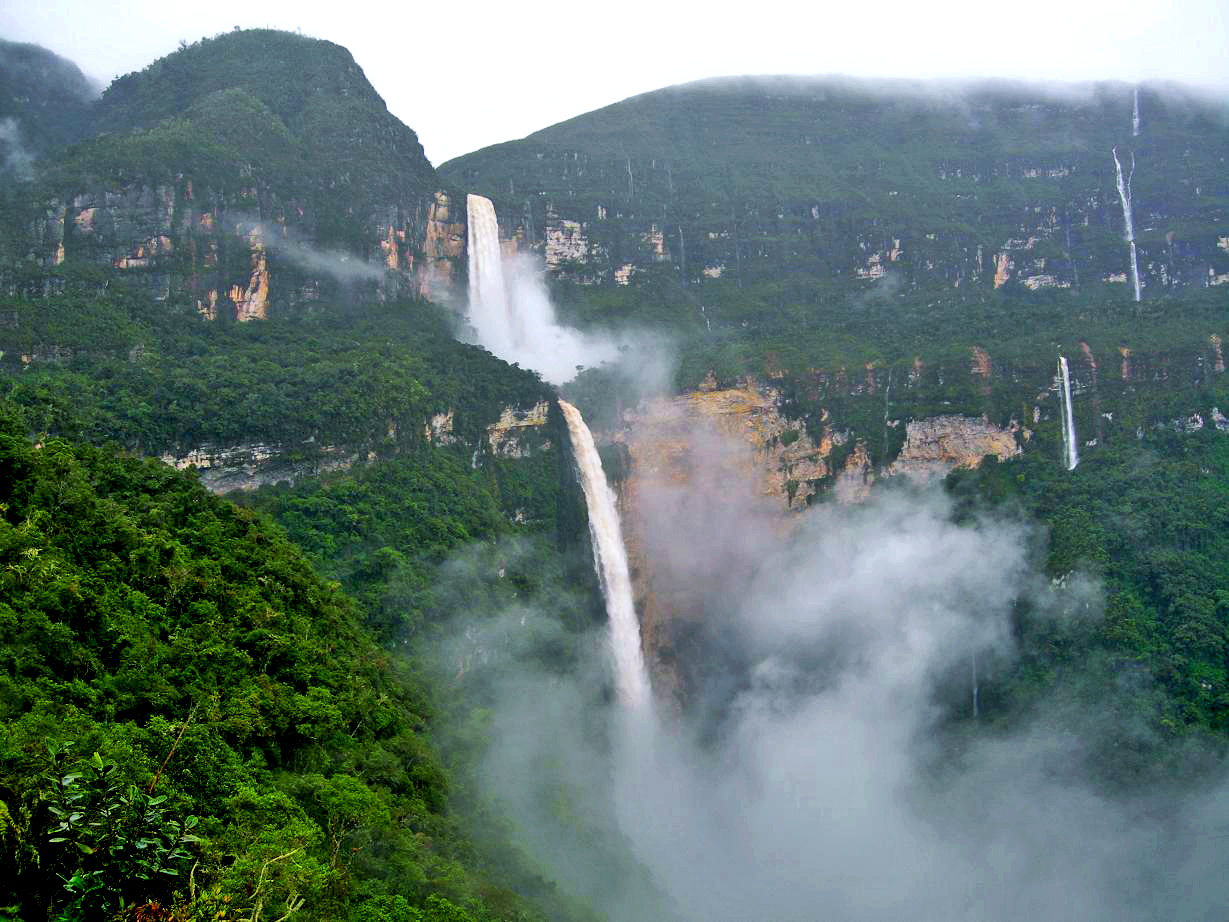
The Catarata de Gocta is one of the tallest waterfalls in the world, with a drop of some 771 meters in two great tiers, hidden in the cloud forest of the Amazonas region, about 44 kilometers from Chachapoyas. Despite its colossal size, it was practically unknown to the rest of the world until 2005, when an expedition made it known internationally. For the people of Cocachimba, on the other hand, it had always been there: they knew it, but a legend surrounded it that kept them at a distance.
Getting to Gocta is a small adventure. From the villages of Cocachimba or San Pablo de Valera, trails set off through the high jungle, crossing streams and viewpoints on the way to the base of the waterfall, where the water comes down hard off an immense wall and forms a pool ringed by vegetation. The classic walk, from Cocachimba, runs about 6 kilometers each way and some 2 to 3 hours up and the same back down, through one of the greenest, wettest landscapes in northern Peru.
The usual base is Chachapoyas, where full-day tours are organized, or you can get there on your own on transport to the access villages. Go with trekking shoes, a rain jacket, repellent and water. Gocta is usually combined on the same trip with Kuélap and the sarcophagi of Karajía, the three great icons of the Chachapoyas circuit. The waterfall looks impressive all year, but its flow changes a lot with the season.
The Catarata de Gocta, some 771 meters high, was always known to the people of Cocachimba, who avoided going near it because of a legend about a mermaid living in its waters. In 2005, an expedition led by the German Stefan Ziemendorff measured it and made it known to the world, placing it among the tallest waterfalls on the planet. The 'discovery' stirred debate, because the waterfall had never been lost to the local population. More detail on the history page.
Read the full history ↓The land of the Chachapoyas, 'the warriors of the clouds': high cloud forest with fortresses such as Kuélap, sarcophagi and mausoleums hanging from cliffs, and the imposing Gocta waterfall.
Read the history of Amazonas →They depart from Chachapoyas, 24 km away. If you book from this link we earn a commission and you pay no more.
No exact prices: a scale from $ (budget) to $$$$$ (luxury), with 2-3 options per category.
Origins, formation and what the sources say.
In the Amazonas region of northern Peru, right on the cloud-forest edge, a rock wall lets water fall from almost 800 meters up. This is the Catarata de Gocta, some 771 meters split into two great tiers, one of the tallest waterfalls in the world. And yet, for centuries, it was practically unknown to the rest of the planet, hidden among mountains and cloud forests, far from the main tourist circuits.
The curious thing is that Gocta was never really 'lost'. The people of Cocachimba and the neighboring hamlets knew it perfectly well: they saw it every day, showing between the mountains. But they didn't go near it. An old legend told that in the pool at the foot of the waterfall lived a creature -in some versions a mermaid, in others a blonde woman or a giant serpent- that bewitched and carried off forever anyone who ventured too close. Fear of that presence kept the community at a respectful distance for generations.
So Gocta combined two kinds of invisibility: the geographical one, being in a remote, hard-to-reach area, and the cultural one, from the taboo around its waters. An enormous waterfall, known to its neighbors but ignored by the world, waiting for the moment someone decided to measure it and show it.
The name Gocta began to be heard around the world in 2005. That year an expedition led by the German economist and explorer Stefan Ziemendorff -who was in the area studying Chachapoya sarcophagi- reached the waterfall, measured it and pushed for it to be publicized internationally. The results placed it among the tallest waterfalls on the planet, and the news traveled the world: a gigantic waterfall had just 'appeared' on the map.
The announcement immediately sparked a debate. Can you 'discover' something the local inhabitants had known all their lives? For the people of Cocachimba, Gocta was no secret; what was new was its measurement, its publicity and its entry into the world tourist circuit. There were also technical arguments about its exact height and its place in the world ranking of waterfalls, depending on how the tiers are measured and what counts as a continuous drop.
Controversy aside, the effect was enormous. Within a few years Gocta went from being a place avoided because of a legend to one of the main natural attractions of northern Peru. The access villages, especially Cocachimba and San Pablo de Valera, developed trails, guesthouses and guide services, and the waterfall was folded into the Chachapoyas circuit alongside Kuélap and Karajía.
The legend surrounding Gocta is one of the loveliest in northern Peru. The story goes that in the pool at the foot of the waterfall lives a long-haired mermaid who guards a treasure, or who bewitches those who come close. In some versions a brave villager tried to reach the base, drawn by the gold or by the creature's beauty, and never came back, or came back transformed. The moral was clear: you didn't go to Gocta, and whoever disobeyed paid for it.
Beyond its value as a story, this legend served a concrete purpose: it kept people away from a dangerous, hard-to-reach place with a powerful flow of water, and at the same time protected the waterfall's surroundings for generations. Like so many Andean-Amazonian stories, it mixes warning, respect for nature and a sense of the sacred around water, which in the local worldview is never just water.
Today that same legend is part of Gocta's appeal. Guides tell it along the way, and many visitors are struck as much by the story that kept it hidden as by the waterfall itself. Getting to know Gocta is therefore doubly fascinating: walking to one of the tallest waterfalls in the world and, at the same time, looking in on an imagination where nature has a voice, a memory and secrets.
Gocta's sudden fame completely transformed the economy of Cocachimba and the neighboring hamlets. Before 2005, these settlements lived almost entirely off subsistence farming in a remote, neglected corner of Peru's Amazonian highlands. In barely a few years, the arrival of travelers from all over the world created demand for rural guesthouses, eateries, local guides and muleteers, opening up a source of income the community had never had.
The process wasn't free of friction and lessons learned. Community entrance fees had to be organized, local guides trained, decisions made about how to share the benefits of tourism among families, and the arrival of visitors balanced against conserving the trail and the cloud forest around the waterfall. Over time, Cocachimba became a case study in community tourism in Peru, with lodgings run by local people themselves and a model designed to keep most of the economic benefit in local hands rather than with outside operators.
Gocta was also the spearhead that helped position the whole Amazonas region —and the route to Chachapoyas in particular— as a serious destination on Peru's tourist map, until then overshadowed by Cusco and Machu Picchu. Together with the fortress of Kuélap and the sarcophagi of Karajía, the waterfall completed a circuit able to hold visitors for several days, cementing Chachapoyas as the gateway to one of the richest and least explored archaeological and natural corners of the Andes.
Gocta doesn't fall just anywhere: it comes down in the heart of the old land of the Chachapoya, the pre-Inca culture known as the 'warriors of the clouds' for living on the misty peaks of the Amazonas region between roughly the 8th and 15th centuries. Those people built stone citadels on the mountains, mausoleums hung from cliffs and human-shaped sarcophagi leaning over the void, in a cloud-forest landscape practically identical to the one that surrounds the waterfall today. It's very likely that the ancient inhabitants of these valleys knew Gocta perfectly well and folded it into their worldview, in which water, mountains and clouds carried a strong sacred charge.
That heritage explains why the Gocta area forms a circuit with two other internationally famous icons. The first is Kuélap, the imposing walled citadel of the Chachapoya, often called 'the Machu Picchu of the north', perched on a mountain above 3,000 meters and protected by walls up to 20 meters high. The second is the sarcophagi of Karajía, those clay funerary figures nearly two meters tall that, lined up on the face of a ravine, have watched over the valley for centuries. Together, Gocta, Kuélap and Karajía turned Chachapoyas into the gateway to one of the most impressive —and still least crowded— archaeological and natural ensembles in Peru.
Understanding that background changes the experience of the visit. Walking toward Gocta isn't only going to see one of the tallest waterfalls in the world: it's stepping into a territory where an entire civilization learned to live among the clouds, and where the legend of the mermaid that kept the waterfall hidden coexists with centuries of human history written in stone across the mountains. That's why many travelers give the region several days: to read, one after another, the chapters of a story that ties nature, myth and archaeology together in a single corner of the Amazonian north.