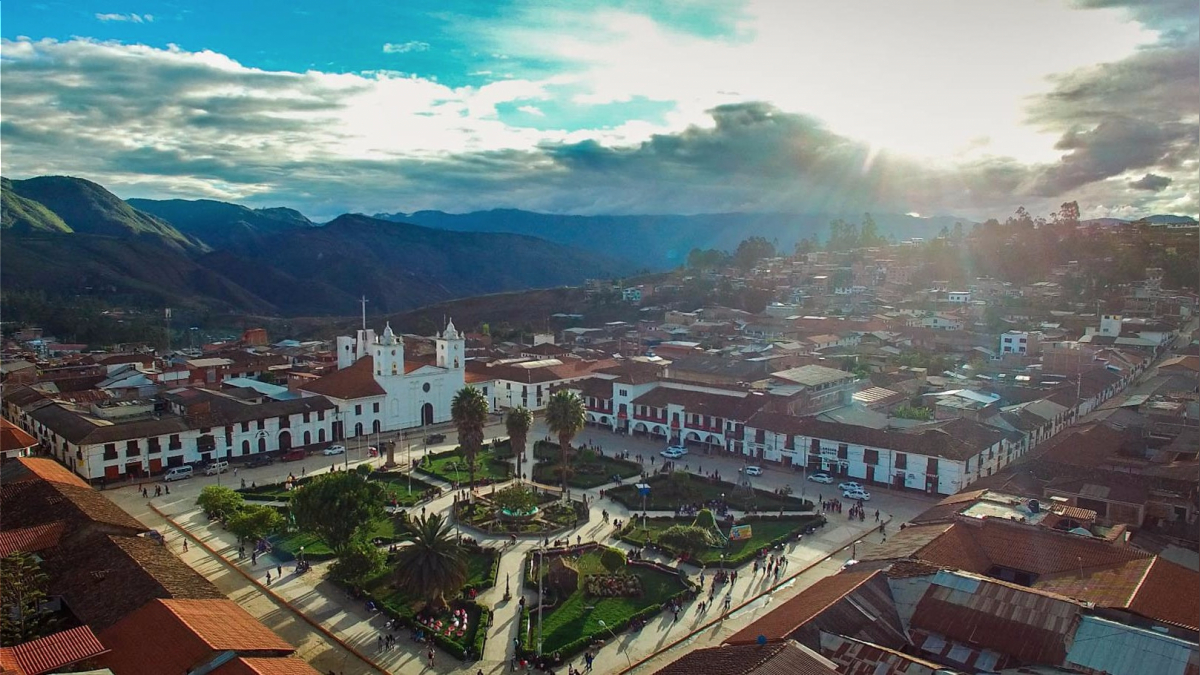
Chachapoyas is a peaceful colonial town set in the cloud-forest edge of northern Peru, capital of the Amazonas region. Ringed by green mountains, cloud forests and deep canyons, it's the perfect base for discovering one of the most fascinating and still little-visited archaeological and natural ensembles in the country: the legacy of the Chachapoyas culture, the 'warriors of the clouds'.
From here you reach marvels such as the imposing fortress of Kuélap (a walled citadel high on a mountain, sometimes called 'the Machu Picchu of the north'), the Gocta waterfall (one of the tallest in the world), the sarcophagi of Karajía, the mausoleums of Revash and any number of burial sites, viewpoints and forests. All of it in a setting of lush nature, traditional villages and a quiet, genuine atmosphere.
This guide runs through the essentials of Chachapoyas with a practical eye: how to get there (by road from the northern coast or via Jaén airport), what trips to organize from town (Kuélap, Gocta, Karajía, Revash, Leymebamba), what to see in the colonial town itself, and where to eat and sleep. An essential destination for anyone who loves archaeology, nature and travel off the main circuits.
Chachapoyas takes its name from the Chachapoyas culture, the 'warriors of the clouds', which flourished in these cloud forests before being conquered by the Incas and then by the Spanish. The colonial town was founded in 1538 and was an important center in the north. Today it's the capital of the Amazonas region and the base for discovering Kuélap, Gocta and the rich Chachapoya heritage. The full story is on our history page.
Read the full history ↓The land of the Chachapoyas, 'the warriors of the clouds': high cloud forest with fortresses such as Kuélap, sarcophagi and mausoleums hanging from cliffs, and the imposing Gocta waterfall.
Read the history of Amazonas →If you book from here we earn a commission and you pay no more. Prices and availability come from Civitatis.
No exact prices: a scale from $ (budget) to $$$$$ (luxury), with 2-3 options per category.
Origins, formation and what the sources say.
The Chachapoyas region owes its name and its identity to the Chachapoyas culture, a pre-Hispanic civilization that flourished in the cloud forests on the jungle edge of northern Peru, roughly between the 8th and 15th centuries. Known as the 'warriors of the clouds' —a nod to their habitat of mist-wrapped mountains— the Chachapoya developed a complex society, with notable achievements in architecture, hillside farming and a singular cult of the dead.
Their architectural legacy is extraordinary. They built citadels and clusters of circular stone houses, often decorated with geometric friezes in zigzags and diamonds, sited in hard-to-reach places high on mountains and ridges. The most celebrated of these is the fortress of Kuélap, a monumental walled citadel that ranks among the most impressive pre-Hispanic works on the continent.
The Chachapoya also stood out for their funerary heritage, unique in the Andes: human-shaped clay sarcophagi placed on cliff ledges (such as those at Karajía), painted mausoleums wedged into rock faces (such as Revash) and the practice of mummification, evidenced by the hundreds of burial bundles found at sites like the Laguna de los Cóndores. This complex cult of the ancestors reveals a rich spiritual life and a sophisticated society.
Despite their fighting spirit and the natural defenses of their territory, the Chachapoyas culture was finally subdued by the Inca Empire during its expansion northward, in the 15th century, under rulers such as Túpac Yupanqui. The conquest was neither easy nor final: the Chachapoya resisted and rebelled on several occasions, which led the Incas to apply control measures such as moving populations (mitimaes) to other regions of the empire.
When the Spanish reached Peru in the 16th century, many Chachapoya, unhappy with Inca rule, allied with the conquistadors against Cusco. The Spanish conquest, however, brought disease, war and a new colonial order that ended up dismantling and decimating the native population, as happened across the Andean region.
The Spanish town of Chachapoyas (San Juan de la Frontera de los Chachapoyas) was founded in 1538 by Alonso de Alvarado, becoming one of the first and most important Spanish settlements in Peru's northeast. During the colonial period it was a strategic waypoint between the highlands, the coast and the jungle, and it kept for centuries the architecture of whitewashed mansions and balconies that still characterizes its historic center.
The Spanish town we know today as Chachapoyas was born under the name San Juan de la Frontera de los Chachapoyas, founded on 5 September 1538 by Captain Alonso de Alvarado. Shortly before, on 20 June of that same year, Francisco Pizarro had granted him a warrant naming him captain general and lieutenant governor of the 'Sachapuyos', authorizing him to found a settlement of Christians in that newly subdued territory.
The original founding didn't happen on the present site but at La Jalca, a village up in the heights, conceived as an administrative center for controlling the newly colonized territories. Soon after, the town was moved to Levanto, and finally, later in the 16th century, it settled where it stands today, in a more accessible valley among mountains.
From that definitive site, Chachapoyas became a political, religious and economic center of the first rank in northwestern Peru. The Spanish even conceived of it as the possible capital of a vast eastern territory, stretching from the right bank of the Marañón river to the borders with neighboring nations —a plan that reflected the strategic importance they assigned it as a gateway to the Amazon. Over the centuries, the town consolidated the colonial look of whitewashed mansions, wooden balconies and cobbled streets that its historic center still keeps.
One of the most remarkable chapters of Chachapoya archaeology in recent times came in 1996, when a group of peasants looking for valuables reached some mausoleums set in cliffs beside a remote high-Andean lake, the Laguna de los Cóndores, about 45 km from Leymebamba. In their search for gold, the looters damaged numerous burial bundles and scattered remains and objects, but word of the find reached archaeologists and cultural institutions.
In 1997 the Peruvian state authorized an emergency rescue mission. A team of archaeologists, among them the researcher Sonia Guillén, worked in very difficult conditions —the lake is reachable only after a long day's walk— to recover everything that could be saved: more than 200 Chachapoya mummies and burial bundles, along with ceramics, textiles, metal objects and other grave goods that had sat in the mausoleums for centuries, remarkably preserved by the dry microclimate of the rock shelters.
To safeguard and display that treasure, the Leymebamba Museum (Centro Mallqui) was built, opened in the early 2000s in the village of Leymebamba, with strong local community involvement in running it. The museum became a model of community museum practice and one of the essential visits in the region, since it lets you see up close the faces and the objects of a culture that would otherwise have been lost to looting.
After the colonial period, Chachapoyas carried on as an important town in northern Peru and came to carry real weight in the region's republican life. Over time, however, its relative geographical isolation —ringed by mountains, canyons and cloud forests— left it somewhat off the country's main development routes, which paradoxically helped preserve both its colonial heritage and the extraordinary archaeological legacy around it.
Today Chachapoyas is the capital of the Amazonas region and is seeing growing tourism. Better roads and the air connection through Jaén airport have made it easier to reach a region that was long difficult to visit. Developing sites such as Kuélap (including installing a cable car to ease access), the Gocta waterfall and the Chachapoya burial sites has driven nature and archaeology tourism.
The town works as the logistical base for discovering the region's rich heritage: the fortress of Kuélap, the sarcophagi of Karajía, the mausoleums of Revash, the Leymebamba Museum and its mummies, plus waterfalls, lakes and forests. Still off the mass tourist circuits, Chachapoyas has established itself as one of the most fascinating destinations in Peru for anyone after history, nature and authenticity far from the crowds.