Viajá con Gus
Home › New Zealand › Kaikoura
Kaikoura
🇳🇿 New Zealand · South Island

Kaikoura

🪪 What do I need to enter New Zealand?Pick your citizenship and we tell you the visa, the days and the paperwork, with the official source.

By leaving your email and citizenship you agree to receive the documents you asked for and weekly travel news. You can unsubscribe whenever you want. How we handle your data.
Jump to what you need
📌State
Coastal town in the Canterbury region (South Island), on a peninsula where the Southern Alps almost drop into the sea, halfway between Christchurch and Picton/Blenheim
📌Best time
All year round: sperm whales live in Kaikoura permanently and whale watching runs in all four seasons. Summer (Dec-Mar) has calmer seas; winter adds passing humpback whales (Jun-Aug) and fewer crowds
📌Suggested days
1 to 2 days: one for whale watching and another for walking the peninsula, seeing seals and feasting on fresh crayfish (lobster)
📌Getting there
By car on State Highway 1 from Christchurch (~2 h 30 min) or from Picton (~2 h). Daily InterCity bus. The Coastal Pacific scenic train (KiwiRail) between Christchurch and Picton stops in Kaikoura in season
📌Getting around
The town and the peninsula can be explored on foot or by car; there is no local bus. The peninsula walk starts from the town centre. Useful app: Google Maps
📌Language and currency
English and te reo Māori; New Zealand dollar (NZD, NZ$). Cards and contactless payment accepted almost everywhere
💱 NZD exchange rate
Loading rate…
🌤️ Weather in Kaikoura
Loading weather…

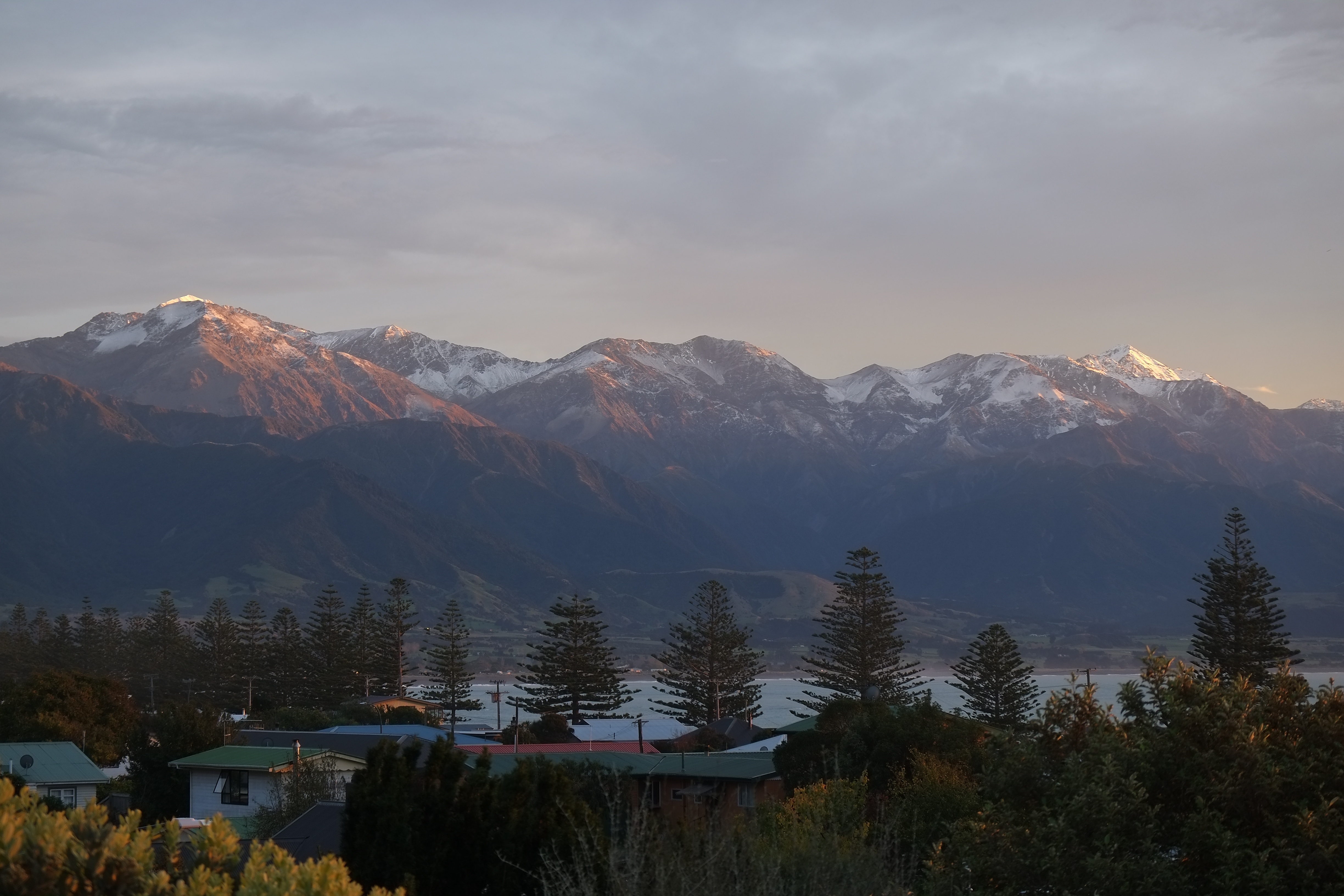
Kaikoura is one of New Zealand's great nature spectacles: a town on a peninsula where the snow-capped peaks of the Kaikoura Ranges rise almost vertically behind the sea, and where, a few kilometres offshore, an underwater canyon more than a thousand metres deep creates a feast of marine life. That canyon is the reason for everything: it brings cold, nutrient-rich water up to the surface, attracting sperm whales, other whales, dolphins, albatrosses and seals all year round. It's one of the few places in the world where you can see the giant sperm whale in any season.

The name says it all: in te reo Māori, 'kai' means food and 'koura' means lobster/crayfish. Kaikoura is 'the place to eat crayfish', and it still is: food trucks and restaurants along the highway serve the famous fresh rock lobster, along with fish and seafood. But the star is whale watching: Whale Watch Kaikoura boat tours (a company owned by the local Māori community) head out to find sperm whales with near-guaranteed success, and there's also swimming with dusky dolphins, albatross trips and seal colonies you can reach on foot.

Kaikoura is the land of Ngāti Kurī, a hapū (sub-tribe) of Ngāi Tahu, whose connection with whales and the sea goes back centuries. The town suffered a devastating magnitude 7.8 earthquake in November 2016 that lifted the seabed, cut off roads and isolated the area; its recovery, with Takahanga Marae as a refuge and the heart of the community, is a story of resilience. Today Kaikoura is also a world pioneer in sustainable tourism. With its mountains, underwater canyon, sperm whales and Māori culture, it's a must-stop on the South Island.

📖 History of Kaikoura

Kaikoura ('the place to eat crayfish' in te reo Māori) is the land of Ngāti Kurī, a hapū of Ngāi Tahu, whose Takahanga Marae sits on a site settled more than 450 years ago and whose relationship with whales is ancestral. After successive Māori settlements, European arrival brought Robert Fyffe's whaling station in 1842. In November 2016 a magnitude 7.8 earthquake shook the region, lifted the seabed and cut the town off; Takahanga Marae became a refuge and served 10,000 meals in a week. Today Kaikoura lives off sustainable sperm whale watching. The full story, from Ngāti Kurī's bond with whales to the earthquake, is on the history page.

Read the full history ↓

🏛️ Kaikoura is in Marlborough

The north-eastern tip of the South Island, from the maze-like Marlborough Sounds to the vineyards of the Wairau Valley, birthplace of the New Zealand Sauvignon Blanc that has shaken up the wine world since 1973. To the south is Kaikoura, the Ngāi Tahu whaling town where the Alps drop into the sea and sperm whales surface.

Read the history of Marlborough →

🗺️ What to see

1
Sperm whale watching with Whale Watch Kaikoura
See the giant sperm whale by boat, with a Māori community-owned company
Leer más ↓
This is the headline activity and one of the best wildlife experiences in the country. Whale Watch Kaikoura, a company owned by the Ngāti Kurī Māori community, heads out to the underwater canyon off the coast to look for sperm whales, the largest toothed predator on the planet, which live here all year. On the trip of about 2-3 hours you'll also see dusky dolphins in pods of hundreds, seals, albatrosses and, depending on the season, orcas or passing humpback whales. The boat uses hydrophones to locate the whales by their echolocation. The sighting rate is around 95% and there's a partial refund if none are seen. It's worth booking ahead, especially in summer.
ℹ️ Ocean Cabin: NZ$60-175 depending on age/promo; Captain's Cabin (VIP): NZ$255 (rises to NZ$265 from 1-oct-2026). Children under 3 not admitted. ~3 h 15 min in total (source: Whale Watch Kaikoura, verified July 2026)
2
Kaikoura Peninsula Walkway
Coastal trail with seals, seabirds and views of the Alps
Leer más ↓
The Kaikoura Peninsula Walkway is one of the best free short walks in New Zealand. The full loop (about 3-4 hours, ~11 km) circles the tip of the peninsula with spectacular views of the snowy mountains on one side and the sea on the other. It passes cliffs, rock platforms lifted by the 2016 earthquake, New Zealand fur seal colonies you can see up close (keeping your distance) and seabirds. You can do the whole thing or shorter sections from the town or from the Point Kean lookout, where seals are often resting. Ideal at sunset. It's free and needs no guide.
ℹ️ Free walk, open access all year. Full loop ~11 km / 3-4 h; short sections available. Parking at Point Kean (source: DOC / Kaikoura District, verified July 2026)
3
Swimming with dusky dolphins
Get in the water with pods of hundreds of playful dolphins
Leer más ↓
Kaikoura is one of the best places in the world to swim with wild dusky dolphins, which gather in huge pods (sometimes several hundred strong) off the coast. With licensed operators such as Dolphin Encounter, you head out by boat with a wetsuit and snorkel and get into the water among the dolphins, which are curious and playful (they swim in circles and respond to sounds). There's also the option to just watch from the boat without getting in. It's an intense experience, regulated to minimise the impact on the animals. The water is more pleasant in summer, but it runs almost all year.
ℹ️ Dolphin Encounter: swim from ~NZ$235 adult; watching only from ~NZ$110 (range; Dolphin Encounter Kaikoura, verified July 2026)
4
Point Kean and Ohau seal colonies (pups)
See New Zealand fur seals up close and a waterfall of seal pups
Leer más ↓
New Zealand fur seals are easy to spot in Kaikoura. At Point Kean, at the tip of the peninsula (at the end of the walkway), there are usually dozens resting on the rocks, very accessible on foot. Always keep at least 20 metres away and never block their path to the sea. Seasonally, at Ohau Stream (north of the town, beside SH1) there's a unique sight: seal pups climbing a waterfall to play in a natural pool, mainly between May and August. Access to Ohau changed after the earthquake; check the state of the track locally before you go.
ℹ️ Free access to the seal colonies. Point Kean all year; Ohau Stream (pups) mainly in winter, subject to track condition. Minimum distance 20 m (source: DOC, verified July 2026)
5
Albatross and seabird flight or tour
Kaikoura, world capital of albatross watching
Leer más ↓
The underwater canyon attracts not only marine mammals but an astonishing variety of ocean birds. Kaikoura is considered one of the best places on the planet to see albatrosses, including the giant wandering and royal albatrosses, as well as petrels, shearwaters and skuas. Operators such as Albatross Encounter head out in small boats and use bait to bring the birds in close, so you can watch them glide and land just metres from the boat. It's a must for bird and photography lovers. You can also see the marine life from the air on scenic flights over the whales.
ℹ️ Albatross Encounter: boat tour from ~NZ$150 adult (range; Albatross Encounter Kaikoura, verified July 2026)
6
Eating fresh crayfish and seafood
The rock lobster that gave the town its name
Leer más ↓
The name Kaikoura literally means 'eat crayfish', and honouring that tradition is part of the visit. The star is fresh rock lobster (crayfish), grilled or boiled, though the price is high because of the season and fishing quotas. The most famous institution is Nin's Bin, a historic food truck beside SH1 north of the town, and there are several stalls and restaurants in the same style. Fresh fish, mussels, paua (abalone) and whitebait are also plentiful. A simple, unmissable plan: buy fresh seafood and eat it by the sea with the mountains behind you.
ℹ️ Crayfish price varies by season and size (usually the most expensive dish; ask on site). Food trucks and restaurants beside SH1 (source: Kaikoura tourism, verified July 2026)
7
Takahanga Marae and Ngāti Kurī culture
The Māori heart of Kaikoura, a refuge after the earthquake
Leer más ↓
Takahanga Marae, on a terrace overlooking the town, is the marae of Ngāti Kurī, a hapū of Ngāi Tahu, and stands on a site settled more than 450 years ago (originally a Kāti Māmoe pā). The current marae opened in 1992 and its carvings and whakairo (carved art) are remarkable. After the 2016 earthquake it became the community's welfare centre, serving 10,000 meals in a week to residents, stranded tourists and emergency workers. Although the marae isn't always open to visitors without prior arrangement, Ngāti Kurī culture runs through all of Kaikoura, starting with Whale Watch. You can learn more about this history on cultural tours and around the town.
ℹ️ The marae is not an open tourist attraction; access requires prior arrangement and an invitation. You can experience Ngāti Kurī culture through Whale Watch and local tours (source: Ngāi Tahu / Takahanga Marae, verified July 2026)
📶I have never landed without internet. I arrive and my phone connects to the strongest network in the country I am visiting: I can say I landed, sort out transport, book tours and keep posting, at a seriously good price. I always use the Maya eSIM — check their plans by clicking the banner.See plans →Maya Mobile eSIM — connect before you land
What nobody tells you

💵 Prices

Tickets

TypePrice
Whale Watch Kaikoura (Ocean Cabin)NZ$60-175 depending on age/promotion (source: Whale Watch Kaikoura, verified July 2026)
Whale Watch Kaikoura (Captain's Cabin VIP)NZ$255 (rises to NZ$265 from 1-oct-2026) (source: Whale Watch Kaikoura, verified July 2026)
Caminata de la península y colonias de focasFree (source: DOC, verified July 2026)
Albatross Encounter (tour de aves)from ~NZ$150 adult (source: Albatross Encounter, verified July 2026)
🔄 updated monthlyOfficial / reference values · double-check when buying

Activities and tours

ActivityPriceDurationOperator
Sperm whale watching by boat (Whale Watch)from NZ$60 (Ocean Cabin, depending on age) per person (verified July 2026)
Swimming with dusky dolphins (Dolphin Encounter)from ~NZ$235 swim / ~NZ$110 watching (range, verified July 2026)
Albatross and seabird tour (Albatross Encounter)from ~NZ$150 per person (range, verified July 2026)
Scenic whale-watching flight (light plane/helicopter)from ~NZ$180-350 per person (range; Wings Over Whales / helicopters, verified July 2026)
Full-day trip from Christchurch with whale watchingfrom ~NZ$200-300 per person (range; operators, verified July 2026)
🔄 updated monthlyOfficial / reference values · double-check when buying

🚌 How to get there and distances

Getting around

ModePriceDurationNotes
On foot around the town and peninsulaFree
Rental car / own vehicleFuel + rental
InterCity busdepends on booking (from ~NZ$25-45 per leg)
Coastal Pacific scenic train (KiwiRail)depends on booking
🔄 updated monthlyOfficial / reference values · double-check when buying

How to get there

RouteAirlines / operatorsAvg. priceDuration
Christchurch → Kaikoura by carOwn/rental vehicle (SH1)Fuel (~NZ$35-45 one way)~2 h 30 min (180 km)
Christchurch → Kaikoura by busInterCityfrom ~NZ$25-45 (varies, verified July 2026)~2 h 45 min
Picton/Blenheim → Kaikoura by carOwn vehicle (SH1)Fuel (~NZ$30 one way)~1 h 45 min - 2 h (130 km from Picton)
Christchurch → Kaikoura by trainCoastal Pacific (KiwiRail, seasonal)depends on booking (verified July 2026)~3 h (scenic journey)
🔄 updated monthlyOfficial / reference values · double-check when buying

🏨 Where to stay

No exact prices: a scale from $ (budget) to $$$$$ (luxury), with 2-3 options per category.

Luxury
Price$$$$$
Recommended options
Hapuku Lodge & Tree Houses, The Factory, boutique stays with sea views; approx. NZ$350-700/night
Mid-range
Price$$$$$
Recommended options
White Morph, Anchor Inn Motel, Panorama Motel, Sudima Kaikoura; approx. NZ$160-300/night
Budget
Price$$$$$
Recommended options
Kaikoura Top 10 Holiday Park, Dusky Lodge Backpackers, Albatross Backpacker Inn; dorm/cabin from ~NZ$35-120/night

🍴 Where to eat

TypePriceOptions / signature dish
Frutos de mar y crayfish$$$$$The Pier Hotel, Green Dolphin, waterfront restaurants; mains ~NZ$35-60 (crayfish more expensive)
Casual y bistró$$$$$Zephyr, cafés and pubs in town; mains ~NZ$22-38
Food trucks de mariscos$$$$$Nin's Bin, Cods & Crayfish, stalls beside SH1; ~NZ$12-25 (crayfish extra)

📖 History of Kaikoura

Origins, formation and what the sources say.

Ngāti Kurī and the people of the whales

Off the coast of Kaikoura, just a few kilometres from the beach, the seabed suddenly plunges into a submarine canyon more than a thousand metres deep. That abyss is the reason behind everything that makes Kaikoura special: cold, nutrient-rich currents rising from the canyon feed a chain of life that supports sperm whales, dolphins, seals and albatrosses. The Māori who lived on this coast understood this long before the word 'oceanography' existed: to them, this was a land of abundance protected by the taniwha (guardian beings) of the sea.

Tradition tells that the ancestral explorer Māui fished up the North Island from his waka (canoe), and that the Kaikoura Peninsula is Te Taumanu o te Waka a Māui, 'the thwart of Māui's canoe'. The name of the place is direct and tasty: Kaikōura means 'to eat crayfish' (kai, food; kōura, rock lobster), in memory of the chief Tama ki te Rangi who, according to the story, stopped here to eat crayfish on his journey. Shellfish, fish and seabirds made this coast a highly prized mahinga kai, or food-gathering site.

The tangata whenua (people of the land) of Kaikoura are Ngāti Kurī, a hapū (subtribe) of Ngāi Tahu, the great iwi of the South Island. Their relationship with whales is deep and ancestral: stranded whales were a sacred and valuable resource, a source of food, oil and bone, and tohorā (whales) hold a central place in the local worldview. That centuries-old connection between Ngāti Kurī and the great whales is not a quaint detail: it is the direct root of the whale-watching tourism that sustains the town today.

Pā, terraces and centuries of settlement

The Kaikoura Peninsula, with its sheltered point and marine resources, was continuously inhabited for centuries by successive Māori peoples. Excavations and oral tradition point to very early settlement: first by descendants of the earliest migrations and by Waitaha, then by Kāti Māmoe, and finally by Ngāi Tahu, who through conquest and marriage established themselves as the dominant iwi across the South Island by the 18th century.

The site where Takahanga Marae stands today, on a terrace overlooking the town, was occupied for more than 450 years. It was originally a Kāti Māmoe pā (fortified village) and later passed to Ngāti Kurī. The headlands of the peninsula were ideal for pā: defensible, with sea views and close to resources. The abundance of crayfish, fish, seals, seabirds and eggs made Kaikoura a place of stable settlement and trade.

That long presence left its mark on the landscape — terraces, mounds, umu oven sites, remains of pā — and a dense web of names, stories and sacred sites that Ngāti Kurī still keeps. When Europeans began arriving in the 19th century, they did not find an empty coast but a deeply known and inhabited territory, with its own centuries of history written into the land and passed down from generation to generation.

Whalers, Fyffe and the European arrival

The first sustained contact with Europeans came, as on so much of the New Zealand coast, with whaling. In 1842, Robert Fyffe set up a whaling station in Kaikoura, the first permanent European presence. Hunting the southern right whale — then abundant in these waters — was the initial economic engine: the whales were chased in boats, towed to shore and cut up for oil and bone, in a brutal, bloody business that nearly wiped out the species.

From that era survives Fyffe House, Kaikoura's oldest historic house, whose foundations literally rest on whale bones, a stark reminder of that trade. In 1845 the Fyffe family bought a second station at South Bay, which became the town's commercial centre until 1867. Ironically, European whaling almost finished off the very animals that are now the backbone of Kaikoura's economy.

Over time, with the whales depleted and whaling banned, Kaikoura reinvented itself as a fishing, farming and livestock town. European settlers put down roots, the railway and road were built, and the town became a quiet stop on the route between Christchurch and Picton. For much of the 20th century, few imagined that the waters off the town — and the Māori memory of the whales — could be its future.

Whale Watch: the revival of Ngāti Kurī

In the late 1980s, Kaikoura was a struggling town: economic reform and the closure of services had hit families hard, and unemployment among Ngāti Kurī Māori was extremely high. That was when four families from the community had a bold and, to many, risky idea: taking tourists out to see the sperm whales that lived over the submarine canyon. In 1987 Whale Watch Kaikoura was born, with a mortgaged house as collateral and a single inflatable boat.

The gamble transformed the town. Whale Watch became one of the most successful and respected wildlife tourism companies in the world, owned by the Māori community, creating jobs, pride and resources for Ngāti Kurī. Its model — based on respect for the animals, sustainability and traditional knowledge of the sea — turned Kaikoura into a world benchmark for ecotourism. A whole economy flourished around whale watching: swimming with dolphins, albatross tours, restaurants, accommodation. In 2004, Kaikoura became one of the first communities in the world to earn Green Globe environmental certification.

The revival was cultural too. The current Takahanga Marae reopened in 1992 with remarkable carvings and whakairo, reaffirming the presence of Ngāti Kurī at the heart of the town. The story of Whale Watch is that of a Māori people who, building on their ancestral relationship with whales, created their own economic future without giving up their values. It is one of the country's great stories of resilience and self-determination.

The 2016 earthquake and the rebuild

At 00:02 on 14 November 2016, a magnitude 7.8 earthquake shook North Canterbury, with its epicentre near Kaikoura. It was one of the most complex earthquakes ever recorded: it ruptured at least 21 separate faults, lifted the seabed by up to two metres in places — leaving seaweed and paua exposed on the rocks — triggered thousands of landslides and completely cut both routes into town, State Highway 1 and the railway line. Kaikoura was cut off, with residents and hundreds of tourists stranded.

At that critical moment, Takahanga Marae became the heart of the response. Ngāti Kurī volunteers opened their doors and, in the week after the earthquake, served around 10,000 meals to anyone who needed them: residents, tourists stranded from all over the world, emergency workers. The marae's solidarity — Māori hospitality, manaakitanga, in action — became one of the symbols of those days. Tourists were evacuated by sea and air; the road would take more than a year to reopen after a colossal engineering effort.

Rebuilding SH1 and the coastal railway, with huge retaining walls and landslide protection, was one of the largest infrastructure projects in New Zealand's recent history. During the recovery, numerous taonga (treasures) and artefacts were uncovered, and they are now kept in a Whare Taonga opened by Ngāti Kurī. The earthquake that threatened to sink Kaikoura ended up showing its strength: a town that, between the sperm whales of its canyon and the resilience of its people, kept standing.

Kaikoura today: sperm whales, mountains and sustainability

Today's Kaikoura is a model of how nature, Māori culture and tourism can sustain one another. The sperm whales are still there, all year round, over the canyon that feeds them; dusky dolphins gather in pods of hundreds; albatrosses glide over the sea; seals rest at Point Kean. Sustainable wildlife watching — led by Ngāti Kurī's community-owned Whale Watch — is the backbone of the economy, along with swimming with dolphins, bird tours and seafood.

The spectacular setting — the Southern Alps dropping almost vertically into the ocean, with the town on the narrow strip between mountain and sea — is one of the most striking in the country. The free peninsula walk sums up Kaikoura in a single loop: seals, birds, rock platforms lifted by the earthquake and views of the snow-capped peaks. And fresh crayfish, served from food trucks by the roadside, still honours the town's name.

Behind the postcard lies a rich history: the ancestral relationship of Ngāti Kurī with whales and the sea; centuries of pā and settlement; the brutal European whaling era; the economic and cultural revival led by Māori themselves; and resilience in the face of the 2016 earthquake. Kaikoura is not just one of the best wildlife destinations in the world: it is proof that a small town, grounded in its culture and its natural environment, can reinvent itself again and again without losing its identity.

📚 Bibliography

  • Kaikōura — Wikipedia — https://en.wikipedia.org/wiki/Kaik%C5%8Dura
  • The Ngāti Kurī/Ngāi Tahu Relationship With Whales — Te Rūnanga o Ngāi Tahu — https://ngaitahu.iwi.nz/ngai-tahu/papatipu-runanga/kaikoura/ngati-kuringai-tahu-relationship-whales/
  • Takahanga Marae — Wikipedia — https://en.wikipedia.org/wiki/Takahanga_Marae
  • Ngāi Tahu — Te Ara Encyclopedia of New Zealand — https://teara.govt.nz/en/ngai-tahu
  • 2016 Kaikōura earthquake — Wikipedia — https://en.wikipedia.org/wiki/2016_Kaik%C5%8Dura_earthquake
  • Our People, Our Stories and Culture — Whale Watch Kaikoura — https://whalewatch.co.nz/our-people/our-stories-and-culture/
  • Fyffe House — Heritage New Zealand — https://www.heritage.org.nz/list-details/1810/Fyffe%20House
  • Kaikoura — Te Ara Encyclopedia of New Zealand (Canterbury region) — https://teara.govt.nz/en/canterbury-region
  • One year on (Kaikoura earthquake) — Te Karaka, Ngāi Tahu — https://ngaitahu.iwi.nz/opportunities-and-resources/publications/te-karaka/one-year-on-tk76/
  • Whale Watch Kaikoura history — https://whalewatch.co.nz/kia-ora/

❓ Frequently asked questions

When is the best time to see whales in Kaikoura?+
You can see them all year: sperm whales live permanently in the Kaikoura underwater canyon, so whale watching runs in all four seasons with a success rate of close to 95%. Summer (December to March) has the calmest seas and fewer cancelled trips. In winter (June to August) migrating humpback whales also pass through, there are fewer people and prices are a bit lower. Whenever you go, you'll see sperm whales, dolphins, seals and seabirds.
How much does whale watching cost and should I book?+
Whale Watch Kaikoura offers the Ocean Cabin for between NZ$60 and NZ$175 depending on age and promotion, and the VIP Captain's Cabin for NZ$255 (rising to NZ$265 from October 2026). The tour takes about 3 hours 15 minutes in total. It's worth booking ahead, especially in summer, because it fills up. If no whales are seen, there's a partial refund. Children under 3 can't board (verified July 2026).
How many days do I need in Kaikoura?+
1 or 2 days is enough. One day for whale watching (or swimming with dolphins) and the peninsula walk with its seals; a second day if you want to add the albatross tour, enjoy crayfish without rushing and relax by the sea. Many people visit as a day stop between Christchurch and Picton, but staying a night is worth it so you can do the activities at a relaxed pace.
Can I see wildlife in Kaikoura for free?+
Yes, plenty. The peninsula walk is free and takes you to New Zealand fur seal colonies you can see very close up at Point Kean (always at least 20 metres away). Seasonally, at Ohau Stream you can see seal pups playing under a waterfall (mainly in winter). And from the shore you can spot dolphins and birds without paying anything. For sperm whales, close-up dolphins and albatrosses, you do need the boat tours.
How do I get to Kaikoura without a car?+
The InterCity bus stops in Kaikoura daily on SH1, connecting with Christchurch (~2 h 45 min) and Picton/Blenheim. In season (usually October to April) KiwiRail's Coastal Pacific scenic train also stops here, one of the most beautiful rail journeys in the country. Both are easy to book online. Within the town you can do everything on foot (verified July 2026).

More places in New Zealand

Lago TekapoLos CatlinsMarlboroughMilford SoundMonte Cook (Aoraki)Napier (Hawke's Bay)
See every place in New Zealand →The history of New Zealand →
Sources consulted (7)
Still planning?
Explore more destinations in New Zealand
See all destinations →
Image credits
Photos from Wikimedia Commons, each under its own licence (CC BY, CC BY-SA or public domain). Open each file to see its author and licence.
Early morning sun on snow-capped Seaward Kaikoura Range