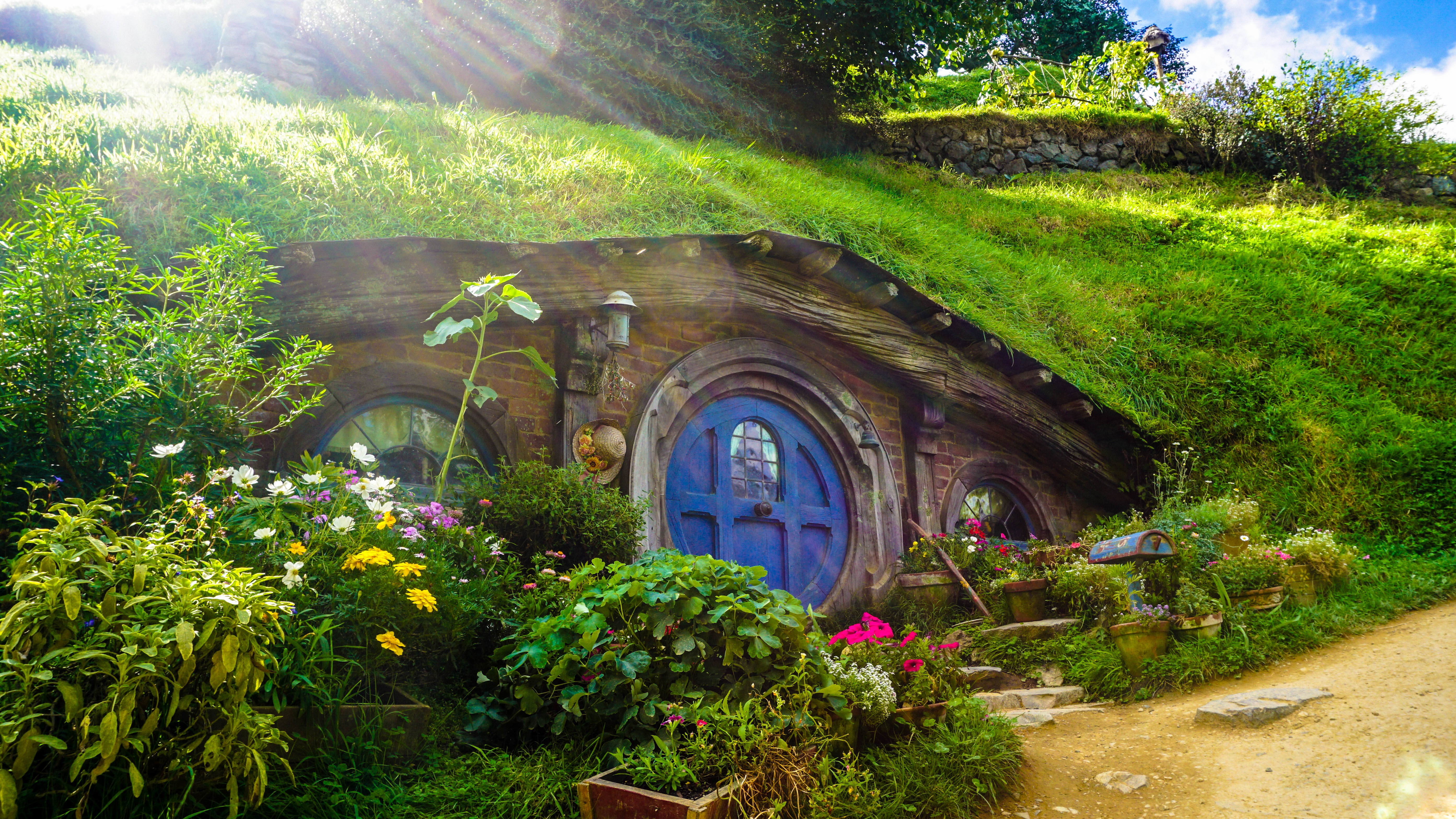
Few places bring a fantasy to life like Hobbiton. Among the rolling green hills of Waikato, on a sheep farm, the filming set of the Shire from The Lord of the Rings and The Hobbit is preserved intact: 44 hobbit holes with round, brightly coloured doors dug into the hillsides, gardens tended down to the last detail, the famous mill by the lake and the Green Dragon Inn, where a beer brewed especially for the place is served.
Unlike most film sets, which are dismantled once shooting wraps, Hobbiton was rebuilt permanently with real materials (genuine thatched roofs, planted gardens) so fans could walk through the Shire just as it appears on screen. A guide leads you around the set sharing stories from the shoot, production secrets and trivia about how Peter Jackson turned a New Zealand farm into Middle-earth.
This guide explains how to visit Hobbiton and make the most of it: which tours there are and what they really cost (in New Zealand dollars, verified in July 2026), how to get there from Auckland, Rotorua or Matamata, what the visit includes and when to go. Whether you're a die-hard Tolkien fan or just curious, walking through the Shire with a pint at the Green Dragon is an experience you're unlikely to forget.
The land where Hobbiton now stands, near Matamata, is ancestral territory of the Ngāti Hauā iwi, part of the Tainui confederation of Waikato, whose leader Wiremu Tāmihana played a key role in the 19th-century Māori King Movement (Kīngitanga). After the British invasion of Waikato in 1863 and the confiscation of land, the area became farmland. In 1978 the Alexander family settled on the farm, and in 1998 Peter Jackson chose it, from the air, to build the Shire for The Lord of the Rings. Its full story is told on the history page.
Read the full history ↓The heart of the Kīngitanga, the Māori King movement founded in 1858 to unite the tribes. The land of the Tainui confederation, it was invaded by imperial troops in 1863 and suffered one of the largest land confiscations in New Zealand's history. Today it is home to Hobbiton and the Waitomo glowworm caves.
Read the history of Waikato →They depart from Rotorua, 58 km away. If you book from this link we earn a commission and you pay no more.
No exact prices: a scale from $ (budget) to $$$$$ (luxury), with 2-3 options per category.
Origins, formation and what the sources say.
Long before it became the hobbits' Shire, and even before it was a sheep farm, the rolling land around Matamata was the ancestral territory of Ngāti Hauā. This iwi (tribe) belongs to the great Tainui confederation, which dominates the Waikato region. Māori had reached Aotearoa (New Zealand) from eastern Polynesia around 1250-1300, sailing in waka (ocean-going canoes). The Tainui tribes descend from the canoe of the same name which, according to their tradition, landed on these shores.
The fertile valleys and hills of the Waikato, watered by the country's longest river, were ideal for growing kūmara (sweet potato) and supported a large population. Ngāti Hauā built pā (fortified villages) and kāinga (villages) in the Matamata area. They organised their lives around whakapapa (the genealogy that binds people to their ancestors and the land), mana (prestige) and the spiritual relationship with the natural world that is central to Te Ao Māori.
Missionaries arrived in the early 19th century. The Church Missionary Society set up a station at Matamata, and there a young man of Ngāti Hauā learned to read and write in te reo Māori. That man, Wiremu Tāmihana Tarapipipi Te Waharoa, would become one of the most important Māori figures of the century and play a central role in New Zealand's political history.
By the mid-19th century, the mass arrival of European settlers and the pressure on land alarmed many Māori iwi. Wiremu Tāmihana of Ngāti Hauā believed that the only way to protect Māori from European encroachment and keep the peace between tribes was to unite under a shared leadership. So he championed the Kīngitanga, the Māori King Movement, and in 1858 he played a decisive role in crowning Pōtatau Te Wherowhero as the first Māori King.
For his part in that ceremony, in which he placed a Bible on the new king's head, Wiremu Tāmihana went down in history as 'the Kingmaker'. The Kīngitanga set out to unite the tribes, halt land sales and create a Māori authority that could deal with the Crown as an equal. Tāmihana was a deeply Christian man and a pacifist who favoured negotiation over war.
But the colonial government saw the King Movement as a threat to British sovereignty. Tensions over land kept rising, especially in Taranaki and the Waikato. Despite Tāmihana's efforts to avoid conflict, war became inevitable. The heart of the Waikato, including Ngāti Hauā land around Matamata, would end up at the centre of one of the most decisive wars in New Zealand's history.
In July 1863, Governor George Grey ordered the British army to cross the Mangatāwhiri River and invade Kīngitanga land. This was the start of the Invasion of the Waikato, the largest campaign of the New Zealand Wars. Ngāti Hauā and the other Tainui tribes joined the Māori King's forces to defend their land against a far larger and better-armed army.
The war was devastating. Māori put up resistance in battles and fortified pā, but the imperial troops pushed on through the Waikato. The harshest consequence came afterwards. As punishment for the 'rebellion', the Crown confiscated around 1.2 million acres of Māori land in the Waikato under the New Zealand Settlements Act 1863. By 1866, Ngāti Hauā had lost most of its land, including the Matamata area.
It took the Waikato tribes more than a century to recover from that confiscation (raupatu), and it left a deep wound in the relationship between Māori and the state. Wiremu Tāmihana, the pacifist who had tried to prevent the war, died soon afterwards in 1866, with his people stripped of their land. The confiscated land passed to European settlers, and the Waikato landscape began to turn into the farmland it is today.
After the confiscations, Waikato land was divided into lots and granted or sold to European settlers, who turned it into crop and livestock farms. The mild climate, steady rainfall and rich soils made the Waikato one of New Zealand's best farming regions. Over time it became the heart of the country's huge dairy industry, with endless green pastures dotted with cows and sheep.
Matamata grew as a service town for this farming country. In 1978 the Alexander family settled on a property of about 500 hectares (over 1,200 acres) of rolling grassy hills, a sheep and cattle farm typical of the area. At first glance it looked like thousands of other Waikato farms: green pasture and gentle gullies, with a lake and a few trees.
To a local it was an ordinary landscape. To other eyes, it turned out to be exactly what they were looking for. The rounded green hills, with no power lines, houses or roads in sight, had the timeless, pastoral quality a filmmaker would need to recreate a fantasy world. Without knowing it, the Alexander farm was about to become the Shire of Middle-earth.
In September 1998, while preparing his adaptation of J.R.R. Tolkien's The Lord of the Rings, New Zealand director Peter Jackson sent teams all over the country to find the landscapes of Middle-earth. For the Shire, the idyllic land of the hobbits, he needed perfect rolling green hills with no trace of the modern world. During an aerial search over the Waikato, the location scouts spotted the Alexander farm, with its lake, its big tree and its flawless hills, and knew they had found the Shire.
Construction of the set began in March 1999, with help from the New Zealand Army, which built the access road. The original trilogy was shot that year. The first Hobbiton was a temporary structure, made largely of plywood and scaffolding and meant to be taken down after filming, as is usual with film sets. The Lord of the Rings films (2001-2003) turned New Zealand into Middle-earth in the eyes of the world.
When Jackson returned to shoot The Hobbit trilogy (2012-2014), the set was rebuilt, this time permanently and with durable materials: real thatched roofs, gardens that were actually planted, and 44 solid hobbit holes. The Alexander family and the producers agreed to keep it as a tourist attraction. The first guided tours had already started in 2002, riding on the films' fame, but it was the 2011-2012 rebuild that created the Hobbiton millions visit today.
Today the Hobbiton Movie Set is one of New Zealand's most visited attractions. Hundreds of thousands of visitors arrive every year from all over the world to walk through the Shire, photograph Bag End and have a pint at The Green Dragon. The farm is still a working sheep and cattle farm, and the set shares the land with grazing sheep, in a very New Zealand mix of real countryside and fantasy. It is a rare case of a film set that has become a permanent tourist landmark.
As Hobbiton became a global icon, the history of the land beneath it followed its own path towards redress. In 2013 the Ngāti Hauā Iwi Trust and the Crown signed a Treaty settlement that included 13 million dollars and recognition of Wiremu Tāmihana's historical role, with a fund created in his honour. It was part of the long process, through the Waitangi Tribunal, by which the Waikato tribes sought justice for the 1863 confiscations.
So walking through Hobbiton today means treading on several layers of history at once. Beneath the colourful round hobbit doors lies the land of Ngāti Hauā and of 'the Kingmaker' Wiremu Tāmihana. It was confiscated after the invasion of the Waikato, turned into dairy farmland by settlers and finally transformed into the Shire by Peter Jackson. An ordinary patch of New Zealand countryside that, thanks to one look from the air, became the most famous home in Middle-earth.