Viajá con Gus
HomeNorwayLofoten Islands
Lofoten Islands
🇳🇴 Norway · Arctic north

Lofoten Islands

Jump to what you need
📍Region
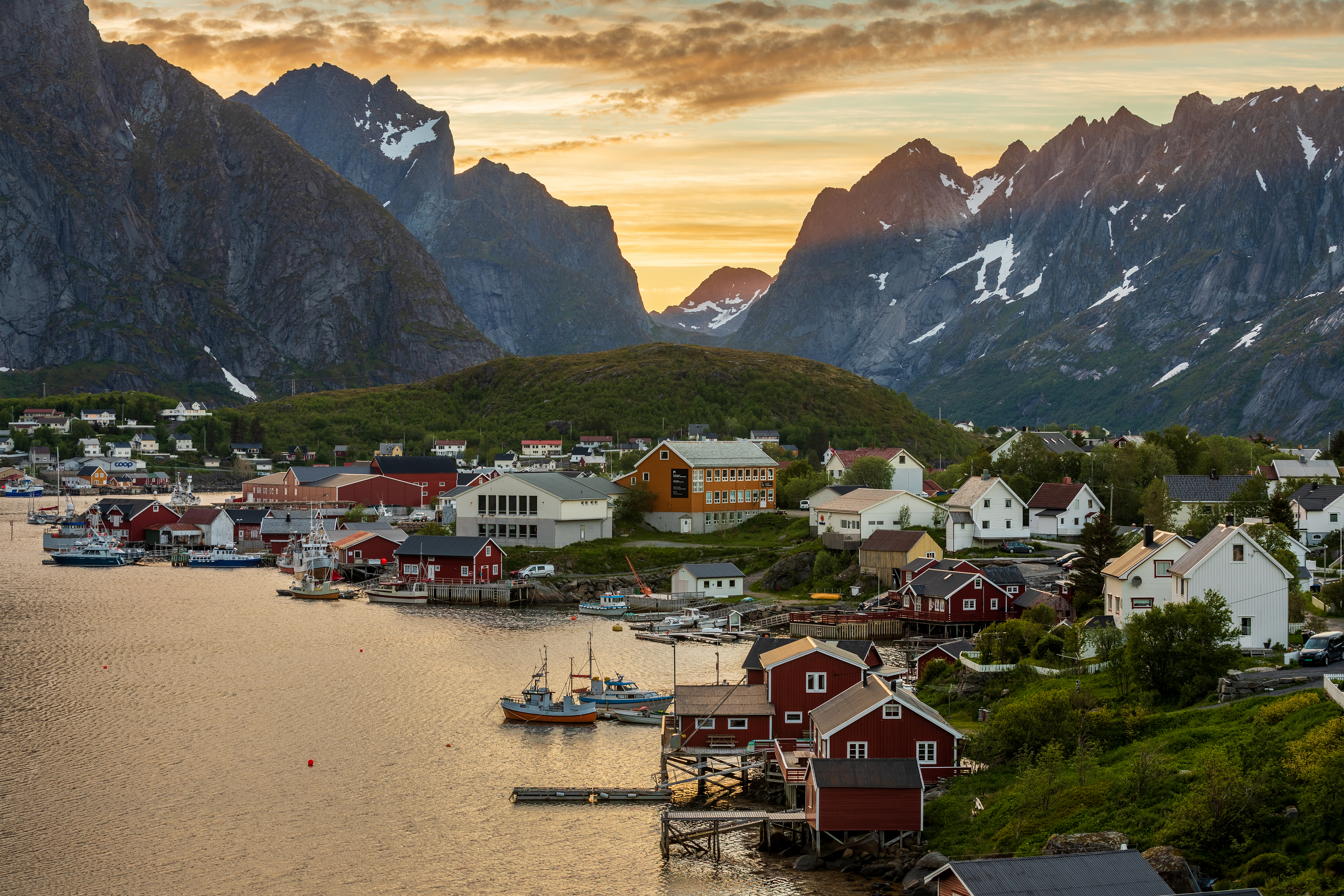
The Lofoten Islands are an archipelago in Nordland county, in Norway's Arctic north, above the Arctic Circle (around 68° latitude). They are a chain of mountainous islands linked by bridges and tunnels, famous for their sharp peaks dropping sheer into the sea, their white sand beaches and turquoise water — surprising at this latitude — their fishing villages of red houses (the rorbuer) and a light that photographers the world over fall in love with. The main settlements are Svolvær, Leknes, Henningsvær, Reine and Å.
📌Best time to visit
It depends what you are after. For the MIDNIGHT SUN and hiking: late May to mid-July, with the sun above the horizon 24 hours a day and the best conditions for walking (Reinebringen, Ryten). For the NORTHERN LIGHTS: roughly late August/September to mid-April, peaking between October and March (in summer you CANNOT see them because it never gets dark). The POLAR NIGHT (when the sun does not rise) runs, in Svolvær, roughly from 7 December to 5 January. Each season is a different world; winter is hard but magical.
📌Suggested days
Three days cover the essentials of the main road (the E10), from Svolvær to Å, stopping in Henningsvær, Reine and Hamnøy. With 4 to 6 days you can add hiking (Reinebringen, Kvalvika and Ryten), beaches (Unstad, Haukland, Kvalvika), quiet villages, boat trips to the Trollfjord or fishing, and wait for clear skies for the northern lights in winter. Lofoten is best enjoyed without rushing: the distances are short but every corner invites you to stop.
📌Getting there
There is no train to Lofoten (the Norwegian rail network only reaches Bodø and Narvik). The two classic routes: (1) fly to Bodø, rent a car and take the FERRY from Bodø to Moskenes (about 3 h 30) to enter with a vehicle at the western end; (2) fly directly to Leknes (LKN) or Svolvær (SVJ) airports with the regional airline Widerøe, almost always via Bodø (the Bodø-Svolvær hop takes about 20 minutes). You can also arrive along the E10 by car or bus from Narvik, and there is a passenger express boat from Bodø to Svolvær.
📌Getting around
A CAR is almost essential: buses exist but they are scarce and infrequent, and many of the loveliest spots (beaches, trailheads, small villages) are far from the stops. Renting a car (in Bodø, Leknes or Svolvær) gives you complete freedom to drive the E10, the scenic road that threads the archipelago together. In winter you have to drive on snow and ice, with winter tires (fitted as standard) and a lot of care. A bike is a nice option in summer for short stretches.
📌Language and currency
Language: Norwegian; English is spoken everywhere. Currency: Norwegian krone (NOK, kr); the euro is NOT used. In July 2026, 1 euro is worth roughly 11–12 kroner as a rough guide. Lofoten is EXPENSIVE, like all of Norway: fuel, food, rorbu accommodation and excursions all carry high prices by international standards. Almost everything is paid by contactless card, even small amounts; cooking where you are staying is a good way to save.
💱 NOK exchange rate
Loading rate…
🌤️ Weather in Lofoten Islands
Loading weather…

Few places on the planet pack so much beauty into so little space as the Lofoten Islands. This Arctic archipelago in northern Norway, above the Arctic Circle, is a succession of steep mountains driven into the sea, narrow fjords, white sand beaches with water an unbelievable turquoise for this latitude, and small fishing villages with red houses — the famous rorbuer — reflected in still water. It is one of the world's great photographic dreams, and once you get there it is easy to see why.

But Lofoten is not a stage set: it is a living place, with more than a thousand years of fishing history. Every winter, enormous shoals of Arctic cod — the skrei — come to spawn in these waters, and since Viking times fishermen have gathered here for the great fishery. The cod dried in the open air on the hjell (wooden racks) becomes stockfish, the dried fish that was exported to half of Europe for centuries, fed the Hanseatic League from Bergen and reached as far as Italy, where it is the basis of Venetian baccalà. An honest note for the traveler: between February and May, the smell of drying cod soaks into everything, and it is genuinely strong.

This guide covers Lofoten in a practical, friendly way: how to get there and why a car makes sense, which villages and beaches not to miss, which hikes are worth the effort (including the famous stone staircase on Reinebringen, built by Nepalese sherpas), when to go depending on whether you want the midnight sun or the northern lights, and how to enjoy nature responsibly. Because Lofoten is fragile and heavily visited, and the Norwegian 'right to roam' (allemannsretten) brings enormous freedoms but also rules worth respecting so that they keep existing.

📖 History of Lofoten Islands

Lofoten has a thousand-year history tied to the sea. As early as around 1000-1100, fishing and stockfish (dried cod) production were so important that they gave rise to Vågar, considered the first urban settlement in northern Norway, near present-day Kabelvåg. For centuries, Lofoten's dried cod was Norway's great export: it was sent to Bergen, where the merchants of the Hanseatic League traded it across Europe, and it reached Italy, where it is still the basis of dishes such as Venetian baccalà mantecato. The skrei fishery — the Arctic cod that comes down from the Barents Sea to spawn every winter — organized life on the islands: thousands of fishermen gathered in season and stayed in the rorbuer, the wooden cabins by the water. The Lofoten Act (Lofotloven) of 1857 regulated and brought order to that mass fishery. The twentieth century brought modernization, the depopulation of some villages and, later, a tourism boom. In recent decades, Lofoten was at the center of an intense national debate about oil drilling off its coast (the LoVeSe area), which political and environmental weight ultimately halted. The full story is on our history page.

Read the full history ↓

🏛️ Lofoten Islands is in Arctic north

The far north of Norway, land of the Sami and the midnight sun: the Pomor trade with Russia, the skrei of Lofoten, Tromsø and the polar expeditions, the sinking of the Tirpitz, the burning of Finnmark in 1944, the North Cape, Bodø and the Svalbard archipelago with its singular Treaty of 1920.

Read the history of Arctic north →

🗺️ What to see

1
Reine and Hamnøy (the most photographed villages in Norway)
The Lofoten postcard par excellence: red houses over the water, with sharp mountains behind.
If one image represents Lofoten — and perhaps all of Norway — it is Reine and its neighbor Hamnøy: a handful of red fishermen's houses (rorbuer) standing over the still water of a fjord, with the steep mountains of the Reinefjord rising behind them like walls of stone. They are on the island of Moskenesøya, at the western end of the archipelago, on the E10 road. Reine is a small, quiet fishing village that became world-famous for its beauty: the view from the walkway and the bridge that cross the fjord is considered one of the finest in the country. Hamnøy, a few kilometers before, offers what many call 'the classic Lofoten photo': from the bridge, the red rorbuer stand out against the Festhæltinden peak. Both villages are still real fishing places, and many of their cabins now work as tourist accommodation. It is the ideal base for exploring the west of the islands: boat trips on the Reinefjord leave from here, you can reach the start of the Reinebringen trail, and Å, at the end of the road, is an easy drive away. Wandering the quays, watching the mountains reflected at sunset or sunrise (with the midnight sun in summer) and breathing the salt air is one of the best parts of the trip. Getting there: on the E10, at the western end; about 45 min by car from Leknes, just a few minutes from the Moskenes ferry. Best time: summer for the light and the boats; winter for the northern lights over the peaks. Tips: stay the night in a rorbu to experience the village without the tour coaches; the best light is early in the morning and at sunset.
ℹ️ Distance: Western end of the archipelago (island of Moskenesøya), on the E10; about 45 min by car from Leknes · Best time: Summer (light and boats) and winter (northern lights); first and last hours of the day for photos · Price: Walking around the villages is free; a night in a rorbu runs NOK 1,800–3,500 in season (2025); boat trips on the Reinefjord from approx. NOK 700–1,000 · Duration: Half a day (more if you base yourself here for several days)
2
Reinebringen (the Nepalese sherpas' stone staircase)
The most famous hike in Lofoten, up almost 2,000 stone steps, to the best view of Reine.
The climb up Reinebringen is the most famous hike in Lofoten and one of the most popular in all of Norway, because from its summit you get 'the' view: Reine and the rorbuer far below, the fjord curving between mountains and the open sea beyond. It is a postcard you see everywhere, and seeing it live, with the effort in your legs, is something else. Until a few years ago, Reinebringen was one of the most dangerous trails in the country: an extremely steep climb over eroded, slippery ground, where loose stones often fell on other walkers and there were serious accidents. To solve it, between 2019 and 2022 a team of Nepalese sherpas — experts in building stone staircases in the Himalayas — built by hand an impressive staircase of about 1,974 stone steps that now climbs the slope. This is not a bit of color: it is a real piece of engineering that transformed the trail and made it far safer. Even so, don't underestimate it. It is almost 2,000 steps and about 450 meters of ascent in little over a kilometer: a very steep gradient that demands decent fitness. The climb takes around 45 minutes to an hour and a half depending on your pace. It is NOT recommended in winter or in rain, because the steps become dangerously slippery and the mountain can have snow and ice. Getting there: the trailhead is on the E10, near the tunnel at the entrance to Reine; park in the designated areas. Best time: late May to September, on a dry, clear day. Tips: wear hiking boots with good grip, bring water and warm clothing; start early or late in the day to avoid the crowds and get the best light; come down carefully, as that is where people slip most.
ℹ️ Distance: Trailhead on the E10, beside Reine; summit with a view over the Reinefjord · Best time: Late May to September, on a dry day (NOT in winter or rain) · Price: Free (public trail) · Duration: 45 min to 1 h 30 to climb; 2 to 3 hours round trip with a rest at the top
3
Henningsvær (the 'Venice of Lofoten' and its football pitch)
A picturesque fishing village spread over islets, famous for its football pitch by the sea.
Henningsvær is one of the most charming villages in Lofoten: an old fishing port scattered across several rocky islets linked by bridges, with wooden houses, fish sheds, quays, art galleries, cafés and restaurants. Its web of channels and bridges earned it the nickname 'the Venice of Lofoten', and it is still an active port with plenty of life. Its worldwide fame, though, comes from an image that traveled around the planet: its football pitch, laid out on a tongue of rock surrounded by sea, with the cod drying racks (hjell) beside it and the mountains behind. Seen from the air (it appears in photos and drone shots everywhere), it is one of the most spectacular and famous football grounds in the world. You can walk up to it and see it close up; there isn't always a game on, but the setting is unbeatable. Beyond the pitch, Henningsvær invites you to wander aimlessly among its narrow streets and quays, drop into a gallery (it has a notable art scene), have a coffee or eat fresh fish facing the water. It is also a base for climbing, kayaking and birdwatching. Getting there: take a turnoff south from the E10; it is about 25-30 min by car from Svolvær. Best time: summer for the light and the life on the quays; any time for the atmosphere. Tips: the pitch has no viewing platform at its level, so the 'aerial photo' takes a drone or a climb up the nearby heights; park at the entrance to the village, as the streets are very narrow.
ℹ️ Distance: Turnoff south from the E10; about 25-30 min by car from Svolvær · Best time: Summer for the light; good atmosphere all year · Price: Walking around the village and seeing the pitch is free; galleries charge approx. NOK 100-150 · Duration: Half a day
4
Å and Nusfjord (the fishing museum villages)
Å, the village at the end of the road with its stockfish museum; Nusfjord, one of the best preserved.
At the far southwest, where the E10 road ends, is Å ('Å i Lofoten', with the shortest letter in the Norwegian alphabet). It is a tiny fishing village frozen in time, with its rorbuer, quays and sheds turned partly into an open-air museum: the Norwegian Fishing Village Museum (Norsk Fiskeværsmuseum) and the Stockfish Museum (Tørrfiskmuseum) tell how the fishermen lived, how the cod was dried and how this economy worked for centuries. Walking around Å is how you understand where everything else comes from. Nusfjord, a little further north, is another gem: one of the oldest and best-preserved fishing villages in Lofoten, tucked into a narrow inlet between mountains, with its characteristic buildings (some yellow, as well as the red ones). It has barely a handful of permanent residents, but it receives crowds of visitors; much of the village works as a kind of living museum and accommodation, and it charges admission to the historic area. Both villages let you dive into the islands' fishing past in a tangible way: the original rorbuer, the tackle, the smell of sea and cod, the worn quays. These are slower, more cultural visits than the great viewpoints, and highly recommended for balancing out the trip. Getting there: Å is at the end of the E10, past Reine; Nusfjord is reached by a turnoff from the E10, between Leknes and Reine. Best time: May to September, with the museums and services open. Tips: in Å, buy the classic buns from the historic bakery; in Nusfjord, check whether the historic area is charging admission that day and how much.
ℹ️ Distance: Å at the end of the E10 (past Reine); Nusfjord by a turnoff from the E10 · Best time: May to September (museums and services open) · Price: Å: museums approx. NOK 100-150 for adults; Nusfjord: admission to the historic area approx. NOK 100 (2025, check) · Duration: Half a day combining the two
5
Lofoten beaches: Kvalvika, Ryten, Haukland and Uttakleiv
White sand and turquoise water in the middle of the Arctic, with hikes to spectacular viewpoints.
One of the great surprises of Lofoten is that, despite sitting above the Arctic Circle, it has beaches of white sand and water a Caribbean turquoise (though freezing: few people are brave enough to swim without a wetsuit). They are scenes of a strange, magnetic beauty, especially under the midnight sun. The most famous is Kvalvika, a wild beach with no road access: you reach it after a walk of roughly 1 hour to an hour and a half from the Fredvang parking area. The reward multiplies if you also climb Ryten, one of the most celebrated viewpoints on the islands, whose summit sits right above Kvalvika and offers a clean view of the whole bay, the cliffs and the open sea. It is a very rewarding half-day outing in summer. More accessible, a few minutes away by car and almost right off the road, are Haukland and Uttakleiv, two spectacular beaches near Leknes, linked by a coastal path, ideal for a stroll, a picnic or photos. Uttakleiv is a classic for photographing the northern lights in winter and the midnight sun in summer, with its rounded rocks in the foreground. Getting there: Haukland and Uttakleiv, by car from Leknes (about 15-20 min); Kvalvika/Ryten, on foot from Fredvang. Best time: summer to enjoy them in the light; winter for the northern lights (Uttakleiv). Tips: for Kvalvika and Ryten bring hiking boots, water and warm clothing; respect the parking and camping signs, because there are rules in these areas.
ℹ️ Distance: Haukland/Uttakleiv near Leknes; Kvalvika 1-1.5 h on foot from Fredvang · Best time: Summer (midnight sun); winter for the northern lights (Uttakleiv) · Price: Free (public beaches and trails); some parking areas charge a fee (approx. NOK 100-150) · Duration: Haukland/Uttakleiv: 1-2 h; Kvalvika + Ryten: half a day
6
Surfing at Unstad (Arctic surf)
One of the northernmost surf beaches in the world, a mecca of Arctic surfing among snowy mountains.
It may sound incredible, but Lofoten is a surf destination recognized worldwide, and its epicenter is Unstad beach, on the island of Vestvågøy. It is one of the northernmost places to surf on the planet: waves from the Norwegian Sea breaking in a bay ringed by mountains that in winter are covered in snow. The image of surfers in wetsuits amid Arctic landscapes is one of the most original postcards from the islands. Unstad receives surfers all year. In summer, with the midnight sun, you can surf at almost any hour; in winter, with snow and northern lights, the experience is extreme and only for prepared people with thick suits. Unstad's waves tend to be bigger and the bottom is rocky, so it is better suited to experienced surfers; there is a surf school offering lessons and equipment rental for anyone who wants to try for the first time in gentler water. Even if you don't surf, Unstad is worth the visit: the bay is beautiful, there is a coastal walk (the 'Unstad-Eggum') with sea views, and a café where you can warm up. Watching surfers take on the Arctic cold is a spectacle in itself. Getting there: by a turnoff from the E10, north of Leknes, by car (about 25-30 min). Best time: summer to try it without so much cold; winter for the extreme experience and the photos. Tips: if you have never surfed, take a lesson with the local school instead of going out alone; the water is very cold all year.
ℹ️ Distance: Turnoff from the E10, north of Leknes; about 25-30 min by car · Best time: Summer (kinder); winter for the extreme experience · Price: Surf lesson with equipment from approx. NOK 900-1,400; wetsuit and board rental from approx. NOK 500-700 (2025) · Duration: Half a day
7
Svolvær, Kabelvåg and the Trollfjord
Lofoten's capital, the historic village of Kabelvåg and the narrow, dramatic Trollfjord.
Svolvær is the largest town in Lofoten and the main gateway to the east of the archipelago, with an airport, a harbor (a call for the Hurtigruten/Havila coastal ferry and the express boat to Bodø) and all services. It is a comfortable base for exploring, with hotels, restaurants, galleries and boat trips. Cruises to the Trollfjord leave from here, along with fishing trips, sea eagle watching and, in winter, northern lights outings. Very close by is Kabelvåg, a village with a lot of history: nearby stood Vågar, considered the first urban settlement in northern Norway, back in the Middle Ages. Today Kabelvåg keeps a charming center, a notable church (Lofotkatedralen, one of the largest wooden churches in the north of the country), the Lofoten Museum and the Lofoten aquarium. It is a quiet, culturally rich stop. The area's great natural attraction is the Trollfjord, an extremely narrow, dramatic fjord — barely 100 meters wide at its mouth — flanked by almost vertical rock walls, reachable only by sea. The cruises from Svolvær push into it on an impressive passage; in winter it is also a place to see white-tailed eagles (havørn), which come close to the boats. Getting there: Svolvær and Kabelvåg are on the E10, in the east; the Trollfjord cruises leave from Svolvær harbor. Best time: summer for sailing in daylight and the midnight sun; winter for eagles and northern lights. Tips: book the Trollfjord cruise ahead in high season; dress warmly, as it is cold on the boat even in summer.
ℹ️ Distance: Svolvær and Kabelvåg on the E10, in the east; the Trollfjord only by sea, from Svolvær · Best time: Summer (sailing and midnight sun); winter (eagles and northern lights) · Price: Trollfjord cruise from approx. NOK 900–1,400 per person; winter eagle safari similar (2025) · Duration: A 2 to 3 hour cruise; half a day including Kabelvåg
8
The rorbuer and the drying cod (living fishing culture)
Sleeping in a red fisherman's cabin and watching the cod dry on the hjell, the essence of Lofoten.
More than a set of landscapes, Lofoten is a living fishing culture, and there are two ways to touch it with your hand. The first is to sleep in a rorbu: the red wooden cabins, mounted on stilts by the water, that for centuries housed the fishermen who came every winter for the great skrei fishery. Many have now been restored as tourist accommodation, keeping their rustic charm (and sometimes adding comfort). Spending the night in a rorbu, with the water lapping underneath and the mountains in front, is one of the most authentic experiences in the archipelago. The second is to see — and smell — the cod drying on the hjell, the big wooden racks where thousands of cod heads and bodies are hung to dry in the cold, salty air of the Arctic winter. It is a thousand-year-old method that turns cod into stockfish (tørrfisk), the dried fish that made these islands' fortune and traveled all over Europe. The drying season runs roughly from February to May, and it is worth saying honestly: the smell is real, penetrating and everywhere in those months. For many it is part of the authenticity of the place; for others, a shock. Worth knowing before you come. Understanding this culture gives meaning to everything else: the villages, the quays, the museums and even the taste of the local dishes. Cod is not a souvenir: it is the historical engine of Lofoten. How to experience it: book at least one night in a rorbu (in Reine, Hamnøy, Å, Svolvær or Nusfjord); the hjell can be seen all over the archipelago, especially in the west. Best time: the fishery and the drying, January to May; the rorbuer, all year. Tips: book rorbuer well in advance in summer and winter; if you are sensitive to smells, keep it in mind when traveling at the height of the drying season.
ℹ️ Distance: Rorbuer and hjell all over the archipelago, especially in the west (Reine, Hamnøy, Å) · Best time: Rorbuer all year; cod drying from February to May (strong smell) · Price: A night in a rorbu: approx. NOK 1,500–3,500 depending on season and category (2025) · Duration: At least one night
9
Northern lights, midnight sun and responsible camping
Lofoten's extreme sky and the allemannsretten rules for enjoying nature without damaging it.
The sky over Lofoten changes radically with the season, and knowing that is key to planning your trip. The NORTHERN LIGHTS can be seen roughly from late August/September to mid-April, peaking between October and March, when there is dark night; in summer you CANNOT see them, because the midnight sun (late May to mid-July) keeps the sky lit 24 hours a day. In Svolvær, the polar night (when the sun does not rise) runs roughly from 7 December to 5 January, though around midday there are a few hours of very beautiful blue light. The northern lights, as always, are not guaranteed: they depend on solar activity and, above all, on a clear sky. Now, a fundamental point for traveling well in Lofoten: the allemannsretten, the Norwegian 'right of public access'. It is a lovely legal tradition that allows anyone to walk, cycle, ski and camp on uncultivated land (utmark) without the owner's permission, as long as you stay at least 150 meters from the nearest inhabited house or cabin, camp for a maximum of a couple of nights in the same spot and leave everything as you found it. But it has important limits: it does NOT cover motor vehicles (you cannot drive or sleep overnight in cars or campers outside designated areas), and it does NOT allow fires in forest during the fire-risk season. The problem is that Lofoten's enormous popularity brought irresponsible wild camping: rubbish, people relieving themselves in the open near beaches and villages, cars and campers sleeping anywhere. That is why, since 2020, the Lofoten municipalities have introduced restrictions and banned camping in several sensitive areas. The recommendation is clear: use designated campsites or accommodation, respect the 'no camping' and 'no overnight parking' signs, leave NO rubbish behind and treat other people's land with respect. Whether these freedoms survive depends on it. How to make the most of it: in summer, for hiking and the midnight sun; in winter, for the northern lights. Best time: October to March (northern lights), late May to mid-July (midnight sun). Tips: download an aurora forecast and weather app; if you camp, do it consciously and in permitted areas; take all your rubbish with you.
ℹ️ Northern lights: Late August/September to mid-April (peak Oct-Mar); in summer they CANNOT be seen · Midnight sun: Approx. late May to mid-July (the sun does not set) · Polar night (Svolvær): Approx. from 7 December to 5 January (the sun does not rise) · Camping: Allemannsretten allows camping on uncultivated land 150 m from dwellings, but NOT for motor vehicles; since 2020 there are banned areas in Lofoten
Advertisements
What nobody tells you

💵 Prices

Tickets

TypePrice
Reinebringen (climbing the sherpa staircase)Free (public trail)
Kvalvika and Ryten (hike)Free; Fredvang parking approx. NOK 100-150 (2025)
Fishing Village and Stockfish museums (Å)Approx. NOK 100-150 for adults (2025)
Nusfjord (access to the historic area)Approx. NOK 100 for adults (2025, check)
Lofoten Museum and Lofoten Aquarium (Kabelvåg)Approx. NOK 150-250 depending on the museum (2025)
Trollfjord cruise (from Svolvær)From approx. NOK 900-1,400 per person (2025)
Sea eagle safari / fishing (winter-summer)From approx. NOK 900-1,400 per person (2025)
Surf lesson at Unstad (with equipment)From approx. NOK 900-1,400 (2025)
Bodø–Moskenes ferry (car up to 6 m + driver)NOK 563 for a vehicle up to 6 m (pedestrians and bikes free) + NOK 250 for an optional reservation (2025, verified July 2026)
🔄 updated monthlyOfficial / reference values · double-check when buying

Activities and tours

ActivityPriceDurationOperator
Trollfjord cruise from SvolværNOK 900-1,400 per person approx. (2025)2-3 hSvolvær operators
Northern lights tour (guided, in winter)NOK 1,000-1,600 per person approx. (2025)4-7 h (at night)Local Lofoten operators
White-tailed eagle and bird safari (RIB)NOK 900-1,400 per person approx. (2025)1.5-2 hSvolvær/Reine operators
Fishing trip by boat (cod)NOK 700-1,200 per person approx. (2025)2-3 hHarbors of Reine, Svolvær, Ballstad
Surf lesson or rental at UnstadLesson with equipment from approx. NOK 900-1,400; rental from NOK 500-700 (2025)Half a dayUnstad Arctic Surf
Sea kayaking on the fjordsNOK 700-1,100 per person approx. (2025)Half a dayLofoten kayak operators
Hiking (Reinebringen, Ryten, Kvalvika)Free (public trails); optional guide from approx. NOK 800-1,200 (2025)Half a day to a full dayOpen access; optional guides
🔄 updated monthlyOfficial / reference values · double-check when buying
Advertisements

🚌 How to get there and distances

Getting around

ModePriceDurationNotes
Rental car (recommended)From approx. NOK 700-1,200 a day depending on season and model (2025); fuel is expensiveVariableAlmost essential for touring the islands along the E10 with freedom. You can rent in Bodø, Leknes or Svolvær. In winter, driving on snow and ice with winter tires (fitted as standard); only for experienced drivers
Local buses (Nordland/Reis Nordland)Fare depends on the leg, from approx. NOK 40-120 (2025)VariableThere are lines along the E10 and to the main villages, but they are SCARCE and infrequent; not much use for reaching beaches and trailheads. Check timetables in advance
Bodø–Moskenes ferry (with a car)Car up to 6 m NOK 563; pedestrians and bikes free; reservation NOK 250 (2025)About 3 h 30The classic way to enter with a vehicle from the west. 1-2 sailings a day in low season and up to about 10 in summer (approx. 18 May-6 Sep); book ahead in high season
Bodø–Svolvær passenger express boatFrom approx. NOK 400-600 per person (2025)About 3 h 30Fast and scenic, for entering from the east without a car (it does not carry vehicles). An alternative to the Moskenes ferry
On foot and by bike around the villagesFree / bike rental from approx. NOK 300-500 a dayVariableVillages such as Reine, Henningsvær and Å are walkable; a bike is nice in summer for short stretches, though the distances between villages are big for pedaling
🔄 updated monthlyOfficial / reference values · double-check when buying

How to get there

RouteAirlines / operatorsAvg. priceDuration
Flight to Bodø + Bodø–Moskenes ferry (with a car)SAS/Norwegian/Widerøe (to Bodø) + Torghatten Nord (ferry)Oslo-Bodø flight from approx. NOK 600-1,500; ferry car up to 6 m NOK 563 + reservation NOK 250 (2025)Flight ~1h20 + ferry ~3h30
Direct flight to Leknes (LKN) or Svolvær (SVJ)Widerøe (almost always via Bodø)Bodø-Svolvær/Leknes from approx. NOK 500-1,000 depending on how early you book (2025)Bodø-Svolvær hop ~20 min
Bodø–Svolvær passenger express boatNordland operatorFrom approx. NOK 400-600 per person (2025)About 3 h 30
By car or bus along the E10 from NarvikOwn/rental car; Nordland busesFuel/bus depending on the leg (2025)Several hours (Narvik is the nearest rail point along with Bodø)
Hurtigruten / Havila coastal ferry (calls at Svolvær/Stamsund)Hurtigruten; Havila VoyagesHighly variable by leg and cabin (check when booking, 2025)Depends on the leg (Bergen-Kirkenes route)
🔄 updated monthlyOfficial / reference values · double-check when buying

🏨 Where to stay

No exact prices: a scale from $ (budget) to $$$$$ (luxury), with 2-3 options per category.

CategoryPriceRecommended options
High-end rorbuer and character hotels$$$$$NOK 2,500-4,500 a night; luxury restored rorbuer and boutique hotels in Reine, Hamnøy, Nusfjord and Svolvær, with spectacular views (2025, book well in advance)
Rorbuer and mid-range hotels$$$$$NOK 1,500-2,800 a night; traditional fishermen's cabins and mid-range hotels in the main villages, the classic way to stay in Lofoten (2025)
Apartments, cabins and guesthouses$$$$$NOK 1,200-2,200 a night; places with a kitchen, ideal for saving money by cooking (eating out is extremely expensive) (2025)
Budget / hostels and campsites$$$$$NOK 350-700 for a dorm bed; designated campsites from approx. NOK 200-350 a pitch; options for backpackers and travelers with a car or camper (2025)

🍴 Where to eat

TypePriceOptions / signature dish
Lofoten fish and seafood$$$$$NOK 250-600 per dish; cod (skrei in season), halibut, scallops and fish soup in restaurants in the fishing villages (2025)
Local and contemporary cooking in rorbuer$$$$$NOK 400-700 per dish; restaurants using Arctic produce and tasting menus, some in historic rorbuer such as Gadus (Hamnøy) or restaurants in Svolvær (2025)
Cafés, bakeries and buns$$$$$NOK 60-120 for coffee and a bun; cafés in Å, Henningsvær and Reine, with cinnamon buns and freshly baked bread (2025)
Cheap eats and supermarkets$$$$$NOK 120-200 for fast food; supermarkets (Rema 1000, Coop, Joker) in Leknes, Svolvær and the villages, much cheaper for cooking where you are staying (2025)
Advertisements

📖 History of Lofoten Islands

Origins, formation and what the sources say.

A thousand years of cod fishing: the skrei and the origin of everything

The history of Lofoten makes no sense without one fish: cod. Every winter, since time immemorial, enormous shoals of Arctic cod (known as skrei) come down from the cold waters of the Barents Sea to the south, seeking to spawn in the milder, sheltered sea around the Lofoten Islands. It is one of the largest fish migrations on the planet, and it happens in the very heart of the Arctic winter, between January and April. That natural phenomenon, repeated year after year for millennia, is the engine of the islands' entire history.

Where there are fish, there are fishermen. Archaeology shows settlements in Lofoten from the Stone Age, and by the Viking age the region was already prosperous: at Borg, on the island of Vestvågøy, the largest Viking longhouse ever found in Scandinavia was excavated, the seat of a local chieftain, now reconstructed as a museum. But what made Lofoten a key place for the whole of northern Europe was the discovery of how to preserve that cod without salt: the islands' climate is perfect for drying it in the open air. In winter the temperature hovers just below zero: the fish neither freezes into pieces nor rots, but dries slowly hanging from wooden racks (the hjell), until it becomes stockfish (tørrfisk), a product as hard as wood that can be kept and transported for years.

By around 1000-1100, stockfish production was already so important that it gave rise to Vågar (or Vågan), considered the first urban settlement in northern Norway. Located near present-day Kabelvåg, Vågar existed as a small trading and fishing center from around the year 1000 until 1400, and it was the heart of an economy that enriched the whole region. Lofoten's dried cod was not just any local food: it was a first-rank export product, prized across Europe for its nutritional value and long shelf life, ideal for the long Christian fasts and for provisioning ships and armies.

museumnord.no · History of lofotenen.wikipedia.org · Lofoten Fisheryvisitlofoten.com · The history of lofotenvisitlofoten.com · Skrei and stockfish

From Bergen to Venice: stockfish, the Hansa and Italian baccalà

Lofoten's dried cod traveled far further than its fishermen could have imagined. Through the Middle Ages and into the modern era, the stockfish produced on the islands was shipped south, above all to Bergen, which became the great export port for Norwegian dried fish. There the Hanseatic League came into play, the powerful network of German merchants that dominated northern European trade: the Hansa considered this trade so valuable that it established one of its four great 'kontor' (overseas trading offices) in Bergen, alongside those in London, Bruges and Novgorod. The German merchants settled on the Bryggen wharf — today a UNESCO World Heritage Site, the only one of those kontor that survives — and from there distributed Lofoten cod all over Europe for centuries.

One of the most fascinating connections in this story links Arctic Norway with the Mediterranean. Over the centuries, Lofoten stockfish became an essential ingredient of Italian cooking. According to tradition, the Venetian merchant Pietro Querini was shipwrecked in Lofoten in 1432 and, after being taken in by the local fishermen, brought back to Venice the knowledge of stoccafisso (the Italian name for dried fish). Legend or fact, what is certain is that Norwegian dried cod took deep root in Italian gastronomy: it is the basis of Venetian baccalà mantecato — that stockfish cream spread on bread that is a glory of Venetian cooking — and of countless dishes in the Veneto, Liguria and the south. To this day, Italy is one of the great markets for Lofoten dried cod, which even enjoys a protected designation of origin.

So for centuries the economy of these remote islands was woven into that of half of Europe. The fish drying in front of the Lofoten mountains ended up on the tables of German merchants, French monasteries and Venetian kitchens. Few products have connected places so distant and so different as the humble cod of the north.

atlasobscura.com · Norway italy dried cod trade stockfishnordnorge.com · The lofoten fisheryen.wikipedia.org · Stockfishvisitlofoten.com · Skrei and stockfish

The rorbuer, the women and the Lofoten Act of 1857

Every winter, during the skrei season, something extraordinary happened in Lofoten: thousands of fishermen from all over northern Norway converged on the islands to take part in the great fishery. They arrived in their open boats, faced the freezing sea and the darkness of the Arctic winter, and needed somewhere to stay for the weeks of work. That is how the rorbuer were born: the wooden cabins, today painted red, mounted on stilts by the water, giving shelter to the seasonal fishermen. The name comes from 'ro' (to row) and 'bu' (dwelling): the house you rowed out to fish from. The rorbuer were not a picturesque whim but essential infrastructure for a massive industry.

While the men went out to sea, much of the work on land fell to the women. They cut, cleaned, hung and tended the cod on the hjell, processed the heads and the roe, and kept the villages going through the season. The history of the Lofoten fishery is also, though it is told less often, a history of intense and decisive work by women.

The skrei fishery brought so many people together in so little space and in such harsh conditions that it generated conflict: over the best grounds, over rights, over order at sea. For centuries, the sea was considered free and open to all, which produced constant disputes. That changed with the Lofoten Act (Lofotloven) of 1857, legislation that ordered and regulated the activity, establishing state supervision, rules for dividing the fishing zones and a more rational organization of that multitude of fishermen. It was a milestone in the history of Norwegian fishing and an early example of regulating a common resource. The 'Lofotfisket' — the Lofoten fishery — became a national institution, with its own administration, its inspectors and its traditions, which structured life on the islands well into the twentieth century.

en.wikipedia.org · Lofoten Fisherymuseumnord.no · History of lofotenvisitlofoten.com · The legendary lofoten fisheryen.wikipedia.org · Lofoten

The twentieth century, tourism and the battle against oil

The twentieth century transformed Lofoten. The modernization of fishing — motorized boats, new techniques, industrial refrigeration — changed a thousand-year-old way of life: armies of seasonal fishermen housed in rorbuer were no longer needed, and many cabins stood empty. Some villages emptied out, and the islands' total population declined as young people moved to the cities of the south in search of other opportunities. Fishing remained important, but it stopped being the only horizon.

Into that context came, almost by surprise, a new life: tourism. Lofoten's extraordinary beauty — those mountains falling into the sea, the red villages, the northern light — began drawing travelers, photographers and climbers from all over the world. Many abandoned rorbuer were restored as tourist accommodation, giving them a second use that helped preserve them. Today tourism is a pillar of the islands' economy, with hundreds of thousands of visitors a year, and it brings both prosperity and challenges: pressure on nature, irresponsible wild camping, rubbish and the crowding of certain places led the Lofoten municipalities, from 2020, to introduce restrictions to protect the environment.

The great debate of recent decades, however, was another one: oil. Beneath the sea off Lofoten, Vesterålen and Senja (the area known as LoVeSe) significant hydrocarbon reserves are thought to lie, and for years the oil industry and part of the political class pushed to open the area to exploration. Against them rose a broad coalition: fishermen who feared for the skrei and for waters that are a cod nursery, environmentalists, scientists and much of society, who saw an unacceptable risk to one of the country's most valuable marine ecosystems and landscapes. It was one of the most intense environmental disputes in modern Norway. The turning point came in 2019, when the Labour Party — a historic ally of the oil industry — withdrew its support for drilling in the area, which in practice left any development plan without enough political backing. In 2023, the popular movement that had fought 'for a Lofoten without oil' dissolved itself, considering the threat to be, for now, averted. Lofoten was thus protected from the platforms, a case cited around the world as proof that an oil country can decide to leave part of its resources under the sea. Today the islands look to the future resting on their thousand-year-old fishery, their intact nature and a tourism that will have to learn to look after them.

museumnord.no · History of lofotenlifeinnorway.net · Lofoten oil drillingoilchange.org · Oil drilling ban in lofoten sets precedent…guidetolofoten.com · Wild camping lofoten norway

📚 Bibliography

  • Museum Nord — «History of Lofoten» — https://www.museumnord.no/en/stories/history-of-lofoten/
  • Visit Lofoten — «The History of Lofoten: From the Stone Age to Modern Times» — https://visitlofoten.com/en/the-history-of-lofoten/
  • Wikipedia (EN) — «Lofoten» — https://en.wikipedia.org/wiki/Lofoten
  • Wikipedia (EN) — «Lofoten Fishery» — https://en.wikipedia.org/wiki/Lofoten_Fishery
  • Wikipedia (EN) — «Stockfish» — https://en.wikipedia.org/wiki/Stockfish
  • Atlas Obscura — «How Dried Cod Became a Norwegian Staple and an Italian Delicacy» — https://www.atlasobscura.com/articles/norway-italy-dried-cod-trade-stockfish
  • Nordnorge — «The Lofoten Fishery – Stockfish and Export» — https://nordnorge.com/en/artikkel/the-lofoten-fishery/
  • Visit Lofoten — «The legendary Lofoten Fishery» — https://visitlofoten.com/en/the-legendary-lofoten-fishery/
  • Life in Norway — «Norway's Lofoten Is Safe From Oil Drilling After Labour Decision» — https://www.lifeinnorway.net/lofoten-oil-drilling/
  • Oil Change International — «Oil drilling ban in Lofoten sets precedent…» — https://oilchange.org/news/oil-drilling-ban-in-lofoten-sets-precedent-for-high-income-fossil-fuel-producing-countries-to-manage-their-decline-of-fossil-fuel-production/
  • Guide to Lofoten — «Rules for Wild Camping in Lofoten Islands» — https://guidetolofoten.com/wild-camping-lofoten-norway/
  • Visit Norway — «The right to roam» (allemannsretten) — https://www.visitnorway.com/plan-your-trip/travel-tips-a-z/right-of-access/

❓ Frequently asked questions

How do you get to the Lofoten Islands? Is there a train?+
There is NO train to Lofoten: the line only reaches Bodø and Narvik. The two classic options are: (1) fly to Bodø, rent a car and take the ferry to Moskenes (about 3 h 30), entering from the west; (2) fly directly to Leknes (LKN) or Svolvær (SVJ) airports with Widerøe, almost always via Bodø (the Bodø-Svolvær hop takes about 20 minutes). You can also arrive by car or bus along the E10 from Narvik, or on the Bodø-Svolvær passenger express boat.
Do you need to rent a car in Lofoten?+
Practically, yes. Buses exist but they are scarce and infrequent, and many of the loveliest spots (beaches, trailheads, small villages) are far from the stops. A car gives you complete freedom to drive the E10 at your own pace. In winter you have to drive on snow and ice, with winter tires (fitted as standard) and care; if you have no experience in those conditions, think it through carefully.
When can you see the northern lights and when the midnight sun?+
The northern lights can be seen roughly from late August/September to mid-April, peaking between October and March; in summer they CANNOT be seen because it never gets dark. The midnight sun runs roughly from late May to mid-July (the sun does not set). The polar night in Svolvær runs roughly from 7 December to 5 January. The northern lights are never guaranteed: they depend on solar activity and a clear sky.
How many days should you spend in Lofoten?+
Three days cover the essentials of the E10, from Svolvær to Å, stopping in Henningsvær, Reine and Hamnøy. With 4 to 6 days you enjoy it far more: hiking (Reinebringen, Kvalvika/Ryten), beaches, quiet villages, boat trips and, in winter, room to wait for clear skies and chase the northern lights. Lofoten is best enjoyed without rushing.
Is it true that it smells of fish? Can you camp freely?+
Yes: between February and May, cod is dried in the open air on the hjell (wooden racks), and the smell is real, strong and everywhere in those months. It is part of the authenticity of the place, but it is worth knowing. On camping: the allemannsretten (right of access) allows camping on uncultivated land more than 150 m from dwellings, leaving everything clean, but it does NOT cover motor vehicles. On top of that, because of irresponsible camping, since 2020 the municipalities have banned camping in several areas. Use designated campsites, respect the signs and leave no rubbish.
How hard is the climb up Reinebringen?+
It is demanding but manageable with decent fitness: almost 2,000 stone steps (built by Nepalese sherpas between 2019 and 2022) and about 450 meters of ascent in little over a kilometer, a very steep gradient. The climb takes 45 minutes to an hour and a half. The reward is the most famous view in Lofoten, over Reine. It is NOT recommended in winter or in rain, because the steps become very slippery.
Is Lofoten very expensive?+
Yes, like all of Norway, and being a remote and fashionable destination, some prices climb even higher: fuel, rorbu accommodation, food and excursions are expensive by international standards. To keep costs down: rent a place with a kitchen and shop in supermarkets (Rema 1000, Coop), book in advance, and make the most of the fact that hiking, the beaches and the landscapes are free. Traveling in shoulder season (May or September) also helps.
Sources consulted (20)
Still planning?
Explore more destinations in Norway
See all destinations →
Advertisements
Image credits
Photos from Wikimedia Commons, each under its own licence (CC BY, CC BY-SA or public domain). Open each file to see its author and licence.
Houses of Reine by Gravdalsbukta, Moskenes, Nordland, Norw