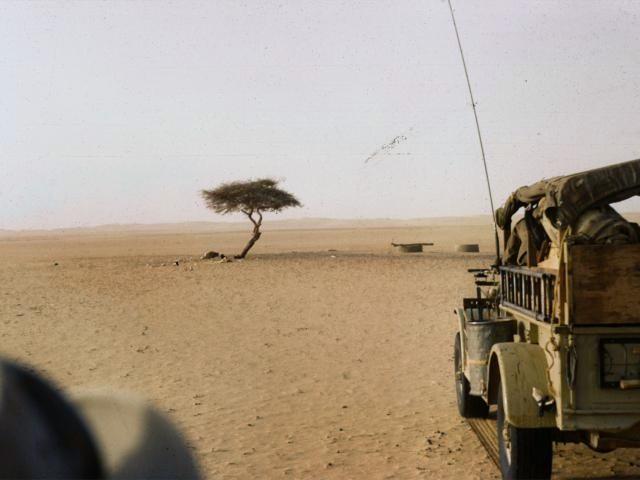
For decades, the Tree of Ténéré was the most famous tree on the planet for a simple reason: it was the only one. A lone acacia, about three centuries old, standing in the middle of a desert with no other tree within some four hundred kilometres. The salt caravans linking Agadez and Bilma used it as a navigation landmark on a plain without a single feature; in 1939 a French officer described it as "a living lighthouse".
Its story has an absurd and very human ending. In 1973, a Libyan truck driver (drunk, according to the most widespread version) pulled off the statistically unlikely feat of crashing into the only tree in an empty desert and knocking it down. The dead trunk was taken to the National Museum in Niamey, where it was installed on 8 November that same year, and an abstract metal sculpture representing it was put up on the exact spot where it grew. Attempts to replant acacias there failed: the water table is about forty metres down and the watering was not kept up.
Important notice: the original site lies deep in the Ténéré, in an area that every foreign ministry now advises against and that is practically inaccessible. The United States keeps Niger at Level 4 "Do Not Travel" and the Nigerien authorities require a military escort outside Niamey. This guide tells the story of the tree and explains where you can really see it today: in Niamey, in the room of the Boubou Hama National Museum where its trunk rests, and at the replica in the historic centre of Agadez.
The Tree of Ténéré was a Vachellia tortilis subsp. raddiana acacia about three hundred years old, the last survivor of a group of trees that grew along the caravan route during a less arid period of the Sahara. When the climate dried out, the others died; it survived because its roots reached the water table 33-36 metres down, as was found when a well was dug beside it in the winter of 1938-1939. On 21 May 1939, the French officer Michel Lesourd visited it and called it "a living lighthouse" for the salt caravans between Agadez and Bilma; the Tuareg considered it taboo and sacred, and nobody cut a branch from it. It was marked on maps at a scale of 1:4,000,000, a unique case for an individual tree. In 1973 it was knocked down by a Libyan truck driver who was allegedly drunk. The trunk was installed at the National Museum in Niamey on 8 November 1973, and a metal sculpture was put up in its place in the desert that still marks the spot.
Read the full history ↓Desert in its purest form: the Ténéré's sea of dunes, the salt caravan to Bilma, the loneliest tree in the world and a dinosaur graveyard beneath the sand.
Read the history of The Ténéré and the treasures of the desert →No exact prices: a scale from $ (budget) to $$$$$ (luxury), with 2-3 options per category.
Origins, formation and what the sources say.
The Tree of Ténéré was not a botanical oddity: it was a remnant. During the Neolithic Subpluvial, roughly between 7500 and 2500 BC, the central Sahara was a savannah with permanent lakes, seasonal rivers and scattered trees. Across what is now the empty plain of the Ténéré grew a whole line of acacias along the underground water line that the caravan route would later follow.
When the monsoon retreated south and the desert closed in, around 2500 BC, those trees died one after another over thousands of years. All but one. The Ténéré acacia, Vachellia tortilis subspecies raddiana and the Saharan species par excellence, survived because it stood right above a spot where the fossil aquifer was within reach of its roots.
The proof came in the winter of 1938-1939, when a well was dug beside it and the roots were found to reach the water table at a depth of between 33 and 36 metres. A tree three or four metres tall was held up by a root system as deep as a twelve-storey building. The acacia was thought to be about three hundred years old when it was knocked down.
The combination was statistically extraordinary: the most isolated living tree in the world, with no other of its kind for some four hundred kilometres in any direction. Most deserts have scattered plants in their wadis. The western Ténéré had absolutely nothing. That total solitude, not its size or its beauty, is what made it a legend.
The tree grew next to the last well before the great Erg of Bilma, at the exact point where caravans left the gravel plain and entered the sea of dunes. This was the route of the azalai, the salt caravan that set out from Agadez every dry season bound for Bilma. It crossed six hundred kilometres of nothing to load up the cone-shaped salt loaves, the kantu, and the dates that would be sold in the Aïr and in the Hausa cities to the south.
On a plain with no relief, no vegetation and not a single visual landmark, a tree is a navigation tool. Caravan guides used it as a fixed marker: if you could see it, you knew exactly where you were and in which direction lay the well and the route to Fachi. On 21 May 1939, the French officer Michel Lesourd visited it and left the most quoted description, calling it “a living lighthouse” for the caravans between Agadez and Bilma.
Its practical value became sacred value. The Tuareg considered it taboo: no one cut a branch, tied an animal to its trunk or made a fire with its wood. That shared ban was kept for generations by people crossing the desert cold, hungry and in need of firewood, and it is the real reason the tree stayed standing. In a desert where any piece of wood is treasure, everyone who passed by chose to leave it alone.
Formal recognition came from mapmakers. The Tree of Ténéré and the Arbre Perdu, the “Lost Tree” further north, were the only trees marked on the region's 1:4.000.000 scale maps. At that scale, where whole cities shrink to a dot, two single trees got a symbol of their own. Nothing shows better what they meant.
In 1973 a Libyan lorry driver crashed into the tree and knocked it down. Every source repeats the claim that he was drunk. The arithmetic is worth a moment: on a plain of hundreds of thousands of square kilometres without a single obstacle, a vehicle managed to hit the only upright object there was. It sounds made up, yet it is documented.
The tree had already taken a beating. In the years before, it had been damaged by traffic, because the lorries that began competing with the caravans used the same landmark and drove close by, and it had lost some of its main branches. The 1973 crash finished it: the acacia lay on the ground, dead.
Niger's authorities acted at once and, looking back, very wisely. Instead of letting the trunk rot or be carried off piece by piece, they moved it to the capital. On 8 November 1973 the remains of the Tree of Ténéré were installed in the National Museum in Niamey, now the Musée National Boubou Hama. The museum was founded in 1959 on the initiative of the intellectual and politician Boubou Hama and its first curator, Pablo Toucet. The trunk is still on display there.
At the desert site, an abstract metal sculpture shaped like a stylised tree was put up to mark the exact spot. There were also attempts to replant acacias there, but they all failed. With the water table about forty metres down and no constant watering, no seedling can survive long enough for its roots to reach water. The loneliest tree in the world turned out to be impossible to replace, for purely hydrogeological reasons.
Once the tree died, its life as a symbol began. The Tree of Ténéré became one of the images Niger uses to represent itself, and a metaphor that has travelled far and wide: lonely endurance, the fragility of anything unique, and human clumsiness that can destroy in a second what nature kept alive for centuries.
Popular culture took it up quickly. The desert that gave it its name also named an adventure motorbike, the Yamaha Ténéré, born in the heyday of the Paris-Dakar. The tree became a must-stop for Saharan expeditions in the seventies, eighties and nineties, and a photo beside the metal sculpture was the trophy of anyone who had crossed the Ténéré. In Agadez a replica was set up in the historic centre, next to the mud-brick architecture that UNESCO would add to the World Heritage list in 2013.
In the Niamey museum the trunk does a different job, and perhaps a more honest one. It is on display in a grounds of about 24 hectares covering the country's ethnography, archaeology, palaeontology and mineralogy, with dinosaur fossils from Gadoufaoua and terracottas from the Bura culture. There the tree stops being a postcard and becomes what it really is: a record of the Sahara's climate, of the trade routes that shaped West Africa and of the bond between the Tuareg and their land.
One detail often goes unnoticed. The tree survived three hundred years because a whole community decided not to touch it, and it died when a new kind of transport arrived that did not share that code. Speed is not the only difference between the azalai and the lorry. The tree is the exact point where you can see what the difference is.
The sculpture is still there, at about 17°44′39″ N and 10°04′58″ E, covered in plaques, stickers and signatures left by the travellers who made it while they still could. The Ténéré well is still beside it. And the Erg of Bilma still begins exactly where it always did.
What has changed is the country around it. The Tuareg rebellions of 1990-1995 and 2007-2009 halted Saharan tourism twice. The collapse of Libya in 2011 and the fall of northern Mali in 2012 flooded the Sahel with weapons and armed groups. The old Ténéré caravan tracks became corridors for smuggling weapons, fuel and migrants towards Libya, with Agadez as the logistics hub. Kidnapping foreigners stopped being a rare risk and became a business model.
The coup of 26 July 2023, which overthrew President Mohamed Bazoum and installed a military junta, closed the chapter for good. The US Department of State keeps Niger at Level 4 “Do Not Travel”, an advisory renewed on 9 July 2026, citing crime, unrest, terrorism, health and kidnapping, and warns that it cannot provide consular services outside Niamey. Canada explicitly advises against the remote areas around Agadez and the Ténéré. In 2026 two Westerners were kidnapped from their own homes in Agadez, one in January and one in April, in the very city that used to be the safe starting point for every expedition to the tree.
The result is a paradox that suits this story. The most isolated tree in the world is out of reach once again, and its trunk, the part that was saved, now sits in the capital. It is in a museum with admission of about 1.500 CFA francs, a ten-minute taxi ride from central Niamey. Anyone who wants to see the Tree of Ténéré can. You just no longer cross the desert to get there. You walk into a room.