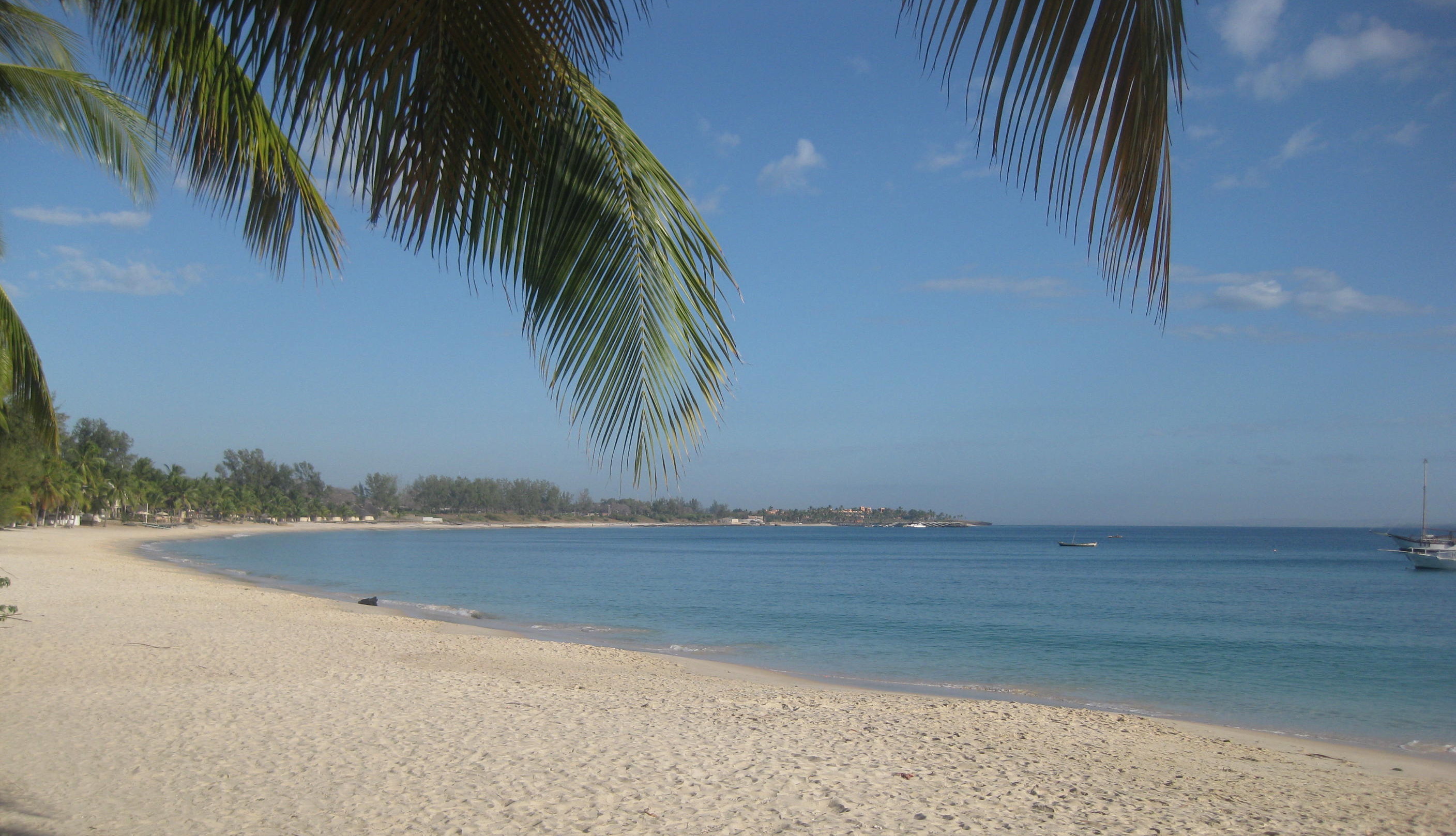
Pemba is the great gateway to Mozambique's far north: a city stretched across a peninsula, looking out over one of the largest bays on the planet, with coral reefs that begin almost at the shoreline and white-sand beaches a few minutes from the centre. Above all, it is the starting point for the Quirimbas Archipelago and the historic island of Ibo, which is why almost every traveller to north-eastern Mozambique passes through here.
The city has several faces: the colonial and commercial district up on the hill, the bustling market and dhow harbour in Paquitequete, and the tourist and beach area of Wimbe, with hotels, restaurants and dive bases. Its reefs, unusually close to the coast, have made it a well-regarded diving destination for decades, with sites such as The Gap, The Playground and Pyro Banks.
This guide covers Pemba with a practical eye: what to do in the city and on its beaches, where to dive and sail in a dhow, how to use it as a base for the Quirimbas and Ibo, how to get around and where to sleep and eat. It also deals honestly with the question of safety in Cabo Delgado, without alarmism but with information, so you can plan a responsible trip to this fascinating and still little-visited corner of the Indian Ocean.
Founded by the Portuguese in 1904 under the name Porto Amélia, in honour of Queen Amélia of Portugal, Pemba was born as the administrative port of the Cabo Delgado region, taking advantage of the huge natural bay. It replaced old Ibo as the regional capital and grew as a commercial and port centre. After independence in 1975 it was renamed Pemba. In the 21st century it enjoyed a brief boom following the discovery of natural gas in the Rovuma basin, overshadowed since 2017 by the armed conflict in Cabo Delgado. The full story is told on our history page.
Read the full history ↓The far north of the country, between one of the largest bays in the world and the coral archipelago of the Quirimbas, holds museum-islands with Portuguese forts and a recent history shaped by gas and conflict.
Read the history of Cabo Delgado and the Quirimbas →No exact prices: a scale from $ (budget) to $$$$$ (luxury), with 2-3 options per category.
Origins, formation and what the sources say.
Pemba Bay —a huge, sheltered arm of the sea, considered one of the largest natural bays in the world— was for centuries part of the Swahili world of the East African coast. Long before today's city existed, these waters and the neighbouring islands of the Quirimbas Archipelago were sailed by Arab and Swahili navigators who traded to the rhythm of the monsoons, and the old island of Ibo, further north, was the great commercial and administrative centre of the Cabo Delgado region.
The population of the area was, and still is, diverse: coastal peoples speaking Kimwani and Swahili, Muslim by religion and seafaring by culture, and inland the Makonde, famous for their ebony carvings, along with the Makua and other groups. The whole region was part of the northern fringe of Portuguese rule, underdeveloped and oriented towards Indian Ocean trade and the world of Zanzibar and the Swahili coast rather than towards the south of the country.
The magnificent bay, however, was an untapped resource: a deep, protected natural harbour that, at the start of the 20th century, the Portuguese finally decided to put to use, giving rise to a new city that would replace old Ibo as the capital of the region.
The city was founded by the Portuguese in 1904 under the name Porto Amélia, in honour of Queen Amélie of Orléans, wife of King Carlos I of Portugal. It was created to meet the need for a modern, well-placed port from which to administer and exploit the Cabo Delgado region, making use of the exceptional natural bay, far better suited than the anchorage at old Ibo, which gradually lost its role as regional capital.
Porto Amélia grew as a commercial port and administrative centre, with a colonial layout on the upper part of the peninsula, commercial districts —where Portuguese, Indian and other traders settled— and working-class neighbourhoods by the sea, such as Paquitequete. The region's economy revolved around exporting farm produce (cotton, sisal, cashew nuts) and goods from the sea, and the city established itself as the main one in Mozambique's far north.
During the first half of the 20th century, Porto Amélia was a typical Portuguese provincial colonial town: modest, but with its church, its administration, its port and its mix of peoples. The region, however, remained one of the poorest and most peripheral in the colony, far from the centres of power in the south.
Cabo Delgado, and Porto Amélia with it, played a central role in the history of Mozambique's independence. It was in the north, near the border with Tanzania, that FRELIMO (the Mozambique Liberation Front) launched the armed struggle against Portuguese colonial rule in 1964. The Makonde of the Mueda Plateau, in the interior of the province, were a mainstay of that guerrilla movement, and the region lived through the years of the liberation war (1964-1974) at first hand.
After the Carnation Revolution in Portugal (1974) and the fall of the colonial regime, Mozambique gained independence on 25 June 1975, with FRELIMO in power. Porto Amélia was renamed Pemba, its current name, as part of the replacement of colonial place names with African ones that came with independence.
The years that followed were extremely hard for the whole country: the civil war between FRELIMO and RENAMO (1977-1992) devastated Mozambique, although it hit the centre and south harder than the far north. Pemba, remote and peripheral, remained a modest port city, capital of one of the poorest and least developed provinces in the country, with huge shortfalls in infrastructure and services.
The 21st century brought Cabo Delgado an unexpected transformation. From 2010 onwards, huge reserves of natural gas were discovered in the Rovuma Basin, off the coast of the north of the province, near Palma. Major energy multinationals launched multi-billion-dollar liquefied natural gas (LNG) projects, and Pemba enjoyed a brief boom as a logistics base for the industry, with an influx of investment, foreign workers and hopes of wealth for one of the poorest regions in the country.
But that promise took a tragic turn. Since October 2017, the province has suffered an armed insurgency by jihadist groups —known locally as 'Al Shabab' (unrelated to the Somali group) and linked to the so-called Islamic State— which has attacked villages, towns and even the town of Palma and the port of Mocímboa da Praia. The conflict has caused thousands of deaths and displaced more than a million people in one of the worst humanitarian crises in Africa, and led to the intervention of forces from Rwanda and SADC in an attempt to stabilise the area.
Pemba, as the provincial capital, has served as a safe rear base, a humanitarian hub and a refuge for tens of thousands of displaced people, and has generally stayed clear of the attacks, although the situation in the province remains volatile, with flare-ups of violence in 2024 and 2025. The city on the great bay, which once dreamed of a future of gas-fuelled prosperity, now lives suspended between that postponed promise and the tragedy of a conflict that casts a shadow over the whole north. Even so, Pemba keeps its coastal beauty and its role as the gateway to the Quirimbas, waiting for better times for its people and for tourism.