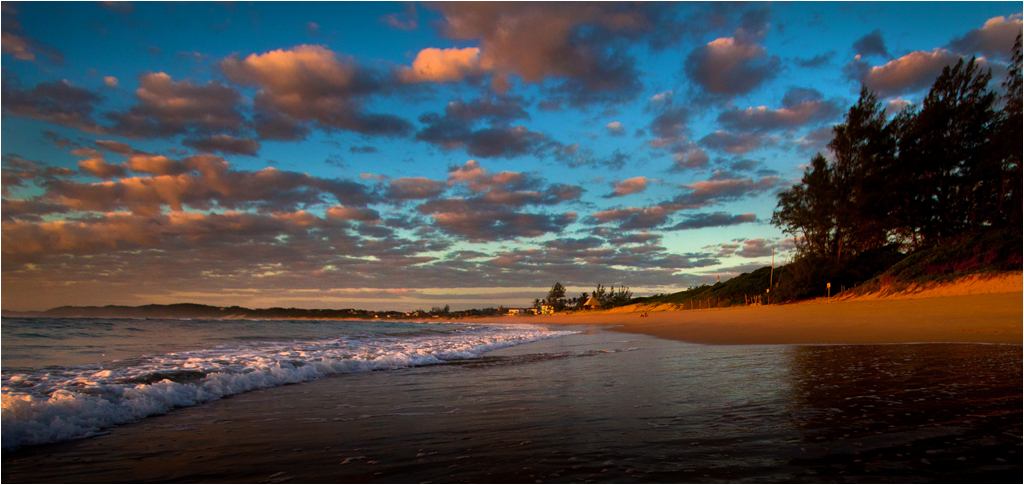
Ponta do Ouro is Mozambique's deep south: a town of sand and palm trees looking out over the Indian Ocean, a stone's throw from the South African border. It's famous for its warm water, its reefs full of life and, above all, its wild dolphins. Here you can swim in the open sea with pods of bottlenose dolphins in their natural setting, dive among sharks and tropical fish, and watch humpback whales go by in season, all in a laid-back, backpacker-style, no-frills atmosphere.
Being so close to KwaZulu-Natal made it South Africans' beach getaway for decades. They cross the Kosi Bay border in 4x4s to camp, fish and dive. That gave it a character of its own, part tropical Mozambique, part overland adventure. With its sandy streets, bars with music, cheap seafood and sunsets over the dunes, Ponta is a place to slow down and live by the sea.
This guide covers how to get there (from South Africa, or from Maputo via the Maputo-Katembe bridge), what to do in the water (swimming responsibly with dolphins, diving its reefs, whale watching), when to come, where to stay, from campsites to lodges, and what precautions to take in a rustic town without many services. Ponta do Ouro is the southern gateway to Mozambique's beaches and one of the best places in the country to meet marine life.
Ponta do Ouro owes its name ('Point of Gold') to the Portuguese navigators who sailed along this coast on their way to India, although for centuries it was little more than a stretch of dunes where the Ronga peoples of the far south fished. Its modern growth came with border tourism: being so close to South Africa, it became a camping, fishing and diving destination for visitors from KwaZulu-Natal. Today its waters are protected within Maputo National Park, and the town is known for its wild dolphins and its diving. You'll find more on the history of this coast and its marine protected areas on our history page.
Read the full history ↓The country's art deco capital grew up around the anchorage of Baía de Maputo, and towards the South African border stretch the beaches and reserves of the far south, where the elephants have returned and dolphins swim offshore.
Read the history of Maputo and the far south →They depart from Maputo, 102 km away. If you book from this link we earn a commission and you pay no more.
No exact prices: a scale from $ (budget) to $$$$$ (luxury), with 2-3 options per category.
Origins, formation and what the sources say.
At the southern tip of Mozambique's long coastline, where the country almost touches South Africa, a headland of dunes and golden sand juts out into the Indian Ocean. The Portuguese navigators who sailed along this coast from the 16th century on their way to India named it Ponta do Ouro, 'Point of Gold', an evocative name whose exact origin has been lost — perhaps from the golden colour of its dunes and beaches at sunset, perhaps from legends of riches.
Long before the Europeans arrived, this coastal strip was the land of Tsonga-speaking peoples, especially the Ronga, who lived from fishing, gathering shellfish and farming in a landscape of lagoons, dune forests and sea. The coast was teeming with life — fish, turtles, dolphins, passing whales — but it was rugged and isolated, with no major natural harbours, so it never became a great trading centre like Delagoa Bay further north, where Lourenço Marques (the future Maputo) would grow.
For centuries, then, Ponta do Ouro was little more than a dot on nautical charts and a local fishing spot, far removed from the bustle of colonial history. Its closeness to the border — first with the British colonies of Natal and Zululand, later with South Africa — would, much later, shape its future as a tourist destination.
Ponta do Ouro's modern development is closely tied to its status as a border town. Throughout the 20th century, and especially in the boom decades before independence, this coast became a holiday destination for South Africans from the neighbouring province of Natal (today KwaZulu-Natal), who crossed the border looking for its warm beaches, plentiful fishing and tropical atmosphere, so different from the cooler coasts further south.
That border tourism gave Ponta do Ouro a character all its own, a mix of tropical Mozambique and South African camping, sport-fishing and 4x4 adventure culture. Campsites went up among the dunes, along with simple lodges and bars, and the village grew to the rhythm of its southern neighbours' holidays as they arrived with their fishing rods, boats and off-road vehicles.
The Mozambican civil war (1977-1992) and tensions across the region cut off that flow for years, leaving Ponta do Ouro isolated and half-abandoned. But with peace in the 1990s and the end of apartheid in South Africa, the village came back to life: visitors returned in droves, drawn by beaches that had stayed almost untouched and by extraordinary marine life that was starting to become famous.
What finally put Ponta do Ouro on the world map was its marine life, and above all its dolphins. A resident community of bottlenose dolphins lives off this coast, meaning they stay in the area all year round and can be recognised individually. From the 1990s, pioneering research and ecotourism projects — such as the one that gave rise to the Dolphin Encountours Research Center — began studying these dolphins and offering responsible in-water encounters with them.
Unlike dolphinariums or mass tours, Ponta's approach was built on respect from the very start: swimming with wild dolphins in the open sea, without touching them or forcing the encounter, and letting the animals decide whether to come closer. That ethical approach made the village an international benchmark for dolphin tourism done right, and drew travellers from all over the world.
At the same time, Ponta established itself as one of the best diving destinations in southern Mozambique. Its reefs — Pinnacles, Doodles, Atlantis and others — revealed remarkable riches: sharks, large rays, turtles, moray eels and an explosion of tropical fish. Divers from South Africa and around the world began flocking to this coast, and the village added a new identity as a capital of diving and dolphins to its old tradition of fishing and camping.
Tourism's success brought with it the need to protect the treasure that drew visitors in the first place. In 2009, the government of Mozambique created the Ponta do Ouro Partial Marine Reserve, which protected some 90 kilometres of coastline and its marine strip, running north from the South African border. The aim was to safeguard the coral reefs, the dolphins, the sea turtles that nest on its beaches and the humpback whales that pass by every year, by regulating fishing and tourism activities.
Inland, the marine reserve connected naturally with the Maputo Special Reserve (the one with the elephants), forming a continuous stretch of protected land and sea at the country's southern tip. Recognising that unity, in 2021 the government merged the two areas to create Maputo National Park, which today protects the dunes, lagoons, beaches and ocean of this region as a whole, under the joint management of the Mozambican State and the Peace Parks Foundation.
For Ponta do Ouro, this meant becoming part of one of the most important conservation areas in southern Africa. Diving and dolphin operators began working under the park's rules, and part of the tourism income started to fund the protection of the sea that sustains them. The border beach village thus became the southern gateway to a large coastal and marine national park.
Today's Ponta do Ouro keeps much of its rustic, adventurous character. Its streets are still sand, you need a 4x4 to get around, and for a long time there were no ATMs, doctor or pharmacy, so visitors have to arrive prepared. For many, that lack of big luxuries and comforts is part of the charm: Ponta is a place to switch off, not for resort tourism.
The village lives from the sea and from tourism: the campsites and lodges mostly host South Africans crossing the border at Kosi Bay, but also international travellers drawn by the dolphins, the diving and the whales. The opening of the Maputo-Katembe bridge in 2018 also brought Ponta closer to the capital, making it easier to get there from Maputo on the N200 without relying on the old ferry.
So today Ponta do Ouro brings together three layers of history: the old 'Point of Gold' of the Portuguese navigators and the Ronga people; the camping, fishing and border village that grew with South African tourism; and the modern marine ecotourism destination, part of Maputo National Park, where swimming with wild dolphins and diving among sharks follow conservation rules. A small sandy village that sums up the meeting of sea, border and protected nature in southern Mozambique.