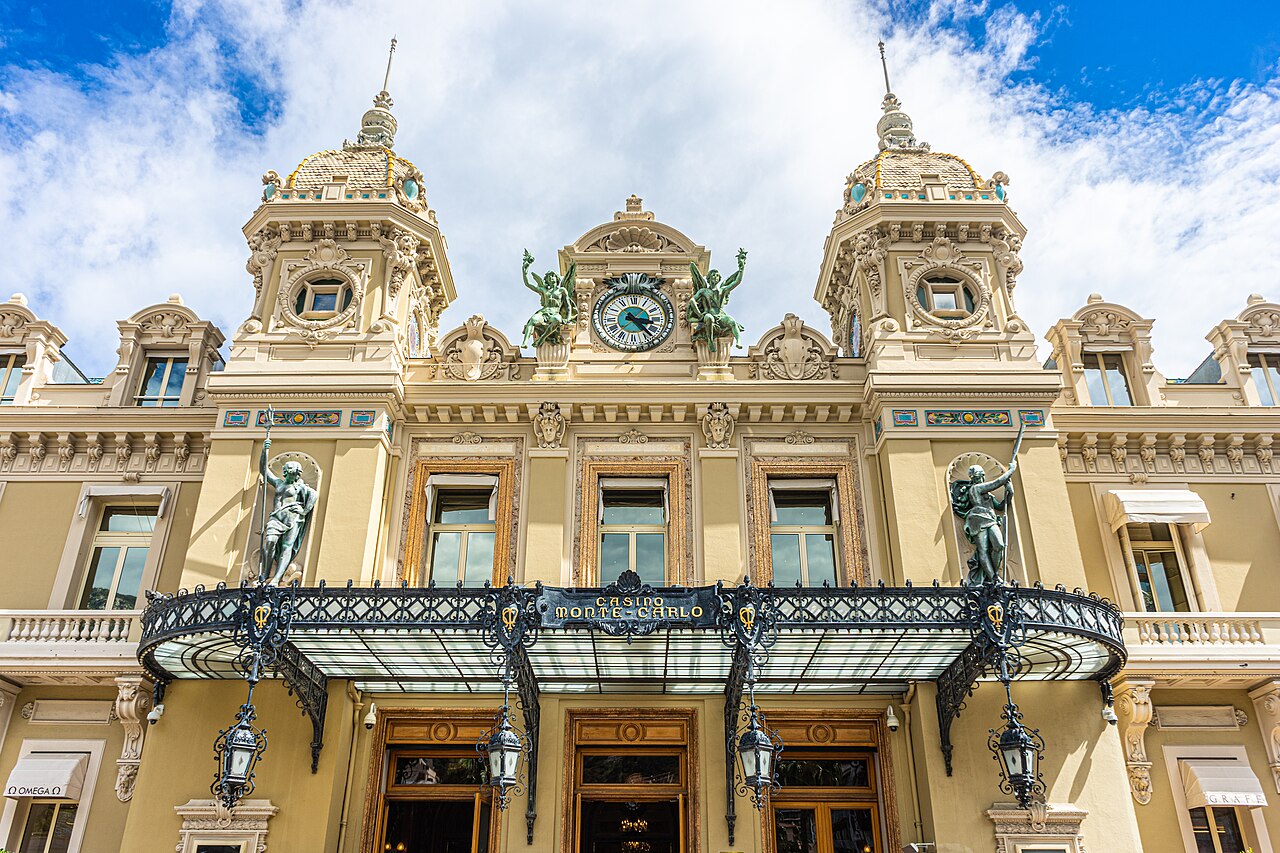
Monte Carlo is the image the world has of Monaco: the hill of luxury, crowned by the Place du Casino, where the Casino de Monte-Carlo shows off its golden stone façade among gardens, fountains and a row of sports cars parked as if in a shop window. It's the setting of James Bond films, of the roulette wheel that made and broke fortunes, and of an old-world elegance that's still alive on every corner.
But Monte Carlo isn't just a backdrop for millionaires: it's also a Belle Époque architectural marvel. The casino and the Opera are the work of Charles Garnier, the same architect behind the Paris Opera; together with the casino, the Café de Paris and the Hôtel de Paris form one of the most harmonious urban ensembles of the 19th century. And behind all this glitter lies a fascinating story: it was gambling that, in the 19th century, saved Monaco from ruin and turned it into the prosperous, independent country it is today.
This guide takes a practical look at Monte Carlo: how to visit the casino (and what dress code you need), how much it costs to enter the gaming rooms, where the Opera and the gardens are, what the Café de Paris is like, and how to stroll among the luxury boutiques without spending a cent. With concrete details to enjoy the Principality's most legendary district, whether or not you play roulette.
Monte Carlo owes its existence and its name to a desperate decision. In the mid-19th century, Monaco was on the verge of bankruptcy: it had lost the income from Menton and Roquebrune, its two richest towns, which had broken away. To rescue its finances, Prince Charles III authorised the creation of a casino and, in 1863, granted the gaming concession to businessman François Blanc, who founded the Société des Bains de Mer (SBM). Blanc, nicknamed 'the magician of Monte Carlo', made the casino a resounding success that filled the Principality's coffers. In 1866, the hill where the casino stood was named Monte Carlo in honour of the prince. The casino and the Opera were designed by Charles Garnier, architect of the Paris Opera. Thanks to gambling, Monaco was even able to abolish income tax and become the tax and tourism haven it still is. The full story is on our history page.
Read the full history ↓The Monaco of luxury and the Belle Époque: the district of the famous Casino and the Monte Carlo Opera, and the Larvotto seafront with its beach, the Grimaldi Forum and the new district of Mareterra, reclaimed from the sea.
Read the history of Monte Carlo and the coast →A local guide tells you in half an hour what no sign at the site will ever explain. We look ours up on Civitatis: guided in Spanish and booked online with no fuss. They have 15 activities in Niza. And there are free tours here: you book without paying and tip the guide whatever you think at the end, so trying one costs you nothing. Three are below so you get the idea: tap any of them and they all open.
They depart from Niza, 14 km away. If you book from this link we earn a commission and you pay no more.
No exact prices: a scale from $ (budget) to $$$$$ (luxury), with 2-3 options per category.
Origins, formation and what the sources say.
The story of Monte Carlo begins with a ruined country. In the mid-19th century, the Principality of Monaco was going through the worst crisis in its history. For centuries, the wealth of the Grimaldis had depended largely on two neighbouring towns, Menton and Roquebrune. Both were much larger and more fertile than the Rock itself, and they produced lemons, olive oil and other crops and paid taxes to the prince.
In 1848, as revolution swept across Europe, Menton and Roquebrune rose up against Monaco's taxes and declared themselves 'free towns', placing themselves under the protection of the neighbouring Kingdom of Sardinia-Piedmont. Overnight, Monaco lost most of its territory and almost all of its income. It was left with the Rock, La Condamine and a few steep hillsides: a handful of square kilometres with barely any economy. The loss became final in 1861, when Prince Charles III formally gave up Menton and Roquebrune in exchange for compensation from France, in the same treaty that guaranteed Monaco's independence.
The Principality urgently needed a new source of wealth. It found one in the most unexpected place: gambling. At a time when many European states were banning or shutting down gambling houses on moral grounds, Monaco did exactly the opposite and bet everything on a roulette table.
The idea of opening a casino in Monaco went back further. Princess Caroline, wife of Florestan I, had already pushed for it in the early 1850s as a financial lifeline. The first attempts, however, failed badly. The casino built on a deserted, hard-to-reach plateau called Les Spélugues drew no one, because getting to Monaco was an ordeal at the time, with no railway and no decent roads.
The turning point came in 1863, during the reign of Charles III. That year the prince granted the gambling monopoly, along with sea bathing, hotels and entertainment, to the leading European expert in the field: François Blanc (1806-1877). Blanc had made his fortune running the casino at the German spa town of Bad Homburg, and when Prussia decided to close Germany's gambling houses, he took his talents to Monaco. He founded the Société des Bains de Mer et du Cercle des Étrangers (the SBM), the company that still runs the casino, the grand hotels and much of Monaco's luxury scene today.
Blanc, nicknamed 'the wizard of Monte Carlo', worked a miracle. He understood that the casino would only succeed if Monaco was easy to reach and somewhere people wanted to be. So he pushed for the railway (1868), built hotels, gardens and luxury infrastructure, and turned gambling into a glamorous experience for the aristocracy and upper middle classes of all Europe. In 1866, to give the new casino district some prestige, the Les Spélugues plateau was renamed 'Monte Carlo' ('Mount Charles') in honour of Prince Charles III. The success was overwhelming, and the Principality's coffers, empty until then, began to overflow.
Gambling money turned into stone, marble and gold. To match its clientele, the SBM hired the most prestigious architect of the day: Charles Garnier, designer of the dazzling Paris Opera. Garnier worked on the extension and embellishment of the Monte Carlo Casino. He gave it the monumental Second Empire and Belle Époque façade, with domes, atlantes and lavish salons, that made it famous around the world. In 1879 he opened the Salle Garnier, attached to the casino. This red-and-gold jewel of the Monte Carlo Opera was inaugurated with a performance starring the legendary Sarah Bernhardt.
A whole district designed for pleasure and luxury grew up around the casino. The Hôtel de Paris opened in 1864 and went on to become the most famous palace hotel in the Principality. Across the square, the Café de Paris livened things up with its terrace. Gardens, avenues and villas were laid out, and the Hôtel Hermitage and other SBM establishments followed. Under Raoul Gunsbourg, who became director in 1892, the Monte Carlo Opera enjoyed a golden age. It premiered works by Massenet and Saint-Saëns, hosted singers such as Caruso and Chaliapin and, in the 20th century, was one of the birthplaces of Diaghilev's Ballets Russes.
Monte Carlo thus became the centre of Belle Époque cosmopolitan Europe. Kings, Russian grand dukes, tycoons and stars met in its salons. The image of elegance and fortune the world associates with Monaco was born in these decades, between roulette, opera and gala dinners.
The casino was more than a brilliant business. It literally saved the Monegasque state and shaped its model for the next century and a half. The SBM paid the Principality so much that it was able to clean up public finances completely and pay for the country's modernisation.
The most symbolic gesture came in 1869. With the treasury overflowing thanks to gambling, Prince Charles III abolished income tax for residents of Monaco. That decision, unthinkable anywhere else, laid the foundations of modern Monaco. Because the microstate does not tax personal income, over time it became a magnet for great fortunes from all over the world. The casino funded the state, and in return the state could offer a unique tax regime. That equation of luxury, gambling and low taxes is still, in essence, Monaco's economic model.
Over the decades, the casino's share of the economy shrank. Today Monaco lives mainly on high-end tourism, financial services, real estate and major events, and gambling accounts for only a small fraction of its revenue. But the casino's historical role is beyond question. Without the bet that Charles III and François Blanc made in the 19th century, it is doubtful the tiny Principality would have survived as an independent state. Monte Carlo is not just a glamorous district. It is where a bankrupt Monaco staked its future on roulette and won.
A place like this soon had legends of its own. The most famous is that of Charles Wells, an English gambler who in 1891 'broke the bank at Monte Carlo' several times in a row. He won fabulous sums at roulette and inspired a popular song, 'The Man Who Broke the Bank at Monte Carlo'. There is also the story of Joseph Jagger, who in 1873 spotted a mechanical bias in a roulette wheel and walked away with a fortune. True or exaggerated, these stories fed the myth of Monte Carlo as a place where anyone could get rich, or go broke, in a single night.
The 20th century strengthened that aura through film. Monte Carlo and its casino became a regular setting for films about glamour and espionage. James Bond is a familiar face at its tables, and the district has appeared in dozens of films. When Grace Kelly arrived as princess in 1956, she added a layer of Hollywood sparkle to a place that was already a byword for luxury. Alongside the casino, major sporting events now define the calendar. There is the Formula 1 Grand Prix, whose lap runs through the Place du Casino itself and around the Fairmont hairpin. There is also the Rolex Monte-Carlo Masters tennis tournament, played on the clay courts of the nearby Monte-Carlo Country Club.
Today's Monte Carlo is still the world's shop window for luxury. The SBM has renovated its historic palaces and added modern complexes such as One Monte-Carlo, bringing together boutiques of the big brands, Michelin-starred restaurants and the most expensive homes on the planet. Yet beneath the gleaming shop windows and the roar of the Formula 1 cars, the district still bears the mark of that bold 19th century. A principality on the edge of ruin decided to reinvent itself as a capital of pleasure, and it has been one ever since.