Viajá con Gus
Home › Mali › Timbuktu
Timbuktu
🇲🇱 Mali · The Saharan north: Timbuktu, Gao and the desert (no-go zone)

Timbuktu

🪪 What do I need to enter Mali?Pick your citizenship and we tell you the visa, the days and the paperwork, with the official source.

By leaving your email and citizenship you agree to receive the documents you asked for and weekly travel news. You can unsubscribe whenever you want. How we handle your data.
Jump to what you need
📌Safety warning
WARNING: Timbuktu is in northern Mali, in a zone of armed conflict and jihadist presence (JNIM, linked to Al Qaeda). In 2012-2013 it was occupied by jihadist groups that destroyed part of its heritage; since then it has remained extremely dangerous, with blockades, kidnappings and attacks (a stifling blockade of the city was repeated in 2023 and in 2025-2026). Access is FORBIDDEN and extremely high-risk. Every foreign ministry (US, Canada, France, Spain, United Kingdom) has Mali at the highest level: "Do Not Travel". This guide is historical and cultural; for any plan, check the current official advice.
📌What it is
Timbuktu (Tombouctou) is the mythical 'city of 333 saints', one of the great intellectual and trading centres of medieval Islam on the edge of the Sahara. Famous for its three great mud mosques (Djingareyber, Sankoré and Sidi Yahya), its saints' mausoleums and its hundreds of thousands of ancient manuscripts, it has been a UNESCO World Heritage Site since 1988 and is on the List of World Heritage in Danger.
📌Location
In northern Mali, a few kilometres from the Niger River (its historic port is Kabara), right at the point where the great river comes closest to the desert. It is a city of around 35.000-55.000 inhabitants, on the border between the Sahel and the Sahara. Its position — a crossroads between river navigation and desert caravans — explains its whole history.
📌Why it's famous
For having been, in the 15th and 16th centuries, one of the greatest centres of learning in the Islamic world: its Sankoré University drew thousands of students, and its libraries treasured manuscripts on theology, law, astronomy, medicine and mathematics. And for its legend as a remote, unreachable city, 'the end of the world', which obsessed 19th-century European explorers. Its name is a universal byword for somewhere impossibly far away.
📌Best time to go (historical)
Under normal conditions, the dry, cool season (November to February) was the only reasonable one, given the extreme heat the rest of the year (northern Mali comfortably tops 45 °C between March and June). January was the season of festivals and salt caravans. Today, any calendar is purely theoretical: access is forbidden because of the war.
📌People and language
Timbuktu is a melting pot of Saharan and Sahelian peoples: Songhai, Tuareg (who founded it), Arab-Berbers (Bidan), Fulani (Peul) and Bambara. French is Mali's official language; Songhai (Koyra Chiini), Tuareg Tamasheq and Hassaniya Arabic are local languages. Classical Arabic was for centuries the language of scholarship.
📌Currency
West African CFA franc (XOF), pegged to the euro at 655,957 XOF per euro; as of July 2026 it is around 575 XOF per dollar. Before the conflict, tourism and the salt caravans were sources of income; everything runs on cash, which is very scarce and unreliable in current conditions.
📌How people used to get there
Historically: by light aircraft from Bamako or Mopti (the safest option and the one most used by tourists), along the Niger River by pinasse from Mopti/Koulikoro to the port of Kabara, or by road/track from Douentza, crossing the river by ferry. Today all these routes are cut off or extremely high-risk, and access is forbidden.
💱 XOF exchange rate
Loading rate…
🌤️ Weather in Timbuktu
Loading weather…

Few names evoke as much remoteness and mystery as Timbuktu. For centuries it was, in the European imagination, the very byword for 'the end of the world', a legendary city of gold and scholars on the edge of the Sahara. The reality was almost as astonishing as the legend: Timbuktu was one of the great intellectual centres of medieval Islam, home of the famous Sankoré University, with its mud mosques, its saints' mausoleums and its libraries full of manuscripts that made it the 'city of 333 saints'.

Born as a Tuareg camp beside a well, Timbuktu grew into the great market where gold from the south met salt from the desert, and into a magnet for scholars from across the Islamic world. At its height, under the Mali and Songhai empires, the city had tens of thousands of inhabitants and a dazzling cultural life. Its decline began with the Moroccan invasion of 1591, but its myth kept growing, fuelling European expeditions that cost many lives.

It has to be said very clearly: today Timbuktu is not a tourist destination but a city in a war zone. In 2012 it was occupied by jihadist groups that destroyed many of its mausoleums and threatened its manuscripts; since then it has remained besieged by insecurity, with blockades and kidnappings. Foreign ministries advise against all travel to Mali. This guide explains, with rigour and admiration for its heritage, what Timbuktu is, without romanticising the idea of visiting it in any way: any plan must start from the official advice.

📖 History of Timbuktu

Timbuktu was born around the year 1100 as a seasonal Tuareg camp beside a well — legend says it belonged to an old woman called Buktu, 'Buktu's well' — at the point where the Niger comes closest to the Sahara. Its position made it the great crossroads of trans-Saharan trade: gold, salt, slaves and books. Under the Mali Empire (that of the famous Mansa Musa) and later the Songhai, it reached its peak as a capital of Islamic learning, with Sankoré University and thousands of students. The Moroccan invasion of 1591 began its decline, but its legend as an unreachable city lived on. Its full story is told on our history page.

Read the full history ↓

🏛️ Timbuktu is in the Saharan north: Timbuktu, Gao and the desert

Legendary Timbuktu of the 333 saints, Gao of the Songhai askias and the Tuareg dunes of the Festival au Désert: the great north of gold, learning and desert blues.

Read the history of The Saharan north: Timbuktu, Gao and the desert →

🗺️ What to see

1
The Djingareyber (Djinguereber) Mosque
Timbuktu's great mud mosque, built around 1327 in the time of Mansa Musa; the city's most imposing monument.
Leer más ↓
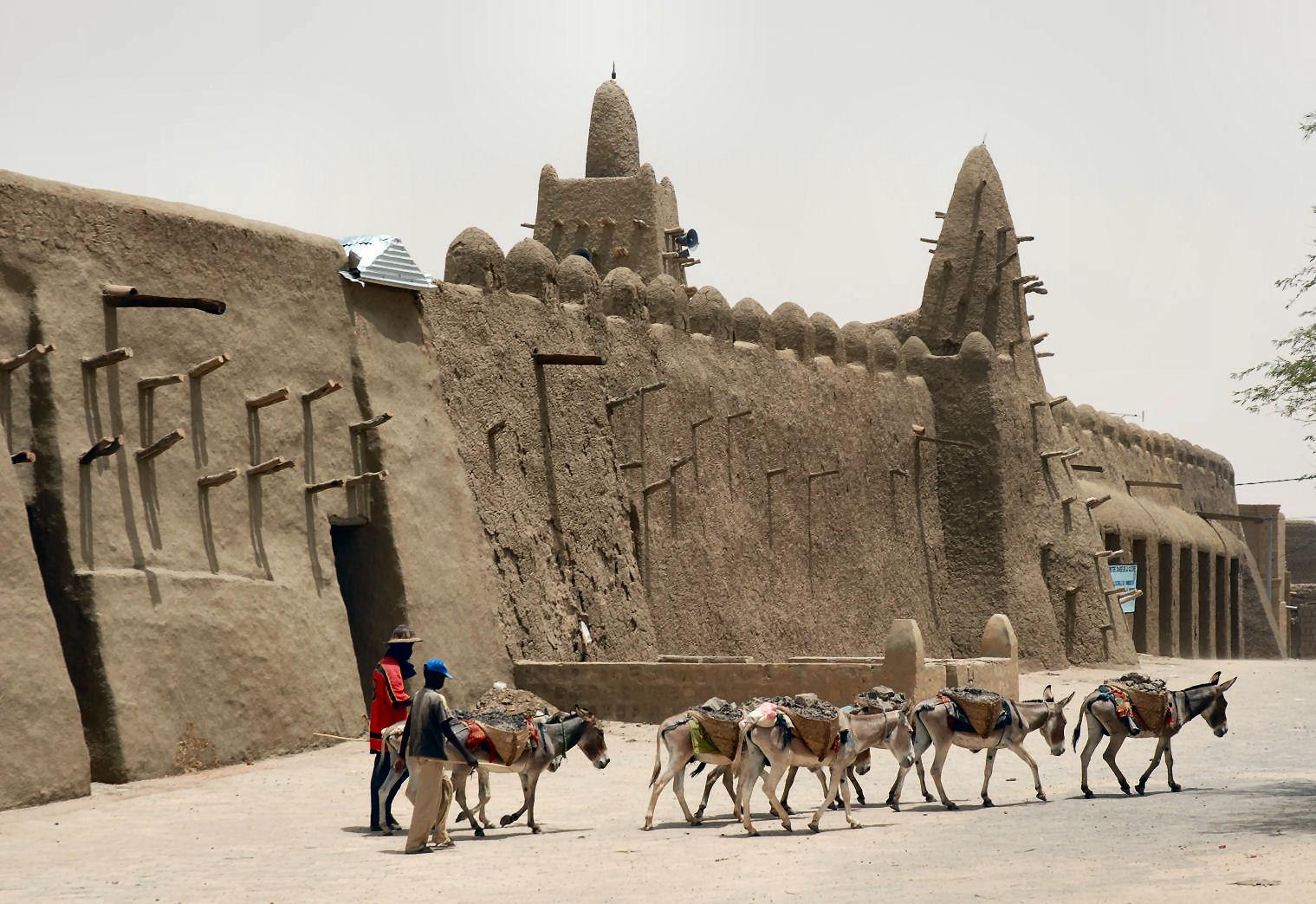
The Djingareyber Mosque is the monumental heart of Timbuktu. It was built around 1327, in the time of the Mali emperor Mansa Musa, and is attributed to the Andalusian architect Abu Ishaq es-Saheli, whom Mansa Musa is said to have brought back after his famous pilgrimage to Mecca. It is an imposing structure of mud (banco), palm wood and limestone, with massive walls, a large pyramid-shaped minaret and a prayer hall of dozens of pillars. Like every earthen building, it is replastered periodically. It is one of the three great historic mosques that form the core of the World Heritage Site. Today a visit is impossible because of the insecurity.
2
The Sankoré Mosque and University
The intellectual heart of Timbuktu: the mosque that housed the famous 'Sankoré University', a centre of African Islamic learning.
Leer más ↓
The Sankoré Mosque, with its distinctive pyramid-shaped minaret bristling with bundles of palm wood, was much more than a place of worship: it was the centre of the legendary Sankoré University, one of the great teaching centres of the medieval Islamic world. In its best days (15th-16th centuries) it drew thousands of students who studied the Quran, law, theology, grammar, astronomy and medicine with renowned masters. Its courtyard, according to tradition, reproduces the dimensions of the Kaaba. Sankoré symbolises the Timbuktu of learning, the one behind the saying that 'salt comes from the north, gold from the south, but the word of God and the treasures of wisdom come from Timbuktu'.
3
The Sidi Yahya (Sidi Yahia) Mosque
The third great historic mosque, from the 15th century, famous for its door that, according to legend, was not to be opened until the end of the world.
Leer más ↓
The Sidi Yahya Mosque, built in the 15th century, completes the trio of great mud mosques of Timbuktu. It is named after a saint and scholar of the city. It is famous for a legend: one of its doors was to stay closed until the end of the world, and its opening would herald the end of time. When jihadists forced that door in 2012, the shock among residents was enormous, as it broke one of the city's most cherished taboos. The door was repaired in the later restoration. The mosque is part of the World Heritage Site.
4
The saints' mausoleums (the '333 saints')
The mud tombs of the Sufi scholars and saints that gave Timbuktu its fame as the 'city of 333 saints'; many were destroyed in 2012 and rebuilt by UNESCO.
Leer más ↓
Timbuktu is known as the 'city of 333 saints' for the many mausoleums of revered scholars, judges and Sufi mystics scattered around the city and its cemeteries. These mud tombs were places of pilgrimage and popular devotion. In 2012, the jihadist occupiers — who considered that veneration idolatrous — destroyed fourteen of the UNESCO-listed mausoleums and desecrated sacred sites, in a deliberate attack on heritage that shocked the world. After the city's liberation in 2013, UNESCO and Timbuktu's traditional masons rebuilt the mausoleums using ancestral methods between 2014 and 2016. It became a symbol of cultural resistance.
5
The manuscripts and the Ahmed Baba Institute
Timbuktu's hundreds of thousands of ancient manuscripts, a treasure of African learning, and the institute that safeguards them; most were saved in 2012-2013.
Leer más ↓
Timbuktu's greatest treasure is not made of stone but of paper and ink: hundreds of thousands of manuscripts in Arabic (and in African languages written in Arabic script), kept for centuries in family libraries and in institutions such as the Ahmed Baba Institute (CEDRAB). They cover theology, law, astronomy, mathematics, medicine, music, history and trade, and prove that a highly sophisticated literate culture existed in the heart of Africa. In 2012, facing the jihadist occupation, a heroic operation led by librarians such as Abdel Kader Haidara smuggled around 350.000 manuscripts to Bamako to save them; even so, some 4.000 were burned at the Ahmed Baba Institute. Preserving them remains a huge challenge today.
6
The salt caravans (azalaï) and the desert
The legendary camel caravans that still bring salt from the Taoudenni mines, deep in the Sahara, to Timbuktu.
Leer más ↓
For centuries Timbuktu was the great market where desert salt was traded for gold from the south. The azalaï still reach the city: camel caravans carrying the large slabs of salt cut by hand in the Taoudenni mines, hundreds of kilometres to the north, deep in the Sahara, after weeks on the move. It is one of the last great caravan routes in the world and a living link to the city's trading past. Before the conflict, you could arrange camel trips to the nearby dunes and to Tuareg camps; today, venturing into the desert is extremely high-risk.
7
The explorers' houses and the Flame of Peace
The houses where the first Europeans to reach Timbuktu stayed, and the Flame of Peace monument that marked the end of a Tuareg rebellion.
Leer más ↓
The legend of Timbuktu obsessed 19th-century European explorers, who believed it was a city of gold. Several died trying; the Frenchman René Caillié was the first to get there and return alive (1828), and before him the Scot Gordon Laing reached it but was murdered on leaving; the German Heinrich Barth visited it in 1853. The city still preserves (or marks) the houses where they stayed, now small historic landmarks. On the outskirts, the Flame of Peace monument (Flamme de la Paix) commemorates the 1996 ceremony in which thousands of weapons were burned to seal the end of a Tuareg rebellion, a symbol — painfully fragile today — of reconciliation.
📶I have never landed without internet. I arrive and my phone connects to the strongest network in the country I am visiting: I can say I landed, sort out transport, book tours and keep posting, at a seriously good price. I always use the Maya eSIM — check their plans by clicking the banner.See plans →Maya Mobile eSIM — skip roaming fees, unlimited data
What nobody tells you

💵 Prices

Tickets

TypePrice
Nota importanteWith tourism ruled out by the conflict (2026), there are no tickets or services operating. The figures below are historical references from before the crisis. Check with official sources.
Visita guiada a las mezquitas y mausoleosHistorical reference: official local guide around 10.000-20.000 XOF per half day (approx. US$ 17-35), plus small fees per site (pre-conflict)
Instituto Ahmed Baba / bibliotecas de manuscritosHistorical reference: admission/donation of a few thousand XOF (pre-conflict)
Interior de las mezquitasAccess for non-Muslims was usually restricted; Djingareyber sometimes allowed guided visits outside prayer times (historical reference)
🔄 updated monthlyOfficial / reference values · double-check when buying

Activities and tours

ActivityPriceDurationOperator
Walking tour of the old town, mosques and mausoleums (with a guide)Historical reference: 10.000-20.000 XOF (approx. US$ 17-35) per half day2 to 4 hoursOfficial local guides (currently inactive)
Visit to manuscript librariesHistorical reference: donation/token admission1 to 2 hoursAhmed Baba Institute and family libraries
Camel trip to the dunes and Tuareg camp (SUSPENDED)Historical reference: 10.000-25.000 XOF (approx. US$ 17-43) per half day/nightHalf a day to 1 nightTuareg guides (currently inactive; desert extremely high-risk)
🔄 updated monthlyOfficial / reference values · double-check when buying

🚌 How to get there and distances

Getting around

ModePriceDurationNotes
On footFreeVariableTimbuktu's historic centre, with its sandy streets, was explored on foot
4x4s and motorbike taxisHistorical reference: negotiableVariableFor trips to Kabara (the port), the airport or the dunes
Pinasse on the Niger from KabaraHistorical reference: depending on the routeVariableThe port of Kabara, a few km away, connected the city with the river
🔄 updated monthlyOfficial / reference values · double-check when buying

How to get there

RouteAirlines / operatorsAvg. priceDuration
Bamako/Mopti → Timbuktu by light aircraftDomestic flights (historical, e.g. Sky Mali / earlier airlines)Historical reference: tens of thousands to over 100.000 XOF one way (approx. US$ 90-250)1 to 2 h. NO RELIABLE TOURIST SERVICE TODAY AND NO-GO ZONE
Mopti → Timbuktu along the Niger River (pinasse)Passenger boats (COMANAV) and private pinasses (historical)Historical reference: depending on class and route2 to 3 days on the river. ROUTE CURRENTLY ADVISED AGAINST / FORBIDDEN
Douentza → Timbuktu by track and ferry across the Niger4x4s and local transport (historical)Historical reference: subject to negotiationA full day. ROUTE CURRENTLY EXTREMELY DANGEROUS AND FORBIDDEN
🔄 updated monthlyOfficial / reference values · double-check when buying

🏨 Where to stay

No exact prices: a scale from $ (budget) to $$$$$ (luxury), with 2-3 options per category.

Note
Price$$$$$
Recommended options
IMPORTANT: with tourism ruled out, accommodation is closed or inactive. The following is a historical reference.
Hotels in Timbuktu (historical)
Price$$$$$
Recommended options
Pre-conflict reference: 20.000-45.000 XOF per night (approx. US$ 35-80); classic addresses such as Hôtel La Colombe, Hôtel Bouctou or Hendrina Khan
Guesthouses and camps (historical)
Price$$$$$
Recommended options
Pre-conflict reference: 7.000-18.000 XOF per night (approx. US$ 12-31); simple lodgings in the city
Tuareg camp in the dunes (historical)
Price$$$$$
Recommended options
Pre-conflict reference: a night in a tent with dinner, around 10.000-20.000 XOF (approx. US$ 17-35); impossible today for safety reasons

🍴 Where to eat

Nota
Price$$$$$
Options / signature dish
The tourist offering disappeared with the conflict; the following is a cultural reference.
Cocina saheliana y songhai
Price$$$$$
Options / signature dish
Riz au gras, tô, couscous, goat and fish from the Niger (capitaine); meals for around 1.500-4.000 XOF (approx. US$ 3-7)
Pan del desierto (takula) y dátiles
Price$$$$$
Options / signature dish
Takula, bread baked under hot sand, and oasis dates are local specialities, along with the ever-present Tuareg green tea
Comedores de hotel (históricos)
Price$$$$$
Options / signature dish
Set menus for travellers for around 4.000-9.000 XOF (approx. US$ 7-16) in the city's hotels

📖 History of Timbuktu

Origins, formation and what the sources say.

The well of Buktu: the birth of a legend

According to tradition, the story of Timbuktu begins beside a well. Around the year 1100, the Tuareg who roamed the Sahara with their herds set up a seasonal camp at the point where the Niger River comes closest to the desert, an ideal spot to unload caravans from the north and load goods from the river. They left their belongings there in the care of an old slave woman named, so the legend goes, Buktu, and they called the place 'Tin-Buktu', 'the well of Buktu'. That is where the name that would travel around the world comes from.

The location was extraordinary. Timbuktu became the hinge between two worlds: river traffic on the Niger, which linked it to the fertile, gold-rich lands of the south, and the camel caravans that crossed the Sahara to the Maghreb and the Mediterranean. Through Timbuktu passed gold from Bambuk and Bure, salt from the Saharan mines of Taghaza and Taoudenni —so valuable that it was sometimes traded weight for weight with gold—, slaves, dates, textiles and books. The city grew into one of the great trading hubs of the medieval world.

During the 13th century, Timbuktu came into the orbit of the Mali Empire, the great state of West Africa. It was under Mali that the city made the leap from camp to metropolis. And it was a Malian episode that put it on the world map for the first time: the fabulous pilgrimage to Mecca of Emperor Mansa Musa.

en.wikipedia.org · Timbuktues.wikipedia.org · Tombuctú

Mansa Musa, gold and the Djingareyber Mosque

In 1324, the Malian emperor Mansa Musa set out on his famous pilgrimage to Mecca at the head of an enormous caravan, carrying so much gold that, according to the chronicles, his stop in Cairo depressed the price of the metal in Egypt for years. That legendary extravagance put Mali —and Timbuktu— on the maps and in the imagination of Europe and the Islamic world: Timbuktu became a byword for endless wealth.

Mansa Musa came back from his pilgrimage with scholars and architects. One of them, the Andalusian Abu Ishaq es-Saheli, is credited with building, around 1327, the great Djingareyber Mosque, Timbuktu's most imposing monument, made of mud, wood and stone. The city filled with mosques, schools and libraries, and began to draw Muslim scholars from all over North Africa.

Under Mali, Timbuktu established itself as a religious and intellectual centre as well as a commercial one. Pilgrims, merchants and scholars met in its sandy streets. But the city's cultural peak was still to come, and it would be brought by another great empire, born downriver in Gao: the Songhai Empire.

en.wikipedia.org · Mansa Musaen.wikipedia.org · Timbuktu

The golden age: Sankoré and the city of 333 saints

Timbuktu reached its height under the Songhai Empire, above all in the 15th and 16th centuries, after King Sonni Ali conquered the city and especially under the great emperor Askia Muhammad. As one of the empire's most important cities, Timbuktu flourished as the capital of learning in sub-Saharan Islam. Its population may have reached tens of thousands, and its intellectual life had no equal in the region.

The heart of that golden age was the University of Sankoré, built around the mosque of the same name and a network of teachers and Quranic schools across the city. Thousands of students came to study the Quran, Islamic law (fiqh), theology, Arabic grammar, logic, astronomy, mathematics and medicine. Books were copied and imported on a large scale; the manuscript trade became as lucrative as the trade in gold or salt. The city filled with scholars, judges and revered mystics, and earned the nickname 'city of 333 saints' for the many sages and holy men buried in its mausoleums.

The most famous of those scholars was Ahmed Baba (1556-1627), a prolific author and a symbol of Timbuktu's learning, whose name is now carried by the institute that looks after the manuscripts. It was in this period that the saying summing up the city's soul was coined: 'salt comes from the north, gold from the south, money from the land of the white man, but the word of God, holy things, beautiful stories, are found only in Timbuktu'. It was one of the world's capitals of knowledge.

en.wikipedia.org · University of Timbuktuen.wikipedia.org · Timbuktu

The Moroccan invasion, decline and the explorers

The beginning of the end came in 1591. The Saadian sultan of Morocco, drawn precisely by the wealth of gold and salt, sent an army across the Sahara armed with arquebuses —firearms, then unknown in the region— under the command of Judar Pasha. At the Battle of Tondibi, that force crushed the Songhai army, which was much larger but armed with spears and arrows. The Songhai Empire collapsed and Timbuktu came under Moroccan rule.

The occupation dealt a fatal blow to the city's intellectual life. Many scholars, Ahmed Baba among them, were deported to Marrakesh; the schools declined; trans-Saharan trade began to shift to other routes, above all towards the Atlantic coast, where European ships were arriving. Timbuktu entered a long decline, and with it, paradoxically, its legend grew: the more inaccessible and mysterious it became, the more it fascinated the European imagination, which still pictured it as a city of gold.

That legend set off a race among explorers in the 19th century. Several died trying to reach it: the Scot Gordon Laing arrived in 1826 but was murdered as he left. The Frenchman René Caillié, disguised as an Arab, became in 1828 the first European to reach Timbuktu and return alive to tell the tale, and he was disappointed: instead of a golden city, he found an impoverished town of mud houses. The German Heinrich Barth studied it in depth in 1853. Each expedition fed the myth of 'mysterious Timbuktu', which ended up fixed in languages everywhere as a byword for the most remote place on earth.

en.wikipedia.org · Battle of Tondibien.wikipedia.org · René Caillié

From colony to conflict: 2012 and after

In 1894, Timbuktu was occupied by France and absorbed into French Sudan, the colony that on independence in 1960 would become the Republic of Mali. During the 20th century the city, by then far from its former splendour, lived on trade, on the salt caravans and, more and more, on its historical prestige: in 1988 UNESCO declared it a World Heritage Site for its mosques, mausoleums and manuscripts, and at the turn of the century a growing stream of cultural tourists began to arrive, drawn by the myth and by festivals such as the Festival au Désert.

It all fell apart in 2012. A Tuareg rebellion in northern Mali, exploited by jihadist groups linked to Al-Qaeda (Ansar Dine, AQIM), ended in the occupation of Timbuktu. The occupiers imposed a brutal version of Islamic law and set about deliberately destroying the city's heritage: they knocked down fourteen of the UNESCO-listed saints' mausoleums, regarding their veneration as idolatry, and forced open the 'sealed' door of the Sidi Yahya Mosque. They also threatened the manuscripts: some 4,000 burned at the Ahmed Baba Institute, but a heroic clandestine operation led by the librarian Abdel Kader Haidara managed to evacuate around 350,000 to Bamako, hidden in trunks and canoes.

In January 2013, French military intervention (Operation Serval) drove the jihadists out of the city. Afterwards, UNESCO and Timbuktu's traditional masons rebuilt the mausoleums using ancestral methods between 2014 and 2016, and in 2016 the International Criminal Court sentenced the jihadist Ahmad al-Faqi al-Mahdi to nine years in prison for destroying the heritage: the first conviction ever for that war crime. But peace did not return: the withdrawal of international forces, the rise of JNIM and the jihadist blockades of the city (in 2023 and again in 2025-2026) keep Timbuktu in a critical situation. The legendary city of learning, a thousand years old and built of mud, is still waiting at the edge of the desert for better times.

whc.unesco.orgicc-cpi.int · Al mahditravel.gc.ca · Mali

📚 Bibliography

  • UNESCO World Heritage Centre — «Timbuktu»: https://whc.unesco.org/en/list/119/
  • Wikipedia (ES) — «Tombuctú»: https://es.wikipedia.org/wiki/Tombuct%C3%BA
  • Wikipedia (EN) — «Timbuktu»: https://en.wikipedia.org/wiki/Timbuktu
  • Wikipedia (EN) — «University of Timbuktu»: https://en.wikipedia.org/wiki/University_of_Timbuktu
  • Wikipedia (EN) — «Timbuktu Manuscripts»: https://en.wikipedia.org/wiki/Timbuktu_Manuscripts
  • Wikipedia (EN) — «Mansa Musa»: https://en.wikipedia.org/wiki/Mansa_Musa
  • Wikipedia (EN) — «Battle of Tondibi»: https://en.wikipedia.org/wiki/Battle_of_Tondibi
  • Wikipedia (EN) — «René Caillié»: https://en.wikipedia.org/wiki/Ren%C3%A9_Cailli%C3%A9
  • International Criminal Court — «The Prosecutor v. Ahmad Al Faqi Al Mahdi»: https://www.icc-cpi.int/mali/al-mahdi
  • Britannica — «Timbuktu»: https://www.britannica.com/place/Timbuktu-Mali
  • Government of Canada — Travel advice for Mali: https://travel.gc.ca/destinations/mali

❓ Frequently asked questions

Can you travel to Timbuktu today?+
No. Timbuktu is in northern Mali, in a zone of armed conflict and jihadist presence. It was occupied by armed groups in 2012-2013 and has remained besieged by insecurity ever since, with blockades, kidnappings and attacks (the city suffered another jihadist blockade in 2023 and in 2025-2026). Access is forbidden and extremely high-risk, and every foreign ministry advises against all travel to Mali. Before any plan, check the current official advice.
Why is Timbuktu a byword for 'somewhere impossibly far away'?+
Because of its legend. For centuries, Timbuktu was for Europeans an almost unreachable city on the edge of the Sahara, from which came tales of fabulous wealth in gold. Its remoteness, the desert around it and the extreme difficulty of getting there (several explorers died trying) made it the universal symbol of 'the end of the world'. The expression 'from here to Timbuktu', used for somewhere extremely remote, was born of that myth.
What happened to Timbuktu's heritage in 2012?+
In 2012, jihadist groups (Ansar Dine, linked to Al Qaeda in the Islamic Maghreb) occupied the city and destroyed fourteen of the UNESCO-listed saints' mausoleums, considering their veneration idolatrous, and forced the 'sealed' door of the Sidi Yahya Mosque. They also threatened the manuscripts: some 4.000 were burned at the Ahmed Baba Institute, although around 350.000 were saved thanks to a smuggling operation to Bamako. After the liberation in 2013, UNESCO rebuilt the mausoleums using traditional methods.
Was there justice for the destruction of the heritage?+
Yes, in a landmark case. In 2016, the jihadist Ahmad al-Faqi al-Mahdi was tried and sentenced by the International Criminal Court in The Hague to nine years in prison for destroying the mausoleums and a mosque in Timbuktu. It was the first time the ICC convicted someone for the destruction of cultural heritage as a war crime, a legal precedent of enormous importance.
What are the Timbuktu manuscripts?+
They are hundreds of thousands of ancient texts, mostly in Arabic, kept for centuries in family libraries and in institutions such as the Ahmed Baba Institute. They cover theology, law, astronomy, mathematics, medicine, history, music and trade, and show that a literate culture of the highest level existed in the heart of Africa, against the prejudice that Africa only had an oral tradition. Their rescue in 2012-2013, led by the librarian Abdel Kader Haidara, is one of the great cultural epics of recent times.
Why did UNESCO put Timbuktu on the List of World Heritage in Danger?+
Timbuktu has been a World Heritage Site since 1988. It was already on the Danger List because of desert sands encroaching on its monuments. It was added again in 2012 because of the armed conflict and the deliberate destruction of its heritage, and remains on that list because of the ongoing insecurity. The aim is to mobilise international aid to protect its mosques, mausoleums and manuscripts.

More places in Mali

BamakoDjennéEssakaneFalla de Bandiagara (País Dogón)GaoHombori
See every place in Mali →The history of Mali →
Sources consulted (8)
Still planning?
Explore more destinations in Mali
See all destinations →
Image credits
Photos from Wikimedia Commons, each under its own licence (CC BY, CC BY-SA or public domain). Open each file to see its author and licence.
Donkeys, Timbuktu