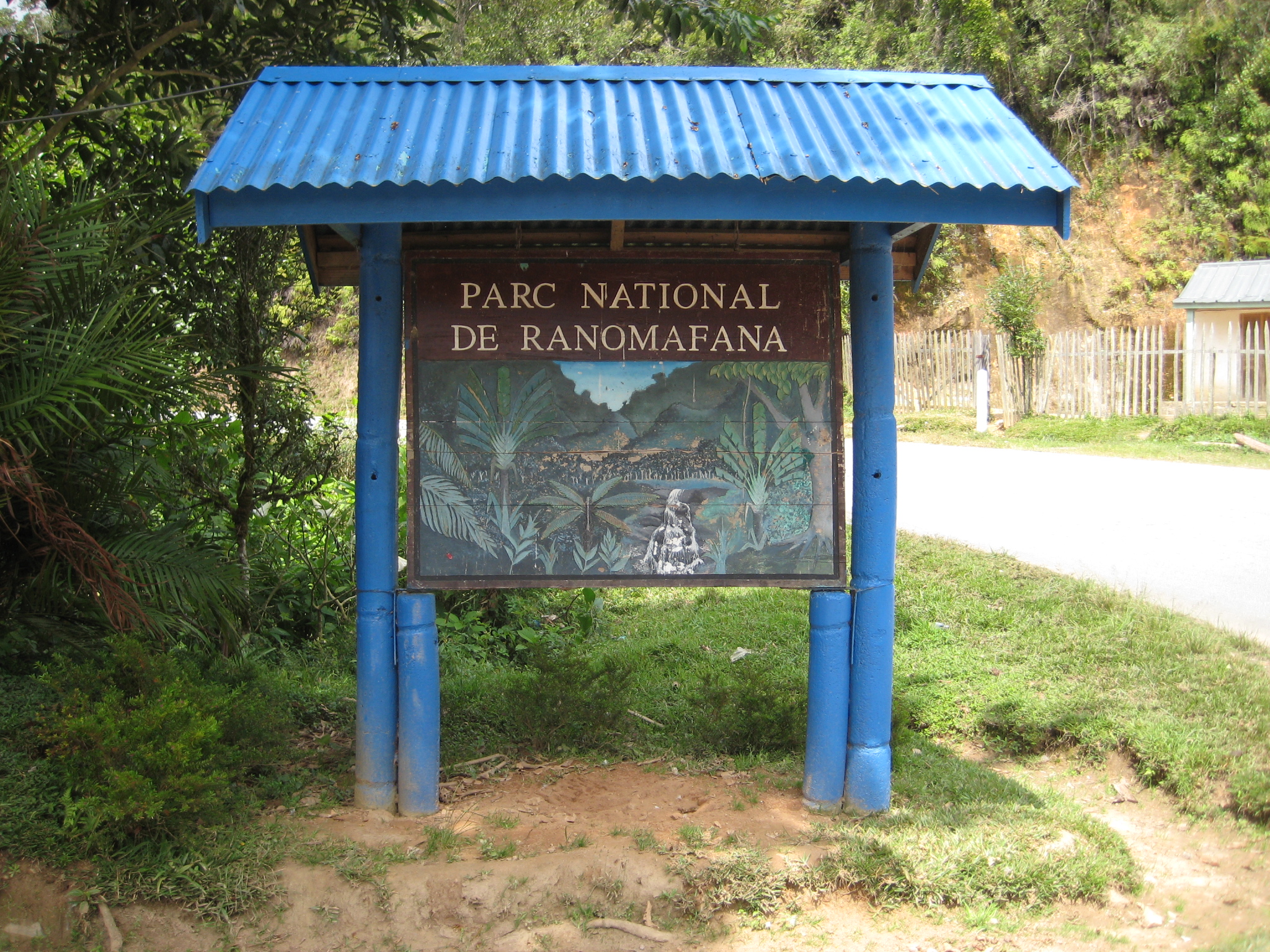
Ranomafana National Park is one of Madagascar's natural treasures: a vast blanket of green, humid montane rainforest, woven with rivers, waterfalls and mist, that protects an extraordinary endemic biodiversity. Its name means 'hot water' in Malagasy, after the hot springs in the neighbouring village, and its fame comes from a scientific milestone: the golden bamboo lemur was discovered here in 1986, a find that led to the creation of the park in 1991.
Walking its trails with a guide is a glimpse into a unique world: lemurs that eat only bamboo shoots, sifakas leaping between trees, tiny chameleons, frogs in impossible colours and plants that exist nowhere else on the planet. Night walks also reveal the wildlife that only wakes up after dark. It is one of the best parks in the country to see lemurs in their forest and to understand why Madagascar is a global sanctuary of evolution.
This guide takes a practical look at Ranomafana: what wildlife and plants to look for, which circuits to choose, how the fees and mandatory Madagascar National Parks guides work, how to do the night walk, where to stay in the village and its hot springs, and how to fit the park into the RN7 route. With a good guide and a little patience, the Ranomafana forest offers unforgettable encounters with the most unusual nature in the world.
Ranomafana owes its existence to a scientific discovery: in 1986 the American primatologist Patricia Wright, searching for the greater bamboo lemur, then thought to be extinct, found a species new to science in these forests, the golden bamboo lemur. The discovery, along with the threat of logging, drove the creation of Ranomafana National Park in 1991, now a World Heritage Site and home to the ValBio research centre. But the forest and its hot springs were known long before by the Tanala and Betsileo communities of the region. The full natural and human history of Ranomafana is told on our history page.
Read the full history ↓The great southern route, the legendary RN7, threads through Betsileo country and its wine, the lemur-filled rainforests of Ranomafana and the sandstone canyons of Isalo to the Vezo beaches of the Mozambique Channel.
Read the history of The South and the RN7 →No exact prices: a scale from $ (budget) to $$$$$ (luxury), with 2-3 options per category.
Origins, formation and what the sources say.
Ranomafana's story begins long before the human one: about 88 million years ago, Madagascar split away for good from the Indian subcontinent and was left isolated in the middle of the Indian Ocean. In that isolation, life evolved along its own paths, and today around 90 % of the island's species exist nowhere else on the planet. The rainforests of the eastern slopes, like Ranomafana's, are some of the richest strongholds of that unique evolution.
Ranomafana protects a strip of mid-altitude tropical montane rainforest, between 600 and 1.400 metres, on the island's eastern slope, where moist winds from the ocean bring heavy rainfall. It is a lush forest of moss-covered trees, tree ferns, orchids, giant bamboo and fast-flowing rivers such as the Namorona. This ecosystem is home to extraordinary biodiversity: a dozen lemur species, dozens of endemic amphibians and reptiles, more than a hundred bird species and a flora that is largely found nowhere else.
That richness is also fragile. The forests of eastern Madagascar have been cleared for centuries by logging and slash-and-burn farming (known as 'tavy'), and today they are islands of forest surrounded by fields. Ranomafana is one of the few large blocks of rainforest that survive, a natural heritage of global value.
Long before the scientists arrived, the forest and its surroundings were lived in and used by Malagasy communities. The region is the land of the Tanala people, whose name means 'the people of the forest', and it borders Betsileo country in the Highlands. The Tanala lived, and still live, in close connection with the forest: it gives them timber, honey, medicinal plants and farmland, and they have traditionally practised 'tavy', the shifting rice cultivation that has been both their livelihood and one of the pressures on the forest.
The name of the place, Ranomafana, literally means 'hot water' in Malagasy, after the hot springs that bubble up next to today's village. Those waters were known and used since ancient times, and during the French colonial period they gave rise to a small thermal spa, built to make the most of their supposed healing properties. So the spot was already a well-known stop on the route to the east coast long before it became a national park.
The relationship between these communities and the forest, one of dependence and pressure at the same time, would later become one of the great challenges for conservation: protecting the forest without leaving behind the people who live from it and in it.
The event that put Ranomafana on the world map happened in 1986. American primatologist Patricia Wright travelled to Madagascar on the trail of an almost legendary animal: the greater bamboo lemur (Prolemur simus), which many believed to be extinct. Exploring these forests, she not only rediscovered that extremely rare species but came across something even more astonishing: a golden-furred lemur, unknown to science, that fed on shoots of giant bamboo laced with cyanide. It was a new species, named the golden bamboo lemur (Hapalemur aureus).
The find was extraordinary: discovering a new primate at the end of the 20th century, and finding three bamboo-eating lemur species living side by side in the same forest, turned Ranomafana into a place of huge scientific interest. At the same time, though, Wright saw that the forest was threatened by commercial logging and deforestation: the habitat of those unique species could disappear within a few years.
Convinced that only legal protection could save the forest and its lemurs, Wright pushed, together with Malagasy authorities and international institutions, for the creation of a national park. It was the start of one of the most remarkable conservation stories in Madagascar.
In 1991, just five years after the discovery, Ranomafana National Park was officially created, with more than 40.000 hectares of protected forest. It was not only a decision to protect trees and animals: from the start, the project was designed as a model combining conservation, scientific research and the development of local communities, in the knowledge that without the support of the people who lived off the forest, protection would fail.
On the edge of the park, Patricia Wright founded Centre ValBio, a research centre that over the years became a world reference. From there, generations of scientists have studied lemurs, forest ecology, amphibians and reptiles, and have developed health, education and alternative-income programmes for the neighbouring villages, aiming to ease the pressure on the forest. Nature tourism, with its local guides and trackers, joined in as a source of income tied directly to conservation.
International recognition came in 2007, when Ranomafana was included, along with other parks on the eastern slope, in the 'Rainforests of the Atsinanana' site, declared a UNESCO World Heritage Site for its outstanding value for biodiversity. However, that same site also appears on the List of World Heritage in Danger, because of the ongoing threat of illegal logging, including of precious woods, and deforestation in the region.
Today Ranomafana is one of the most visited and most valued parks in Madagascar, a must for nature lovers and a symbol of what is at stake on the island. Its trails let travellers see lemurs in the wild, incredible chameleons and a forest so lush it is hard to describe, while Centre ValBio remains a living laboratory where this unique biodiversity is studied and fought for.
Ranomafana's story is also a lesson about how fragile Madagascar's natural heritage is. Madagascar is at once one of the most biodiverse countries in the world and one of the poorest, and you can feel that tension here: the forest gives communities timber, land and a livelihood, and protecting it means offering them alternatives. The Ranomafana model, with conservation, science and local development going hand in hand, is a pioneering attempt to solve that dilemma.
From the isolation of an island-continent to the evolution of unique species, from the 'hot water' of the Tanala to the discovery of a golden lemur, and from there to a national park and a threatened World Heritage Site: Ranomafana's story sums up, in a single forest, both the wonder and the vulnerability of Madagascar's nature.