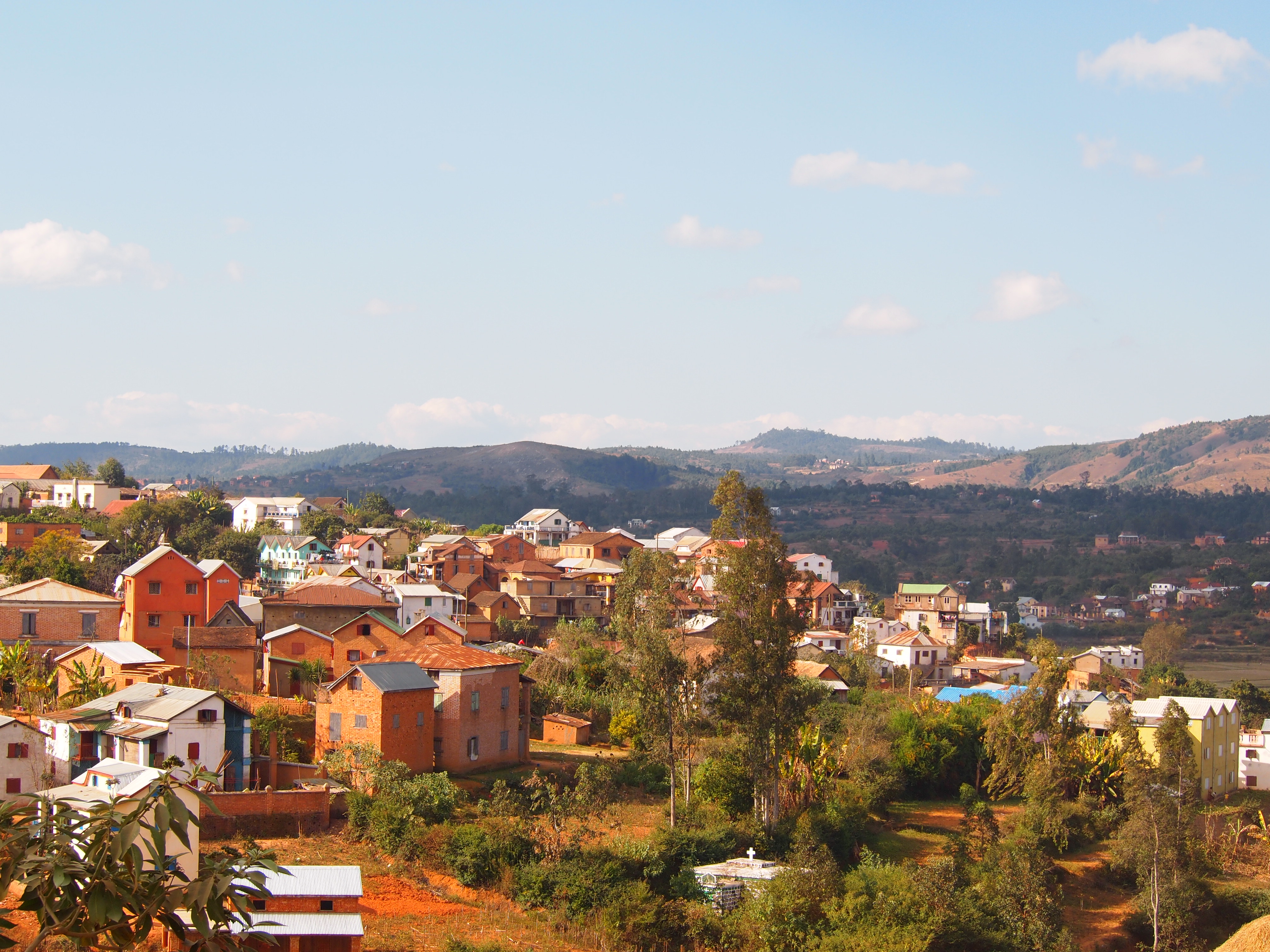
Ambositra is the handicraft capital of Madagascar: a quiet Highlands town whose streets are full of workshops and shops selling woodcarving, marquetry and crafts that draw travellers from all over the island. Set in Betsileo country, among hills of terraced rice fields, it still has traditional houses with wooden balconies and a calm mountain feel.
Its great treasure is Zafimaniry culture. The Zafimaniry are a Betsileo subgroup living in the forested mountains southeast of town, and they keep alive a unique woodcarving art, with geometric motifs full of meaning and houses and tombs assembled without a single nail. UNESCO recognised this knowledge as Intangible Cultural Heritage of Humanity, and Ambositra is both its gateway and its main showcase.
This guide looks at Ambositra from a practical angle: what to buy and how to spot good craftsmanship, how to visit the workshops and the Zafimaniry villages in the mountains, what to see in the town and the surrounding rice fields, and how to fit it into an RN7 itinerary. It's an essential cultural stop for taking home the best of Malagasy art and getting a glimpse of a living, centuries-old tradition.
Ambositra, whose name refers to a place 'where there are many castrated zebu', a nod to its cattle-raising past, is an old town in Betsileo country. Under the Merina kingdom and later French colonial rule, it grew into a trading and craft centre for the Highlands. Its worldwide fame comes from Zafimaniry woodcarving. The Zafimaniry are a Betsileo subgroup who took refuge in the forested mountains to the southeast in the 18th century and preserved a tradition of carpentry and ornamentation that UNESCO proclaimed Heritage of Humanity in 2003. From the Betsileo kingdom to the capital of Malagasy handicrafts, our history page tells the full story of Ambositra.
Read the full history ↓The political and spiritual heart of Madagascar: Tana rises over twelve sacred hills, capital of the old Merina kingdom, among terraced rice paddies, spa towns and the cradle of Malagasy craftsmanship.
Read the history of Antananarivo and the Highlands →No exact prices: a scale from $ (budget) to $$$$$ (luxury), with 2-3 options per category.
Origins, formation and what the sources say.
Ambositra lies at the heart of Betsileo country, home to the people of Madagascar's south-central Highlands who are famous as the island's finest rice growers. The Betsileo, whose name is usually translated as 'the many invincible' or 'those who cannot be defeated', are of Austronesian origin like the Merina, with African contributions. They developed a culture closely tied to terraced rice, to the veneration of ancestors and to monumental stone tombs that still dot the landscape.
Before the 19th century, the Betsileo region was organised into several independent kingdoms and principalities, among them Isandra and Lalangina, with centres such as nearby Fianarantsoa. Ambositra, whose name refers to a place 'where there are many castrated oxen' (a nod to its zebu-herding past), was a settlement and trading point in those highlands of rice paddies and hills.
In the early 19th century, the expanding Merina kingdom of Antananarivo, under Radama I, conquered the Betsileo kingdoms and brought the region under its rule. First under Merina administration and later under French colonial rule, Ambositra gradually grew into the commercial and administrative centre of this part of the Highlands, on the route linking the capital with the south.
Ambositra's worldwide fame is tied to one particular people: the Zafimaniry, a Betsileo subgroup living in the forested mountains southeast of the town. According to tradition, the Zafimaniry, whose name means something like 'the descendants of those who desire' or 'of those who long for', took refuge in these remote heights in the 18th century, fleeing conflicts and pressures in the lowlands. There, in isolation, they kept alive a skill that was once far more widespread across the island: the art of woodworking.
In a setting still covered in forest, the Zafimaniry developed a material culture based entirely on wood. Their houses and tombs are built without a single nail, hinge or metal part: everything is assembled with mortise-and-tenon joints, in carpentry of astonishing precision. Every element (posts, doors, windows, shutters, lintels) is covered in carved geometric motifs. This is a highly codified repertoire of symbols that expresses the community's social order, values and beliefs, with echoes of its Austronesian origins and of the Arab influences found in Malagasy culture.
Today there are some 25,000 Zafimaniry spread across around a hundred villages and hamlets in the mountains. Their art, the sole survivor of a tradition once common throughout Madagascar, is the soul of the Ambositra region's craft identity.
During the 19th century and above all the French colonial period (from 1896), the region's craft knowledge was transformed and professionalised. Religious missions, both Catholic and Protestant, played an important role: they trained artisans, set up workshops and trade schools, and spread new techniques and tools. In this context, marquetry flourished in Ambositra. This is the art of inlaying small pieces of different-coloured woods to create images and patterns, and here it blended traditional Malagasy motifs with Western decorative styles.
The town thus became Madagascar's main trading centre for woodcrafts. Here the traditional Zafimaniry art of the mountains met urban workshops, cooperatives and missions, and carved and inlaid objects began to be sold to travellers and traders from all over the island. Carving was no longer just a ritual and household practice in the villages. It also became a craft industry and a source of income.
This dual role, as guardian of an ancestral tradition and as the commercial capital of crafts, defines modern Ambositra. Its streets filled with workshops and shops that are now its main tourist attraction.
The key year for the international profile of the region's culture was 2003. That year UNESCO proclaimed the 'woodcrafting knowledge of the Zafimaniry' a Masterpiece of the Oral and Intangible Heritage of Humanity, Madagascar's first inscription in this field (it was later incorporated into the Representative List of the Intangible Cultural Heritage). The recognition drew attention to how fragile this tradition is and to the need to protect it and pass it on to new generations.
This heritage faces real threats. Deforestation is reducing the wood available in the mountains, economic pressure is pushing young people to emigrate, and there is a fine line between valuing the art and cheapening it for the tourist market. At the same time, demand for crafts supports thousands of families in Ambositra and in the Zafimaniry villages, and cultural tourism has become an important source of income, from treks to the villages to shopping in the workshops.
Today Ambositra brings all its layers together. It is a Betsileo town of rice paddies and ancestral tombs, a former Merina and colonial possession, the commercial capital of Malagasy crafts and the gateway to the Zafimaniry world, recognised by all of humanity. It's a stop where you can quite literally touch the history of Madagascar with your own hands, in every piece of carved wood.