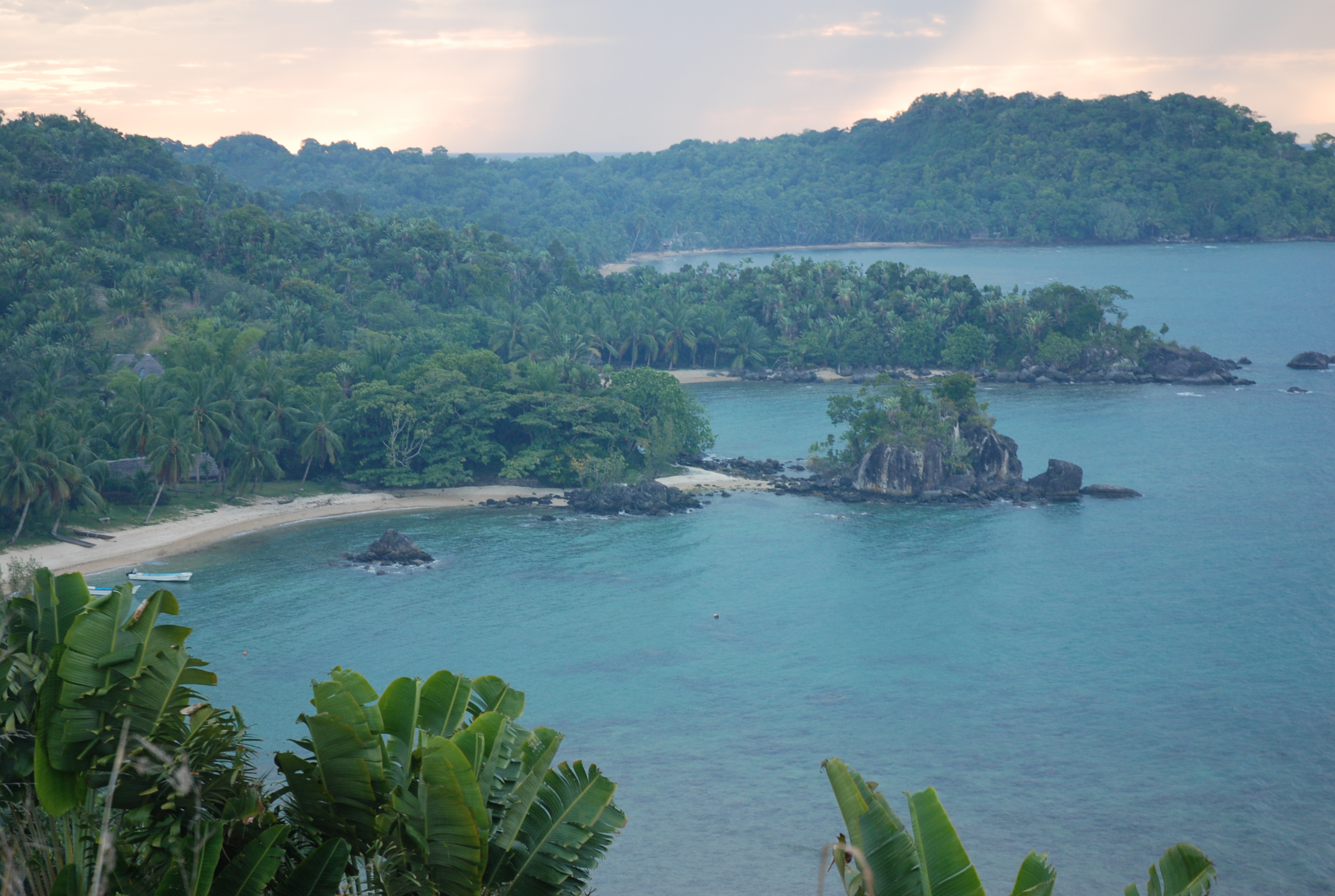
Île Sainte-Marie, or Nosy Boraha, is Madagascar's most romantic and history-rich tropical island: a long strip of white-sand beaches lined with coconut palms, turquoise bays, coral reefs and fishing villages, all moving at a slow, Caribbean-style pace. Travellers come here to switch off, to dive among the corals and, above all, to witness one of nature's great spectacles: the arrival of the humpback whales.
Every year, between July and September, hundreds of humpback whales migrate from Antarctica to the warm waters of the channel that separates the island from the mainland to mate and give birth. You can see them breach, slap the water with their fins and swim with their calves just a few metres from the boats, at one of the best whale-watching spots on the planet, celebrated every year with a Whale Festival.
But Sainte-Marie also has a fascinating past: in the 17th and 18th centuries it was a pirate hideout — English, French and from all over the Atlantic — used as a base to attack ships sailing to and from the Indies. From that era there remain a famous pirate cemetery and plenty of legends. This guide covers the island with a practical eye: the whales, the beaches, diving, the pirate history, Île aux Nattes and how to get to and around this small Indian Ocean paradise.
Inhabited by the Betsimisaraka people, the island — Nosy Boraha — became famous in the 17th and 18th centuries as one of the great pirate havens of the Indian Ocean: its sheltered bay, its resources and its position on the route of the ships of the Indies drew buccaneers such as those who, according to legend, founded the utopian republic of Libertalia here. In 1750 a local princess married to a Frenchman ceded the island to France, which named it Sainte-Marie. It was a French possession and a trading base, and today it is a quiet Malagasy tourist destination. Its full story — pirates, Libertalia, colonisation and the whales — is told on our history page.
Read the full history ↓The humid, green eastern seaboard holds the forests where the indri sings and the island of Sainte-Marie, once a pirate hideout and today a sanctuary for humpback whales.
Read the history of The East: rainforest and whales →No exact prices: a scale from $ (budget) to $$$$$ (luxury), with 2-3 options per category.
Origins, formation and what the sources say.
Long before the pirates and the French arrived, the island we now call Sainte-Marie had, and still has, its Malagasy name: Nosy Boraha. Its exact meaning is debated. Some interpretations link it to 'the island of Ibrahim/Abraham', which would point to early contact with Muslim traders from the Indian Ocean, who had been present on the Malagasy coasts for centuries. The island was home to the Betsimisaraka, the large ethnic group of Madagascar's east coast, who lived from fishing, farming and trade.
Long and narrow, with a very sheltered bay on its western side, Sainte-Marie sits in a strategic spot off the north-east coast. That natural bay could shelter ships and hide them from prying eyes. Add plenty of fresh water, fruit and other supplies, and it was an ideal place to restock. Right in front of it ran the sea routes used by the rich ships trading between Europe, India and the Spice Islands.
That combination of a safe harbour and trade routes loaded with treasure would seal the island's fate. What was home to the Betsimisaraka would become, from the 17th century onwards, the perfect hideout for sea adventurers. Nosy Boraha was about to enter the legend of Indian Ocean piracy under another name.
Between the late 17th and early 18th centuries, Sainte-Marie lived through its most famous chapter. In the middle of the 'Golden Age' of piracy, it became one of the main pirate nests in the Indian Ocean. As the crackdown grew tougher in the Caribbean and the Atlantic, many buccaneers set course for the Indian Ocean. English, French, American and others came to raid the heavily laden ships of the East India companies and the pilgrim ships bound for Mecca. Sainte-Marie's sheltered bay, with little Île aux Forbans in the middle, was the ideal hideout and supply base.
Legendary pirates sailed through these waters or took refuge here. The most famous one linked to the island is Captain William Kidd. His ship, the 'Adventure Galley', was abandoned and sank near Sainte-Marie at the end of the 17th century, and centuries later underwater archaeologists found the remains of pirate ships in the bay. Other names from pirate lore are also tied to the island. At its peak, hundreds of outlaws of the sea are thought to have operated from here, living and trading alongside the local people.
From that era there remains the famous Pirate Cemetery, on a hill above the bay, where skulls and crossbones can still be made out on the headstones. There are also countless legends of buried treasure that still fire visitors' imaginations today. History and myth are so mixed up that it is sometimes hard to tell them apart, but the pirate legacy is an essential part of Sainte-Marie's identity and charm.
No legend of Sainte-Marie is as evocative as Libertalia (or Libertatia). According to the story, this utopian 'pirate republic' was founded in northern Madagascar towards the end of the 17th century, often placed around the bay of Sainte-Marie or Diego Suárez. Libertalia was supposedly a community of pirates who rejected the authority of kings and states, abolished slavery, held property in common and governed themselves by equal rules, all under the banner of liberty. Its founding is credited to a captain named Misson and a former priest, Caraccioli.
The problem is that the only source for Libertalia is an 18th-century book, 'A General History of the Pyrates', credited to one Captain Charles Johnson. Some identify him, with doubts, as the writer Daniel Defoe. No independent historical document confirms that Libertalia really existed. Most historians see it as a literary invention or, at most, an idealised picture of the real pirate communities that did operate in Madagascar. There were real pirates, and plenty of them; an organised utopian republic, probably not.
History or legend, Libertalia became a powerful myth. The idea of a free and equal society founded by outlaws on a remote island has inspired writers, anarchist thinkers and popular culture right up to today. Sainte-Marie, with its pirate cemetery and its bay full of echoes, is where that dream is still told. Visiting it means walking through the setting of one of the most fascinating utopias of the age of sail.
In Sainte-Marie, the shift from piracy to colonial rule reads almost like a novel. In the early 18th century, a French adventurer named Jean-Onésime Filet, nicknamed 'La Bigorne', was shipwrecked on the island and married Bety (or Betia), the daughter of a local chief and princess of the island. In 1750, Princess Bety formally ceded Sainte-Marie to the King of France, beginning the island's long tie with the European power. The French renamed it with the Christian name Sainte-Marie ('Saint Mary').
From then on, the island was a French possession that served as a trading and military base in the Indian Ocean. That period brought ups and downs, resistance and spells of neglect. When France colonised all of Madagascar at the end of the 19th century (the protectorate was set up in 1896), Sainte-Marie became part of the colony. Traces of the French period remain, such as the Catholic church in Ambodifotatra, considered the oldest in Madagascar. Part of the population is also of mixed French-Malagasy descent, the 'zana-malata'.
With Madagascar's independence in 1960, Sainte-Marie joined the new country as what it is today: a quiet Malagasy island off the east coast, administratively part of the Analanjirofo region. The official Malagasy name, Nosy Boraha, sits alongside the historical name Sainte-Marie. For a long time the traditional economy rested on growing spices, above all cloves, which the island produces in large quantities, together with fishing and farming.
In recent decades, Sainte-Marie has found a new calling in nature, and it has put the island on the world tourism map: humpback whales. Every year, between July and September, hundreds of these whales migrate from the cold waters of Antarctica to the warm, sheltered channel between the island and the mainland to mate and give birth to their calves. This happens very close to the shore, which makes Sainte-Marie one of the best places on the planet for responsible whale watching.
This natural spectacle gave rise to an annual festival, the Whale Festival, and to a marine ecotourism industry. Together with the beaches, diving and the pirate heritage, it is now key to the island's economy. The island has managed to bring together its three great draws. The first is nature: whales, reefs, and idyllic Île aux Nattes with its endemic orchids. The second is history: pirates, Libertalia and the colonial legacy. The third is the relaxed tropical way of life of its Betsimisaraka people.
Sainte-Marie also faces the challenges of any island destination. It has to protect its reefs and marine life, manage tourism sustainably, keep disturbance to the whales down and support a population that depends more and more on visitors. Even so, its unique mix of beauty, history and unhurried pace keeps winning over everyone who arrives. From pirate hideout to whale sanctuary, the island of Nosy Boraha has rewritten its legend without losing its magic.