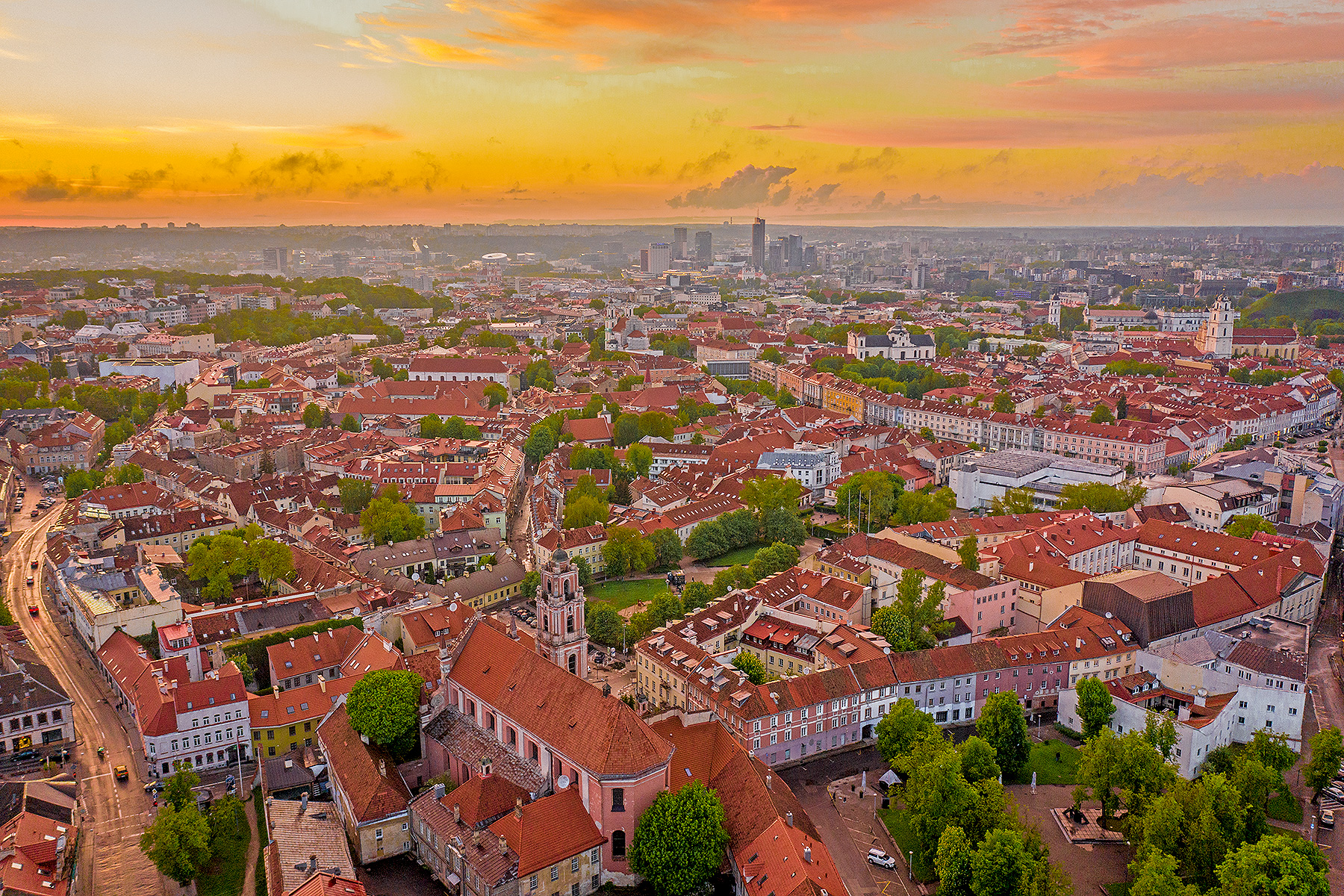
Vilnius is one of Europe's most underrated and charming capitals. Its Old Town is one of the largest Baroque ensembles on the continent and is listed by UNESCO as a World Heritage Site. It's a maze of cobbled lanes and hidden courtyards, with more than forty churches from every era and palaces with pastel façades. Walking through it, you feel the crossroads of worlds it has always been: Lithuanian, Polish, Jewish, Russian, German.
But Vilnius isn't only about the past. It's also a young, creative university city, with a rising food scene, specialty coffee shops and a restless cultural life. The best symbol of that spirit is Užupis, a former bohemian neighbourhood across the Vilnia River. In 1997 it declared itself an 'independent republic', with its own constitution hung on the walls, its own flag and even its own national day. It's artistic, ironic and completely unique.
This guide takes a practical look at Vilnius: how to get there and get around, what to see in the Old Town and Užupis, which museums are worth it, where to eat cepelinai and where to stay. Vilnius is best enjoyed on foot and at an easy pace, looking up at its bell towers and into its courtyards. It pairs a very dense history with a surprisingly relaxed and easy-going energy.
Vilnius was officially founded in 1323, when Grand Duke Gediminas wrote letters inviting merchants and craftsmen to settle there. It became the capital of the Grand Duchy of Lithuania, one of the largest states in medieval Europe. Its union with Poland turned it into a great multicultural centre. It was home to a Jesuit university founded in 1579 and to a Jewish community so important that the city became known as 'the Jerusalem of the North'. After the partitions of Poland it passed into Russian hands. It went through both world wars with enormous violence, and the Nazi occupation wiped out almost its entire Jewish population in the Holocaust. Half a century of Soviet occupation followed. In 1990 Lithuania became the first republic to declare independence from the USSR, and Vilnius was once again the capital of a free country. The full story is on our history page.
Read the full history ↓The country's historic heart: baroque Vilnius, founded by Gediminas and called the “Jerusalem of the North”; the island castle of Trakai and its Karaites; and Kernavė, the first medieval capital, now an archaeological site.
Read the history of Vilnius and around (Trakai, Kernavė) →If you only have one day, take a guided tour on the first one: it sets up the rest of your trip and saves you a lot of walking. We look ours up on Civitatis: guided in Spanish and booked online with no fuss. They have 8 activities in Vilna. And there are free tours here: you book without paying and tip the guide whatever you think at the end, so trying one costs you nothing. Have a look below: tap any of them to see them all.
If you book from here we earn a commission and you pay no more. Prices and availability come from Civitatis.
No exact prices: a scale from $ (budget) to $$$$$ (luxury), with 2-3 options per category.
Origins, formation and what the sources say.
Legend has it that Grand Duke Gediminas, hunting in the forests near the confluence of the Neris and Vilnia rivers, fell asleep and dreamt of a huge iron wolf howling on a hilltop with the strength of a hundred wolves. The pagan priest Lizdeika explained the dream: the duke was to found a city there so powerful that its fame, like the howl, would be heard all over the world. That is how Vilnius was born, according to the story every Lithuanian knows.
Beyond the myth, the founding of Vilnius is dated to 1323. That year Gediminas sent a series of letters to the Hanseatic towns and to the merchants, craftsmen and monks of Western Europe, inviting them to settle in his capital and promising them freedom of worship and trade. Those letters survive today. They are the first documented mention of Vilnius and the city's birth certificate. Vilnius stood at a strategic crossroads of trade routes, in the heart of a forested, marshy territory that was easy to defend, and it was destined to become the capital of one of the largest states in medieval Europe: the Grand Duchy of Lithuania.
When Vilnius became the capital, Lithuania was the last pagan state in Europe. The rest of the continent had been Christian for centuries, but the Lithuanians still worshipped gods of nature, fire and thunder. They fought off, weapons in hand, the crusades that the Teutonic Order launched against them again and again in the name of conversion. Even so, the Grand Duchy kept growing. Under Gediminas and his successors it came to stretch from the Baltic almost to the Black Sea, taking in vast Slavic territories.
The decisive turn came in 1385-1387, when Grand Duke Jogaila (Jagiełło) agreed to be baptised and to marry Queen Jadwiga of Poland, sealing the union of the two kingdoms. Lithuania officially adopted Christianity, one of the last peoples in Europe to do so, and Vilnius received its town rights in 1387. Under Grand Duke Vytautas the Great, in the early 15th century, the Duchy reached the height of its size and prestige. In 1410, together with Poland, it defeated the Teutonic Order at the Battle of Grunwald (Žalgiris). It was one of the largest battles of medieval Europe, and it broke the power of the Teutonic Knights for good.
The Union of Lublin in 1569 merged Poland and Lithuania into a single Commonwealth, one of the great powers of Europe. Vilnius then lived through a multicultural golden age. In 1579 the Jesuits founded Vilnius University, the oldest in Eastern Europe and the Baltics, and it turned the city into a major intellectual centre. Dozens of baroque churches went up, and the city still has one of the richest skylines of bell towers on the continent. Lithuanians, Poles, Ruthenians, Germans, Tatars and a huge Jewish community lived side by side in its streets.
That Jewish community made Vilnius a world-famous spiritual centre. The Vilna Gaon (Elijah ben Solomon, 1720-1797), one of the most influential sages in Judaism, lived and taught here. The city earned the name 'Jerusalem of the North' (Yerushalayim de Lita) because it had so many synagogues, yeshivas and Hebrew printing houses. In the early 20th century, nearly half the population was Jewish, and Yiddish could be heard in every market. That world, centuries deep, would be almost entirely wiped out just a few decades later.
At the end of the 18th century, the partitions of Poland divided the Commonwealth among its neighbours, and Vilnius came under the Russian Empire in 1795. The 19th century brought tsarist rule, Russification and repression. After the uprisings of 1831 and 1863, the university was closed, printing in Lithuanian with Latin letters was banned, and the national language and culture were persecuted. Even so, a Lithuanian national revival was taking shape underground.
The 20th century hit Vilnius with extreme violence. After the First World War, Lithuania declared independence in 1918. But Vilnius was fought over by Lithuanians, Poles and Bolsheviks, and in 1920 Poland annexed it. For twenty years the city was cut off from the young Lithuanian state, and the provisional capital moved to Kaunas. In 1939-1940, after the Molotov-Ribbentrop Pact, the city returned to Lithuania, only to fall almost at once under Soviet and then Nazi occupation. The German occupation (1941-1944) brought the Holocaust. Vilnius's Jewish community, some 60,000 people, was confined to two ghettos and almost entirely murdered. Many were shot in the pits of the Paneriai (Ponar) forest, on the outskirts of the city. With them, the 'Jerusalem of the North' disappeared.
In 1944 the Red Army drove out the Nazis and Lithuania was annexed to the Soviet Union, a situation that would last almost half a century. Vilnius became a capital again, this time of a Soviet republic. Then came mass deportations to Siberia, with tens of thousands of Lithuanians sent to the gulags, along with forced collectivisation and political repression. It was all run from the KGB building in the city centre, whose cellars are now a harrowing museum.
Many refused to accept it. Between 1944 and the early 1950s, the 'forest brothers' (miško broliai), thousands of armed partisans, fought a desperate guerrilla war against Soviet rule from the country's forests. Almost all of them were killed or deported, but their resistance is etched into the national memory. Repression failed to erase Lithuanian identity. It lived on in the language, the Catholic Church and the culture, and it would burst out again with force in the last decades of the century.
In the late 1980s, the Soviet opening allowed the national movement to rise again. Sąjūdis, the independence front, was founded in 1988. In August 1989, two million people formed the 'Baltic Way', a 600 km human chain linking Vilnius, Riga and Tallinn to demand freedom. On 11 March 1990, Lithuania became the first republic to declare the restoration of its independence from the USSR. Moscow responded with pressure and, in January 1991, with tanks. In the early hours of 13 January, Soviet troops stormed the Vilnius TV tower, and fourteen unarmed civilians were crushed or shot dead defending it. Peaceful resistance and the shock it caused around the world proved decisive: that same year, after the failed coup in Moscow, the world recognised Lithuanian independence.
Since then Vilnius has been through a remarkable transformation. Lithuania joined the European Union and NATO in 2004 and adopted the euro in 2015. The capital has become a dynamic, tech-minded and culturally restless city, while still looking after its UNESCO World Heritage old town. Užupis, once run-down, has reinvented itself as a bohemian artists' republic, and the old industrial districts are now full of startups and cafés. Today Vilnius looks firmly westwards, keeping a close eye on its neighbours Belarus and Russia. It is proud that in 1990 it was the city that dared to say 'no' first.