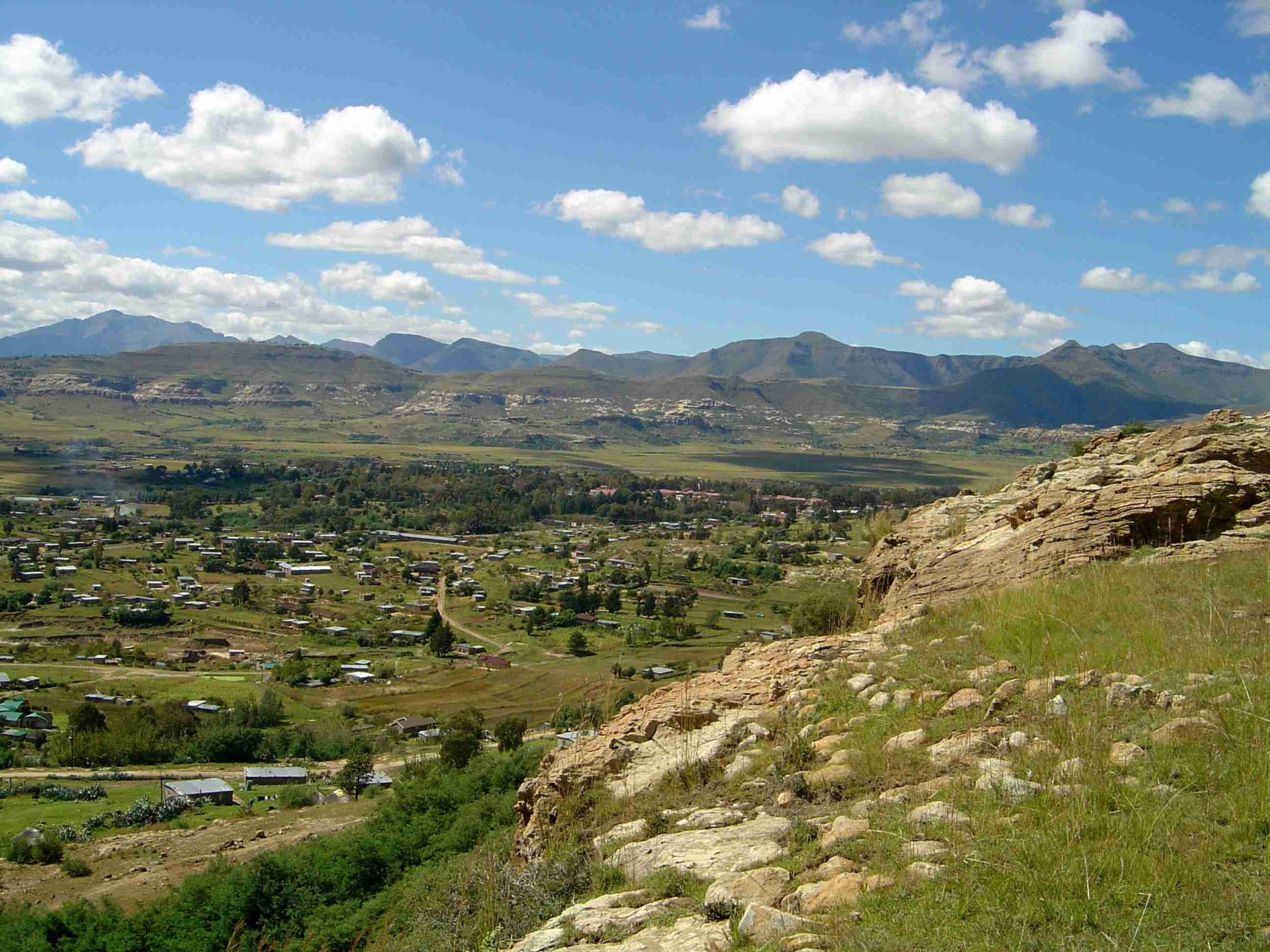
Roma is one of Lesotho's surprises: a green, peaceful valley enclosed by tall sandstone cliffs that is home to both the country's main university and its Catholic heart. Just 45 minutes from Maseru, the landscape changes completely: the city gives way to a wide farming valley surrounded by mountains, with a relaxed student vibe and an almost contemplative atmosphere.
The town owes its name, Roma (Rome), to the Catholic Church, which founded its first mission here in 1862 and turned the valley into the spiritual and educational centre of the kingdom. That mission gave rise, in 1945, to a Catholic university college that over time became the National University of Lesotho, the country's most important university. Today Roma brings together seminaries, novitiates, the university and a large sandstone church where African choirs and drums ring out on Sundays.
This guide takes a practical look at Roma: the valley and its mountains, the historic Catholic mission, the NUL campus, the dinosaur footprints nearby and how to get there from Maseru. It is an ideal getaway to see another side of Lesotho (green, studenty and spiritual) just a short hop from the capital.
Roma began as a Catholic mission in 1862, when Father Joseph Gérard settled in this valley at the invitation of Moshoeshoe I's court, in a kingdom where the Protestants of Morija were already preaching. Over time the mission became the centre of Catholicism in Lesotho, with a large sandstone church, seminaries and novitiates. In 1945 the bishops founded a Catholic university college here which, secularised in 1965, became the National University of Lesotho, the country's leading university. Its full story is told on our history page.
Read the full history ↓The heart of the kingdom: the capital on the banks of the Caledon, the sacred mountain of Thaba-Bosiu where the Basotho nation was born, and the old missions of Morija and Roma.
Read the history of Maseru and the west →They depart from Maseru, 27 km away. If you book from this link we earn a commission and you pay no more.
No exact prices: a scale from $ (budget) to $$$$$ (luxury), with 2-3 options per category.
Origins, formation and what the sources say.
The valley where Roma stands today is one of the most beautiful corners of western Lesotho: a broad, fertile basin ringed by a wall of reddish sandstone mountains, about 34 km from Maseru. In the 19th century, when the Basotho nation was only just taking shape under Moshoeshoe I, this secluded valley drew a new group of missionaries: the Catholics.
Until then, the Christian presence in the kingdom had been almost entirely Protestant, led by the Paris Evangelical Missionary Society, based in Morija since 1833. But Moshoeshoe, true to his policy of balance, did not shut the door on other denominations. In 1862, Catholic missionaries from the congregation of the Missionary Oblates of Mary Immaculate arrived in the kingdom, and the king granted them land to settle in this valley.
The new mission was put in the hands of a young French priest, Father Joseph Gérard. The valley and its mission came to be called Roma, after the Roman Catholic Church. And so, in a mountain corner of southern Africa, a small centre was born that would in time become the Catholic and educational heart of all Lesotho.
Father Joseph Gérard devoted much of his life to the Roma mission, where he served until his death in 1914. His work among the Basotho was so highly regarded that the Church eventually beatified him: he is revered as a founding figure of Catholicism in the country. His tomb is kept in the mission's large church.
Over the decades, the Roma mission grew until it dominated the valley with an imposing late-19th-century sandstone church. The same church is also the resting place of Archbishop Emmanuel Mabathoana, a great-grandson of Moshoeshoe I, who was consecrated in 1961 as the first Archbishop of Maseru and Metropolitan of Basutoland: a perfect symbol of where the old Basotho royalty met the new Catholic hierarchy.
Roma became the spiritual centre of Basotho Catholicism, with seminaries and novitiates training local priests and members of religious orders. Catholicism took root so deeply in Lesotho that today it is the country's largest denomination. On Sundays, Mass at the mission church — with choirs and drums in African style — is still one of the most vibrant religious experiences in the kingdom.
Roma's most influential legacy is educational. On 8 April 1945, the Catholic hierarchy of southern Africa founded a Catholic university college in the valley — Pius XII Catholic University College — in a modest primary-school building belonging to the mission. It was the region's first institution of higher education for African students, and it drew young people from all over the south of the continent.
Over time, the college grew and changed status. In 1964 it became the University of Basutoland, Bechuanaland and Swaziland (UBBS), shared by those three territories. When Lesotho became independent in 1966, and after the national universities later went their separate ways, the Roma campus became the National University of Lesotho (NUL). The institution, born Catholic, was secularised in 1965 and established itself as the kingdom's leading place of learning.
Thanks to that history, Roma is today synonymous with higher education in Lesotho: a university town with student life, research and culture, the direct heir of that 19th-century mission. The NUL has trained a large share of the country's professionals, civil servants and intellectuals.
Like much of Lesotho, the Roma valley hides an astonishing geological past. The sandstone rocks around the town formed some 180 to 200 million years ago, in the Early Jurassic, and preserve fossil footprints of the dinosaurs that walked across those ancient plains.
The Roma area has several ichnite (fossil footprint) sites, some of them on the grounds of the National University of Lesotho itself and others on the so-called Roma plateau. It is a remarkable quirk: in the very place where students work towards their degrees, the footprints of giant reptiles from millions of years ago are preserved.
These footprints are part of Lesotho's extraordinary palaeontological heritage, one of the best on the continent for studying Jurassic dinosaurs. Together with those at Morija, Quthing and other sites, Roma's tracks make the kingdom a destination of interest for palaeontology enthusiasts.
Today's Roma combines three souls: the academic, the religious and the mountain one. It is the country's main educational hub, with the NUL, its seminaries and its novitiates, which gives it a young, cultured atmosphere that is unusual in rural Lesotho. It is also the centre of Basotho Catholicism, with its historic mission and its great sandstone church. And thanks to its geography, it is a gateway to the outdoors: the valley and its mountains invite you to hike, climb hills such as Makhetha and go pony trekking.
For travellers, Roma is a perfect getaway from Maseru: in 45 minutes you go from the bustle of the capital to a green, peaceful valley full of history, spirituality and nature. The town's historic Trading Post, an old trading station turned into accommodation, is a good base for exploring the area.
Roma is also the natural starting point of the route into the mountainous southeast — Ramabanta, Semonkong and the Maletsunyane Falls — so many people use it as the first stage of a deeper adventure into the highlands. Green, studenty and spiritual, Roma shows a side of Lesotho very different from the alpine postcards, and no less charming.