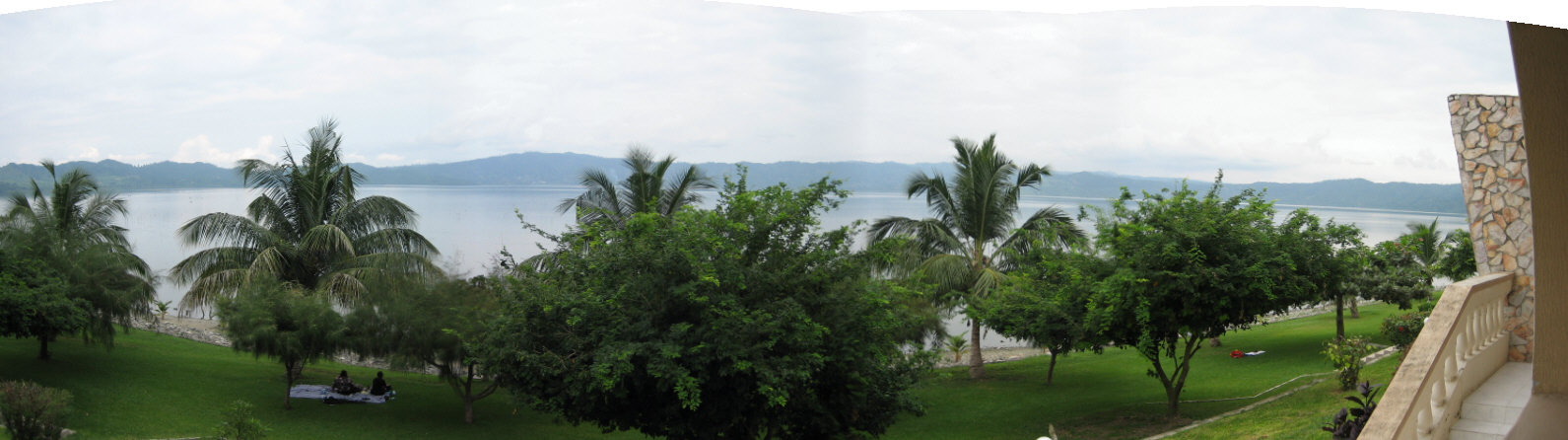
Lake Bosumtwi is one of the most unusual and serene places in Ghana: the country's only natural lake, enclosed in a perfect amphitheatre of green hills that is nothing other than an ancient meteorite crater. More than a million years ago, a rock from space crashed into the forest of what is now the Ashanti Region and gouged out this huge circular hollow, about ten kilometres across, which over time filled with water. The result is a magical landscape, a mirror of water surrounded by forest, villages and silence.
For the Ashanti people, Bosumtwi is no ordinary lake but a sacred place. According to traditional belief, the souls of the dead come here to bid farewell to the god Twi, and the lake is surrounded by taboos and rituals: for a long time it was forbidden to fish from metal boats, and fishermen used wooden planks that they sit on and paddle. That spiritual aura, added to its cosmic origin and its beauty, gives the place a special atmosphere, somewhere between the natural and the mythical.
This guide takes a practical look at Lake Bosumtwi: how to get there from Kumasi, what to do on its shores —swimming, paddling, walking through the villages, watching the sunset—, where to stay and eat, and how to combine the lake with the Ashanti culture of Kumasi and the craft villages. It is the natural, relaxed counterpoint to the region's cultural intensity: a place to slow down, take a dip in sacred waters and gaze at a unique landscape born of an impact from the sky.
Lake Bosumtwi fills an impact crater formed just over a million years ago, when a meteorite struck the forest of what is now the Ashanti Region; it is one of the best-preserved young impact craters on Earth and Ghana's only natural lake. For the Ashanti it is a sacred lake, linked to the god Twi and to the souls of the dead, surrounded by ancestral taboos (such as the ban on fishing from metal boats). According to tradition, it was 'discovered' by an Ashanti hunter who followed a wounded antelope to the shore. Today it is a biosphere reserve and an ecotourism destination. Its geological and cultural history is told on our history page.
Read the full history ↓The heart of the Ashanti Empire: Kumasi and its Golden Stool, the kente looms of Bonwire and the sacred lake of Bosumtwi, born from a meteorite.
Read the history of Ashanti Region: the kingdom of kente →They depart from Magné, 98 km away. If you book from this link we earn a commission and you pay no more.
No exact prices: a scale from $ (budget) to $$$$$ (luxury), with 2-3 options per category.
Origins, formation and what the sources say.
The story of Lake Bosumtwi does not begin with human beings, but with a cosmic catastrophe that happened a little over a million years ago. In that remote past, a sizeable meteorite plunged onto the forest of what is now the Ashanti region, in central Ghana, and slammed into the ground with enormous energy. The impact gouged a huge, almost perfectly circular crater into the rock, some ten to eleven kilometres across, and completely transformed the landscape in an instant.
Over time, the floor of that crater gradually filled with rainwater, forming the lake we see today, enclosed by a ring of hills that are, in fact, the raised rim of the crater. Bosumtwi is a 'closed' lake: no major rivers flow into or out of it, so its level depends on the balance between rainfall and evaporation, and it has varied over the millennia. It is also the only natural lake in Ghana.
The Bosumtwi crater is famous in the international scientific community: thanks to its geological youth and excellent state of preservation, it is one of the best-preserved impact craters on Earth and a natural laboratory for studying these phenomena. Drilling projects and scientific studies have been carried out here, and experts link it to a field of small glass fragments of meteoritic origin (tektites) found in neighbouring Côte d'Ivoire. Science and beauty go hand in hand in this amphitheatre of water born from the sky.
For the Ashanti people, who live on the land surrounding the crater, Bosumtwi is not just a geographical feature but a deeply sacred place. According to traditional belief, the lake is the home of a deity — the god or 'abosom' Twi — and it is here that the souls of the dead come to say farewell before setting off on their journey to the afterlife. The lake's very name is associated with this spiritual dimension. That is why Bosumtwi is surrounded by taboos, rituals and rules of respect that the communities have kept for generations.
The best known of these taboos concerns fishing. For a long time it was forbidden to sail the sacred lake in ordinary canoes or to use metal objects in its waters, as this was considered an offence to the deity. To be able to fish while respecting that ban, the locals developed a unique technique: the 'padua', flat wooden planks on which the fisherman sits or lies and propels with his hands or a paddle, gliding across the surface of the water. Watching the fishermen move about on these planks is still one of the most characteristic sights of the lake today.
Tradition also preserves the legend of the Ashanti 'discovery' of the lake. It is said that a hunter named Akora Bompe, chasing a wounded antelope, saw it vanish into the waters of the lake; as he drew closer, he discovered that sheet of water hidden in the crater and settled in the area. According to some versions, this is where the name 'Bosumtwi' comes from ('bosum' for deity and 'twi', the antelope or the god). History, myth and nature are intertwined in the story of the lake.
Around the lake, on the fertile slopes of the crater, a network of some thirty Ashanti villages has been settled for generations, home to tens of thousands of people. These communities have traditionally lived from fishing in the lake — respecting its taboos — and from farming on the slopes around the water, where they grow cocoa, plantain, cassava, maize and other crops, making the most of the rich soil and the crater's humid microclimate.
The villages' relationship with the lake has always been close and full of spiritual meaning. Bosumtwi provides food and water, but it is also an object of veneration and ritual respect; certain practices, times of year and behaviours are governed by tradition. The village of Abono, on the shore most accessible from Kumasi, gradually became the main point of contact with visitors, while other, more remote villages around the crater ring keep a more traditional pace of life.
The lake has not been free of challenges. Being closed makes it sensitive to changes in rainfall and to the use of its waters and shores; population pressure, deforestation of the slopes and pollution are causes for concern for the conservation of this unique ecosystem. Fishing, the traditional mainstay of local livelihoods, has also been affected over time. Preserving the balance of the crater is a challenge for both the communities and the authorities.
In recognition of its natural and cultural value, the Lake Bosumtwi area has been the subject of protection measures and conservation projects, and it has been included among the areas of interest as a biosphere reserve in Ghana. The aim is to preserve the crater's ecosystem — its forest, wildlife, birds and the lake itself — while offering the communities sustainable development alternatives, including ecotourism, that make the most of the place without degrading it.
In recent decades, Bosumtwi has established itself as the great nature getaway of the Ashanti region and a perfect complement to the cultural riches of Kumasi and its craft villages. Along the shore, lodges and guesthouses have sprung up offering waterfront accommodation, swimming, boat and kayak trips, hiking and cycling along the crater rim, and contact with village life. Its proximity to Kumasi (45 minutes to 1 hour) makes it very easy to reach for a day trip or a stay of a couple of nights.
Today, Lake Bosumtwi offers travellers a combination that is hard to match: a spectacular landscape born from a meteorite impact, the country's only natural lake, a swim in warm, sacred waters, the unique sight of fishermen on their wooden planks and the weight of centuries of Ashanti spiritual tradition. From cosmic cataclysm to the calm of its shores today, Bosumtwi is a place where geology, myth and everyday life merge into a single horizon of water and hills.