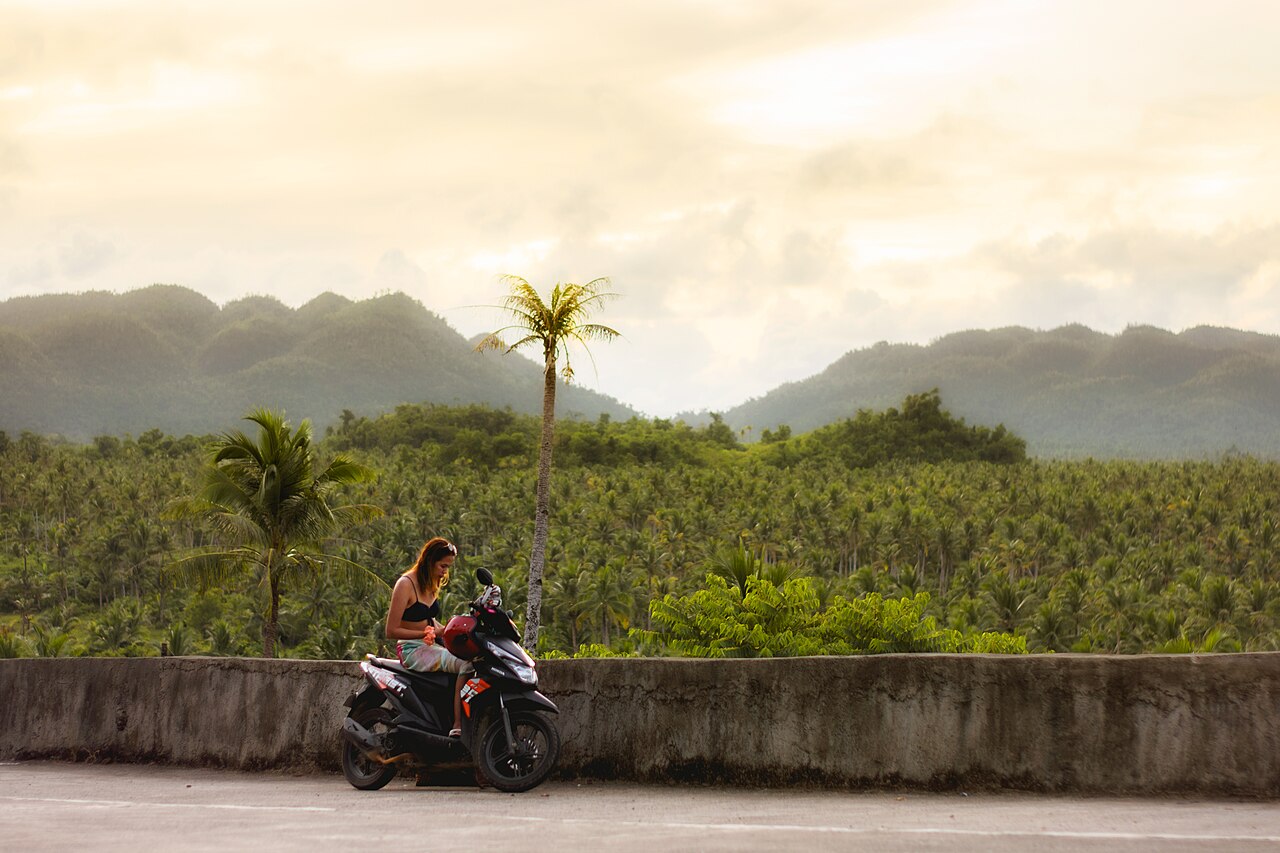
For many, Siargao is the coolest island in the Philippines: a teardrop of land covered in coconut palms, facing the Pacific, where Cloud 9 breaks, one of the most legendary waves in Asia. What twenty years ago was a surfers' secret is now a global hotspot, with specialty coffee shops, sunset bars, yoga classes and an international community of surfers, digital nomads and travellers who arrive for a few days and stay for weeks. But beneath that 'hipster' layer beats an authentic island of fishermen and coconut palms, intensely green, with an unhurried rhythm that's contagious.
And there's a Siargao for everyone, whether you surf or not. There are the waves, of course —from Cloud 9 for experts to gentle beaches for learning—, but also island hopping to three postcard islets (Naked, a bare sandbar; Daku, with palm trees; Guyam, tiny), the emerald Sugba Lagoon hidden among mangroves where you can leap off a diving board, the Magpupungko natural pools that appear in the rock at low tide, the Maasin River with its leaning palm tree, and Sohoton park, where you swim among jellyfish that don't sting. All among the coconut palms, on a scooter and in no hurry.
This guide lays out Siargao with a practical eye: what the surf is like and where to learn, how to plan your island hopping and the trips to Sugba and Sohoton (with prices and fees), which beaches and lagoons not to miss, how to get there by plane or ferry and how to get around by scooter. Siargao rewards travellers who go with its flow: it's not an island of grand monuments, but of waves, lagoons and sunsets among palm trees, that hard-to-explain mix that makes almost nobody want to leave.
For centuries Siargao was a remote island of fishermen and copra gatherers (copra being dried coconut meat), inhabited by Visayan peoples and barely connected to the rest of the country. Its name only began to be heard around the world in the late 1980s and the 1990s, when foreign surfers 'discovered' the Cloud 9 wave on the east coast, and photographs by an American photographer put it on the international surf map; the first competition at Cloud 9 was held in 1995 and cemented Siargao as the surf capital of the Philippines. Since then, and especially in the 2010s, the island went through a tourism boom that transformed it. In December 2021, Super Typhoon Rai —known locally as Odette— struck Siargao with devastating force, flattening homes, resorts and coconut palms; the island and its community faced a tough rebuild and within a few years were back on their feet. The full history of Siargao, the 'discovery' of Cloud 9 and Typhoon Odette is on our history page.
Read the full history ↓The great south of the Philippines: the land Spain never fully subdued, with its Muslim sultanates, its volcanoes and its intense nature, and a recent history of conflict and peace.
Read the history of Mindanao (south) →If you book from here we earn a commission and you pay no more. Prices and availability come from Civitatis.
No exact prices: a scale from $ (budget) to $$$$$ (luxury), with 2-3 options per category.
Origins, formation and what the sources say.
For almost all of its history, Siargao was the opposite of what it is today: not a fashionable destination, but a remote, forgotten island at the far north-eastern tip of Mindanao, facing the vast Pacific Ocean. Its people, Visayan communities who speak Surigaonon, lived on what the island and the sea gave them: fishing in its rich waters and, above all, growing coconuts. Siargao was — and still is — covered by an ocean of coconut palms, and for generations copra, the dried coconut flesh from which oil is extracted, was what kept its families going and its main export.
That economy of copra and fishing set the island's unhurried pace. Villages grew up around the beaches and mangroves — Siargao is home to one of the largest mangrove forests in the Philippines, now a protected area — and life went on far from the country's big events. Getting to the rest of the Philippines was hard: you had to cross by boat from Surigao, and the island lacked the infrastructure of other, more accessible destinations.
That isolation had an unexpected consequence. While the Pacific swells broke, year after year, over the reefs of the east coast, nobody in the wider world paid them any attention. The fishermen knew the sea, but surfing, the sport that would transform the island, had not arrived yet. Siargao was a green, salty secret kept by the ocean, waiting to be 'discovered'.
Everything changed in the late eighties. Travelling surfers — Australians, Americans, Europeans — roaming South-East Asia in search of untouched waves began arriving in Siargao and were amazed by what they found on the east coast: a powerful, hollow, perfect wave breaking over a reef, capable of producing dream barrels. That wave needed a name, and legend has it that it got one from a chocolate bar called 'Cloud 9': the name stuck, and it stayed for good.
Worldwide fame came through photography and surf magazines. Pictures of Cloud 9 started appearing in specialist publications, and in 1995 the island held its first international surfing competition, the Siargao Cup, which became an annual event and put Siargao firmly on the world surfing map. Little by little, the remote island of coconut palms and copra was turning into the 'surfing capital of the Philippines'.
Through the 2000s, Siargao grew as a destination mainly for surfers and adventurous travellers: simple guesthouses, surf camps, a laid-back and still fairly alternative vibe. The big explosion came in the 2010s, when social media, more affordable flights and the island-tourism boom made it one of the most sought-after destinations in the country, drawing not just surfers but crowds of travellers, influencers and digital nomads won over by its image as a bohemian paradise among the palms.
Siargao's transformation in the 2010s was dizzying. What had for years been a secret whispered among surfers became a global phenomenon. Better air links — with Sayak Airport receiving more and more flights from Cebu and Manila — brought the island within reach of a much wider public. Social media did the rest: images of the Cloud 9 boardwalk, the palm-fringed islets of the island-hopping tours, the curved palm tree over the Maasin River and the sunsets among the coconut palms went viral and made thousands of travellers want to go.
General Luna, the town where most of the tourism happens, filled up with design resorts, specialty coffee shops, international restaurants, yoga studios, bars and coworking spaces. Siargao came to embody a certain modern ideal of paradise: spectacular nature, surf culture, healthy living, good coffee and wifi to work from a hammock. Several travel publications named it among the best islands in the world, and its fame kept growing.
As in so many other Philippine destinations, that success brought its tensions: pressure on the water, waste, electricity and infrastructure of an island that was not ready for such growth; rising prices; and the debate over how to preserve authenticity, nature and the local way of life in the face of rapid development. Siargao was torn — and still is — between the economic opportunities tourism brings and the risk of losing, through too much success, the very thing that made it special.
On 16 December 2021, just as tourism was recovering after the pandemic, Siargao lived through its darkest hour. Super Typhoon Rai — known in the Philippines as Odette — made landfall on the island as one of the most powerful storms to hit the country in years, with catastrophic winds. Siargao was devastated: homes, resorts, schools and shops destroyed, and a huge share of its iconic coconut palms uprooted or snapped. The island was left without electricity, running water or communications for weeks, and much of its population lost almost everything.
The blow was brutal for a community that depended heavily on tourism and copra, just as it was starting to recover from the pandemic closures. Images of the flattened island, with its broken palms and wrecked buildings, travelled around the world and sparked a major wave of solidarity: donations, aid teams and campaigns to rebuild the island and support its people through the hardest months.
Siargao's recovery was remarkably fast and is, in itself, a story of resilience. Within months and a few years, the island rebuilt much of its infrastructure, reopened its accommodation and welcomed travellers again, while nature began to turn green once more. The experience also left lessons about how vulnerable these paradises are to an increasingly extreme climate, and about the importance of rebuilding in a more sustainable, better-prepared way. Today Siargao is back on its feet, with its waves, its lagoons and its coconut palms, but with a fresh memory of how fragile paradise can be.