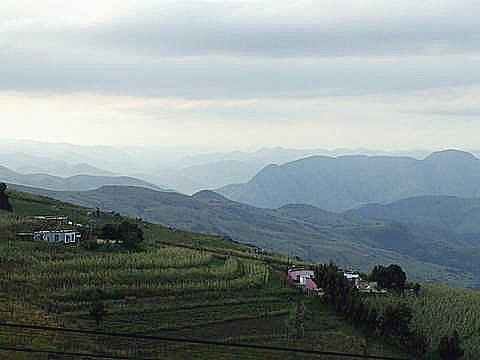
Piggs Peak is the heart of Eswatini's mountainous north. It's a quiet forestry town high on the Highveld among pine plantations, hills and mist, and it makes a good base for exploring some of the greenest and most spectacular landscapes in the kingdom. Its unusual name recalls a 19th-century French gold prospector, William Pigg, who found gold in these hills and gave rise to the settlement.
The gold ran out decades ago and today the town lives mostly from forestry, but Piggs Peak keeps a particular charm and a surprising tradition of craftsmanship. Here you'll find the Peak Fine Craft Centre, perhaps the most beautiful group of craft workshops in the country, with the famous Coral Stephens mohair weaving and the woven sisal of Tintsaba. All around lie the Phophonyane waterfalls, the huge Maguga reservoir, the ancient San rock art of Nsangwini and the Malolotja mountains.
This guide takes a practical look at Piggs Peak and the area around it: what to see and buy in town, how to plan trips to the waterfalls, reservoirs and rock paintings, where to sleep and eat, and how to get around the mountainous north. Used as a base camp for a couple of days, Piggs Peak opens the door to Eswatini's most natural, green and authentic side.
Piggs Peak was born of a gold rush. Around 1884, the prospector William Pigg discovered gold in these northern hills, and a mining town that took his name grew up around the find. The gold mine was the most important in the country until it was exhausted in 1954, by which time it had already been overtaken by the asbestos of Havelock (Bulembu), further west. Once mining ended, the economy turned to forestry, now its main activity, with enormous pine and eucalyptus plantations. The town remains an important crafts hub and the base for tourism in the mountainous north. The full story is on our history page.
Read the full history ↓The north of gold and forests: Piggs Peak, born of a mining rush, the San rock art of Nsangwini and the great Maguga Dam on the Komati River.
Read the history of The mountainous north (Piggs Peak) →They depart from Maputo, 131 km away. If you book from this link we earn a commission and you pay no more.
No exact prices: a scale from $ (budget) to $$$$$ (luxury), with 2-3 options per category.
Origins, formation and what the sources say.
Long before the town of Piggs Peak existed, the mountainous north of Eswatini was a land of hills, forests and valleys that people had lived in and travelled through since ancient times. In the nearby Komati River valley, the ancient San (Bushmen) hunter-gatherers left their rock paintings in the Nsangwini shelter, with images thousands of years old linked to their trance rituals. These first inhabitants lived for millennia by hunting, gathering and their deep knowledge of the mountains.
With the spread of Bantu-speaking peoples and the formation of the Swazi kingdom in the 18th and 19th centuries, these northern highlands became part of the domain of the Dlamini dynasty. The cold, rugged Highveld was not the most populated part of the kingdom, but its valleys and slopes were used for grazing, hunting and as a frontier, in a landscape of mist and forest very different from the warm Lowveld to the east.
It was in this setting of northern mountains and valleys that, in the late 19th century, the gold rush broke out. It would change the history of the area and give rise to a town with a rather peculiar name.
Piggs Peak owes its origins to gold. Around 1884, at the height of the concessions that King Mbandzeni granted to European adventurers, a prospector named William Pigg discovered a rich gold reef in these northern hills. A mine was set up around his find, and a settlement of miners, traders and workers grew up that eventually took the prospector's name: 'Piggs Peak', Pigg's peak.
The Piggs Peak gold mine became the most important in the country for decades. It drew miners from many backgrounds and brought the town to life, with its streets, shops and services, in a mountain landscape reminiscent of other mining areas in southern Africa. During the first half of the 20th century, gold was one of the pillars of the economy of colonial Swaziland.
Like every gold rush, though, it came to an end. The reefs gradually ran out, and by the time the Piggs Peak mine closed for good in 1954, it had already been overtaken in importance by another major operation in the north-west: the Havelock asbestos mine at Bulembu, further west, which for years was one of the largest of its kind in the world. Northern Eswatini thus went through two great mining cycles, gold and asbestos, which shaped its landscape and its people.
Once gold mining ended in the mid-20th century, northern Eswatini reinvented its economy around a very different resource: trees. Making the most of the Highveld's cool, damp climate and its soils, vast areas were planted with pine and eucalyptus, which today cover the hills around Piggs Peak and made forestry the main industry in this part of the country.
These plantations, some of the largest in the southern hemisphere in their day, transformed the landscape of the north and gave it its distinctive look of orderly forests, sawmills and mist rising from the valleys. Timber and paper pulp became important exports, and after gold's decline the town of Piggs Peak carried on as a service centre for this forestry economy.
At the same time, the north kept and developed another calling: crafts. Piggs Peak became home to a remarkable hub of quality handicrafts, with businesses such as Coral Stephens Hand Weaving, which weaves mohair, and Tintsaba, which specialises in sisal weaving and jewellery. Between them they employ hundreds of people from rural communities and export their products around the world. The Peak Fine Craft Centre has become one of the town's main attractions.
Today's Piggs Peak is a quiet town of a few thousand people that combines its mining and forestry heritage with a growing role as a base for tourism in Eswatini's mountainous north. Perched on the Highveld among forests and hills, it is the ideal starting point for exploring some of the kingdom's most spectacular scenery.
All around it lie the waterfalls and pools of the private Phophonyane reserve, the huge Maguga Dam on the Komati River (one of the most photogenic landscapes in the country), the ancient San rock art of Nsangwini and the wild mountains of the Malolotja Nature Reserve, with its zip-line canopy tour. This is the greenest, most natural and most authentic side of Eswatini, far from the bustle of the centre and the south.
Like the rest of the country, the area faces today's challenges: dependence on forestry, the search for new sources of jobs and development, and a commitment to sustainable tourism that benefits local communities, as in Nsangwini or the craft workshops. For travellers, Piggs Peak is still what it has been since it was founded: a gateway to the riches of the north, gold in the past and nature, culture and crafts today.